The Saguenay Fjord is hiding something nobody talks about, and it’s not the dramatic cliffs. Local guides have quietly noticed a strange pattern in the deep, dark waters, a pattern they once dismissed as coincidence.
In the fall of 1888, a woman collecting driftwood at low tide on the shore of Baie des Ha! Ha! encountered a large gray shark stranded by the falling water. She fought the animal, and the tide helped her finish it. The local paper called it a sea monster and identified it as a porbeagle, but modern researchers believe it was almost certainly a Greenland shark. For the next century, the sighting drew little scientific attention.
The Saguenay Fjord looks like a river. Tourists kayak its surface, whales feed at its mouth, and ferries cross its entrance at Tadoussac. But the fjord is not a river. It is a deep marine basin carved by glaciers over roughly the past million years. The walls rise up to 400 meters in places, and the bottom sits an average of 240 meters down. Near Tadoussac, however, the floor rises sharply to only about 20 meters, leaving a raised ridge, called a sill. That sill is key to everything the fjord holds.
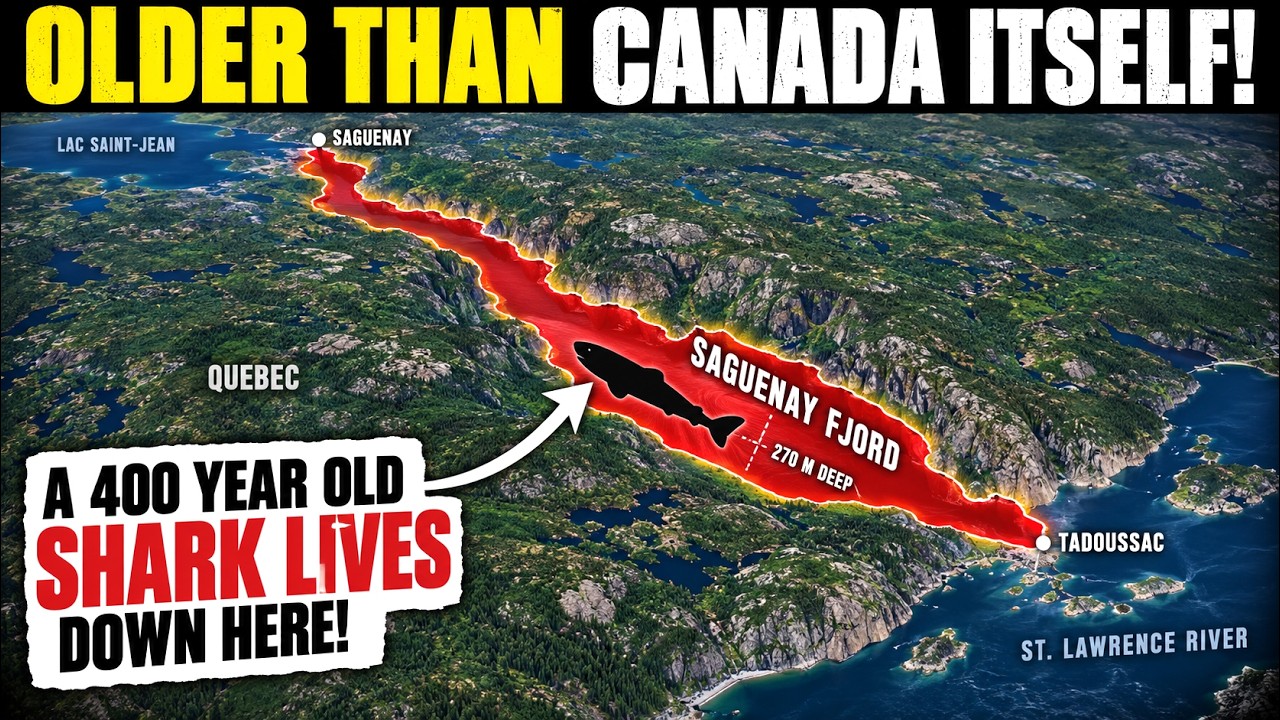
The fjord hides its first secret in plain sight. Roughly 40 rivers drain into it, and the surface water is largely fresh. On a summer day, swimmers and kayakers float in a thin brackish layer often only six to eight meters thick. Below that lies up to 270 meters of cold, dense seawater with temperatures near freezing. Twice a day, tides push this frigid water from the Gulf of St. Lawrence over the sill, where it sinks and remains trapped. The result is a two-layer ecosystem: a freshwater world on top of a marine one that resembles conditions found far north in the Arctic. Researchers sampling the deep layer have found polar plankton species and animals characteristic of Arctic environments at the same latitude as Paris.
One of the most surprising inhabitants of this cold layer is the Greenland shark. Ice fishers along the fjord have been pulling them up for generations. In January 2006, a woman ice fishing near Saint-Fulgence hooked a shark about 2.7 meters long. A few winters later, a couple near the same area caught a Greenland shark of roughly 2.8 meters and weighing more than 225 kilograms. They had to widen the hole in the ice before they could see what they had caught. By law, they released it. Records and old newspaper accounts show that ice fishers had been catching Greenland sharks in the Saguenay since at least the middle of the 20th century, with reports going back to the early 1800s. In one single winter, 1996, five were caught at one ice fishing camp.
Science was slow to follow. In the late 1990s, researchers identified the Saguenay as a place where Greenland sharks had been caught repeatedly. A small team launched an expedition to dive with the sharks under the ice. For more than five years, they searched without success. Then, in the spring of 2003, recreational divers near Baie-Comeau, about 200 kilometers downriver from the fjord, reported encountering large, slow-moving fish they could not identify. The team went there and filmed a free-swimming Greenland shark. Over the following years, they logged hundreds of encounters near Baie-Comeau, a rate of sightings unmatched anywhere else on Earth. Some of what they found contradicted the textbooks. Most St. Lawrence sharks did not carry the eye parasite common in Arctic populations. Satellite tags showed one shark wandering only five kilometers in three months, while another traveled about 100 kilometers upriver toward Tadoussac.
The question of how long these sharks have lived in the region was answered in 2016. A team led by Danish biologist Julius Nielsen published a study in the journal Science. They radiocarbon-dated the eye lenses of 28 female Greenland sharks, focusing on a core of tissue that forms before birth. Only the smallest sharks carried the carbon-14 signature from nuclear bomb tests in the 1950s and 1960s. The largest shark, just over five meters long, was estimated to be about 392 years old, with an uncertainty range from roughly 272 to 512 years. Even at the low end, the Greenland shark is the longest-lived vertebrate known to science. Females may not reach maturity until around 150 years old. A five-meter Greenland shark alive today could have been born while Samuel de Champlain was still alive. One research group notes that some of these sharks may be older than European settlement in the western Gulf of St. Lawrence.
The sharks also carry chemical records of where they live. When scientists examined the shark caught near Saint-Fulgence in 2006, they found PCBs, flame retardants, stain repellents, and heavy metals in its tissues. Its chemical signature suggested it was not a visitor passing through but a resident of the fjord. A slow-moving animal living for centuries soaks up whatever its home contains.
The fjord’s floor holds a complicated history. In the 1920s, a company town called Arvida was built upstream for aluminum production. A chlor-alkali plant in Arvida used liquid mercury as part of its process, and some of that mercury entered the river and settled into the fjord’s mud. By the 1970s, sediment cores showed mercury levels near the head of the fjord reaching around 12,300 parts per billion, while the open Gulf averaged about 150. One estimate put the total at roughly 105 tons of mercury above natural levels sitting in the sediments of the river and fjord. The chlor-alkali plant shut down in 1976, but mercury does not break down. It remains in the mud, and spring floods and underwater slides have kept stirring it up.
In July 1996, a major flood changed the situation. Heavy rain saturated the region, and on July 19 and 20, a storm brought water equivalent to what goes over Niagara Falls in four weeks. Dikes and dams gave way. In Chicoutimi, the water swept through a neighborhood so completely that almost nothing was left standing. Ten people died, around 16,000 were evacuated, and damage was estimated at $1.5 billion. It remains one of the worst natural disasters in Quebec’s history. The flood also carried several million tons of old, clean sediment into the upper fjord. Across wide areas, this fresh layer averaged 10 to 20 centimeters thick, and near river mouths it piled up several meters. This new sediment had natural background levels of metals, with no industrial mercury. The flood had capped the contaminated mud beneath a clean layer. Researchers who studied the cores afterward reported that most of the buried mercury remained trapped at or just below the old seafloor, locked up by sulfur compounds.
The 1996 flood was not the first time the fjord buried its own floor. On February 5, 1663, a large earthquake struck New France. Modern estimates put its magnitude between 7.3 and 7.9, possibly the largest earthquake ever witnessed in eastern North America. The shaking caused more than three cubic kilometers of waterlogged sediment to break away from the fjord’s walls and pour into the basin. In places, the debris piled up 100 meters thick. On land, huge landslides of sensitive clay let go, and a slide may have blocked the Saguenay River itself. When the river broke through the dam, a dense current of mud surged into the fjord and kept flowing for an estimated 28 days, spreading a single layer of sediment across the bottom. Out in the St. Lawrence estuary, the same earthquake appears to have set off as many as nine separate underwater landslides. A core of sediment pulled from the fjord in 1999 found 14 sudden layers, each one the fingerprint of a flood, landslide, or earthquake. Other surveys have linked underwater landslides to major earthquakes around 7,250 years ago and more than 9,280 years ago.
The region’s geology also affects the land. When the last ice sheet retreated, the sea flooded inland over lowlands that today hold farms and towns, leaving behind thick deposits of marine clay. Some of that clay is “sensitive,” meaning it can turn almost liquid under the right conditions. In May 1971, the ground collapsed near Saint-Jean-Vianney, close to where the ground had given way in 1663. Thirty-one people died.
All of these layers remain relevant today. The Saguenay sits near one of the most active earthquake zones in eastern Canada, the Charlevoix-Kamouraska zone along the St. Lawrence. On November 25, 1988, the Saguenay was struck by a magnitude 5.9 earthquake, one of the strongest in eastern North America in the 20th century. Sonar surveys of the fjord floor have shown widespread landslide scars in the upper fjord, exactly where the mercury sits. Scientists who mapped them warned that a new slide could expose the contaminated sediments covered by the 1996 flood. The deep water feeding the fjord’s Arctic world is also tied closely to winter conditions, including how much sea ice forms. As winters warm, the environment for the sharks and other cold-water species could change. Researchers now treat the Greenland sharks as sentinels, living indicators of the deep.
The fjord’s shores are protected by the Saguenay Fjord National Park and its waters by the Saguenay-St. Lawrence Marine Park. Fishers who hook a Greenland shark are required to release it. Scientists continue to study the sediment and monitor the situation. No one can prevent an earthquake, but the work of documenting what lies beneath the surface continues. The Saguenay has been offering pieces of its history for a long time: a shark comes up through the ice, a core of mud contains evidence of 14 disasters, a flood quietly buries a poison. Each time, the surface goes calm again. That calm is part of the story. The fjord hides its secrets not with distance but with layers.
Recommended Stories

Scientists dropped a dead cow into the deep ocean, and what showed up stunned them. The carcass was placed 320 meters down to study how sea creatures consume a massive food fall, and the team never expected such a rapid, gruesome response.
In June 2025, a Chinese research team published results from an experiment designed to simulate a whale fall in the...

Deep in the Everglades, scientists finally identified what’s been hunting Florida’s giant pythons—and it’s not another snake. For years, massive invasive pythons have devastated local wildlife, and researchers suspected an unexpected predator was pushing back.
The Burmese python has been an established apex predator in the Florida Everglades for roughly two decades. The invasive species,...
Florida’s invasive python crisis just got a terrifying new twist: a predator is devouring them from the inside out. Wildlife officials now report that the Burmese pythons, which have devastated local ecosystems, are falling victim to something they never anticipated.
Burmese pythons brought to Florida decades ago have caused severe declines in native wildlife, but their impact may extend beyond...