A rare great white shark surfaced in the Mediterranean, and divers captured the entire encounter on camera. For years, experts insisted the apex predator had nearly vanished from these waters, making this sighting a shocking biological anomaly.
A technical diver working off the coast of Sicily recorded what is believed to be the first underwater video of an adult great white shark in the Mediterranean Sea. The encounter took place at a depth of about 200 feet near a shipwreck in the Strait of Sicily, the waterway between Italy and Tunisia.
The diver, Dirk Remmers, was volunteering with Ghost Diving, a network of technical divers who locate and remove abandoned fishing nets from shipwrecks and reefs. These lost nets, known as ghost gear, continue to trap and kill marine life for decades after they are lost. The work is slow and precise, requiring divers to cut tangled lines underwater while managing strict decompression schedules.

Remmers was not looking for sharks. He was working on a wreck that researchers consider a biodiversity hotspot. The sunken steel structure had become an artificial reef over time, attracting schools of fish, moray eels, and groupers.
About three minutes into the dive, a large shape appeared behind the wreck. A great white shark, estimated at roughly 13 feet long, passed within about 9 feet of the diver. Remmers later said his hands were shaking so much that he had difficulty operating his camera, but he managed to capture the encounter. The shark swam past slowly, did not change course toward the divers, and disappeared into the blue. The entire encounter lasted about 90 seconds.
The footage is now widely considered the first underwater video of an adult great white shark in the Mediterranean. Researchers in Europe responded with interest, in part because live encounters with this species in the region are extremely rare.
Great white sharks have been documented in the Mediterranean for centuries. Historical records, museum specimens, and fisherman accounts confirm their presence. But in recent decades, confirmed sightings have become infrequent. Researchers compare the odds of an encounter to winning the lottery. Much of what is known about the Mediterranean population comes from dead specimens caught incidentally in fishing gear rather than from live observations.
Genetic research led by scientists at the University of Bologna has shown that Mediterranean great whites are unusually distinct. Analysis of historical remains and museum samples suggests the population has been isolated from other great white populations for roughly 3.2 million years, dating back to the Pliocene era. Researchers believe their ancestors entered the Mediterranean through an ancient seaway connecting the Pacific and Atlantic oceans before the Isthmus of Panama closed about 3.5 million years ago. After that closure, the Atlantic was later recolonized by a separate wave of great whites, likely from southern Africa.
The Mediterranean population carries a different genetic signature from Atlantic sharks. The same research found concerningly low genetic diversity within the Mediterranean group, a sign of a small, isolated population that has been breeding largely within itself for millions of years. Researchers describe the group as potentially small and threatened, possibly more vulnerable to extinction than its numbers alone would suggest.
Historical data gathered by independent researchers includes more than 700 records of great white sightings and captures around the Mediterranean. These records include an 1862 account from Spain describing an attack on a swimmer near Malaga. The animal was later believed to have been a great white.
Modern assessments indicate the Mediterranean subpopulation has declined significantly, with some estimates suggesting a drop of at least 80 percent across roughly three generations. The International Union for Conservation of Nature classifies great white sharks globally as vulnerable. The Mediterranean subpopulation is assessed as critically endangered, one step below extinct in the wild.
The species reaches sexual maturity slowly and produces relatively few young, making recovery from sustained losses difficult even if threats were removed.
Confirmed live sightings remain rare. In 2018, a Spanish conservation group reported a confirmed sighting of a great white shark near Cabrera in the Balearic Islands, the first such confirmation in Spanish waters in about three decades. A small juvenile great white was also caught incidentally in Spanish Mediterranean waters in recent years. Researchers who examined historical reports found more than 60 separate records in Spanish waters alone, many clustered around the Balearic Islands, and noted a possible link between shark movements and the migration patterns of Atlantic bluefin tuna.
The footage from Sicily is notable not only because it shows a live adult but also because it documents the animal in its natural underwater environment. Most confirmed records come from surface sightings of fins or from dead specimens. Underwater footage provides information about behavior, movement, and habitat use that dead specimens cannot offer.
The location of the encounter also matters. The Strait of Sicily is considered by some researchers to be one of the last strongholds for the declining Mediterranean great white population. The footage was captured during an active environmental restoration effort, a detail that researchers say adds context to the sighting.
The shark in the video appeared calm and uninterested in the divers. It did not display aggressive behavior or circle the pair. It simply swam past and left. Researchers caution that a single sighting, however significant, does not confirm that the population is recovering. Climate change may be shifting the distribution of marine species, meaning sharks could appear in areas where they were historically less common without any real increase in overall numbers.
The fact that the shark was a large adult is also significant. Adult great whites are observed less frequently than juveniles in most regions. A confirmed adult in a deep-water setting provides useful data for researchers studying the population.
Scientists also note that juvenile great whites in the region can be confused with shortfin mako sharks, another endangered species in the same waters. High-quality confirmed footage removes that uncertainty.
For researchers, each confirmed sighting adds to a slowly growing picture of where these sharks still travel and what conservation measures might be effective. Organizations in the region have pointed to the encounter as support for continued habitat protection, stronger enforcement of fishing gear regulations, and further monitoring of areas such as the Strait of Sicily and the waters around the Balearic Islands.
Many questions remain unanswered. Researchers do not yet know how individual Mediterranean great whites move within the sea, where important nursery areas might be, or how much genetic exchange still occurs through the Strait of Gibraltar.
The footage was not captured by a funded expedition. It was recorded by volunteers carrying out routine cleanup work on a forgotten wreck. The shark appeared unexpectedly, a reminder that ongoing marine conservation efforts can keep the door open for such moments.
Off the coast of Sicily, near a shipwreck that has been on the seabed for decades, a great white shark still moves through the Mediterranean as its ancestors have for millions of years. For 90 seconds, a diver with a shaking hand captured a glimpse of that long history. For the first time in the recorded history of underwater exploration, the rest of the world could see it too.
Recommended Stories

Texas may never get the secret remedy proven to stop super pigs, and experts say the method actually works. While the destructive hybrids tear through farms and threaten ecosystems, one effective weapon adopted elsewhere remains off-limits for the Lone Star State.
In the winter of 2022, Dale Friesen found three dead wild pigs in the snow at the creek crossing on...
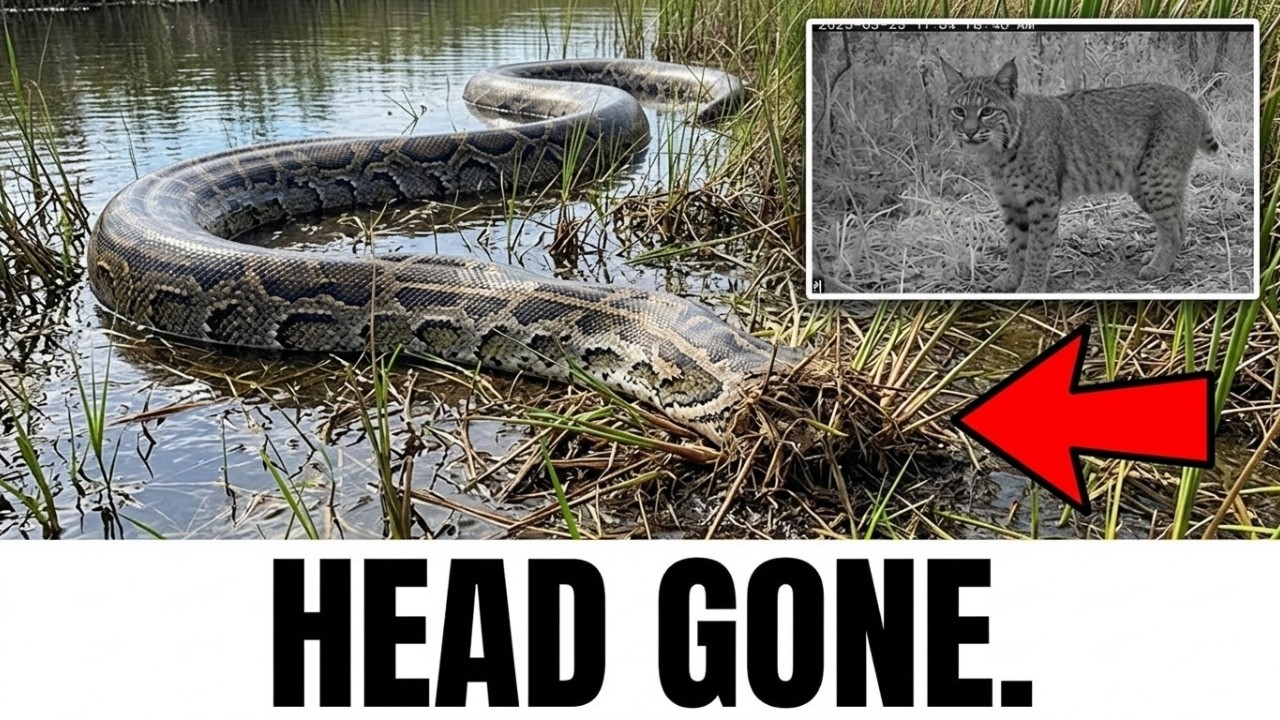
A 20-foot python was found decapitated in the wild, its massive head missing. Investigators initially suspected a rival predator.
Biologists from the Conservancy of Southwest Florida found a 20-foot Burmese python dead in pine flatwoods at the edge of...

Australia’s deadliest invader met a surprising adversary: a tiny predator that officials deployed to stop its spread. The plan seemed straightforward—release this pint-sized hunter to curb an unstoppable menace disrupting ecosystems and agriculture across the country.
The cane toad is a medium-sized amphibian, typically no more than a few inches long. It has no notable features,...