THE POOR GIRL WHISPERED SHE’D NEVER HAD A BIRTHDAY CAKE—THEN A BILLIONAIRE HEARD HER, AND ONE QUIET DECISION FOLLOWED THEM BOTH FOR YEARS IN WAYS NOBODY EXPECTED – Life Story
On her eighth birthday, Leora Wren stood in freezing rain outside a bakery and whispered that she had never had a birthday cake.
The man who heard her could have bought the entire block, but the choice he made that night created a debt neither mother nor daughter wanted to owe.
Years later, when Leora finally learned what happened after those eight candles went dark, she had to decide what real kindness required from the person who received it.
Cold Glass
Leora Wren pressed both palms against the bakery window and tried not to breathe too hard because every warm breath fogged the glass and hid the cakes.
“Don’t touch too much, sweetheart,” Maren said softly. “They just cleaned it.”
Leora immediately pulled her hands away.
“Sorry.”
That one word made Maren’s chest hurt more than any complaint could have.
It was Leora’s eighth birthday, and the child had already learned to apologize for wanting things.
Inside Velvet Crumb Bakery, warm golden lights fell across rows of cakes arranged behind polished glass.
Chocolate ganache shone beneath tiny lamps.
Strawberries rested on cream as if someone had placed them individually with tweezers.
Ivory frosting curled into roses, stars and ribbons.
Outside, late-November rain glazed the sidewalk.
Maren’s cardigan was too thin for the weather.
Leora’s was worse.
They had not come to buy anything.
That was the part Maren had not admitted.
They had missed their bus after Maren’s diner shift ran late, and Leora had seen the bakery while they walked toward the next stop.
“Can we just look?”
Maren had said yes.
Looking was free.
That was becoming one of the most common sentences in their lives.
Leora studied a small round cake near the center of the display.
It was white with pale pink stars around the edge and enough empty space on top for a name.
“How much do you think that one is?”
Maren looked at the tiny price card.
Forty-eight dollars.
She had thirty-one dollars until Thursday.
“It’s pretty.”
“That means expensive.”
“Usually.”
Leora smiled as if she had made a sophisticated financial observation.
Behind them, buses hissed through the intersection.
Cars threw mist against the curb.
People moved beneath umbrellas, shoulders lifted against the cold.
Maren checked the time.
“We should go.”
Leora nodded.
No whining.
No bargaining.
She simply looked one last time through the glass.
Maren wished she would complain.
She wished Leora would stomp a foot and say it wasn’t fair.
Instead, the girl tucked both hands beneath her arms and said, “It’s okay, Mom.
We need the rent more.”
The words were too practical for eight.
Maren turned away because her face had betrayed her.
She worked mornings at Dotty’s Diner, three evenings a week at a pharmacy warehouse, and four nights cleaning offices downtown.
She could carry five plates on one arm.
She could remember thirteen tables’ orders without writing anything down.
She could clean an entire executive floor before midnight and still wake at to pack Leora’s lunch.
She could not buy a forty-eight-dollar cake.
Not this week.
Maybe not next month.
Leora looked back through the window.
“I’m not sad.”
“I didn’t say you were.”
“I know.”
The child shifted her backpack.
“At school, Ava said everybody gets cake when they turn eight.”
Maren swallowed.
“Ava doesn’t know everybody.”
“I told her that.”
“Good.”
“She asked what cake I had last year.”
Maren said nothing.
Last year, they had shared two chocolate cupcakes from the grocery-store bakery because the power bill was late.
Leora had put a birthday candle in one and split the second with her mother.
The year before that, Maren had made pancakes and drawn a seven in syrup.
Leora’s father had disappeared before she was two.
There had never been enough room in the budget for traditions that cost money.
“I told her I didn’t remember,” Leora said.
Maren crouched so they were eye level.
“You don’t ever have to be embarrassed by us.”
“I’m not.”
“Or by what we have.”
“I know.”
Leora’s eyes moved toward the cakes again.
Then the truth slipped out before she could protect her mother from it.
“I just wish I knew what a real birthday cake tasted like.”
Maren’s smile broke.
Leora saw it and immediately tried to repair the damage.
“It’s okay.”
“Leora—”
“Really.”
She stepped closer and whispered, as if lowering her voice could make the sentence weigh less.
“I’ve never had one, but that doesn’t mean I need one.”
A few feet behind them, beneath the bakery awning, a man stopped walking.
Neither mother nor daughter noticed him.
Silas Vale had spent the last twenty minutes trying to escape a private dinner he had never wanted to attend.
His driver waited two blocks away because Silas sometimes walked after investor meetings when his head became too crowded.
At thirty-six, he was founder and chief executive of Vale Meridian Systems, a logistics-software company valued at more than seven billion dollars.
He had spent that afternoon discussing international expansion.
He had spent the evening being congratulated for becoming richer.
Then an eight-year-old girl in a wet cardigan whispered that she had never tasted birthday cake.
Silas stopped.
For several seconds, the traffic disappeared.
The rain disappeared.
So did the tailored coat, the company, the driver, the apartment overlooking the river.
He was eight again.
A dark apartment.
An empty refrigerator except for milk, mustard and half an onion.
His mother crying quietly over a stack of envelopes because she thought he was asleep.
His father gone.
His birthday almost over.
Then came a knock.
Mrs.
Alvarez from downstairs had stood in the doorway holding a grocery-store cake with crooked blue frosting.
Not beautiful.
Not expensive.
One corner had collapsed because she carried it upstairs too quickly.
But eight candles had burned on top.
Silas remembered every one.
He looked at Leora.
Maren was already taking her daughter’s hand.
“Come on.
We’ll miss the next bus.”
Leora nodded.
Then the bakery door opened behind them, and a stranger stepped into the rain carrying eight unlit candles.
Maren turned.
Silas held a small white bakery box beneath one arm.
Not the enormous wedding cake from the window.
Not some ridiculous display of wealth.
The bakery manager had offered him three options, and he had chosen the simplest cake she could decorate immediately: vanilla with strawberry filling and eight small pink stars around the edge.
Forty-eight dollars.
The exact cake Leora had been looking at.
“Excuse me.”
Maren immediately moved Leora behind her.
Silas stopped several feet away.
“I’m sorry.
I don’t want to frighten you.”
“You’re not.”
She was lying.
He respected the lie enough not to challenge it.
Silas held up the little packet of candles.
“I heard what your daughter said.”
Maren’s expression hardened.
“We were having a private conversation.”
“You were.”
“Then you shouldn’t have been listening.”
“I wasn’t trying to.”
Leora peeked around her mother.
Her eyes found the bakery box.
Silas noticed.
“So what is this?” Maren asked.
“A birthday cake.”
“For who?”
He looked at Leora.
“For her.”
Maren’s jaw tightened.
“No.”
Leora immediately looked down.
Silas did not move closer.
“All right.”
Maren seemed surprised.
He lowered the box slightly.
“I won’t push.”
“Good.”
“But may I tell you why?”
“You have thirty seconds.”
Silas almost smiled.
“When I turned eight, my mother couldn’t afford a cake.”
Maren’s eyes changed a fraction.
“A neighbor brought one anyway.”
He looked at Leora.
“I remember the candles more clearly than almost anything else from that year.”
Leora whispered, “Were they blue?”
Silas looked at her.
“They were.”
“Mine would be pink.”
“I noticed.”
Maren looked from Silas to the cake.
Then at the dark street.
“What do you want?”
“Nothing.”
“Everybody wants something.”
“That’s generally true.”
“Especially men carrying expensive coats and random birthday cakes.”
That earned a small laugh from him.
“You’re right to be suspicious.”
“So?”
“So take the cake and never see me again.”
Maren folded her arms.
“Then why do it?”
Silas thought of Mrs.
Alvarez climbing three flights of stairs with that crooked cake.
“Because someone once interrupted a bad birthday for me.”
His voice softened.
“I can interrupt one for her.”
Leora looked up at Maren.
She said nothing.
That made the decision harder.
Maren hated charity.
Not because she thought receiving help was shameful.
Because help often arrived with invisible contracts.
Gratitude.
Access.
Control.
A story rich people could tell later about what good people they were.
Silas seemed to read some of that in her face.
“No photograph,” he said.
“What?”
“No post.
No foundation.
No publicity.
I don’t need your name.”
Leora raised one finger.
“My name is Leora.”
Maren closed her eyes.
Silas smiled.
“Then happy birthday, Leora.”
She smiled back despite herself.
Maren finally exhaled.
“Just the cake.”
“Just the cake.”
“No money.”
“No money.”
“No ride.”
Silas glanced at the heavy box.
“I wasn’t going to offer.”
“That’s good.”
“I was considering it.”
Maren almost smiled.
“Don’t.”
He handed her the box.
She took it with both hands.
The weight surprised her.
Leora stared at it as though the box contained a moon.
“Thank you,” the girl whispered.
Silas handed her the candles separately.
“Those are your responsibility.”
Leora clutched them carefully.
Eight pink candles.
Maren looked at Silas.
“Thank you.”
This time the words cost her less.
“You’re welcome.”
Then he did something she did not expect.
He walked away.
No business card.
No request for her phone number.
No dramatic promise.
He simply lifted one hand in goodbye and disappeared into the rain.
Leora stared after him.
“Mom?”
“Yes?”
“Was he rich?”
Maren looked at the disappearing dark coat.
“Probably.”
“How rich?”
“I don’t know.”
“Like dentist rich?”
Maren laughed.
“I don’t know what that means.”
“Dr.
Patel has a car with seats that warm your butt.”
“That is an extremely specific financial category.”
Leora hugged the candles to her chest.
They walked home carrying the cake between them.
For six blocks, neither complained about the rain.
At apartment 3B, Maren cleared laundry from the kitchen chair and moved overdue envelopes away from the table.
The cake looked absurdly elegant beneath their single ceiling bulb.
That made Leora love it more.
Maren found matches.
They pushed eight candles into the frosting.
One leaned sideways.
Leora corrected it.
“Perfect.”
“Nothing is perfect.”
“This is.”
Maren lit the candles.
The flames reflected in Leora’s eyes.
For a moment, Maren forgot the late rent.
Forgot the pharmacy shift beginning at seven the next morning.
Forgot the ache in her feet and the cleaning schedule folded inside her purse.
She sang.
Her voice cracked on the second line.
Leora laughed.
“Mom.”
“What?”
“You’re crying.”
“I am not.”
“You absolutely are.”
“Make your wish.”
Leora closed her eyes.
Silas was sitting three miles away in the back of his town car when she blew out the candles.
He never heard the wish.
Maren did.
Leora whispered it after the lights went dark.
“I wish you didn’t have to be tired all the time.”
Maren stood completely still.
“Sweetheart.”
“You work when I’m sleeping.”
“I’m okay.”
“You say that when you aren’t.”
The sentence entered quietly and stayed.
Leora opened her eyes.
“I don’t want more stuff.”
Maren sat beside her.
“I know.”
“I just want you home sometimes.”
Maren pulled her daughter against her chest.
That night, after Leora fell asleep with a smear of pink frosting still near her thumb, Maren sat alone at the kitchen table.
The cake box remained open.
Four slices left.
Beside it lay three pay stubs.
She had been avoiding them.
Now she spread them out.
The diner paid correctly.
The warehouse paid correctly.
The cleaning company did not.
Maren had suspected it for months.
Tonight, with Leora’s wish still echoing in the kitchen, she finally looked closely enough to prove it.
Two overnight shifts were missing.
Again.
Eight Candles
At 12:46 a.m., Maren opened the notes app on her phone and began reconstructing six weeks of cleaning shifts.
She did not have a lawyer.
She did not know labor law.
She knew hours.
Tuesday: p.m. to 11:45.
Thursday: to midnight.
Saturday: to a.m.
She compared her calendar with the payroll stubs.
Seven hours missing one pay period.
Nine and a half the next.
No overtime premium even when her total passed forty.
Maren stared at the numbers until anger pushed exhaustion aside.
BrightShield Facilities cleaned twelve downtown office buildings.
One of them was Vale Meridian Systems.
She knew that because the company logo occupied an entire wall on the thirty-second floor where she emptied executive trash cans after meetings ended.
She had seen Silas Vale before.
That realization came so suddenly she sat back.
Not in person.
In photographs.
Internal magazine covers.
Award plaques.
A giant founder profile in the lobby.
The man with the cake was Silas Vale.
Maren laughed once.
Of course.
The universe had a vulgar sense of humor.
At , she searched BrightShield’s payroll portal.
A banner appeared:
TIME ADJUSTMENT QUESTIONS MUST BE SUBMITTED TO SITE SUPERVISOR.
Her site supervisor was Dennis Carver, a man who described every payroll error as “system lag.”
She had asked twice already.
Once he told her missing hours would roll forward.
They had not.
The second time he asked whether she wanted “to keep making this difficult.”
Maren took screenshots.
Then she photographed every pay stub.
At , she emailed them to herself.
The next morning, Leora ate cake for breakfast.
Maren permitted it because birthdays occasionally deserved unconstitutional behavior.
“You’re smiling weird.”
“I’m doing math.”
“That doesn’t make people smile.”
“This math might.”
At Dotty’s Diner, Maren used her break to call BrightShield payroll.
The representative sounded sympathetic until she entered Maren’s employee number.
Then her tone changed.
“You need to speak with your site supervisor.”
“He told me to call payroll.”
“Adjustments come through site management.”
“Can you tell me how many hours were submitted?”
“I’m not authorized.”
“They’re my hours.”
“I understand.”
“No, I don’t think you do.”
The line went quiet.
Maren softened her voice.
“I’m not yelling at you.”
“I know.”
“I’m asking who can show me my submitted time.”
“Human resources.”
“Transfer me.”
“They don’t take employee calls directly.”
“Then email?”
The representative gave her an address.
Maren wrote it on a napkin.
When her break ended, she folded the napkin into her pocket.
At six that evening, she worked the pharmacy warehouse.
At eight forty-five, her phone buzzed.
An email.
BRIGHTSHIELD HUMAN RESOURCES.
Her inquiry had been received.
Please allow ten business days.
Maren laughed under her breath.
Ten days was nearly half a rent cycle.
At eleven thirty, she arrived at Vale Meridian Systems wearing the gray polo BrightShield issued to cleaners.
The building after hours felt entirely different from the city outside.
Quiet.
Polished.
Almost unreal.
During business hours, thousands of employees filled the tower.
At night, cleaning crews moved through the remains of corporate decisions: abandoned coffee cups, catered dinners, whiteboards covered in arrows, glass rooms where numbers large enough to change lives had been written and erased.
Maren pushed her cart onto the thirty-second floor.
The executive level.
Silas’s floor.
She entered a conference room and began collecting glasses.
One still held expensive mineral water.
Beside it sat a presentation packet.
Maren did not read confidential papers.
That rule mattered.
But the title page faced upward.
SUPPLIER COST OPTIMIZATION — FACILITIES.
BrightShield’s logo appeared in one corner.
Maren stopped.
She should not care.
A corporation hiring a cheap cleaning contractor was not a crime.
Then she saw one line beneath the title.
LABOR SAVINGS: 18.4%.
Her missing hours suddenly felt less like a mistake.
Footsteps approached.
Maren put the glass into her cart.
A woman entered.
Mid-forties, dark hair, navy pantsuit, laptop under one arm.
She looked at Maren.
“You’re still here?”
“I’m scheduled until twelve.”
The woman checked the wall clock.
“Your crew usually leaves by eleven.”
“Our schedule says midnight.”
“That explains the floors.”
Maren frowned.
The woman extended a hand.
“Dana Keller.
Operations.”
“Maren.”
“BrightShield?”
“Yes.”
Dana looked at the cart.
“Do you have enough people tonight?”
“Enough for what?”
“The floor.”
“Two.”
Dana’s expression changed.
“This floor is contracted for four after ten.”
Maren stared at her.
“There are four names on the schedule.”
“Where are the others?”
“One got cut last month.
One was moved to another building.”
“But we still pay for four.”
Maren’s stomach tightened.
“I wouldn’t know.”
Dana studied her.
Maren could see the question forming.
She stopped it.
“If you have contractor questions, you should ask BrightShield.”
“Probably.”
Dana nodded.
Then left.
Maren finished at midnight.
Dennis Carver waited near the service elevator.
“You’ve been talking to people.”
Maren’s hand tightened around the cart.
“I said hello to an employee.”
“Dana Keller asked me why staffing is down.”
“That isn’t my problem.”
“It becomes your problem when you create questions.”
Maren looked at him.
“My missing hours create questions.”
His face flattened.
“So this is about payroll.”
“It has always been about payroll.”
“You got paid.”
“Not correctly.”
“Everybody’s checks fluctuate.”
“Time worked doesn’t.”
Dennis stepped closer, not threatening, just impatient.
“You want advice?”
“No.”
“Take it anyway.
BrightShield has contracts all over the city.
People who are easy to place get hours.
People who create headaches don’t.”
Maren understood him perfectly.
“Are you threatening to cut my shifts?”
“I’m explaining business.”
There were phrases employers used because they sounded cleaner than intimidation.
Explaining business was one.
Maren took out her phone.
Dennis looked at it.
“You recording me?”
“No.”
She opened her notes.
“I’m writing down what you said.”
His expression changed.
“Don’t be dramatic.”
“You just told me complaining about missing wages could cost me work.”
“I didn’t say that.”
“What did you say?”
He walked away.
Maren typed the time.
12:07 a.m.
Service elevator, level 32.
Dennis Carver.
At 12:11, Dana Keller’s business card appeared on the floor near the elevator.
Maren stared at it.
Dana must have dropped it.
She picked it up.
For the first time that night, she considered doing something dangerous.
Not calling Silas Vale.
Not asking the billionaire with the cake to rescue her.
Something much harder.
Giving the evidence to someone who might force his company to look at what it paid not to see.
The Night Shift
Dana answered Maren’s email at the next morning.
Thank you for flagging this.
I’m in internal operations, not BrightShield HR, but contractor staffing and invoice accuracy are within my scope.
Can you meet confidentially?
Maren read the email four times.
Then she closed it.
At noon she reopened it.
At 12:03, she replied.
Yes.
No promises.
No favors.
They met in a coffee shop two blocks from Vale Meridian the next afternoon.
Dana arrived with no assistant and ordered regular coffee.
Maren appreciated that for reasons she could not explain.
“You said no favors.”
“Yes.”
“Good.
I don’t have any to offer.”
“Better.”
Dana opened a notebook.
“What do you have?”
Maren gave her copies, not originals.
Pay stubs.
Schedule screenshots.
Emails to payroll.
Dates.
Dana studied them.
“How many workers?”
“I don’t know.”
“Who else says they’re missing time?”
“At least four on my crew.”
“Would they talk?”
“Depends.”
“On?”
“Whether talking costs them rent.”
Dana nodded.
Fair answer.
“Vale Meridian pays BrightShield by staffing level and coverage hours.”
Maren remembered the presentation packet.
“I know.”
Dana looked up.
“How?”
“I clean your conference rooms.”
The corner of Dana’s mouth moved.
“Right.”
“You pay for four workers on the executive floor.”
“Yes.”
“There are two.”
“For how long?”
“Three months, maybe more.”
Dana stopped writing.
“That much?”
“Yes.”
“And your timesheets?”
“Digital clock-in.
Supervisor approves.”
“So if hours disappear, either records are being changed or payroll is not using the approved time.”
“Yes.”
“You’ve thought this through.”
“I’m tired, not stupid.”
Dana looked embarrassed.
“I didn’t mean—”
“I know.”
Maren softened slightly.
“I get that reaction a lot.”
“What reaction?”
“Surprise when people who clean things understand things.”
Dana closed her notebook.
“I’m sorry.”
Maren nodded.
Accepted.
Not erased.
Dana asked one final question.
“Do you know Silas Vale?”
Maren’s eyes narrowed.
“Why?”
“Your daughter’s birthday video.”
“What video?”
Dana froze.
Maren’s stomach dropped.
“What video?”
Dana pulled out her phone reluctantly.
A clip had been posted by someone across the street.
Silas in the rain.
Cake box.
Leora’s face when Maren accepted it.
The caption:
BILLIONAIRE CEO BUYS BIRTHDAY CAKE FOR POOR GIRL.
Three million views.
Maren watched without sound.
Her skin went cold.
“No.”
“I thought you knew.”
“No.”
“I’m sorry.”
“Who posted it?”
“Unknown account.
It spread.”
Maren stood.
Dana stood too.
“Wait.”
“No.”
“Maren, Silas didn’t post it.”
“You know that?”
“I know his communications team has been trying to get platforms to remove versions showing your daughter clearly.”
That stopped her.
“He knew?”
“Since this morning.”
“And he didn’t call.”
“He doesn’t have your number.”
Good.
At least that.
Maren sat again.
“I don’t want Leora becoming somebody’s inspirational content.”
“Neither does he.”
“You work for him.”
“I work for the company.”
“Same thing.”
Dana shook her head.
“No.
It isn’t.”
That answer would matter later.
For now, Maren left.
At home, Leora was furious for an entirely different reason.
“My hair looked weird.”
“Leora.”
“What? It did.”
“People are watching us online.”
“I know.”
“You know?”
“Ava showed me.”
Maren crouched.
“How do you feel?”
Leora shrugged.
That meant badly.
“Tell me.”
“They called me homeless.”
Maren’s chest tightened.
They were not homeless.
Close enough that the word frightened her.
“Who?”
“People in comments.”
“You read comments?”
“Ava did.”
Maren sat beside her.
“You are not what strangers call you.”
“I know.”
“Do you?”
Leora stared at the carpet.
“Was the cake charity?”
The question surprised her.
“What do you think?”
“I don’t know.”
Maren thought carefully.
“The cake was a gift.”
“What’s different?”
“A gift doesn’t make you smaller.”
“And charity does?”
“No.”
Maren corrected herself.
“Bad charity does.”
Leora considered that.
“Was his bad?”
“No.”
“How do you know?”
“Because he left.”
Leora smiled slightly.
That evening, someone knocked.
Silas Vale stood in the hallway.
Maren did not open the door fully.
“How did you get my address?”
His face changed immediately.
“I didn’t.”
“Then?”
“Dana told me she spoke with you, but she did not give me the address.
I came because the bakery manager remembered your building.”
Maren’s expression hardened.
Silas realized how bad that sounded.
“I asked her only because of the video.”
“You tracked us down.”
“Yes.”
“After I told you no strings.”
“Yes.”
He did not defend himself.
That helped slightly.
“Why?”
“To apologize.”
“For what?”
“The video.”
“You didn’t film it.”
“No.”
“You didn’t post it.”
“No.”
“Then why apologize?”
“Because my face is why it spread.”
Maren looked at him.
“That may be the first billionaire sentence I believe.”
He almost smiled.
“I’m trying.”
Leora appeared behind her.
“Cake man.”
Silas looked down.
“Hello.”
“You’re famous.”
“So I’m told.”
“You were famous before.”
“Yes.”
“That seems inconvenient.”
“It often is.”
Maren fought a smile.
Silas held out an envelope.
“No money.”
“What is it?”
“A letter from our legal team confirming they’re requesting removal of clips that clearly identify Leora and asking media partners not to reuse them.”
Maren took it.
“No NDA?”
“No.”
“No agreement?”
“No.”
“Good.”
Silas hesitated.
“Dana told me there may be a contractor problem.”
Maren stiffened.
“She shouldn’t have.”
“She didn’t give me your documents.”
“Then what did she say?”
“That we may be paying BrightShield for staffing we aren’t receiving.”
“That’s true.”
“And workers may be missing wages.”
“That’s also true.”
Silas’s jaw tightened.
“I’ll investigate.”
Maren shook her head.
“Don’t investigate me.”
“I wasn’t planning to.”
“Don’t fix my paycheck and call it solved.”
He stopped.
She continued.
“If they stole eight hours from me, they stole hours from somebody else.”
“I understand.”
“No.”
Her voice remained calm.
“That’s the thing powerful people always say too fast.”
Silas listened.
Maren folded the legal letter.
“If you want to help, find out what your company paid for and whether the people doing the work got paid for doing it.”
Silas looked at her.
“That’s fair.”
“And don’t call me later with a job.”
He raised an eyebrow.
“I wasn’t—”
“You were thinking it.”
He laughed.
“Yes.”
“Don’t.”
“Why?”
“Because I don’t want Leora growing up believing the route out is being noticed by the right rich person.”
Silas stopped smiling.
Maren’s voice softened.
“I want her to believe work should count even when nobody important is watching.”
Silas nodded slowly.
“I needed to hear that.”
“Probably.”
He left five minutes later.
No check.
No offer.
No promise.
But the next morning, BrightShield received a formal audit notice from Vale Meridian.
And by lunchtime, Dennis Carver had canceled all of Maren’s shifts.
No Special Favor
The text arrived at 12:17.
NO WORK AVAILABLE UNTIL FURTHER NOTICE.
Maren read it beside the diner’s industrial dishwasher.
Her first feeling was not surprise.
It was calculation.
BrightShield represented almost thirty percent of her monthly income.
Rent due in nine days.
Electricity in eleven.
Leora needed new winter shoes.
The pharmacy had cut overtime.
Maren typed:
Is this disciplinary?
Dennis replied:
Scheduling needs changed.
She screenshot it.
Then sent it to Dana.
Dana called within three minutes.
“Did he give a reason?”
“You saw it.”
“We told BrightShield yesterday no retaliation.”
“Apparently Dennis missed the memo.”
“I’m escalating.”
“No.”
Dana went quiet.
“What?”
“Document it first.”
“We have the text.”
“I want the schedule.”
“Maren—”
“If you restore my shifts ten minutes after I complain to a client executive, they’ll say nothing happened.”
Dana understood.
“You’re willing to lose the work?”
“No.”
Maren looked toward the diner kitchen.
“I’m willing to prove I lost it.”
That distinction defined the next week.
BrightShield claimed staffing requirements changed.
But other workers received Maren’s shifts.
Dana preserved Vale Meridian’s staffing invoices.
They showed BrightShield continued billing for Maren’s position.
That was the first new piece.
The second came from Rosa Jiménez, another cleaner.
She had missing hours too.
Eleven.
Then Malik Owens.
Sixteen.
Then Tran Nguyen.
Nine.
Each had complained informally.
Each had been told the system would correct itself.
None had been paid.
Dana connected them with an outside labor attorney because Vale Meridian’s lawyers had a conflict.
Her name was Rebecca Sloan.
She did not make speeches.
Maren liked her immediately.
“This is wage theft if the records support what you’re telling me.”
Rosa looked nervous.
“Can they fire us?”
“They can fire people for lawful reasons.
They cannot lawfully retaliate because workers assert wage rights.”
“That isn’t what she asked,” Maren said.
Rebecca looked at her.
“No.”
She closed the folder.
“They might still do it.”
Rosa’s face fell.
Rebecca continued.
“My job is not to tell you there is no risk.
My job is to make sure you understand the risk before choosing.”
Maren trusted her after that.
Six workers joined initially.
Then eleven.
BrightShield offered to correct isolated payroll errors.
Rebecca asked for time records.
BrightShield delayed.
Silas’s procurement team suspended new assignments but did not immediately terminate the contract because several thousand workers across multiple client sites depended on it.
That decision angered Maren.
She told Silas so during a meeting Dana arranged.
“You know they’re stealing.”
“I know there are credible allegations.”
“You sound like a press release.”
“I sound like someone with eleven thousand employees and contracts I cannot cancel based on one week of evidence.”
“Workers are evidence.”
“Workers are witnesses.”
Silas remained calm.
“Records matter too.”
Maren crossed her arms.
“You’re protecting your company.”
“Yes.”
The honesty stopped her.
“And?”
“And I’m trying not to protect it by hurting the same workers I claim to care about.”
She studied him.
“If I terminate BrightShield tonight, they could stop paying workers before replacements are arranged.”
Maren hated that he had a point.
Silas continued.
“So Dana is building a transition plan.
Rebecca is gathering claims.
We preserve records.
Then we move.”
“You always talk like a project plan?”
“Yes.”
“It’s annoying.”
“I’ve heard.”
Dana smiled from the end of the table.
Maren noticed something else.
Silas had not offered her a job.
He had listened.
That earned a little trust.
Two days later, Maren found a voicemail from a Vale Meridian recruiter.
Her first reaction was anger.
She called Silas.
“You promised.”
“I did.”
“Then why is your recruiter calling me?”
Silence.
“I have no idea.”
She did not believe him.
“Convenient.”
“I’ll find out.”
“No.
I will.”
She called the recruiter herself.
The woman sounded confused.
“You applied eight months ago.”
Maren froze.
“What?”
“For Operations Support Coordinator.
Your application was inactive because we couldn’t verify one reference.”
Maren remembered.
Eight months earlier.
Two in the morning.
After a cleaning shift.
She had seen an opening on a job board and applied, then forgotten because nothing came of it.
“We reopened several archived applications because the department expanded,” the recruiter explained. “Dana Keller flagged that your service-management experience may be relevant, but hiring has not been instructed to select you.”
Maren sat down.
“So this isn’t Silas Vale.”
“Mr.
Vale does not participate in coordinator hiring.”
That answer embarrassed her.
“Right.”
“Would you like to interview?”
Maren looked at Leora’s school picture on the refrigerator.
“Yes.”
The interview was not easy.
Good.
A panel asked about scheduling conflicts.
Customer escalations.
Vendor coordination.
Emergency response.
Maren used examples from the diner, the warehouse and cleaning jobs.
One interviewer asked, “You don’t have corporate operations experience.
Why do you think you can succeed here?”
Maren answered before fear could make her small.
“Because corporate operations is not the only place operations exist.”
The panel waited.
“I’ve opened a diner after a refrigerator failed at four in the morning.
I’ve reorganized twelve servers when two didn’t show.
I’ve managed inventory counts, vendor delays and customer emergencies while somebody screamed because toast was cold.”
One interviewer smiled.
Maren continued.
“You call it stakeholder management when people wear badges.
Service workers just call it Tuesday.”
Dana, who sat on the panel but did not lead it, looked down to hide a smile.
Three days later, Maren received an offer.
She did not accept immediately.
First she asked Rebecca whether taking it could damage the wage case.
“No.”
“Could BrightShield claim I manufactured the dispute to get hired?”
“They can claim the moon is leased property.
Claims require evidence.”
Then she asked Dana a harder question.
“Would I have gotten this interview if you didn’t know me?”
Dana considered it.
“Maybe not.”
Maren appreciated the honesty.
“Would I have gotten the job?”
“Yes.”
“How do you know?”
“You ranked first.”
Maren looked at the offer again.
Stable hours.
Health insurance.
Salary more than her three jobs combined.
She thought of Leora’s birthday wish.
I wish you didn’t have to be tired all the time.
Maren accepted.
But she kept the diner for one Saturday shift every other week for the first two months.
Not because she needed the money.
Because stability frightened her.
People who had lived in survival mode sometimes mistrusted rest.
Leora noticed before she did.
“You don’t need Dotty’s.”
“I like Dotty’s.”
“You complain about Dotty every day.”
“That’s how affection works when you’re thirty-one.”
“Sounds unhealthy.”
Maren laughed.
Then, one Saturday at a.m., she stood in her diner uniform staring at herself in the mirror.
She did not go.
She called Dotty and gave two weeks’ notice.
Afterward, she cried in the bathroom.
Leora knocked.
“Mom?”
“I’m okay.”
Silence.
Then Leora said through the door, “You say that when you aren’t.”
Maren laughed and cried harder.
At Vale Meridian, she learned fast.
Dana never praised her in front of people unnecessarily.
Instead, she gave her harder work.
That was better.
Maren learned software systems.
Vendor schedules.
Operations dashboards.
She discovered that office workers made mistakes with the same frequency as restaurant workers but used longer emails to explain them.
Within three months, she had redesigned an escalation queue that cut response delays by nineteen percent.
Silas saw her once in an elevator.
He nodded.
“Ms.
Wren.”
“Mr.
Vale.”
“How’s the job?”
“Ask my boss.”
He smiled.
“Good answer.”
She stepped off.
No gratitude ceremony.
No special lunch.
Exactly as she wanted.
Then Rebecca called.
“BrightShield produced the time records.”
Maren sat down.
“And?”
“They’re worse than we thought.”
Her stomach tightened.
“How much worse?”
“They didn’t just shave hours.”
Rebecca paused.
“They appear to have billed clients for workers who were never scheduled, then used some of the labor savings to fund supervisor performance bonuses.”
Maren thought of the line she had seen on the conference table.
LABOR SAVINGS: 18.4%.
Suddenly the missing hours had a number attached to someone else’s success.
“What do you need from me?”
“Your testimony.”
Maren looked through the glass wall of her new office area.
A clean desk.
A computer.
A coat hanging over a chair.
The first stable job she had ever had.
“What happens if I testify?”
“The case becomes harder for BrightShield to dismiss as accounting error.”
“And Vale Meridian?”
“They’ll be asked what they knew.”
Maren thought of Silas.
Of Dana.
Of the company giving her a chance.
Rebecca’s voice softened.
“You do not owe Vale Meridian silence because they hired you.”
“I know.”
“Do you?”
Maren looked toward the tower windows.
Outside, the city was turning dark.
“I’m learning.”
What The Clock Stole
BrightShield’s strategy changed when it realized workers would testify.
First came corrected checks.
Then came private settlement offers.
Maren’s arrived in a FedEx envelope.
Twenty-eight thousand dollars.
Confidentiality.
Release of claims.
No admission of wrongdoing.
Enough money to erase every late bill she still carried.
Enough for a safer apartment.
Enough to put something into Leora’s college account.
Maren left the papers unopened for six hours.
Then she read every line.
Rebecca did not tell her what to do.
Silas did not know the offer existed.
Dana knew only because Maren asked for the afternoon off to speak with counsel.
At home, Leora sat at the table doing fractions.
Maren placed the settlement envelope in a drawer.
Leora looked up.
“What’s that?”
“Grown-up paperwork.”
“Bad?”
“Complicated.”
“That means bad.”
Maren smiled tiredly.
“Sometimes.”
That night, after Leora slept, Maren calculated again.
Twenty-eight thousand.
After taxes and fees, still life-changing.
If she refused and lost, she could get nothing.
BrightShield had expensive attorneys.
Workers had memories, scattered screenshots and records a corporation would call incomplete.
She called Rosa.
“Did they offer you?”
“Yes.”
“How much?”
“Eleven.”
“You taking it?”
Silence.
“My husband says yes.”
“What do you say?”
“I say my mother’s insulin bill is real.”
Maren closed her eyes.
That was the cruelty of moral choices made under financial pressure.
People who could afford principles often demanded them from people who could not.
“Take it if you need it.”
Rosa whispered, “What about the others?”
“We don’t get to make your family the price of everybody’s justice.”
Rosa began crying.
Maren stayed on the phone.
The next morning, BrightShield’s attorneys requested individual mediation.
Rebecca told the workers they could choose separately.
Four accepted.
Seven did not.
No one called the four cowards.
Maren made sure of that.
“People can’t be free if we punish them for choosing rent,” she told Malik.
He nodded.
Then asked, “What are you choosing?”
“I don’t know yet.”
At Vale Meridian, tension spread.
A financial newspaper reported that the company’s largest cleaning contractor faced wage allegations.
Grant Mercer, Vale Meridian’s chief financial officer and Silas’s oldest executive partner, called an emergency meeting.
Grant was not a monster.
That made him harder.
He had helped keep the company alive through three near-bankruptcies.
He had taken no salary for six months during its earliest year.
He believed numbers were moral because bankrupt companies employed nobody.
“The audit covers twenty-three sites,” he told Silas. “If we terminate now, replacement costs rise forty percent.”
Silas sat at the head of the conference table.
“Then they rise.”
“Shareholders won’t see it that way.”
“They will if the alternative is paying a vendor that stole wages.”
“Allegedly.”
Dana looked at Grant.
“We have altered time records.”
“We have evidence of altered records.”
“Is there a useful distinction?”
“In litigation? Yes.”
Silas rubbed his temple.
Grant continued.
“I am not defending BrightShield.
I’m telling you that moral certainty is easiest before the invoice arrives.”
Silas looked at him.
“That sounds cynical.”
“It’s arithmetic.”
“No.
Arithmetic tells you the cost.
It doesn’t tell you the choice.”
Grant leaned forward.
“And if the choice forces layoffs elsewhere?”
Silas had no immediate answer.
That mattered.
At home, Maren had a similar argument with herself.
Twenty-eight thousand.
The number sat in her mind through dinner.
Leora talked about a library project.
Maren barely heard.
Finally Leora stopped.
“You’re doing the thing.”
“What thing?”
“Listening with your forehead.”
Maren blinked.
“What?”
“When you’re pretending to listen but your forehead is thinking about something else.”
“That is not a thing.”
“It is.”
Maren put down her fork.
“I got offered money.”
Leora’s eyes widened.
“A lot?”
“Yes.”
“For what?”
“To settle the cleaning case.”
“Does that mean they pay everybody?”
“No.”
“Just you?”
“Yes.”
Leora thought.
“Did they steal just from you?”
“No.”
The child returned to her vegetables.
Maren almost laughed.
“That’s all?”
“What?”
“You’re not going to tell me what to do?”
“You say I’m eight when I tell you what to do.”
“You are eight.”
“Nine next month.”
“Still not counsel.”
Leora smiled.
Then her expression became serious.
“If you take it, are you bad?”
“No.”
“If you don’t take it, are you good?”
Maren looked at her daughter.
“No.”
“Then pick what you can live with.”
Maren stared.
“Where did you hear that?”
“Mrs.
Holloway.”
“I need to meet this woman.”
The next day, Maren rejected the settlement.
Not because she thought refusal made her noble.
Because she had a stable job now.
That changed what she could afford to risk.
She told Rebecca exactly that.
“If they offered this six months ago, I’d sign.”
“That’s honest.”
“I don’t want Rosa feeling guilty.”
“She won’t hear it from me.”
Maren agreed to testify.
BrightShield reacted within forty-eight hours.
A former supervisor signed a declaration claiming Maren had routinely left shifts early and asked coworkers to clock out for her.
False.
But specific enough to be damaging.
A local blog published it.
Then came comments.
Opportunist.
Billionaire’s project.
She got a corporate job and now wants more.
The birthday video resurfaced.
Someone edited Silas’s face beside Maren’s employment announcement.
The implication was obvious.
She had been rewarded.
The wage claim was a performance.
Maren sat in her parked car outside Vale Meridian and cried before going inside.
Not because strangers believed lies.
Because Leora would eventually see them.
Dana knocked on the passenger window.
Maren wiped her face.
“What?”
Dana held up two coffees.
“I am not asking if you’re okay.”
“Good.”
“I hate pointless questions.”
Maren unlocked the door.
Dana sat beside her.
For several minutes, neither spoke.
Then Dana said, “The supervisor who accused you?”
“What?”
“He was not assigned to your building on six of the eight dates he referenced.”
Maren turned.
“How do you know?”
“Access badge records.”
Hope rose.
Dana stopped it.
“Company lawyers need to preserve them properly.
Don’t treat that as won.”
Maren breathed.
“Thank you.”
Dana handed her coffee.
“You know why I believed you initially?”
“The evidence?”
“That too.”
Dana looked through the windshield.
“My mother cleaned hospitals for twenty-two years.”
Maren said nothing.
“She used to come home and complain that administrators called her ‘support staff’ as if the operating room could function when nobody cleaned it.”
Dana smiled faintly.
“She told me every building has two organizations.
The one on the org chart and the one that actually keeps the place alive.”
Maren looked at her.
“That sounds like my kind of woman.”
“She would have liked you.”
Something about the sentence steadied Maren.
The labor hearing was scheduled for six weeks later.
Then Leora got sick.
Not seriously.
Influenza.
High fever.
Three days off school.
Maren’s new job included paid family leave.
The first morning she stayed home without calculating lost wages, she stood in the kitchen and cried.
Leora, miserable beneath a blanket, looked at her.
“Why are you crying?”
“I’m not.”
“You are literally crying.”
Maren laughed.
“I get paid today.”
Leora frowned.
“You always get paid.”
“No.”
Maren sat beside her.
“Before this job, when I stayed home with you, I lost money.”
“Oh.”
“That’s why I went to work sick sometimes.”
Leora looked guilty.
Maren saw it and corrected herself immediately.
“No.
Don’t do that.”
“What?”
“Don’t make my old problems your fault.”
“I wasn’t.”
“You were.”
Leora looked away.
Maren took her hand.
“This is what stability feels like.”
“Boring?”
“Yes.”
“Good.”
“Yes.”
Leora closed her eyes.
“I like boring.”
So did Maren.
That made what happened the next week worse.
Vale Meridian’s board announced Silas would temporarily step aside from vendor-related decisions while an independent committee reviewed whether his personal connection to Maren created a conflict.
The news became a spectacle.
Grant supported the review.
Silas did too.
Maren called him anyway.
“I’m sorry.”
“For what?”
“This.”
“You didn’t create governance rules.”
“You bought my kid a cake.”
“That may be the strangest cause of recusal in corporate history.”
She laughed despite herself.
Then Silas’s voice turned serious.
“Do not change your testimony because of what happens to me.”
“I wasn’t planning to.”
“I know.”
“Then why say it?”
“Because people sometimes call pressure a coincidence.”
Maren thought of Dennis canceling her shifts.
The settlement.
The false declaration.
She understood.
Silas added, “Whatever happens with Vale Meridian is my responsibility.”
“And whatever happens with BrightShield is mine.”
“No.”
Maren frowned.
“The choice to speak is yours.”
His voice softened.
“What they did is theirs.”
That distinction stayed with her.
Three days before the hearing, Rebecca called.
“We have a problem.”
Maren gripped the phone.
“What?”
“BrightShield deleted a set of supervisor edits from the live timekeeping system last month.”
“Deleted?”
“We have backups from subpoenaed cloud logs.”
“Then why is that bad?”
“Because now this is bigger.”
Maren understood slowly.
“Evidence destruction?”
“Potentially.”
“What does that mean for the hearing?”
Rebecca exhaled.
“It means they are going to fight much harder before anyone gets to ask who ordered it.”
For the first time since the birthday cake, Maren felt the ground beneath their new life move.
And this time, there was no stranger outside a bakery who could fix it with forty-eight dollars.
The Cost Of Speaking
The hearing took place in a beige state labor building with fluorescent lights and chairs designed to discourage comfort.
Nothing looked cinematic.
That reassured Maren.
Real decisions, she had learned, often happened in ugly rooms.
BrightShield’s attorneys filled one side.
Workers filled the other.
Rosa attended despite having settled her individual claim because her agreement allowed cooperation with government investigations.
Malik sat beside Tran.
Dana sat in the public section.
Silas did not attend.
Maren appreciated that.
This was not his scene.
Rebecca called Maren first.
The questions were simple.
Where did you work?
How were shifts assigned?
How did you clock in?
When did you first notice missing wages?
Maren answered plainly.
No speeches.
No dramatic adjectives.
Dates.
Hours.
Screenshots.
Then BrightShield’s lawyer, Thomas Greer, stood.
He was polite.
Politeness could cut more cleanly than aggression.
“Ms.
Wren, you now work for Vale Meridian Systems.”
“Yes.”
“A company led, until recently, by Silas Vale.”
“Yes.”
“The same billionaire who purchased your daughter’s birthday cake.”
“Yes.”
“And after that highly publicized event, you obtained a job at his company.”
“I applied eight months before I met him.”
Greer paused.
“You had no interview until afterward.”
“That’s true.”
“So the relationship benefited you.”
“I met Dana Keller because I worked in her building.”
“You met her after Mr.
Vale’s involvement.”
“Yes.”
“You expect us to believe this is coincidence?”
Rebecca started to object.
Maren answered first.
“No.”
The lawyer blinked.
“No?”
“No.”
The room shifted.
Maren continued.
“I think being noticed changed my life.”
Greer looked pleased.
Then she added, “That is part of the problem.”
His smile faded.
“I should not have needed a billionaire to hear my daughter outside a bakery before anyone cared whether the company cleaning his offices paid workers correctly.”
Silence.
Maren looked toward the hearing officer.
“I benefited from being seen.”
Her hands were steady now.
“Rosa didn’t.
Malik didn’t.
Dozens of cleaners didn’t.”
Greer stepped closer.
“Ms.
Wren, we are not discussing social philosophy.”
“No.”
She looked at him.
“We’re discussing hours.”
Rebecca hid a smile.
Greer changed direction.
“You sometimes left work before midnight.”
“When the supervisor released us.”
“Yet you claimed hours until midnight.”
“When the schedule guaranteed minimum shift hours or when I worked through breaks.
Check the records.”
“We did.”
“Then you know.”
Greer produced the former supervisor’s declaration.
“Mr.
Carver states you repeatedly pressured coworkers to confirm hours you did not work.”
“False.”
“Why would he lie?”
Maren looked at Dennis.
He sat behind counsel.
For the first time, he would not meet her eyes.
“I don’t know.”
“Convenient.”
“No.”
She leaned forward slightly.
“I could guess.”
“Please don’t.”
“I wasn’t going to.”
A few people shifted.
Maren continued.
“What I know is that Mr.
Carver threatened my shifts after I raised missing wages, and the next day my work was canceled.”
“Your work was canceled due to staffing.”
“Vale Meridian was still billed for my position.”
That landed.
Greer turned toward counsel.
Rebecca had the invoice ready.
By afternoon, the case changed.
Cloud logs showed supervisor edits reducing worker hours after digital clock-out.
Some edits happened days later.
Dennis’s credentials appeared repeatedly.
Then the backups showed administrative access from BrightShield regional payroll.
Not one rogue supervisor.
A process.
Grant Mercer arrived during the second day.
He sat near Dana.
Maren noticed but kept speaking.
BrightShield’s owner, Curtis Hall, testified that supervisors were permitted to correct missed punches but denied any policy encouraging wage reductions.
Rebecca asked about performance bonuses.
Curtis described efficiency metrics.
She showed him an internal slide.
LABOR RATIO IMPROVEMENT.
Then another.
EXCESS CLOCK HOURS RECOVERY.
Then an email.
Regional managers were praised for “recovering” paid hours after client invoices had already been submitted.
The hearing officer asked the obvious question.
“If the client paid for those labor hours, and the workers did not receive them, where did the difference go?”
Curtis requested a break.
The room changed.
For eighteen months, Maren had felt as if money vanished because she was poor and poor people were expected to experience money as weather.
Unexpected.
Uncontrollable.
Never anybody’s decision.
Now there were columns.
Names.
Approvals.
Bonuses.
Weather had signatures.
During the recess, Grant approached Maren.
“Can we talk?”
“About?”
“Silas.”
She looked at him.
“No.”
Grant seemed surprised.
“He’s risking control of the company over this.”
“No.”
“Maren—”
“He’s risking control over decisions he made.”
Grant’s face hardened.
“You sound like him.”
“That seems insulting to both of us.”
Dana coughed to hide a laugh.
Grant lowered his voice.
“You don’t understand what happens if Vale Meridian admits failures in vendor oversight.”
“Then explain.”
“Shareholder suits.
Contract reviews.
Insurance fights.
Thousands of vendors reexamined.
Millions in cost.”
Maren nodded.
“That sounds difficult.”
He stared.
“That’s all?”
“What do you want me to say?”
“That you understand there are consequences beyond your paycheck.”
Maren’s expression changed.
“My paycheck is how my daughter eats.”
Grant realized the mistake.
Too late.
She continued quietly.
“You call millions ‘consequences’ because spreadsheets make them look large.”
She pointed toward Rosa.
“Eleven missing hours was a consequence.”
Toward Malik.
“Sixteen was a consequence.”
Then toward herself.
“I worked nights while my eight-year-old slept because those hours mattered.”
Grant looked away.
Maren softened, but only slightly.
“I believe you when you say the company could get hurt.”
He looked back.
“But companies don’t get to be protected from truth because truth is expensive.”
Grant said nothing.
When the hearing resumed, the most damaging evidence did not come from Maren.
It came from Dennis Carver.
Faced with system logs and the possibility of personal liability, he changed his testimony.
His voice shook.
Regional management had pressured supervisors to cut “unverified” time.
Workers who complained were labeled friction.
Hours were reduced to hit labor targets.
“Did you understand workers had actually performed those hours?” Rebecca asked.
Dennis stared at the table.
“Sometimes.”
“Did you alter Ms.
Wren’s time?”
“Yes.”
Maren felt nothing triumphant.
Only tired.
“Did you remove her from the schedule after she complained?”
Dennis closed his eyes.
“Yes.”
“Why?”
“My regional manager told me we needed people who weren’t going to create client problems.”
Maren looked down.
There it was.
Not hatred.
Not a grand conspiracy.
Cowardice moving downhill.
A regional manager pressured Dennis.
Dennis pressured workers.
Executives protected margins.
Clients enjoyed cheap contracts.
Everyone stood one step away from the harm and called that distance innocence.
The hearing officer ordered interim wage restoration calculations and referred potential record destruction for further investigation.
BrightShield lost Vale Meridian’s contract the following week.
Not overnight.
Dana had spent six weeks preparing replacement vendors so workers could transfer without losing shifts.
That mattered.
Silas returned to the board meeting where his future was being decided.
Grant made the argument against him personally.
“You blurred governance because one story affected you.”
Silas did not deny it.
“Yes.”
“You involved yourself in contractor operations.”
“Yes.”
“You exposed the company to avoidable reputational damage.”
Silas looked around the table.
“The damage existed before the reputation knew about it.”
Several directors shifted.
Grant continued.
“You cannot run a public company by emotion.”
“No.”
Silas nodded.
“And you cannot run one by pretending everything not on the balance sheet is somebody else’s problem.”
The board did not remove him.
They did something harder for his ego.
They reduced his unilateral procurement authority.
Created independent worker-protection oversight.
Separated compliance from operations.
Required direct workforce auditing for major service vendors.
Silas hated parts of it.
He voted yes anyway.
BrightShield eventually entered a multi-state settlement covering back wages, penalties and monitoring.
Workers received different amounts based on records.
Maren’s was far less than the private offer she had rejected.
She was fine with that.
Rosa received both her settlement and additional back wages because her private agreement preserved statutory rights the company could not waive.
Maren cried when Rebecca told her.
“You okay?”
“Yes.”
“You’re crying.”
“My daughter uses that line too much.”
The story did not end with a giant check.
It ended with corrected payroll records.
A vendor hotline.
Workers learning they could request their time data.
Supervisors learning deleted edits were still recoverable.
Small systems.
Boring systems.
The things that actually changed lives.
On Leora’s ninth birthday, Maren bought the cake herself.
Chocolate.
Strawberry filling.
Pink stars.
Forty-six dollars because Velvet Crumb gave neighborhood families a small discount on weekday orders.
Leora stared at the box.
“You paid for it?”
“Yes.”
“With your money?”
“Yes.”
“All of it?”
“Please stop auditing me.”
Leora grinned.
They lit nine candles.
Before she blew them out, someone knocked.
Silas stood outside.
He held no cake.
Only a book wrapped in brown paper.
Maren looked at it suspiciously.
“How much?”
“Twelve dollars.”
“Receipt?”
He produced it.
She laughed.
Leora opened the book.
A children’s mystery about a hidden map beneath an old library.
Inside the cover, Silas had written:
For Leora—because curiosity is worth protecting.
No company logo.
No money.
No promise.
She hugged him.
This time Maren did not tense.
They ate cake around the little kitchen table.
Silas took one bite and looked at Leora.
“This is better than last year.”
Leora gasped.
“You can’t say that.
The first one was magic.”
“Fair.”
Maren watched them.
For the first time in years, tiredness was simply the normal tiredness of a full day.
Not desperation.
Not fear.
When Leora closed her eyes over nine candles, Maren did not ask what she wished for.
Some wishes were private.
Some had already begun coming true.
Ten Years Of Small Things
The decade that followed did not move like a montage.
It moved through ordinary Tuesdays.
That mattered.
Maren learned operations.
At first she double-checked every email because corporate grammar intimidated her more than the work itself.
Then she stopped.
Within two years, Dana promoted her to senior coordinator.
Three years later, Maren managed a six-person support team.
She was good at the parts of management that required noticing pressure before it became failure.
When an employee missed deadlines, she asked why before assuming laziness.
When schedules looked perfect on paper, she checked whether the people assigned could actually perform them.
She never said, “We’re family here.”
She hated that phrase.
“We’re coworkers,” she told new hires. “That means we owe each other clarity, not fake intimacy.”
Dana promoted her again.
Silas had no involvement.
Maren verified that.
Twice.
Leora grew.
At ten, she spent Saturdays in the public library.
At eleven, she began helping younger children sound out words.
At twelve, she convinced the librarian to create a “mystery shelf” where books came wrapped in paper with only three clues written outside.
At thirteen, she discovered that some children avoided library events because birthday parties were discussed afterward and they had never had one.
That information landed strangely.
She came home quiet.
Maren noticed.
“What?”
“Nothing.”
“Your forehead is listening.”
Leora laughed.
“You stole that.”
“I gave birth to the person who said it.
Legally, it’s mine.”
Leora told her.
A boy named Theo had lied about his birthday party for two weeks.
Another girl, Nyla, stopped coming to reading club during her birthday month because classmates kept asking what she was doing.
Leora understood immediately.
Not having cake had never really been about cake.
It was about the moment a child realized ordinary joy might belong to other families more naturally than to theirs.
Leora asked the library if they could start a monthly birthday table.
Nothing expensive.
Cupcakes.
Paper crowns.
A card every child could sign.
The library director liked the idea but had no budget.
Leora came home.
“We need money.”
Maren raised an eyebrow.
“Who is we?”
“The library.”
“How much?”
“One hundred twenty dollars a month.”
“Okay.”
Leora waited.
Maren kept cooking.
“Okay what?”
“Make a budget.”
“I thought you’d give it to me.”
“No.”
“Why?”
“Because you don’t need a billionaire to teach you the wrong lesson.”
Leora smiled.
She made a budget.
Then she asked the bakery for day-old cupcake pricing.
Velvet Crumb agreed to provide twelve cupcakes monthly at cost.
A neighborhood grocery donated juice.
The library covered plates.
Leora raised the rest through a used-book sale.
No billionaire.
When Silas heard months later, he offered nothing.
That was harder for him than writing a check.
Maren noticed.
“You’re learning.”
“I hate it.”
“Good.”
Silas changed too.
Vale Meridian became less dependent on the myth of its founder.
He had spent years believing control was the same as responsibility.
The BrightShield case taught him otherwise.
Real responsibility sometimes meant designing a system that did not require a good person at the top.
Grant remained CFO for four more years.
Their friendship survived badly at first.
Then honestly.
One evening over coffee, Grant admitted, “I thought you were turning one emotional incident into policy.”
“I was.”
Grant looked surprised.
Silas continued.
“The incident made me look.
The evidence made it policy.”
Grant nodded.
“That distinction would have saved us several fights.”
“You enjoyed the fights.”
“Yes.”
They both laughed.
Maren never became Silas’s employee-protégé in the sentimental way reporters wanted.
A magazine once requested a photograph of “The Birthday Cake Family.”
Maren declined.
Leora, fourteen, said, “That sounds like a cereal brand.”
The magazine did not get the photograph.
At sixteen, Leora asked Silas something no reporter had.
“Do you remember the name of the woman who gave you your cake?”
He did.
“Mrs.
Alvarez.”
“What happened to her?”
“She died before I started the company.”
“Did she know you got rich?”
Silas smiled.
“She knew when I got my first office.”
“Did you pay her back?”
“No.”
Leora frowned.
“Why?”
“Because she wouldn’t let me.”
“What did you do?”
Silas looked through the café window.
“For a long time? I felt guilty.”
“That sounds useless.”
“It was.”
“What changed?”
“I realized gratitude is not a bill.”
Leora listened.
“You don’t settle it with the person who helped you.”
“What do you do?”
“You become someone who notices.”
Leora remembered that sentence.
At eighteen, she graduated high school with honors and chose Ashbourne State because its education program placed undergraduates in city schools early.
Silas offered to connect her with scholarships.
She declined.
Then applied to his foundation’s general scholarship anyway under a blind review process.
She did not get it.
Maren laughed for almost a week.
“This is hilarious.”
“It is not.”
“The billionaire cake man’s scholarship rejected you.”
“I hate this family.”
Leora won a state teaching grant instead.
Silas sent her a card.
GOOD.
No money.
Leora kept it.
College was not magical.
She struggled with statistics.
Worked ten hours a week in the library.
Changed roommates after the first one held parties until three in the morning.
She learned that being once poor did not make her uniquely wise.
It simply gave her certain reflexes.
She noticed who skipped meals.
Who avoided field trips with fees.
Who returned forms unsigned because parents worked nights.
During her second year, she volunteered in an elementary literacy program.
A nine-year-old boy named Marcus refused to read aloud.
The teacher called him defiant.
Leora watched for a week.
Then she realized he was memorizing class discussions because he could barely decode text.
After school, she sat beside him.
“You’re good at hiding.”
He glared.
“I’m not hiding.”
“Okay.”
She opened a book.
“Then help me.”
“With what?”
“I keep messing up this page.”
“You’re a college student.”
“Yes.”
“You don’t mess up reading.”
“Everybody messes up something.”
He stared at her.
She deliberately stumbled over a word.
Marcus rolled his eyes.
“That’s not how you say it.”
“Show me.”
He did.
Then again.
Twenty minutes later, he had read half the page.
Leora walked home thinking about Silas’s cake.
Not the money.
The interruption.
Someone had interrupted shame before it became identity.
That was the work.
By graduation, Leora knew exactly what she wanted.
Public elementary education.
Not private school.
Not educational consulting.
Classroom.
Maren sat in the audience in a navy dress.
Silas sat four seats away because Leora had invited him herself.
When her name was called, Maren cried loudly enough to embarrass multiple surrounding families.
Afterward, Leora found them near the fountain.
Silas handed her a box.
She narrowed her eyes.
“How much?”
Maren laughed.
Silas looked wounded.
“Twelve dollars.”
Inside was another mystery novel.
The same series he had given her at nine.
The final volume.
Leora hugged him.
Then she hugged her mother longer.
Maren whispered, “You did this.”
Leora pulled back.
“We did.”
“No.”
Maren’s eyes filled.
“I kept you alive.”
“That seems important.”
“You built the rest.”
Leora looked toward Silas.
He shook his head before she could speak.
“Don’t include me.”
“You bought the first cake.”
“I know.”
“You helped change Mom’s work.”
“Maren changed Maren’s work.”
“That sounded rehearsed.”
“It was.”
Leora smiled.
“Fine.”
She looked at both adults.
“Then maybe everybody did a piece.”
That was the answer that survived.
Not saviors.
Pieces.
The Return
Leora’s first classroom was Room 14 at West Hollow Elementary.
The building was seventy-six years old.
The heating system made noises resembling moral objections.
Half the classroom library was older than she was.
Three desks wobbled.
She loved it immediately.
She arranged books low enough for children to reach.
Put pencils in jars.
Created a quiet corner without calling it a “calm-down zone,” because some children hated being publicly identified as needing calm.
On the wall near her desk, she pinned one photograph.
Eight-year-old Leora.
Maren.
A cake.
The picture had been taken with Maren’s old phone just after the candles were lit.
Silas was not in it.
He had already left.
That mattered to Leora.
The first month was chaos.
One student cried daily.
Another stole granola bars.
A third refused to write.
Leora went home every Friday convinced she had chosen the wrong career.
Then Monday arrived and she returned.
In October, she noticed a girl named Casey always stayed near classmates when birthdays came up but never joined the conversation.
Casey was small, serious and careful.
Too careful.
Leora knew careful children.
One afternoon, Casey waited until the classroom emptied.
“Ms.
Wren?”
“Yes?”
“Do we have to tell people our birthday?”
“No.”
“Okay.”
She turned to leave.
Leora did not ask why.
Two weeks later, Casey’s emergency-contact form showed a date.
November 19.
The next day, Leora saw Casey’s mother at pickup.
Young.
Tired.
Scrubs beneath a winter coat.
The woman apologized for being late three times in one sentence.
Leora knew that kind of apology too.
She did not mention birthdays.
Instead she said, “Casey is a strong reader.
She notices character motives faster than most of the class.”
Her mother’s face changed.
Pride.
Relief.
“She loves books.”
“I can tell.”
That night Leora went home and thought about cakes.
Then she stopped herself.
Not every poor child needed Leora to recreate her own childhood.
That would turn kindness into projection.
She waited.
On November 19, Casey came to school as usual.
No announcement.
No cupcakes.
Leora respected it.
At lunch, another student found out.
“How old are you?”
“Nine.”
“What are you doing tonight?”
Casey shrugged.
“Nothing.”
“No cake?”
Casey’s face closed.
Leora saw it from across the cafeteria.
The same closing she once felt inside herself.
She did not intervene publicly.
After school, Casey stayed behind.
“My mom said maybe Saturday.”
Leora stacked books.
“That sounds possible.”
“She gets paid Friday.”
Leora’s hands stopped.
Casey immediately added, “I don’t care.”
There it was.
The ancient sentence.
The sentence children used to protect adults.
Leora sat on the edge of a desk.
“It’s okay to care.”
Casey looked at her.
“We need groceries more.”
Twenty-two-year-old Leora Wren felt time fold.
Cold glass.
Pink stars.
Rain.
Her mother’s face breaking.
For one second, she wanted to drive to Velvet Crumb and buy the biggest cake in the window.
Then she remembered what Maren had taught her.
Do not turn another person into your redemption story.
Leora called Casey’s mother.
Not to offer a cake.
To ask permission.
“We have a classroom birthday tradition,” she said, although they did not yet.
“Nothing big.
A card, a cupcake if families are comfortable.”
Casey’s mother went quiet.
“I don’t want her singled out.”
“Neither do I.”
“I can’t pay.”
“You’re not being billed.”
Silence.
“Is this because she told you we’re broke?”
Leora chose honesty.
“She told me groceries matter more this week.”
The mother exhaled shakily.
“I hate that she knows that.”
Leora closed her eyes.
“So did my mom.”
“What?”
“When I was eight.”
That changed the conversation.
The next morning, Room 14 shared twelve cupcakes.
One for each cluster of desks, not one giant cake for Casey.
Everyone signed a card.
No one called it charity.
Casey smiled the entire afternoon.
After school, her mother hugged Leora.
It lasted only a second.
“Thank you.”
“You’re welcome.”
The woman pulled away.
“I’m going to repay you.”
Leora smiled.
“No.”
The answer came with surprising certainty.
“You’re not.”
Casey’s mother frowned.
“Then what am I supposed to do?”
Leora heard Silas’s voice from years earlier.
Gratitude is not a bill.
“You’ll notice somebody someday.”
The woman stared.
Then nodded.
That evening, Leora called Silas.
He had stepped down as CEO the previous year.
New leadership.
A quieter schedule.
He answered from his porch.
“I did something.”
“That sounds ominous.”
“I bought cupcakes.”
“Financially reckless.”
She laughed.
Then told him.
When she finished, Silas was quiet.
“What?”
“Nothing.”
“You’re doing the forehead thing and I can’t even see you.”
“I was thinking about Mrs.
Alvarez.”
Leora sat on her apartment floor.
“Do you ever wish you found her sooner?”
“Yes.”
“Still?”
“No.”
“Why?”
“Because I finally understood what she gave me.”
“A cake?”
“No.”
He looked out over his yard.
“Evidence.”
“Of what?”
“That the world had at least one person in it who noticed.”
Leora did not speak.
Silas continued.
“When you’re poor as a child, you start confusing invisibility with worth.”
Leora knew exactly what he meant.
“The cake contradicted that.”
“Yes.”
She looked at the photograph of her eighth birthday sitting on a bookshelf.
“Mine did too.”
A week later, Velvet Crumb Bakery called her school.
The owner, Evelyn Park, had heard about Room 14’s birthday cupcakes from Casey’s mother.
She wanted to start a program.
Leora almost refused.
Then she met Evelyn.
No cameras.
No branding campaign.
No giant ceremonial check.
Evelyn proposed using cakes that were cosmetically imperfect but safe, plus small sponsored birthday cakes funded by regular customers who could add five dollars to an order.
Families would opt in privately through schools and community centers.
No proof of poverty.
No photographs required.
No social media.
Leora loved it.
They called it Eight Candles.
Not because every child was eight.
Because eight had been where the story started.
Maren joined the advisory group.
Dana helped with logistics.
Silas offered funding.
Leora said no.
He looked offended.
“You reject me often.”
“You taught me systems should not depend on one rich person.”
“That sounds annoyingly familiar.”
“Wonder where I got it.”
Instead, Vale Meridian matched public donations up to a capped amount, anonymously at first.
The program belonged to the community.
Within three years, Eight Candles partnered with twenty-two schools and six bakeries.
No viral videos.
No children used in advertising.
No “before and after” stories without family consent.
Just cakes.
Cards.
Candles.
Sometimes grocery vouchers when families requested them.
Sometimes nothing more than a cupcake.
The point was not to manufacture gratitude.
The point was interruption.
Interrupt shame.
Interrupt loneliness.
Interrupt the quiet belief that joy belonged somewhere else.
Then, on a rainy November evening almost twenty years after Leora’s eighth birthday, she returned to Velvet Crumb.
Not for a program meeting.
Not for work.
For her mother.
Maren was turning fifty-one.
Leora had ordered a cake.
Chocolate with strawberry filling.
Pink stars.
Maren complained that the design was childish.
Leora ignored her.
Silas arrived ten minutes late carrying candles.
Maren pointed at him.
“You’re enabling her.”
“I have a long history of cake-related misconduct.”
Dana came next.
Then Elena.
Then Rosa, who now supervised housekeeping at a hospital and remained incapable of arriving anywhere without food.
The bakery closed its front section for one hour.
No press.
No speeches.
Leora placed candles into the cake.
Maren looked around the table.
“You realize I hate attention.”
“Yes.”
“Then why are there eleven people here?”
“Because apparently people like you.”
“Terrible judgment.”
Everyone laughed.
Before they lit the candles, the bakery door opened.
A little girl stood outside under the awning with her father.
They were not part of the party.
They were just looking through the window.
The girl pointed toward the display case.
Her father checked something on his phone.
Then shook his head gently.
Leora could not hear the words.
She did not need to.
She recognized the posture.
The child immediately nodded as if she understood.
Too quickly.
Leora felt the old reflex rise.
Buy the cake.
Fix the moment.
She stopped herself.
Maren noticed.
“What?”
Leora looked at the window.
Her mother followed her gaze.
For a moment, neither spoke.
Then Maren smiled.
“Go ask.”
Not give.
Ask.
Leora walked outside.
One More Candle
The rain was colder than she remembered.
Maybe childhood had made the original night feel larger.
Maybe twenty years had simply made her less willing to romanticize being wet and broke.
The father looked up as Leora approached.
“Hi.”
He shifted slightly in front of his daughter.
Protective.
Leora understood.
“I’m sorry to bother you.”
“No problem.”
“My family is having cake inside.”
The girl looked through the glass.
Leora smiled.
“We have too much.”
Her father’s eyes narrowed slightly.
“We’re fine.”
There it was again.
Fine.
The most overworked word in America.
“I believe you.”
That surprised him.
Leora continued.
“I’m not asking because I think you need something.”
She gestured toward the bakery.
“It’s my mom’s birthday.
She hates wasting food, and I ordered enough cake for a congressional committee.”
The father almost smiled.
“How big is your family?”
“Emotionally? Huge.”
The girl laughed.
Good.
Leora crouched slightly, keeping respectful distance.
“Do you like chocolate?”
“Yes.”
“Strawberry?”
“Yes.”
Her father looked down.
“Amelia.”
“What?”
“We weren’t—”
“I know.”
Leora stood.
“You don’t owe us company.
I can send two slices out.”
The man studied her.
“Why?”
Leora looked through the window.
Maren stood inside beside Silas.
The two of them were pretending not to watch.
Leora thought about Mrs.
Alvarez.
About Silas.
About eight pink candles.
About her mother refusing a shortcut and demanding fairness instead.
About Rosa taking a settlement because insulin was real.
About Dana preserving records.
About Casey’s mother accepting cupcakes without turning gratitude into debt.
“Because somebody once had too much cake when I had none.”
That was not exactly true.
But it was true enough.
The father’s shoulders softened.
“Two slices.”
“Deal.”
“No pictures.”
“Absolutely not.”
“No internet.”
“I teach fourth grade.
I already have enough reasons to fear the internet.”
That made him laugh.
Five minutes later, Leora returned carrying two bakery boxes.
Amelia opened hers slightly.
Her face lit.
Pink frosting.
“Thank you.”
“You’re welcome.”
The father accepted his box.
“I’m Marcus.”
“Leora.”
He nodded toward the bakery.
“Happy birthday to your mom.”
“I’ll tell her.”
He and Amelia walked toward the bus stop.
No miracle followed.
Leora did not ask where they lived.
She did not call anyone to investigate their finances.
She did not offer Marcus a job.
She did not assume she knew what their lives needed.
She gave them cake.
And let them keep the rest of their story.
When Leora returned inside, Maren looked at her.
“Well?”
“Two slices.”
“That’s all?”
“That’s all.”
Silas smiled.
“You learned faster than I did.”
Leora sat beside him.
“You had billions.
It probably made everything more confusing.”
“True.”
Maren lit the candles.
Fifty-one small flames would have triggered the smoke detector, so they used six.
“One for each decade and one for bad decisions,” Leora explained.
“I need more candles for that.”
They sang.
Maren hated every second.
Then loved it.
When she leaned forward to blow out the candles, Leora saw again the woman from twenty years earlier crouched on wet pavement outside the glass.
Thirty-one.
Exhausted.
Ashamed that she could not buy a cake.
Trying to make a child feel safe while the world slowly emptied her.
Leora wished she could speak to that version of her mother.
She would not tell her everything became perfect.
It did not.
Maren still had scars from overwork.
Silas still struggled with the instinct to solve problems through power.
Leora still became frightened whenever money felt uncertain.
Kindness did not erase damage.
It made room around it.
Maren blew.
The flames disappeared.
Everyone clapped.
Silas looked at Leora.
“Do you remember your first wish?”
“Yes.”
“Did it come true?”
Leora looked at Maren.
Her mother was laughing because Rosa had gotten frosting on Dana’s sleeve.
Not exhausted laughter.
Not brave laughter.
Just laughter.
“Yes.”
Silas nodded.
“What was it?”
Leora smiled.
“You know the rule.”
“Still secret?”
“Still secret.”
Maren overheard.
“She wished I wasn’t tired.”
Leora stared.
“Mom!”
“What? Twenty-year statute of limitations.”
Silas laughed.
Leora shook her head.
“You broke birthday law.”
“I’m fifty-one.
Arrest me.”
The bakery windows fogged from warmth.
Outside, rain moved in silver lines beneath the streetlights.
Leora walked toward the glass.
For a second, her reflection overlapped the cakes.
She thought of eight-year-old Leora standing on the other side.
Hands pressed to the cold window.
Trying not to want too much.
If she could speak to that girl now, she would not tell her a billionaire was coming.
That was not the important part.
She would tell her that wanting a cake did not make her selfish.
That her mother’s exhaustion was not her responsibility.
That receiving kindness did not put her in debt.
That someday she would learn the difference between being rescued and being seen.
And that being seen, if handled carefully, could teach you to see someone else.
Silas joined her.
“What are you thinking?”
“That the cake wasn’t the thing.”
“No.”
“You knew that?”
“Eventually.”
“What was the thing?”
He looked toward Maren.
Then toward the door Amelia and Marcus had gone through.
“The stop.”
Leora understood.
He had been walking.
Then he stopped.
Mrs.
Alvarez had been going home.
Then she stopped.
Dana had been reading invoices.
Then she stopped.
Maren could have taken the private settlement.
Instead, she stopped.
Leora could have walked past Casey’s silence.
She stopped.
Real kindness was not endless giving.
Sometimes it was simply refusing to move past another person quickly enough to pretend you had not seen them.
Maren called from the table.
“If you two are having a philosophical conversation while my cake dries out, I’m leaving.”
Leora turned.
“You don’t know how cake works.”
“I know exactly how cake works.”
Silas followed her.
Before sitting, Leora looked outside one final time.
At the bus stop, Amelia had opened her cake box.
Marcus held his phone flashlight over it while she took one careful bite.
The girl’s face changed.
Not because the cake had solved anything.
It had not.
Tomorrow might still be difficult.
Rent might still be due.
Her father might still say no to something else.
But tonight had been interrupted.
Leora watched Amelia smile.
Then she turned away before the girl could notice her watching.
No photograph.
No applause.
No debt.
Just cake.
Twenty years earlier, Leora Wren had stood outside the same window wondering whether ordinary happiness belonged to other people.
Now she knew better.
Happiness was never something the fortunate owned.
It was something people made room for.
One candle at a time.
Recommended Stories

The Saleswoman Laughed at His Worn Jacket and Said, “You Can’t Afford This Car”—Then the Dealership Owner Called Everyone to the Showroom Floor – Life Story
Madison Cole looked at Mason Reed’s grease-stained jacket, glanced at his scuffed work boots, and laughed before he had finished...
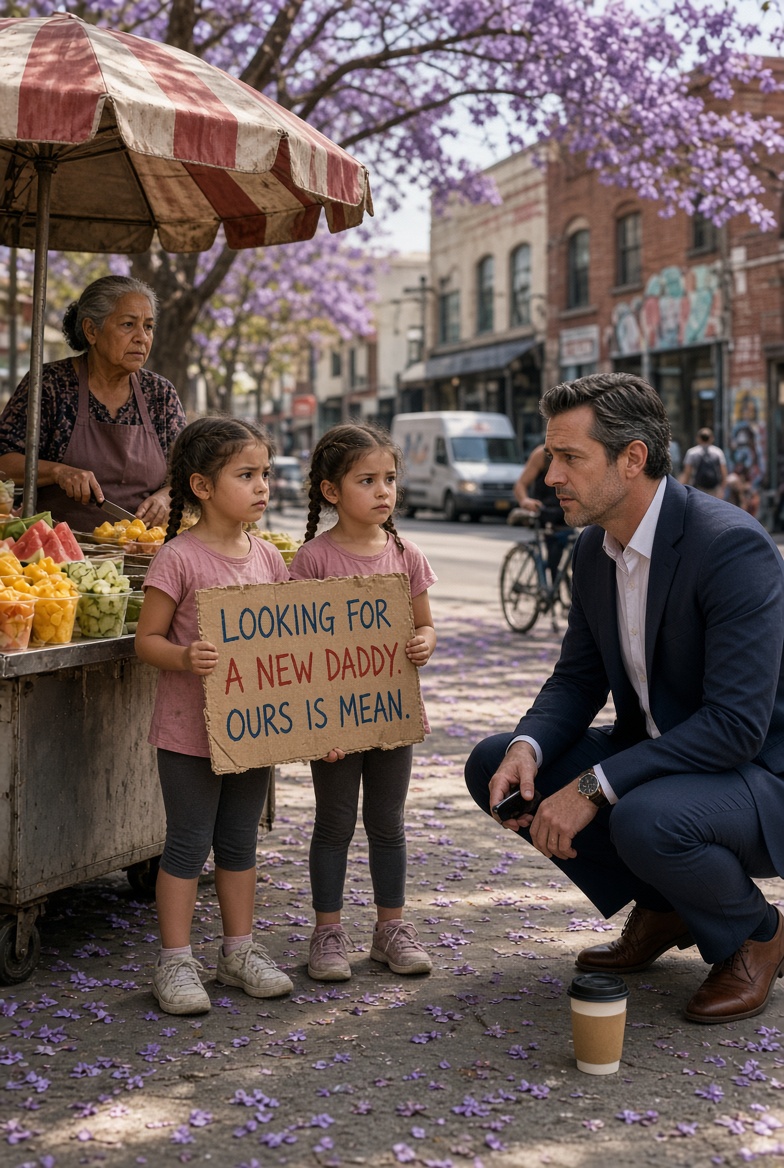
“Looking for a New Daddy… Ours Is Mean,” the Little Girls Said—Then the CEO Knelt Down and Did This – Life Story
Two six-year-old girls stood beneath a striped fruit-cart umbrella in downtown Los Angeles holding a cardboard sign that read, “Looking...

THE VALET SHOVED A 9-YEAR-OLD GIRL AWAY FROM THE CEO’S BENTLEY— THEN HER RUINED ENVELOPE EXPOSED A $1.4 MILLION CHARITY FRAUD – Life Story
“Get away from the car.” The valet’s voice was sharp enough to cut through the November rain. Nine-year-old Briana Wilson...