I BROUGHT OUR SECRET BABY BACK TO THE MAFIA BOSS I RAN FROM—THEN A SECOND ENVELOPE PROVED SOMEONE INSIDE HIS OWN HOUSE HAD SOLD US OUT – Life Story
The man I had spent fifteen months hiding from found me in his kitchen at two in the morning, holding the son he never knew existed.
Someone had been photographing our baby for weeks, and the last message promised that running would no longer save him.
But when Nicholas Bellini examined the photographs, he noticed something that made him question the loyalty of everyone living under his roof.
The kitchen lights snapped on, and Nicholas Bellini said, “Put your hands where I can see them.”
I froze beside the marble island, my six-month-old son strapped against my chest.
Nicholas stood in the doorway wearing dark pajama pants, his hair disheveled, his expression frighteningly calm.
For one terrible second, he looked at me as though I were an intruder he had already decided not to forgive.
Then Luca moved.
Nicholas’s eyes dropped to the baby carrier.
His gaze lingered on the dark hair, the round cheeks, and the small fist gripping the collar of my sweater.
Something changed in his face, something I had never seen during the three years I worked for him.
“Samantha?”
My name sounded unfamiliar in his voice.
I had imagined hearing it again a thousand times, but never like this.
“I need help,” I whispered.
His attention returned to Luca. “Whose baby is that?”
The question broke me more efficiently than anger could have.
“Yours.”
For several seconds, Nicholas didn’t move.
Beyond the enormous windows, rain streaked the black glass overlooking the gardens.
Somewhere inside the house, an alarm gave a brief electronic chirp, followed by footsteps approaching at a run.
Nicholas raised one hand toward the hallway.
“Dominic.
Nobody comes into this kitchen.”
A man’s voice answered from outside. “We had an unauthorized entry at the service door.”
“I know.
Secure the property.”
“Boss, we need to verify—”
“Do it.”
The footsteps retreated.
Nicholas looked at me again. “How old?”
“Six months.”
He closed his eyes briefly.
I could almost see him doing the calculation.
Fifteen months since I had disappeared.
Nine months between the night that changed everything and the morning Luca entered the world.
Six months of birthdays, bottles, sleepless nights, and ordinary miracles Nicholas had never witnessed.
“Why didn’t you tell me?”
I had rehearsed answers for that question while rocking Luca through sleepless nights in our Boston apartment.
None of them survived the sight of Nicholas standing in front of his son.
“Because I was afraid.”
“Of me?”
“Of what happens to people you love.”
His jaw tightened.
Luca began fussing, his small face folding with exhaustion.
We had left Boston before sunset, abandoning nearly everything I owned.
I had purchased our train tickets with cash, switched subway lines twice after arriving in New York, and walked six blocks through freezing rain because I believed someone had followed us from the station.
My legs were shaking.
Luca’s diaper bag was nearly empty.
The emergency key I had kept hidden in my wallet had been my last option.
Nicholas noticed the wet blanket around my shoulders.
“What happened?”
I reached into my coat and removed a white envelope.
It was creased from being folded against my body, one corner damp from the rain.
“Someone left this on my apartment door.”
I pushed it across the island.
Nicholas opened it and slid out three photographs.
The first showed me carrying Luca out of our neighborhood pharmacy.
The second showed his stroller outside our apartment building.
The third had been taken through the living room window, while I was holding him beside the lamp.
Nicholas’s face went utterly still.
He turned the third photograph over.
On the back, someone had written six words in black ink.
YOUR SON IS WORTH THE HARBOR.
“Who gave you these?”
“I don’t know.”
“Did anyone approach you?”
“Two men.
Outside the pharmacy.
One of them knew your name.”
Nicholas placed the photographs carefully on the counter.
“Did they touch you?”
“No.”
“Did they threaten Luca directly?”
I swallowed.
“One of them said that fathers make expensive mistakes.”
Nicholas stared at the note for a long moment.
Then he glanced toward the security camera above the kitchen entrance.
He wasn’t looking at me anymore.
He was looking at someone I couldn’t see.
“There’s something wrong with this,” he said.
“What?”
He lifted the third photograph into the light.
And I realized he wasn’t studying Luca.
He was studying the reflection in the window.
The House That Remembered Me
In that reflection, barely visible beyond my shoulder, stood the distorted shape of a man holding a phone.
I knew he had been there.
I had noticed the stranger across the street that afternoon, wearing a gray coat and pretending to study a parking meter.
But Nicholas pointed to something else.
A narrow strip of yellow tape crossed the man’s wrist.
“Access band,” Nicholas murmured.
“What does that mean?”
“Possibly nothing.
Possibly he works somewhere he shouldn’t.”
He studied it another moment, then turned the picture facedown.
“First, we get Luca warm.
Then you tell me everything.”
The command irritated me on instinct.
Fifteen months earlier, Nicholas had spoken like that about everything from business appointments to which entrance I should use when returning late.
He had never understood how easily concern could become control when the person expressing it possessed enough power.
I shifted Luca higher against my chest.
“I need to know something before I go upstairs.”
“What?”
“Am I allowed to leave?”
The question landed between us.
Nicholas looked toward the hallway, then back at me. “There are people outside who may be looking for you.”
“That isn’t what I asked.”
His expression hardened.
For a moment, I saw the man everyone else saw: the head of the Bellini organization, a man who could make people reconsider their decisions simply by entering a room.
Then his eyes went to Luca again.
“Yes,” he said. “You’re allowed to leave.
I think it would be dangerous tonight, but I won’t lock you in.”
“Or take him?”
His breath caught.
“No, Samantha.
I’m not taking your baby away.”
“He’s your baby too.”
“I know.”
He said it so quietly that the anger drained out of me before I could protect myself with it.
Dominic Moretti appeared at the end of the hallway a moment later.
He was forty-three, broad-shouldered, with graying hair and the steady expression of a man who had spent years anticipating problems before anyone else noticed them.
When I worked for Nicholas, Dominic had managed household security and some of the family’s legitimate transportation operations.
He was one of the few people who had never treated silence as a form of obedience.
His eyes moved from me to Luca.
“Samantha,” he said carefully. “It’s good to see you alive.”
It was such an unexpected thing to say that I nearly cried.
Nicholas handed him the envelope. “Photograph it, preserve the original, and document exactly where it came from.
We may need to give it to investigators.”
Dominic raised an eyebrow.
“Investigators?”
“Yes.”
That surprised both of us.
Nicholas looked at me. “You’ll get a room on the east side.
Maria can help with supplies.
Dominic will make sure nobody enters without your permission.”
“And the photographs?”
“I want to know who took them.”
Dominic looked at Luca again, then asked, “Do you have enough formula for tonight?”
It was an ordinary question in a room filled with extraordinary danger.
“No,” I admitted. “One sealed bottle.
Maybe two feedings if he doesn’t finish them.”
“I’ll have Maria check the pantry.
And I’ll call the pharmacy that provides the family’s medical supplies.
We won’t improvise anything he hasn’t had before.”
“Thank you.”
Dominic nodded.
For the first time since leaving Boston, somebody had asked what my son needed instead of what his existence meant.
Maria Alvarez was waiting at the staircase when Dominic escorted us upstairs.
She had worked in the house for almost eighteen years, long enough to have known Nicholas before he inherited the Bellini organization from his father.
She wore a pale blue cardigan over her uniform, and her silver-streaked hair was twisted into the same neat bun I remembered.
When she saw me, one hand flew to her mouth.
“Oh, Samantha.”
“I’m sorry.”
She came forward and embraced me as carefully as possible around the carrier.
“Whatever happened, you are freezing.”
That was Maria.
No interrogation until everyone had been fed.
The guest room overlooked the garden I had helped redesign years earlier.
The white roses were gone for the season, but the stone fountain remained, illuminated beneath the rain.
Maria brought clean towels, diapers, bottled water, and a portable crib kept for visiting family.
She prepared the room while I changed Luca, washed my hands, and made him a fresh bottle using the formula he was accustomed to.
He drank greedily.
I sat in an armchair near the window, watching the rain and counting the tiny movements of his fingers.
“He’s beautiful,” Maria said.
“He looks like Nicholas.”
“Very much.”
She smiled sadly.
“Does he know?”
“Yes.”
“How did he take it?”
I looked toward the door.
“I think he’s still trying to breathe.”
Maria didn’t smile this time.
“That sounds right.”
She helped me settle Luca in the crib on his back, with a fitted sheet and nothing else around him.
He slept almost immediately, his small body finally surrendering to exhaustion.
Then Maria sat opposite me.
“May I ask something?”
“Of course.”
“Did you leave because he hurt you?”
I stared at her.
Maria had always been direct, but there was something unmistakably protective in her expression.
“No,” I said. “Nicholas never hurt me.”
“That wasn’t exactly my question.”
I looked down at my hands.
“He made me feel like everything I wanted depended on what he was willing to allow.
And I was scared of the people around him.
The business.
The things nobody explained.”
Maria considered that.
“Then you should tell him exactly what you just told me.”
“He won’t like hearing it.”
“That doesn’t make it less true.”
Downstairs, a door slammed.
Maria glanced toward the sound.
“And he has spent too much of his life confusing being obeyed with being trusted.”
When she left, I stood beside Luca’s crib and watched him sleep.
I had told myself for fifteen months that returning to this house would mean admitting I had failed.
Yet here I was, grateful for a warm room and terrified of the price that might eventually be attached to it.
A soft knock came at the door around four.
“Sam?”
Nicholas.
I opened it only halfway.
He had changed into a charcoal sweater and dark pants.
His hair was damp, and there were deep shadows under his eyes.
He looked less like the man whose name made people uneasy and more like someone who had received terrible news and hadn’t figured out whether he was allowed to grieve.
“Can I come in?”
I stepped aside.
He approached the crib slowly.
For nearly a minute, he simply stood there.
“He’s really mine,” he said.
“Yes.”
“You’re certain?”
I felt myself stiffen.
Nicholas immediately noticed.
“I’m not accusing you of anything.
I just…” He rubbed his face. “I need to hear it again.”
“He’s your son, Nicholas.”
His eyes shone.
“What did you name him?”
“Luca Bellini.”
He turned toward me.
“You gave him my name?”
“It was his name before he could choose anything else.”
Nicholas swallowed.
“Can I touch him?”
I moved beside the crib.
“Just gently.
He’s finally asleep.”
He extended one finger and brushed Luca’s hand.
The baby curled his fingers around it.
Nicholas went absolutely still.
A man who had negotiated with dangerous people without visibly trembling stood beside a sleeping infant, unable to speak because five tiny fingers were holding on to him.
I looked away.
There were some things I couldn’t bear to witness directly.
After a while, Nicholas whispered, “Was he healthy when he was born?”
“Yes.
Nine pounds even.
He scared the nurses by being so quiet at first, but his doctor said he was fine.”
“Were you alone?”
I nodded.
“A nurse named Michelle held my hand.”
Nicholas shut his eyes.
“Sam…”
“Don’t.”
He looked at me.
“Don’t make me comfort you about the things I went through alone.”
He stepped back.
“You’re right.”
That surprised me.
He glanced at Luca, then toward the hallway.
“We should talk tomorrow.
When you’ve slept.”
“There’s something I need you to understand tonight.”
“I’m listening.”
“I came because somebody threatened our child.
That doesn’t mean I came back to our old relationship.”
He nodded slowly.
“Understood.”
“And if you want to be Luca’s father, you need to learn who he is.
Not just who he belongs to.”
Nicholas looked toward the crib.
“I’d like that.”
He reached the door, paused, and said, “There’s one other thing.”
“What?”
“Whoever photographed your apartment knew where you lived.
But they also knew something about the harbor negotiations that wasn’t public.”
“Which negotiations?”
“An independent freight operator has been pressuring me to surrender our East River terminal lease.
I’ve refused.”
“Who operates it?”
Nicholas hesitated.
“The Hsu Group.
Raymond Hsu runs it.
He has connections to a criminal network operating through several transportation businesses.
People call it the Triad, though that name covers more than one organization.”
I knew the name.
Not because Nicholas had explained it to me.
Because I had seen it once, fifteen months earlier, in a contract I wasn’t supposed to read.
“Raymond Hsu,” I repeated.
Nicholas’s expression changed.
“You know him?”
“No.
But I know a company he uses.”
“Which one?”
“Aster Logistics.”
The silence that followed was long enough for me to hear the rain tapping against the glass.
Nicholas spoke carefully.
“Where did you hear that name?”
“I used to proofread your shipping reports.
There were invoices from Aster that never matched the manifests.”
His eyes narrowed.
“Those records were supposed to have been destroyed.”
“They weren’t.”
And for the first time since I arrived, I saw something more troubling than anger on Nicholas’s face.
I saw fear.
The Price of Protection
By morning, the house had become a maze of quiet precautions.
A security technician checked the service entrance.
Dominic replaced the access code and reviewed footage from the overnight cameras.
Deliveries were moved to a receiving building outside the main property, and every staff member was told to report unusual calls without attempting to investigate alone.
Nicholas offered to move me into his private suite.
I declined.
He offered a larger room closer to his office.
I declined that too.
Then he asked whether I would at least let him purchase the supplies Luca needed.
“Diapers, yes,” I said. “A nursery designed by somebody who thinks babies need chandeliers, no.”
For the first time, his mouth twitched.
“I wasn’t going to buy a chandelier.”
“You were considering it.”
“A small one.”
“Absolutely not.”
He laughed.
It lasted only a second, but hearing it made the room feel different.
At breakfast, I found him sitting at the dining table with a yellow legal pad and three parenting books.
He had underlined entire paragraphs.
“Did you sleep?” I asked.
“Enough.”
“That’s not an answer.”
“I read until five.”
“About?”
He glanced at the books, looking almost embarrassed.
“Feeding schedules.
Developmental milestones.
Safe sleep.
How to recognize when a baby is overstimulated.”
I set Luca’s carrier beside my chair.
“Nicholas, he’s six months old, not an international merger.”
“International mergers come with better documentation.”
I nearly smiled.
He looked at Luca.
“May I hold him?”
The question mattered.
It was different from issuing instructions, and I wanted Nicholas to know I had noticed.
“Yes.
But support his back.
He’s strong enough to surprise you.”
Nicholas took Luca with the concentration of a man handling something infinitely more valuable than his entire estate.
Luca studied his face.
Then he grabbed Nicholas’s sweater.
“That’s a good sign,” I said.
“He’s trying to pull it off.”
“He likes textures.”
“Mine in particular?”
“He has excellent taste.”
Nicholas’s smile came slowly.
For twenty minutes, he sat with Luca while I ate breakfast without balancing a bottle, burp cloth, and piece of toast at the same time.
It was a luxury so small that I hated myself for feeling grateful.
Afterward, Dominic entered with a tablet.
“The external camera footage from Boston is incomplete,” he said. “Your building manager says they overwrite most recordings after a few weeks.
But we have a preservation request going through counsel.”
Nicholas looked up.
“And the men outside the pharmacy?”
“We have images of one vehicle.
Massachusetts plates.
Rental registration pending.”
“Any connection to Aster?”
“Not confirmed.”
Dominic glanced at me.
“Miss Wells, there’s something I need to ask.
Did you receive any unusual mail before yesterday?”
I considered it.
“Three weeks ago, I got a package addressed to Sarah Mitchell.”
“Your Boston name?”
I nodded.
“It was a children’s book.
No return address.
I thought Ashley might have sent it, even though she didn’t know where I lived.”
“What was the book?”
“Goodnight Moon.”
Nicholas went still.
“Why does that matter?” I asked.
He didn’t answer immediately.
Dominic looked at him.
“Nicholas?”
“That was in my office,” Nicholas said.
I frowned.
“What was?”
“Goodnight Moon.
My mother gave me an old copy.
It sits on the lower bookshelf, behind the framed photograph of my father.”
I knew the book.
I had dusted it every week when I worked for him.
Its green binding was worn, and there was a tiny crack in one corner where Nicholas had dropped it as a child.
“Anyone could buy that book,” I said.
“Yes,” Dominic agreed. “And that’s why we aren’t jumping to conclusions.”
He made a note.
“But we’ll want to examine the packaging if you kept it.”
“I didn’t.”
My stomach tightened.
“I left it in Boston.”
Dominic nodded. “Then we’ll document what you remember.”
Nicholas looked at Luca, who had fallen asleep against his chest.
I could see the calculation behind his eyes.
He was doing what he had always done: looking for the person to confront, the pressure point to apply, the leverage that would end the problem fastest.
“I want you to hear something,” I said.
Both men looked at me.
“Yesterday, I spent the whole day trying not to be noticed.
I checked reflections in store windows.
I avoided cameras.
I kept Luca’s face turned toward my chest on the train.”
My throat tightened.
“I don’t want him growing up thinking that’s normal.”
Nicholas shifted.
“He won’t.”
“You don’t know that.”
“I’ll make sure—”
“No.
You can’t promise him a life without danger.
You can promise what you’ll do when danger comes.”
Dominic lowered his tablet.
Nicholas stared at me.
“What would you have me do?”
“Start by not turning this into another private war.”
His expression closed.
“You think I want that?”
“I think it’s how you’ve solved problems for a long time.”
He looked away.
Dominic was the one who spoke.
“She’s right about one thing.
If someone has threatened a child to influence a commercial negotiation, there’s a path forward that doesn’t involve us handling everything ourselves.”
Nicholas’s jaw tightened.
“Law enforcement.”
“Yes.”
“A federal investigation of my port operations would be a gift to every competitor I’ve ever had.”
Dominic shrugged.
“Probably.
But an attempted extortion involving a baby isn’t a problem we should be settling across a conference table.”
I looked from one man to the other.
There was history in the room, the kind built from years of arguments neither wanted to repeat.
Nicholas finally said, “My attorneys are coming at noon.”
It wasn’t agreement.
But it wasn’t refusal.
Later that morning, Nicholas appeared at the guest room door carrying a package of diapers.
He looked at Luca, who was lying on a play mat and enthusiastically kicking a cloth elephant.
“I want to try something.”
“What?”
“Changing him.”
I stared.
“You?”
“Apparently, fathers do that.”
“Frequently.”
“I’d like to become one of those fathers.”
He knelt beside the changing pad and listened while I explained what to do.
He followed each step carefully, occasionally looking up for confirmation.
Halfway through, Luca sneezed.
Nicholas jumped.
I laughed before I could stop myself.
He glanced at me.
“That’s funny?”
“Very.”
He shook his head and continued, determined not to be defeated by a diaper.
When he finished, he looked almost proud.
“Acceptable?”
“More than acceptable.”
Luca kicked both legs.
Nicholas smiled down at him.
“See? Your mother approves.”
I watched them together.
It would have been so easy to let that moment erase everything else.
Nicholas could be impossibly tender when he wanted to be.
He could make a person feel like the center of his entire world.
But I’d learned that tenderness didn’t automatically make someone safe.
After Luca settled for his nap, I found Nicholas standing outside the guest room.
“I spoke with my attorney,” he said.
“And?”
“She wants to bring in an independent lawyer for you.”
That surprised me.
“Why?”
“Because if the situation becomes a criminal investigation, your interests may not always align with mine.”
He let the statement hang there.
It was the first time I’d ever heard him acknowledge that his interests and mine might be different.
“I’d like that,” I said.
“Her name is Rebecca Shaw.
She handles criminal defense and victim representation referrals.
She’ll help you find someone who doesn’t work for me.”
“Thank you.”
Nicholas nodded.
Then he hesitated.
“There’s another thing I owe you.”
I waited.
“When you disappeared, I spent months wondering whether you were alive.”
“I know.”
“No,” he said. “You don’t know all of it.”
The quiet in the hallway changed.
“What are you talking about?”
He looked toward the nursery door.
“I found you, Samantha.”
My stomach went cold.
“What?”
“Three months after you left.
I found you in Boston.”
I stared at him.
He had known?
While I worked nights at my kitchen table to pay rent, while I carried groceries up three flights of stairs, while I went to prenatal appointments alone and whispered to my unborn son that we were going to be okay?
Nicholas had known where I was.
“How?” I asked.
He hesitated.
And that hesitation was worse than the answer.
“I had someone looking for you.”
“Someone?”
“A private investigator.”
I stepped away.
“Did he know about Luca?”
“No.
Not then.”
“But he knew where I lived.”
“Yes.”
I suddenly remembered the photographs on the kitchen counter.
The reflection.
The yellow band around the stranger’s wrist.
The book somebody had mailed to my apartment.
“You had someone watching me,” I whispered.
Nicholas shook his head.
“Only long enough to confirm you were safe.”
“How long?”
“Two weeks.”
I stared at him, hardly recognizing the man standing before me.
“And where are those records now?”
His expression changed.
Because he didn’t know.
The File With No Owner
Nicholas didn’t ask me to calm down.
That was fortunate, because if he had, I might have walked out of the house with Luca before breakfast.
Instead, he followed me into the small sitting room adjoining the guest suite and remained standing near the doorway.
“I hired a licensed investigator,” he said. “His name is Daniel Mercer.
He located you in Boston and confirmed you were living under another name.”
“Did he take photographs?”
“Yes.”
“Of me?”
“Yes.”
I felt physically sick.
“Did he watch my apartment?”
Nicholas’s silence answered before he did.
“For a limited period.
I wanted to know whether someone had forced you to disappear.”
“And after he reported back?”
“I told him to close the investigation.”
“You never contacted me.”
“I thought leaving you alone was what you wanted.”
I laughed once, without humor.
“Leaving me alone would have meant not hiring somebody to follow me.”
“I know that now.”
I walked to the window.
The garden below looked impossibly peaceful.
Wet stone paths reflected the pale morning light, and a groundskeeper was collecting broken branches near the fountain.
“I was pregnant,” I said. “Every morning I woke up afraid I had made the wrong decision.
Every night I wondered whether you were looking for me.
And somewhere in the middle of all that, you already knew where I was.”
Nicholas didn’t answer.
I turned.
“What happened to Mercer’s reports?”
“They were supposed to remain with my attorney.”
“Supposed to?”
“My operations director handled the payments through a discretionary account.
I told him the investigation was closed.”
“Your operations director.”
“Vincent Rinaldi.”
I knew Vincent.
Everyone in Nicholas’s organization knew Vincent.
He was fifty-two, impeccably dressed, and possessed the kind of courteous voice that made an insult sound like an invitation.
He had worked for Nicholas’s father before Nicholas inherited the business.
He understood the port contracts, the trucking routes, the family relationships, and the quiet obligations that never appeared on any company balance sheet.
He had also been the person who told me, the morning after my last night with Nicholas, that I should remember my place.
The memory arrived so sharply I grabbed the windowsill.
Vincent standing in the office doorway.
His tailored navy suit.
The silver watch resting against his cuff.
And his voice, pleasantly dismissive.
Women who mistake an evening for a future usually discover how expensive that mistake can become.
I had never told Nicholas about that conversation.
Now I wondered why.
“Vincent knew you found me?”
“He knew the investigator submitted a closing invoice.”
“Did he see the report?”
“I don’t know.”
“You need to find out.”
Nicholas nodded.
“I will.”
“No,” I said. “We need to find out.
With my lawyer present.”
His eyes met mine.
There was a flicker of irritation, followed by something better.
Agreement.
“All right.”
Rebecca Shaw referred me to a lawyer named Claire Bennett, who arrived just after noon carrying a leather satchel and wearing flat black shoes that looked chosen for usefulness rather than appearance.
She was in her early forties, with short brown hair and an expression that suggested she had very little patience for theatrical men.
I liked her immediately.
She sat with me in the conservatory while Nicholas waited elsewhere.
“I represent you,” she explained. “Not Mr.
Bellini, not his companies, and not his interests as Luca’s father.
If those interests conflict, your decisions come first.”
“Good.”
“Do you feel free to leave this property?”
I hesitated.
“Legally, yes.
Emotionally, I’m not certain.”
“That’s a useful distinction.”
She asked about Boston, the photographs, the threatening encounter, and the decision to return.
She also asked whether Nicholas had ever prevented me from accessing money, transportation, friends, or family.
I told her the truth.
He hadn’t.
But he had built a world in which nearly everyone expected his word to be final, and I’d been young enough to confuse his attention with the promise that I would eventually become an exception.
Claire wrote that down.
Then she asked, “What outcome do you want?”
I almost answered, I want Luca safe.
But safety wasn’t a complete answer anymore.
“I want to know who found us.
I want Nicholas to be his father without deciding everything for us.
And I want the ability to leave without hiding.”
Claire nodded.
“Then we’ll work toward those things separately.
They don’t all require the same solution.”
By three, she had arranged a preliminary conversation with a federal investigator through an attorney familiar with port-related crimes.
She also sent me information about establishing legal parentage and creating a temporary parenting arrangement, rather than leaving the future to an argument between two exhausted people.
Nicholas’s lawyer, Evelyn Price, joined us for a meeting that afternoon.
She was a composed woman in her late fifties who had clearly spent years telling powerful clients things they did not enjoy hearing.
“Mr.
Bellini,” she began, “if these threats involve your business activities, we cannot treat the matter as a private security dispute.”
Nicholas folded his arms.
“I understand.”
“Do you?”
She looked at the photographs.
“Because cooperation may expose matters you would prefer remained undisclosed.”
“Such as?”
Evelyn gave him a patient look.
“Don’t ask a question you already know the answer to.”
I watched Nicholas’s face.
He didn’t argue.
That troubled me more than if he had.
After the attorneys left, Dominic brought in a slim folder from the internal audit team.
“There’s a problem,” he said.
He opened it on the dining table.
The private investigator’s original invoice showed that Mercer had been paid for his work and that the assignment was closed shortly afterward.
But six weeks later, a second expense had been approved under the same project number.
The vendor listed on the second payment was Aster Logistics.
Nicholas stared at it.
“That’s impossible.”
“Someone changed the account description,” Dominic said. “The finance archive shows it as a security consultation.”
“How much?”
“Twenty-eight thousand dollars.”
“For what?”
“No supporting report.”
Nicholas looked up.
“Who approved it?”
Dominic turned the folder.
A digital authorization appeared beside the transaction.
VINCENT RINALDI.
The room became completely silent.
Nicholas stared at the signature.
“He may have been cleaning up an expense incorrectly,” Dominic said, though his tone suggested he didn’t believe it.
“Or purchasing information,” I said.
Nicholas looked at me.
“From Mercer?”
“Maybe.
Or from somebody who could access Mercer’s file.”
I examined the document more closely.
Below the vendor information was a project reference.
ASTER-B17.
I knew that sequence.
I had seen it years earlier on warehouse invoices that arrived without matching delivery records.
“Can I borrow this?”
Nicholas slid it toward me.
I compared the reference to a photograph of an old invoice stored in my email archive.
Same project code.
Same unusual abbreviation in the billing description.
Ancillary handling and reconciliation.
It had meant nothing when I first saw it.
Now it looked like a doorway.
“These invoices aren’t about security,” I said.
Dominic leaned closer.
“What makes you say that?”
“Because Aster used this code before I disappeared.
They billed the Bellini freight company for cargo transfers that never appeared on the port’s ordinary records.”
Nicholas’s eyes narrowed.
“Why would you remember that?”
“Because you asked me to proofread a compliance report.
The numbers didn’t match.
I asked Vincent for the supporting documents, and he told me I was wasting my time.”
The room seemed to contract around us.
“Did you keep copies?” Dominic asked.
“Not company originals.
But I kept my editing notes and a few excerpts because the report was never finalized.”
Nicholas rubbed his jaw.
“Where?”
“In a personal backup connected to my freelance work.
I didn’t realize how important they might be.”
Dominic looked at me with open respect.
“You’re certain you can access them?”
“I can try.”
Nicholas pushed away from the table.
“Vincent has worked for my family for twenty-seven years.”
I met his eyes.
“So?”
“So I need more than an irregular invoice before I accuse him of putting my son in danger.”
“Then we get more.”
He looked away.
I understood his hesitation.
Vincent wasn’t merely an employee.
He had been present at Nicholas’s father’s funeral, helped negotiate his first major contract, and stood beside him during conflicts that had nearly destroyed the family business.
Loyalty like that could become indistinguishable from blood.
But blood wasn’t the only thing that mattered anymore.
Upstairs, Luca woke from his nap and began calling out with his impatient little sounds.
I stood.
“I have to get him.”
Nicholas followed me to the stairs.
“Samantha.”
I stopped.
“Whatever Vincent has done, I’ll find out.”
“I believe you.”
His expression softened.
“Thank you.”
“But Nicholas?”
“Yes?”
“If the truth implicates you too, I expect you to tell it.”
The softness disappeared.
He didn’t promise.
And that frightened me.
That evening, Vincent Rinaldi arrived at the house for what he believed was an ordinary operations meeting.
I watched his car pull up through the sitting room window.
He emerged wearing a dark overcoat and carrying a familiar black briefcase.
When he entered the foyer, Maria greeted him.
He looked toward the staircase.
For one fraction of a second, he saw me.
His expression didn’t change.
But his hand tightened around the handle of the briefcase.
Then he smiled.
“Samantha Wells,” he said pleasantly. “What an unexpected homecoming.”
I smiled back.
“Vincent.
You look well.”
“And you’ve brought a child.”
“Yes.”
His eyes moved to Luca.
Then he said something that made my skin go cold.
“Boston must have been difficult with a newborn.”
I hadn’t told him where I had been living.
And Nicholas hadn’t announced it.
The Things We Never Said
Vincent realized his mistake almost immediately.
“You know how quickly news travels,” he added smoothly. “Nicholas has had everyone concerned.”
“Of course.”
I kept my tone neutral.
He moved toward the office, and I carried Luca upstairs without letting him see my hands shake.
When Nicholas came to the guest room twenty minutes later, I told him exactly what Vincent had said.
He listened without interrupting.
“Did Dominic tell him?” he asked.
“I don’t know.”
“Then we establish that before assuming anything.”
I stared at him.
“Do you hear yourself?”
“Samantha—”
“He knew where I lived.
He knew you found me.
And now he’s standing downstairs acting surprised that I have a child.”
“You’re asking me to accuse a man who helped raise me.”
“I’m asking you to stop protecting the person you want him to be.”
Nicholas flinched.
For a moment, I regretted the words.
Then I remembered Vincent’s smile.
“I understand loyalty,” I said more quietly. “But if Luca is the price of that loyalty, you have to choose.”
Nicholas stood very still.
“I already have.”
“Have you?”
He looked toward the crib.
“I’m trying.”
It was the first honest answer he’d given me without dressing it in certainty.
I didn’t know whether it was enough.
Over the following days, the house settled into a fragile routine.
Dominic worked with the attorneys and investigators to preserve financial records.
Claire kept me informed without asking me to become involved in anything that might endanger Luca.
Nicholas continued running the business, though he began delegating more routine responsibilities and temporarily limited Vincent’s access to sensitive files.
And Luca discovered that his father was an entertaining person.
Nicholas had a habit of speaking to him in Italian while walking him around the garden.
He would point out the trees, the stone fountain, and the bronze birds decorating the walls.
Luca understood none of it.
But he loved the sound of Nicholas’s voice.
One morning, I found them in the breakfast room.
Nicholas had laid a blanket on the floor and was sitting beside Luca, who had just rolled onto his stomach.
“Look at that,” Nicholas said.
Luca lifted his head triumphantly.
“He’s been doing that for weeks,” I told him.
Nicholas barely glanced up.
“Not for me.”
I stood in the doorway.
Something painful moved through my chest.
He wasn’t trying to recover the months he’d missed by pretending they hadn’t happened.
He was learning to value the moments available to him now.
Later, when Luca fell asleep, Nicholas brought two cups of coffee into the sitting room.
He set mine on the table and sat opposite me.
“Did you ever think about telling me?” he asked.
“Every day.”
“Then why didn’t you?”
I watched steam rise from the cup.
“The night after we were together, Vincent told me I should forget it happened.”
Nicholas’s eyes sharpened.
“He said what?”
“He told me women who confused one evening with a future usually regretted it.”
Nicholas set his coffee down.
“I never asked him to say that.”
“I know.”
“Why didn’t you tell me?”
“Because a part of me believed him.”
Nicholas stared at me.
I took a breath.
“I was your assistant.
You owned the house, the companies, the cars, the world everyone around you seemed determined to preserve.
I was twenty-nine, working for a man whose business I barely understood.”
“Sam, you were never just—”
“Don’t.”
He stopped.
“You treated me well, Nicholas.
You trusted me with your schedule, your private letters, your mother’s birthday plans.
But I also knew you could make a decision that changed a hundred people’s lives without asking any of them what they wanted.”
I looked at him.
“Then we spent that night together, and suddenly I had something to lose.”
His face changed.
“I thought you left because you regretted it.”
“No.”
I swallowed.
“I left because I didn’t regret it.”
Silence filled the room.
“Two weeks later, I learned I was pregnant.
I wanted to call you.
I wrote messages and deleted them.
I even went back to the train station once.”
“Why didn’t you come?”
“Because somebody was waiting outside my apartment.”
Nicholas straightened.
“What?”
I closed my eyes briefly.
It was a memory I had avoided for fifteen months.
“A man in a black sedan.
He approached me when I came home from work.
He knew my name and said Nicholas Bellini had enemies who would do anything to hurt him.”
“Did he threaten you?”
“Not directly.
He told me that smart women knew when to disappear before they became liabilities.”
Nicholas’s face drained of color.
“What did he look like?”
“Late forties, maybe.
Gray hair.
Expensive coat.
I couldn’t identify him now.”
“Did he say who sent him?”
“No.”
I looked down at my hands.
“He said, ‘A man can protect a secret only if nobody knows it exists.’”
Nicholas stood abruptly.
“That’s not something I ordered.”
“I know.”
“Why didn’t you tell me about him before?”
“Because I thought he worked for someone who wanted you dead.
And then I found out I was pregnant, and all I could think was that somebody already understood how to use me against you.”
Nicholas walked to the window.
The morning light caught the hard line of his jaw.
“I would have helped you.”
“Maybe.”
He turned.
“Maybe?”
“Would you have let me choose how?”
He opened his mouth.
Then closed it.
There was the answer I had feared.
Eventually he came back to his chair.
“I’m sorry,” he said.
Not for the past in general.
Not for some vague misunderstanding.
“For making you believe love from me would always come with orders.”
I looked away.
That apology hurt more than I expected.
That night, Luca woke shortly after midnight with stomach discomfort.
I was exhausted, having spent most of the evening recovering old editing notes from my backup drive.
Nicholas heard Luca crying while passing the guest room and knocked.
“Do you need help?”
I opened the door.
“He’s uncomfortable.
I’ve already fed and changed him.”
Nicholas washed his hands and sat beside me.
“May I?”
I handed Luca over.
He held him upright against his shoulder and gently patted his back.
When that didn’t help, he tried the slow rocking motion Maria had taught him, walking the length of the carpet while humming a song in Italian.
Luca eventually burped.
Then he settled.
Nicholas looked absurdly relieved.
“I think we survived.”
I laughed.
“An extraordinary achievement.”
He returned Luca to my arms.
I placed the baby in his crib, and we stood together watching him fall asleep.
“What’s that song?” I whispered.
“My mother used to sing it.”
“You remember it?”
“Only half.”
“What’s the other half?”
“I’ve been trying to remember for twenty years.”
Something about that confession made him feel unexpectedly young.
I looked at the man beside me.
He had inherited a world of obligations before he had learned how to escape them.
His father had taught him that love meant control, that security required secrecy, and that any weakness could be used against him.
And Nicholas had believed those lessons because no one had ever given him an alternative that survived.
Now Luca slept peacefully between us.
I wondered whether a child might be the first person in Nicholas’s life who loved him without asking him to win anything.
“He’s lucky,” Nicholas whispered.
“Why?”
“Because you knew how to love him before you knew whether you could protect him.”
I turned toward him.
He looked exhausted.
For the first time in fifteen months, I reached for his hand.
He didn’t close his fingers around mine immediately.
He waited.
Then he held it gently, as though he understood how easily I could pull away.
We stood like that until Luca’s breathing deepened.
The next afternoon, my recovered editing files revealed why Vincent had been so eager to discourage me from asking questions.
Among the archived drafts was a discrepancy report I had prepared fifteen months earlier.
It compared container arrival records with invoice entries from Aster Logistics.
Several containers had been billed as ordinary equipment transfers even though their handling codes placed them outside the company’s standard customs documentation.
At the time, I’d assumed the mismatch was an accounting error.
But attached to one draft was a scanned approval sheet.
The authorizing officer was Vincent Rinaldi.
And beneath his signature was a note in his handwriting.
KEEP THIS OUT OF THE QUARTERLY DISCLOSURES UNTIL N.B.
SIGNS OFF.
N.B.
Nicholas Bellini.
I stared at the scan.
Suddenly, I remembered exactly why Vincent had entered my office that morning fifteen months earlier.
He hadn’t come to warn me against falling in love.
He had come to collect the report.
I had believed his personal cruelty was a warning that I didn’t belong in Nicholas’s life.
But it had also given him a reason to push me away from the files.
I called Claire immediately.
She reviewed the material through our secure document-sharing process, then arranged for it to be preserved and discussed with the federal investigators already examining the threats.
Two hours later, Dominic brought the original company access records into Nicholas’s office.
He had obtained them through a formal audit requested by the company’s outside counsel.
The records showed that on the evening before the stranger approached me outside my apartment, Vincent had accessed my employee information.
Then someone had exported a contact sheet listing my address.
Nicholas looked at the report.
For a long time, he said nothing.
Finally, he whispered, “He wanted you gone.”
“Yes.”
Dominic turned another page.
“There’s more.”
The same administrative account had accessed the private investigator’s closing file almost a year earlier.
Not long after Nicholas had decided to stop looking for me.
And that file contained my Boston address.
For fifteen months, I had believed a criminal world I barely understood had somehow reached across two hundred miles to find me.
Now the shape of the truth was changing.
Someone inside Nicholas’s world had known how to find me long before Raymond Hsu’s men appeared.
And someone had decided the information was worth selling.
When the Lights Went Out
The first major disagreement came over a suitcase.
Not a security system.
Not a freight contract.
Not Vincent Rinaldi.
A suitcase.
After Claire reviewed the evidence, she recommended moving Luca and me temporarily to a location outside the Bellini property.
She could coordinate the arrangement with investigators and keep our address confidential while they examined the threats.
I agreed.
Nicholas didn’t.
“Absolutely not,” he said when I told him.
We were standing in the upstairs sitting room.
My suitcase lay open on the couch, half-filled with baby clothes, documents, and the few belongings I had brought from Boston.
Nicholas looked at it as though it were an accusation.
“Someone inside my organization has been passing information about you to a criminal operation,” he said. “And your solution is to leave the one property I can secure?”
“My solution is to stop letting your property define where I’m safe.”
“Samantha—”
“You told me I could leave.”
“I did.”
“Then don’t make me fight you for permission.”
He looked away.
The muscles in his jaw tightened.
“I’m worried about Luca.”
“So am I.
That’s why Claire is arranging professional protection and a location that Vincent doesn’t control.”
“Dominic doesn’t answer to Vincent.”
“No.
But somebody in this house has been using company records to find us.
You can’t guarantee every person here is trustworthy.”
Nicholas stared at the suitcase.
Then he did something unexpected.
He picked up a folded stack of Luca’s pajamas and placed them inside.
“What time are you leaving?”
I blinked.
“Tomorrow morning.”
“All right.”
“You’re not going to argue?”
“I already did.”
He zipped the small side compartment.
“And you were right.”
It was such a simple concession.
But I knew what it had cost him.
That evening, Nicholas helped me prepare a list of Luca’s medications, feeding preferences, sleep schedule, and pediatrician’s number.
He asked whether he could continue seeing Luca in a safe location approved by Claire and the investigators.
I said yes.
He accepted the answer without requesting guarantees I couldn’t give.
After dinner, we sat together in the nursery.
Luca was on the floor between us, concentrating fiercely on a cloth book.
Every time he managed to turn a page, Nicholas reacted as though he had achieved something historic.
I watched them in the warm lamplight.
“He’s going to miss you,” I said.
Nicholas looked at me.
“I’ll miss him.”
Then, after a pause, “I’ll miss you too.”
I lowered my eyes.
“Nicholas…”
“You don’t have to say anything.”
“I want to.”
He waited.
“I don’t know what happens to us after this.”
“Neither do I.”
“I still love you.”
The words escaped before I could arrange them into something safer.
Nicholas went completely still.
I hadn’t meant to confess it like that, beside a basket of stuffed animals while our son chewed on the corner of a book.
But there it was.
I had spent fifteen months trying to make love disappear by refusing to acknowledge it.
And all I’d accomplished was making myself lonely.
Nicholas looked at me for a long moment.
“I love you too.”
His voice was almost inaudible.
“I never stopped.”
I reached across the blanket.
He met my hand halfway.
There was no dramatic embrace, no promise that love would solve everything.
Just his fingers around mine.
And our son between us.
A little later, as Luca slept in his crib, Nicholas walked me to the guest room.
We stopped outside the door.
“May I kiss you?” he asked.
The question made my eyes sting.
“Yes.”
His kiss was gentle, almost hesitant.
Nothing like the desperate night fifteen months earlier, when everything had happened too quickly for either of us to understand what it meant.
This time, he didn’t pull me toward him.
He didn’t ask me to stay.
He kissed me once, brushed his thumb over my hand, and stepped back.
“Good night, Sam.”
“Good night.”
I watched him walk away.
For the first time, leaving the house felt like a choice I could make without destroying whatever remained between us.
The alarms began at a.m.
At first, I thought the sound belonged to a dream.
Then the lights blinked twice.
A low mechanical tone came from the hallway, followed by the emergency shutters lowering over the ground-floor windows.
Luca woke crying.
I was beside his crib before the second alarm sounded.
My phone lit up.
A message from Dominic.
STAY IN YOUR ROOM.
POSSIBLE UNAUTHORIZED ACCESS.
I’M COMING TO YOU.
I lifted Luca, wrapped him in his sleep sack, and held him close.
The next message arrived almost immediately.
NICHOLAS IS ON HIS WAY.
KEEP THE DOOR CLOSED UNTIL WE VERIFY IDENTITIES.
I looked at the door.
A terrible memory flashed through me.
The stranger outside my apartment.
The photographs.
The man with the yellow strip around his wrist.
Then I heard something beyond the hallway.
A voice.
“Emergency maintenance.
We need access to the electrical room.”
The words were muffled.
A second voice answered, sharper.
“Who authorized this?”
A pause.
“Mr.
Rinaldi.”
My heart stopped.
I moved away from the door and called Dominic.
He answered immediately.
“Sam?”
“Someone outside says Vincent authorized maintenance.”
“We’re checking it.”
“Dominic, the east electrical room connects to the service corridor.
You don’t need to enter the main house to access it.”
Silence.
Then he said, “How do you know that?”
“I used to coordinate maintenance schedules.
The service contractor always entered through the exterior utility door.”
“Stay where you are.”
His voice changed.
“Don’t open for anyone.”
The call ended.
I heard footsteps running.
Then Nicholas’s voice came through the door.
“Samantha, it’s me.
Dominic is verifying me on the camera.”
A moment later, Dominic called.
“It’s Nicholas.
You can open.”
I unlocked the door.
Nicholas stood outside wearing a dark sweater and jeans.
His face was pale, but his movements were controlled.
“We’re going to the protected room,” he said.
“What happened?”
“Someone used a valid vendor credential to reach the service courtyard.
The credential belongs to a contractor we haven’t used in six months.”
“Vincent?”
“We don’t know yet.”
He looked at Luca.
“Let’s move.”
We crossed the hall with Dominic ahead of us.
No one shouted.
No one ran recklessly.
The guards moved in coordinated silence, communicating through radios while the shutters remained closed.
The protected room was beneath the east wing.
It had reinforced doors, independent communications, emergency supplies, and security monitors connected to cameras around the property.
Nicholas closed the door after us.
Luca was crying hard now.
I sat in a chair and held him upright, trying to settle him while Dominic reviewed the camera feeds.
On one screen, three unfamiliar men stood beside a white maintenance van.
One wore a gray jacket.
The angle was poor, but I recognized the way he held his shoulders.
I had seen him outside our Boston pharmacy.
“That’s one of them,” I whispered.
Nicholas turned.
“You’re certain?”
“Yes.”
Dominic called the security team and asked them to preserve every camera recording.
Then he contacted the police dispatcher, reporting an unauthorized attempted entry and the existing threats.
The men outside appeared to realize the entrance had been secured.
They returned to the van.
A security vehicle followed at a distance until local police intercepted the van on a public road.
No one in the house was injured.
No confrontation reached the nursery.
But the attempt changed everything.
The people who threatened Luca had not simply been testing Nicholas’s perimeter.
They had used a credential connected to his own business.
While Dominic coordinated with the responding officers, Nicholas sat beside me.
Luca had finally stopped crying.
His face rested against my shoulder, exhausted.
“I’m sorry,” Nicholas said.
“For what?”
“For bringing you back into this.”
I stared at him.
“I came here.”
“Because my world followed you.”
He looked at our son.
“I can’t keep pretending the problem exists only outside these walls.”
I wanted to tell him that realization was enough.
But it wasn’t.
Not yet.
At five, Dominic received an update from the responding officers.
The maintenance van had been rented using false identification.
The occupants were being questioned, and the investigators already assigned to the extortion case had been contacted.
More importantly, the vendor credential had been issued through an internal administrative request.
The request was authenticated by Vincent’s account.
Nicholas looked at the screen.
He said nothing.
Dominic placed the report on the table.
“We have enough to justify immediately revoking his access and referring the whole chain to investigators.”
Nicholas nodded.
“Do it.”
Then another message appeared.
This one came from Evelyn Price.
She had located a draft agreement in the corporate document system.
It was titled:
EAST RIVER TERMINAL — PROVISIONAL TRANSFER OF OPERATING RIGHTS.
I watched Nicholas read it.
His face changed.
“What is it?”
He hesitated.
“Something I was negotiating.”
“With whom?”
He didn’t answer.
I moved closer and read the first page.
The proposed recipient was a holding company affiliated with Raymond Hsu.
My mouth went dry.
“You’ve been negotiating with him?”
Nicholas closed the document.
“Samantha, listen.”
“How long?”
“Since before you came back.”
I stared at him.
The photographs were still fresh in my mind.
The stranger at the pharmacy.
The message on the back.
YOUR SON IS WORTH THE HARBOR.
“You knew they wanted the terminal, and you were preparing to give it to them?”
“It was a contingency.”
“A contingency for what?”
“If they escalated the dispute.”
“While they were threatening our child?”
“I didn’t know about Luca when the draft was first prepared.”
“But you know now.”
He looked away.
And I understood.
He had considered completing the transfer.
Not because he trusted Raymond Hsu.
Because he believed surrendering the terminal might make the threats stop.
The thought should have comforted me.
Instead, it terrified me.
“How many people work there?” I asked.
Nicholas frowned.
“What?”
“At the East River terminal.
How many employees?”
“Just over two hundred, including contracted staff.”
“And you were going to hand their jobs, their pensions, their contracts, and their safety to the people who followed me around Boston?”
“It wasn’t that simple.”
“It never is with you.”
I could hear my voice rising.
Luca stirred against my shoulder.
I lowered it.
“You told me we were going to do this differently.”
“I was trying to buy time.”
“With other people’s lives.”
His face hardened.
“I was trying to keep our son alive.”
There it was.
The old Nicholas.
The man who believed every terrible decision could be justified if he called it protection.
I stepped back.
“That’s exactly why I left.”
His expression broke.
“Samantha…”
“No.
You don’t get to use Luca as a reason to do whatever you want.
You don’t get to make the same choices that frightened me fifteen months ago and expect me to be grateful because this time you say you’re making them for us.”
He said nothing.
I looked at Dominic.
“Is the route to Claire’s arranged location still available?”
Dominic hesitated.
“Once the officers clear the property, yes.”
“Then Luca and I are leaving this morning.”
Nicholas closed his eyes.
For a moment, I thought he would argue.
Instead, he stepped aside.
“All right.”
The two words nearly destroyed me.
Because I knew he meant them.
But I also knew that if I stayed simply because I loved him, I would be teaching our son that love meant accepting decisions made out of fear.
And I refused.
At dawn, I carried Luca through the same service hallway I had entered in desperation.
This time, Nicholas did not follow us.
He stood beneath the kitchen lights, watching as Dominic opened the exterior door.
I turned back once.
Nicholas looked older than he had a few hours earlier.
“Will you tell Luca I love him?” he asked.
My throat tightened.
“You can tell him yourself,” I said. “When you decide what kind of father you want to be.”
Then I walked out.
And for the second time in fifteen months, I left Nicholas Bellini behind.
The Morning of Receipts
Claire met us at a discreet apartment in Manhattan arranged through a victim-support referral and a security consultant working with the investigation.
It wasn’t luxurious.
There were two bedrooms, a small kitchen, a sturdy crib, and windows overlooking a courtyard where rainwater collected between uneven paving stones.
I loved it immediately.
Nobody had decorated it to impress me.
Nobody had told me what I was supposed to feel.
I could close the bedroom door without wondering whether someone on the other side believed they had a right to enter.
Luca slept through our arrival.
I unpacked his clothes, put his formula in the kitchen, and sat beside the crib.
Then I cried.
Not because I wanted Nicholas back.
Not exactly.
I cried because I had wanted us to work, and I had begun to believe we might.
Claire arrived with coffee an hour later.
She didn’t ask whether I was all right.
Instead, she handed me a cup.
“Have you eaten?”
I shook my head.
“Then eat something before we make decisions.”
I laughed weakly.
“You sound like Maria.”
“Maria sounds sensible.”
We sat at the kitchen table.
Claire opened her folder.
“The investigators are treating this as a coordinated extortion and potential conspiracy case.
The attempted entry gives them additional evidence, but they still need to establish who directed it.”
“And Vincent?”
“His account authorized the credential.
He claims someone used his access without permission.”
“Do they believe him?”
“Belief isn’t the standard.
Evidence is.”
I appreciated that.
Too many people in Nicholas’s world treated suspicion like a verdict.
Claire continued.
“The financial records you recovered may be important.
But I want you to understand something.
You don’t have to solve this case.
You can provide what you know and let investigators do their work.”
I looked toward Luca.
“I know.”
“Do you?”
“Yes.
But I also know why those reports matter.”
I opened my laptop.
The original compliance report included an appendix I had almost forgotten.
It wasn’t simply a list of mismatched invoices.
It contained my editorial questions.
Whenever I had found an inconsistency, I had left a dated comment asking for clarification.
The comments were preserved in the version history of the document stored in my personal working archive.
One of those questions concerned a transfer assigned to an empty container yard.
The report listed a delivery at a.m.
But the receiving company had ceased operations seven months earlier.
“Why would anybody bill for a delivery to a closed company?” I asked.
Claire leaned forward.
“Possibly fraud.
Possibly poor records.
We’d need the underlying documents.”
I opened another file.
This one contained the reply Vincent had sent after I asked him to clarify the discrepancy.
His message was short.
Delete the question.
The issue has been reconciled.
I remembered how angry I had been.
Not because the answer was rude, although it was.
Because he hadn’t answered the question.
At the time, I had assumed Vincent was protecting a business arrangement that Nicholas preferred not to discuss.
Now I wondered whether he had been protecting himself.
Claire forwarded the preserved copies to the investigative team through an approved secure channel, maintaining a record of their origin.
Later that afternoon, a federal agent named Elena Ruiz came to speak with me.
She was calm, precise, and uninterested in the reputation surrounding Nicholas Bellini.
She asked me to describe the stranger outside my old apartment.
Then the men in Boston.
Then the envelope.
Then Vincent’s comment about my living in Boston.
She let me finish without interrupting.
“Did you ever give Mr.
Rinaldi permission to share your address?” she asked.
“No.”
“Did Mr.
Bellini?”
“I don’t know.”
She wrote that down.
“What do you believe happened?”
I considered lying.
Not a dramatic lie.
Just a small one that would allow me to say Nicholas had known nothing, that all the bad decisions belonged to other people, that love could remain uncomplicated if I refused to examine the past too closely.
Instead, I said, “I think Vincent used private information to get rid of me because I was asking questions.
And I think Nicholas allowed a dangerous business to grow because confronting it would have cost him money and loyalty.”
Agent Ruiz looked at me.
“Those are different allegations.”
“I know.”
“Can you separate what you witnessed from what you suspect?”
“Yes.”
“Then let’s do that.”
We spent almost three hours reviewing events.
When she left, I felt exhausted.
But for the first time since the photographs appeared on my Boston door, my fear had been converted into something useful.
Dates.
Names.
Documents.
Questions that other people were legally required to answer.
That evening, my sister called.
I had sent Ashley a message earlier that morning.
Only four words.
I’m safe.
Please call.
She answered with tears and anger.
“Where have you been, Samantha?”
I closed my eyes.
“I know.”
“Do you? Because for over a year I’ve been trying to reach my sister, and all I got was a postcard from Europe that suddenly stopped making sense.”
“I’m sorry.”
“Are you hurt?”
“No.”
“Are you in trouble?”
“Yes.”
Silence.
Then she asked, “How much trouble?”
I looked at Luca sleeping in his crib.
“I have a baby.”
Ashley didn’t speak.
“His name is Luca.”
Another silence.
Then, very softly, “Sam?”
I started crying.
For the next hour, I told her the truth.
Not every business detail.
Not information that would compromise the investigation.
But enough.
I told her about Nicholas.
The pregnancy.
Boston.
The photographs.
The night alarms.
And the decision to leave the house.
When I finished, Ashley was quiet.
Then she said, “I’m coming.”
“You don’t have to.”
“I wasn’t asking.”
She arrived the following afternoon with a suitcase and the same stubborn expression she’d worn since we were children.
The moment she saw Luca, her face crumpled.
“Oh, Sam.”
She held him carefully, blinking through tears.
“He looks like somebody.”
“His father.”
“That much?”
I nodded.
Ashley looked at me.
“Well, then his father has some explaining to do.”
For the first time in days, I laughed.
That night, while Luca slept, Ashley and I sat on the floor eating takeout noodles from cardboard containers.
She asked the question I’d been avoiding.
“Do you want Nicholas back?”
I stared at the television, which neither of us was watching.
“I want the man he could be.”
Ashley shook her head.
“That’s dangerous.”
“I know.”
“Love somebody for what they do, Sam.
Not for the person you can imagine them becoming.”
I looked at my sister.
She had always been better at saying painful things without making them cruel.
“What if he’s trying?”
“Then give him time to show you.
Real time.
Not a week of good behavior.”
I nodded.
Ashley reached for my hand.
“And don’t disappear from your own life again just because you love him.”
At nine the following morning, Claire called.
“There’s been a development.”
I straightened.
“What happened?”
“Mr.
Bellini has agreed to make a voluntary disclosure to federal investigators.”
My heart stopped.
“Of what?”
“Internal financial records, communications, and information concerning the proposed terminal transfer.”
“And Vincent?”
“Mr.
Bellini has revoked his access.
His attorney has instructed the company to preserve his records.”
I stared at the wall.
Nicholas had chosen to expose his own business.
The business he’d spent his adult life protecting.
The one he’d inherited from his father.
The one he’d once told me was the only thing keeping the family together.
“Why?” I whispered.
Claire paused.
“I think you’d have to ask him.”
An hour later, Nicholas called.
I almost didn’t answer.
Then I remembered what I’d said to him.
You can tell Luca you love him yourself.
I picked up.
“Hello.”
For a moment, there was only breathing.
“Sam.”
His voice sounded tired.
“Is Luca okay?”
“He’s fine.”
“Good.”
A pause.
“I spoke with Evelyn.
I’m cooperating with the investigation.”
“I heard.”
“I should have done it sooner.”
“Yes.”
He accepted that.
“I was afraid,” he said.
It was the first time I had heard him say those words without immediately trying to turn them into a justification.
“Of losing the business?” I asked.
“Of losing the only life I knew how to run.”
I sat down.
“And Luca?”
“I was afraid he’d grow up learning the same things my father taught me.”
Nicholas took a breath.
“That being strong meant nobody could question you.
That protecting people meant making every decision for them.”
My eyes filled.
“I don’t want that for him,” he said.
“Neither do I.”
“I know.”
A long silence followed.
Then he asked, “Will you let me keep being his father?”
“You are his father, Nicholas.
That isn’t something you have to earn from me.”
His breathing changed.
“But being part of his life means respecting mine.”
“I understand.”
“Do you?”
“I’m starting to.”
I looked toward Luca’s crib.
He had woken and was gripping the wooden rail, examining his own hands.
“He’s awake,” I said.
Nicholas was quiet.
“Would you like to hear him?”
“More than anything.”
I switched to speakerphone.
Luca made a series of enthusiastic sounds into the phone.
Nicholas laughed softly.
“Hi, little man.”
Luca kicked his legs.
I watched my son react to a voice he already recognized.
And something inside me loosened.
The following morning, Agent Ruiz contacted Claire.
Investigators had corroborated several important parts of the financial trail.
Aster Logistics had received payments through companies associated with Vincent.
Some of those transfers coincided with unauthorized access to internal records.
A cooperating contractor had also provided information about the vendor credential used during the attempted entry.
The money trail alone didn’t establish every threat.
But it helped investigators connect events that had previously appeared separate.
Raymond Hsu was pressuring Nicholas for the terminal.
Vincent had been diverting funds and concealing irregular transfers.
And both men had a reason to keep Nicholas from examining the books too closely.
The last missing piece was intent.
Who had directed the surveillance?
Who had decided to use Luca?
And how much had Nicholas known?
Agent Ruiz told us investigators were preparing an operation involving a controlled meeting with Vincent and Hsu, with cooperation from Nicholas and his legal team.
Nicholas would attend under an arrangement made with counsel.
I would not.
I could provide testimony and documents from a secure location, but no one was going to put Luca or me inside a confrontation to obtain evidence.
I agreed immediately.
That was the difference between this investigation and the world I’d fled.
Nobody asked me to prove my love by putting myself in danger.
Two days later, Nicholas sat across from Raymond Hsu in a conference room overlooking the East River.
Outside, cargo cranes moved against the gray morning sky.
Vincent occupied the chair beside Hsu.
Nicholas’s attorney was present, and the meeting was being documented as part of the investigation.
The room looked ordinary.
A polished table.
Water glasses.
Folders arranged neatly in front of each participant.
No raised voices.
No dramatic entrances.
Just three men discussing the future of an entire terminal as though the lives attached to it were numbers on a spreadsheet.
Raymond Hsu was forty-eight, well dressed, and soft-spoken.
He had built his transportation company by purchasing distressed contracts and persuading struggling operators that his money came without uncomfortable questions.
He viewed the Bellini terminal as a valuable piece of infrastructure, and he had grown impatient with Nicholas’s refusal to surrender it.
“I understand this has become personal,” Hsu said.
Nicholas looked at him.
“You sent men to photograph my child.”
Hsu’s expression barely changed.
“People make unfortunate decisions during difficult negotiations.”
“Who authorized it?”
Vincent shifted.
“Nicholas, we’re here to settle the commercial issue.”
Nicholas ignored him.
“Who authorized it?”
Hsu folded his hands.
“I didn’t personally order anyone to approach your family.”
It was a carefully constructed sentence.
Nicholas looked toward Vincent.
“Did you?”
Vincent sighed.
“You’re asking the wrong questions.”
“Then answer the right ones.”
Vincent leaned back.
For the first time, his courteous expression began to fracture.
“I spent twenty-seven years keeping this business alive.
Your father understood what that required.
He knew the difference between signing a contract and surviving a negotiation.”
Nicholas said nothing.
Vincent continued.
“When you inherited the company, you wanted clean books and polished offices.
Meanwhile, freight rates collapsed, insurance costs rose, and half our shipping clients threatened to move their business.”
“So you stole from us.”
“I kept the company operating.”
“By billing nonexistent transfers?”
“By moving expenses where they wouldn’t destroy our borrowing agreements.”
“And Aster?”
Vincent glanced at Hsu.
“An arrangement that was necessary.”
Nicholas opened a folder.
Inside were documents supplied through the investigation.
Expense approvals.
Internal access records.
The closing invoice from the private investigator.
And the second payment associated with Aster.
Nicholas slid the page across the table.
“Why did you purchase the report on Samantha?”
Vincent didn’t touch it.
“You were making irrational decisions about her.”
Nicholas stared.
“What?”
“You were distracted.
Your father would never have allowed an assistant to influence business decisions the way she did.”
“She asked why the numbers didn’t match.”
“Exactly.”
Vincent’s voice sharpened.
“She was getting involved in matters she didn’t understand.
She was digging through records that could have brought regulators into our warehouses.”
“So you frightened her.”
“I encouraged her to move on.”
Nicholas’s expression became perfectly still.
“You sent a man to her apartment.”
Vincent’s eyes flicked toward the documents.
“I instructed someone to make clear that staying close to you would be dangerous.”
“And later?”
Vincent said nothing.
Nicholas placed another page on the table.
“Aster received money after she disappeared.
You accessed Mercer’s report.
That gave you her Boston address.”
Hsu shifted in his seat.
“This conversation is going nowhere.”
Nicholas didn’t look at him.
“Vincent.
Why did you give him my son’s location?”
Vincent’s face tightened.
“I didn’t know she had a child when I obtained the file.”
“That wasn’t my question.”
Hsu rose slightly.
“Perhaps we should reconvene with a different agenda.”
Nicholas remained seated.
Vincent glanced at Hsu.
Then he looked back at Nicholas.
“You refused to transfer the terminal,” he said. “Raymond needed leverage.
Your former assistant was the only personal connection you had ever allowed anyone to see.”
Nicholas didn’t move.
“And Luca?”
Vincent looked away.
“Once they discovered the baby, they understood what it meant.”
Nicholas’s voice dropped.
“You knew?”
“Not until later.”
“And you let them use him.”
Vincent’s expression finally cracked.
“I thought you’d surrender the terminal.
Nobody was supposed to be physically harmed.
It was pressure, Nicholas.
Pressure to complete a transaction that should have happened months ago.”
For a moment, Nicholas looked like the man who once believed every problem had an answer hidden inside power.
Then he glanced at the papers before him.
He remembered the people whose jobs would disappear if he quietly surrendered the terminal.
He remembered the old reports he had never bothered to examine.
He remembered the woman who had walked away from him twice because she refused to raise their child inside a world built on fear.
“No,” he said.
Vincent frowned.
“No what?”
“No transfer.”
Nicholas closed the folder.
“No private settlement.
No more hidden agreements.
No more deciding that hurting innocent people is an acceptable cost of doing business.”
Hsu’s expression hardened.
“You are making a serious mistake.”
“Maybe,” Nicholas said. “I’ve made plenty.”
He looked at Vincent.
“But this one ends here.”
Investigators already had evidence beyond the conversation, including records and witness accounts obtained independently.
With the meeting concluded, agents moved forward with the enforcement steps they had prepared.
Vincent and Hsu were taken into custody based on the evidence developed in the investigation.
Further arrests followed as investigators traced payments and communications through their associated companies.
The case would not be resolved in one afternoon.
There would be hearings, challenges, additional evidence, and months of legal proceedings.
But the coercion surrounding the East River terminal had finally been brought into the open.
And Nicholas Bellini had chosen not to hide the part of the truth that could destroy him.
That evening, my phone rang.
It was Nicholas.
“They’re in custody,” he said.
I closed my eyes.
“Are you okay?”
“Yes.”
“Is it over?”
“The immediate threat is contained.
There will be more legal proceedings.”
I nodded, even though he couldn’t see me.
“And you?”
A pause.
“I’ve given the investigators the records they requested.
Some of them involve decisions I made.”
“Are you going to be charged?”
“I don’t know yet.”
He was quiet for a moment.
“Sam, I won’t ask you to wait for me.”
My throat tightened.
“I know.”
“I love you.
That hasn’t changed.”
“I love you too.”
He breathed in slowly.
“But I need to know who you become when none of this is yours anymore.”
“I understand.”
“Do you?”
This time, his answer came without hesitation.
“Yes.”
And for the first time, I believed him.
The Door We Left Open
The legal proceedings lasted longer than any of us expected.
Vincent Rinaldi and Raymond Hsu faced federal charges connected to extortion, fraud, and the misuse of confidential information.
Their attorneys challenged portions of the evidence, and investigators continued tracing financial transactions long after the initial arrests.
Vincent eventually admitted his involvement in providing Samantha Wells’s location to Hsu’s associates as part of a negotiated plea.
Hsu’s case continued through additional proceedings.
The threats against Luca were no longer an active campaign, but that didn’t mean our lives returned to normal overnight.
They couldn’t.
Nicholas had his own decisions to answer for.
He had allowed questionable shipping practices to continue, approved misleading business records, and ignored discrepancies because confronting them would have jeopardized the organization he’d inherited.
He hadn’t ordered the threats against us.
But that didn’t erase his other responsibilities.
After extensive negotiations, he pleaded guilty to a federal fraud-related offense involving false customs documentation.
The court imposed restitution and a fourteen-month custodial sentence, followed by supervised release.
His businesses underwent restructuring and independent review.
Nicholas gave up his controlling role in the freight operation.
He didn’t call the sentence unfair.
He didn’t blame Vincent.
He told me, “For years, I thought refusing to look at something meant I wasn’t responsible for it.”
Then he added, “I was wrong.”
I had never loved him more painfully than I did in that moment.
Because loving him no longer meant pretending he was innocent of everything.
It meant believing he could be accountable for what he had done and still become a better man.
During the months before his sentence began, we worked with attorneys and a family mediator to establish a parenting arrangement that respected both of us.
Nicholas learned how to care for Luca without a staff member standing nearby.
He fed him breakfast, changed his diapers, read to him, and discovered that a baby who disliked naps was not impressed by his father’s business experience.
Sometimes we argued.
Sometimes we laughed.
Once, Luca spilled an entire bowl of oatmeal down Nicholas’s shirt during a supervised visit, and Nicholas looked at me with such genuine disbelief that I laughed until I cried.
“You think that’s funny?” he asked.
“Extremely.”
He looked down at the oatmeal.
Then he laughed too.
No money could have given him that moment.
No amount of power could have replaced it.
When Nicholas began serving his sentence, Luca and I visited when arrangements allowed.
Nicholas also sent letters, sometimes addressed to me and sometimes to our son.
The letters to Luca were the hardest to read.
He described the garden, the fountain, the trees outside the house, and the things he wanted to teach him when they were together again.
But he never promised that nothing bad would happen.
Instead, he wrote about keeping his word.
About telling the truth.
About how a strong person could admit being wrong.
I saved every letter.
Meanwhile, I continued working as an editor under my own name.
I rented a modest apartment not far from Ashley, rebuilt friendships I’d abandoned, and learned to make decisions without first imagining Nicholas’s reaction.
When Luca learned to walk, Nicholas wasn’t there to catch his first steps.
That hurt both of us.
I sent him a photograph and described the moment in a letter.
He wrote back that he was proud of Luca, and proud of me for making sure our son had room to grow.
It was a different kind of love.
Less dramatic.
More difficult.
And more real.
After Nicholas completed his sentence, we didn’t move into his house together immediately.
We dated.
Properly.
He took me to a small Italian restaurant where nobody recognized him.
We walked through Central Park while Ashley watched Luca.
We argued about ordinary things, like whether the kitchen needed a new table and whether Nicholas was buying too many books.
On a rainy Thursday, he arrived at my apartment with a grocery bag.
Inside were tomatoes, pasta, basil, and a packet of cookies Luca liked.
“No flowers?” I teased.
“I thought I’d make dinner.”
“Do you know how?”
“Maria has been teaching me.”
“That sounds dangerous.”
“I have references.”
He made a terrible mess of the kitchen.
The pasta was slightly overcooked.
Luca loved it.
So did I.
When Nicholas finished washing the dishes, he stood beside me at the sink.
“I want to ask you something,” he said.
I smiled.
“What?”
“Would you consider being my girlfriend?”
I stared at him.
Then I laughed.
“After everything, you’re asking me that?”
“Yes.”
“Why?”
“Because I don’t want to assume you belong to me.”
The laughter disappeared.
He looked nervous.
This man who had once controlled a powerful organization was standing in my small kitchen, waiting to learn whether the woman he loved wanted to go on another date.
“Yes,” I said.
He smiled.
“Yes?”
“Yes, Nicholas.”
He kissed me.
And for the first time, it felt as though neither of us was trying to recover the past.
We were building something new.
We married nearly a year later.
Not in a ballroom filled with people who owed Nicholas favors.
Not beneath chandeliers bought with money neither of us wanted to examine.
We married in the garden of the old Bellini house, which Nicholas had retained as his personal residence after separating it from the restructured businesses.
The guest list was small.
Maria cried through the ceremony.
Dominic stood beside Nicholas, wearing a suit that he complained was too tight.
Ashley held Luca until he insisted on walking toward his father.
Halfway down the path, he stopped to examine a fallen leaf.
Everyone waited.
Nicholas knelt and held out his hand.
“Come on, little man.”
Luca considered him.
Then he ran forward.
Nicholas caught him and carried him the rest of the way.
When we exchanged vows, I didn’t promise that I would never leave.
Nicholas didn’t promise that he would protect me from everything.
We promised to tell each other the truth.
To listen.
To make difficult decisions together.
And to build a home where our children would never confuse fear with love.
Two years later, I stood in the kitchen on a Sunday morning, watching Nicholas prepare breakfast.
Luca was nearly five, sitting at the island with a box of crayons.
He was drawing a picture of our family beneath an enormous yellow sun.
Beside him lay a pink blanket.
It belonged to his baby sister, Sofia, who was asleep upstairs.
Nicholas turned from the stove.
“Coffee?”
“Please.”
He handed me a mug.
Outside, sunlight spread across the garden.
The white roses were blooming again, and the fountain caught the morning light.
The old security systems had been replaced with ordinary residential precautions.
The freight business no longer controlled the household’s routines.
We still paid attention to safety.
But our children were growing up in a home, not a fortress.
Nicholas looked toward the service entrance.
“Do you remember the night you came back?”
“Every detail.”
“I was terrified.”
I smiled.
“You looked furious.”
“I was both.”
He came closer.
“I thought I’d lost you forever.
Then you appeared in my kitchen with a baby I didn’t know existed.”
I glanced at Luca.
“And now?”
Nicholas looked at our son, then toward the stairs where Sofia slept.
“Now I know what I’m responsible for.”
He took my hand.
“Not controlling everything.
Not making everyone afraid to disagree with me.”
He squeezed my fingers gently.
“Being here.
Listening.
Coming home.”
I leaned against him.
For a moment, the years between that terrible night and this peaceful morning seemed to fold together.
I remembered the rain.
The photographs.
The desperation of carrying Luca through a locked service entrance because I believed I had nowhere else to go.
Then I looked around our kitchen.
At my husband.
At our son carefully coloring his sister’s blanket blue because he thought she would like it.
At the sunlight touching the marble counter where I had once laid an envelope that changed all our lives.
A knock came at the service door.
Maria had arrived with fresh bread from the bakery.
Nicholas reached for the handle.
Luca jumped off his stool.
“I’ll get it, Dad!”
“Ask who it is first,” Nicholas reminded him.
“It’s Maria!”
“Then go ahead.”
Luca opened the door.
Maria laughed and stepped inside, carrying the warm bread and greeting him with a kiss on the cheek.
No one panicked.
No one gave orders.
No one needed to hide.
I watched my son welcome someone into the house where I had once been too frightened to breathe.
And I finally understood what coming home was supposed to feel like.
This time, the door stayed open.
Recommended Stories
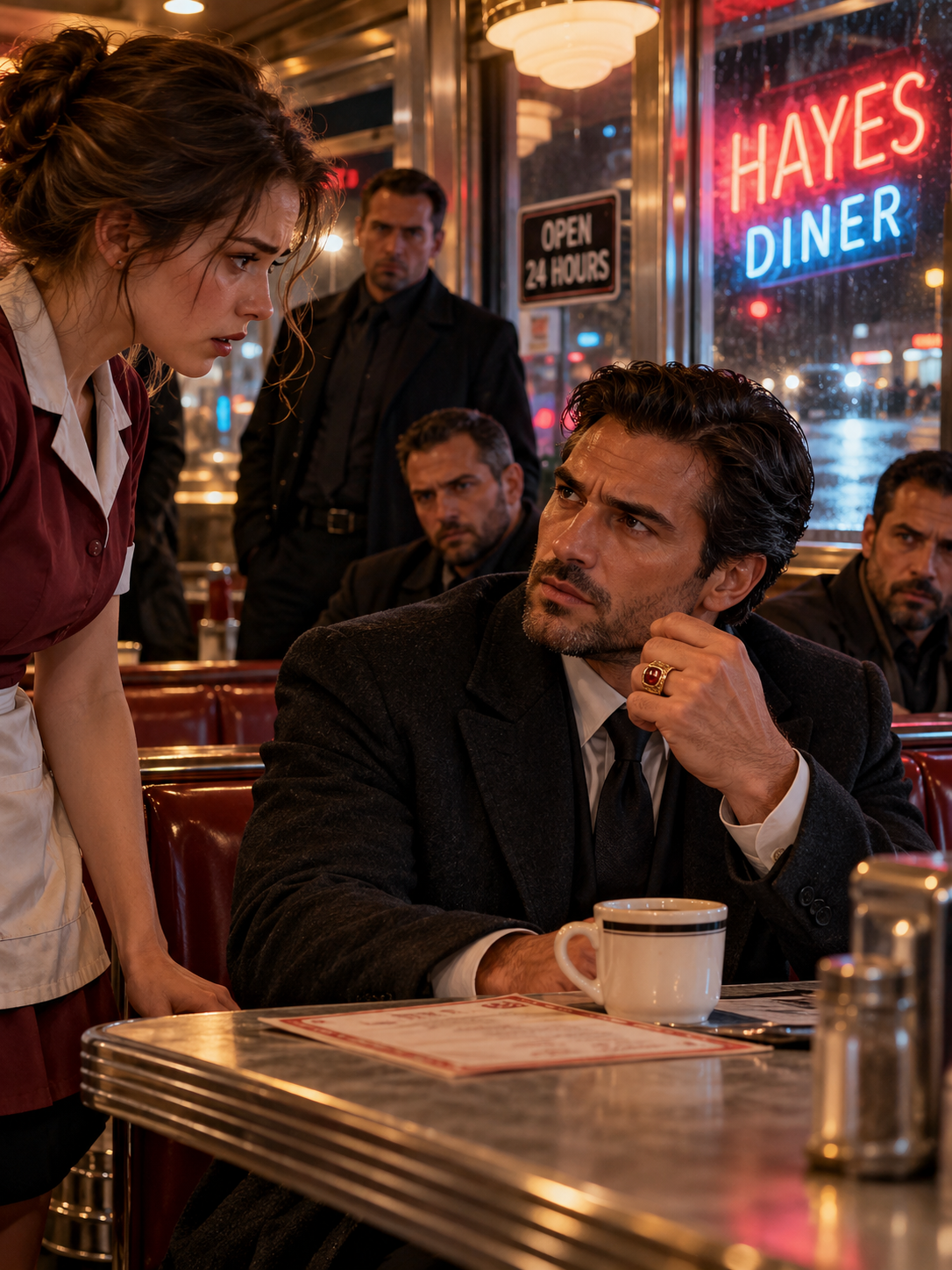
THE MOB BOSS WALKED INTO MY DINER WEARING MY DEAD SISTER’S RING—THEN HE ASKED ONE QUESTION THAT MADE ME DOUBT EVERYTHING THE POLICE HAD TOLD ME – Life Story
The ring on the stranger’s hand was the last thing I remembered my dead sister wearing. He entered my diner...

A SIX-YEAR-OLD GIRL TOLD A STRANDED MILLIONAIRE HER MOM COULD FIX HIS CAR—HE LAUGHED UNTIL THE MECHANIC FOUND A SECRET HIS OWN COMPANY BURIED – Life Story
His $280,000 car died on an empty Illinois road, and the six-year-old beside it told him her mother could fix...

MY BOSS ORDERED ME TO APPROVE THE EXPENSES FOR HIS AFFAIR—THEN ONE MAN AT THE CLUB HEARD WHAT HE SAID TO ME – Life Story
“Approve the expenses by morning,” Martin said, sliding the receipts across his desk. “I don’t care what the system says.”...