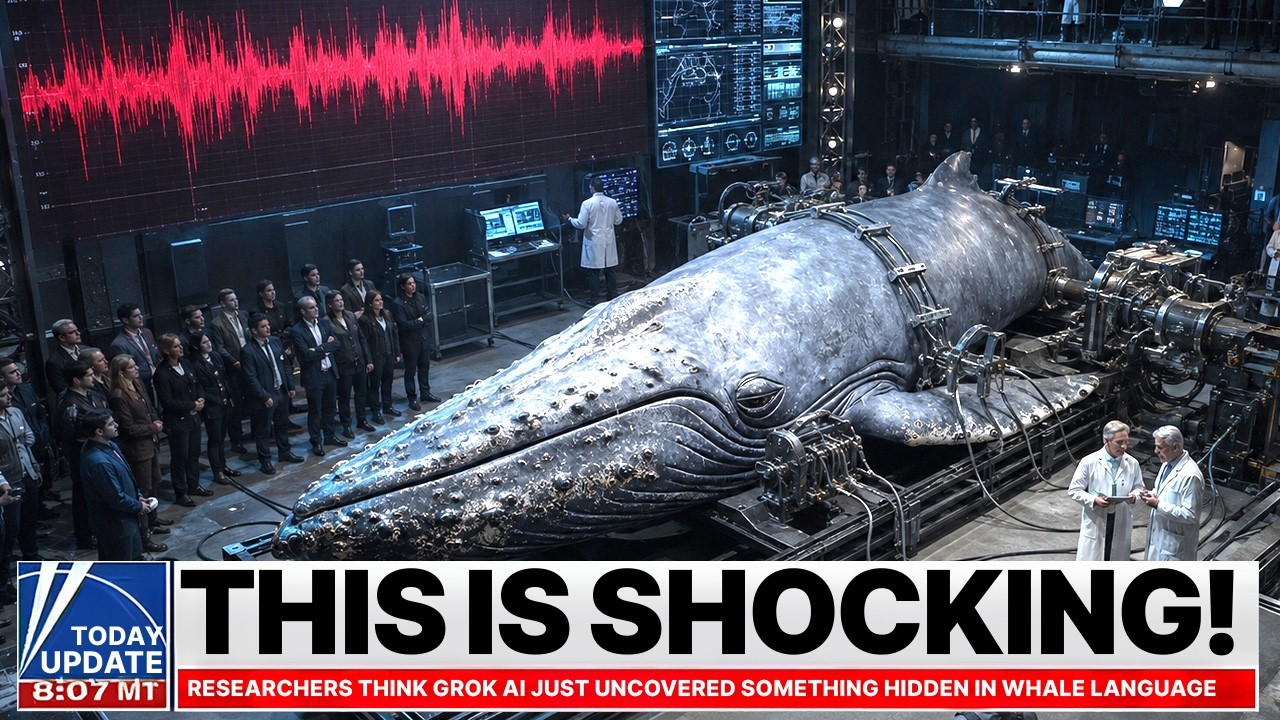
Researchers think Grok AI just uncovered something hidden in whale language, and they’re stunned by what the pattern might mean. Feeding thousands of hours of recorded whale calls into the model, the team noticed a structure far more complex than simple songs, hinting at a possible grammar-like system.
In 2023, researchers off the coast of Alaska conducted an experiment in marine biology. They anchored a small research vessel in open water, lowered an underwater speaker, and broadcast a recorded humpback whale contact call. The recording had been made the previous day from a group of whales in the same waters, including a 38-year-old female known to researchers as Twain.
A whale surfaced and approached the boat. Over the next 20 minutes, each time the researchers played the call, Twain responded with her own vocalizations. The exchanges followed a pattern of call and response, with pauses consistent with those used in natural whale conversation. The lead scientist, Dr. Brenda McCowan of the University of California, Davis, later described this as the first known communicative exchange between humans and humpback whales conducted in the whale’s own signaling system.
The groundwork for this experiment began years earlier at Harvard University, where a chance encounter brought together two researchers from different fields. Shafi Goldwasser is a cryptographer who has spent her career studying how information can be hidden, protected, and recovered. While passing the office of marine biologist David Gruber at Harvard’s Radcliffe Institute, she heard audio recordings of sperm whales. She stopped and asked whether machine learning had been used to analyze the clicking sounds, noting that they resembled Morse code in structure.
Gruber had collected the recordings years earlier while studying jellyfish in the Caribbean. The clicks had always been regarded as background noise. No one had applied cryptographic or machine-learning analysis to whale vocalizations before. Goldwasser, along with AI researcher Michael Bronstein, proposed using deep learning systems, the same architecture behind large language models, to analyze animal communication. The main requirement was volume: vast amounts of recorded audio.
A related observation came from an earlier field study in the Galápagos. Researcher Oscar Palacios and his team were tracking 25 sperm whales with underwater microphones. One day, all the whales stopped vocalizing simultaneously and disappeared from the study area. The researchers concluded that the whales had detected the microphones, recognized they were being monitored, and coordinated a collective silence in response.
Sperm whale calves are not born knowing their language. While their mothers dive to depths of around a thousand feet to hunt squid, calves remain near the surface and practice vocal patterns. They produce incomplete versions of clan-specific click sequences, known as codas, gradually refining them over weeks. One of the first patterns a calf learns is its family identity coda, a sequence carried for life.
In 2020, the CETI project was established as a large-scale effort to analyze sperm whale communication. It brought together researchers from MIT, Harvard, UC Berkeley, and more than a dozen other institutions, working from Dominica in the Caribbean, where multigenerational sperm whale families return consistently. The team deployed permanent hydrophone arrays and tagging devices equipped with multiple microphones and movement sensors, designed to capture who was speaking, who was being addressed, and what the animals were doing during vocal exchanges.
Analysis of 9,000 recordings produced results that contradicted previous assumptions. Scientists had long believed sperm whale communication consisted of roughly 21 codas, each with a fixed meaning. The new analysis identified 156 distinct codas and found that each coda contains four internal elements: rhythm, tempo, ornamentation, and rubato. These can be independently modified, allowing for a much wider range of possible meanings. The system displays what linguists call duality of patterning, the capacity to create unlimited meanings from a small set of meaningless units, a feature once considered unique to human language.
The analysis also suggested that whales adjust their communication style based on their audience. Researchers called this audience design. In human language, it is the ability to speak differently to a child than to an adult. In whales, it appears to involve a working model of another individual’s mind.
Historical records offer indirect evidence that whale communication transmits information across large distances. In the early nineteenth century, American whalers in the Pacific initially had high success rates hunting sperm whales. Within about two and a half years, their kill rates dropped by 58 percent. Surviving whales appeared to have passed warnings through their communication network to whales that had never encountered whaling ships. Historian Patchiba Demuth of Brown University examined whaling logbooks and found repeated entries in which sailors described changes in whale behavior and noted that younger whales seemed to have learned from somewhere they could not identify.
Sonic analysis by linguist Gaspar Begi of UC Berkeley produced another unexpected finding. When recordings from Dominica were slowed down and examined, the vocalizations contained structures comparable to human vowels, including sounds resembling the “a” in “father” and the “i” in “see,” as well as gliding diphthongs. This is notable because sperm whale anatomy did not evolve for spoken language. Their sound production system evolved for echolocation in deep, dark water. Researchers described the finding as an example of convergent evolution, in which two species separated by hundreds of millions of years develop similar solutions independently.
The same anatomical system that produces whale codas also produces the sperm whale’s powerful echolocation clicks. Sperm whales are among the loudest animals on Earth, with clicks recorded at levels that would be harmful to human hearing. The organ used for communication is the same one used for acoustic sensing.
Researchers have not confirmed the meaning of any individual coda. The AI systems used in the analysis cannot verify data or confirm whether a pattern in recordings represents actual communication. They can only identify structure. The finding that communication has complex internal structure does not mean researchers know what the components mean.
Among the 156 codas, one pattern has received particular attention. Called “1+1+3,” it consists of two separate clicks, a pause, and three faster clicks. It appears frequently across Caribbean sperm whale families, before deep dives, after surfacing, during gatherings, and at births. Researchers have suggested it may carry a meaning roughly equivalent to “I am here.”
In November 1820, the American whaling ship Essex was hunting sperm whales in the Pacific. The first mate observed an unusually large whale floating motionless at the surface, facing the ship. It then swam toward the vessel at increasing speed and struck it. After a second strike, the ship was severely damaged. Twenty crew members abandoned ship in three open boats. During the 83 days that followed, eight of the twenty men survived. The incident inspired the novel Moby-Dick.
Some researchers later noted that the crew had been repairing a damaged whaleboat, hammering wood and metal on the ship’s hull in rapid, repeated patterns. It is possible the whale interpreted these sounds as sperm whale clicks coming from inside the ship and attacked what it perceived to be another whale. Whether that explanation is correct remains uncertain.
Sperm whale populations were drastically reduced by commercial whaling in the twentieth century. Ship strikes and underwater noise pollution continue to affect them. Research has documented that intense industrial noise underwater can cause physical harm to marine mammals, including hearing loss and tissue damage. For animals that rely on sound for navigation, feeding, and social communication, chronic noise can force them from their habitats and disrupt the social bonds between family groups.
In 2024, indigenous leaders from New Zealand and the Cook Islands signed a treaty recognizing whales as legal persons with specific rights. The document followed years of advocacy and research on whale behavior and communication.
The CETI project continues to collect and analyze data. Researchers have described their findings as evidence that the structural complexity of sperm whale communication is far greater than previously believed. What the sounds mean, and what information whales have been sharing about humans over generations of contact, remains an open question.
Recommended Stories

Wildlife managers in the greater Yellowstone ecosystem have documented a previously underestimated pattern of natural mortality among adult grizzly bears. Research indicates that wolves, mountain
Wildlife managers in the greater Yellowstone ecosystem have documented a previously underestimated pattern of natural mortality among adult grizzly bears....
American wildlife officials made a stunning discovery: only 129 of these animals remain on Earth. The number alone was alarming enough to warrant immediate emergency action.
In 1979, the last known black-footed ferret in captivity died at a research center in Maryland. For years, biologists had...

Sharks in broad daylight off Israel’s coast stunned swimmers, but the newest predator stalking these waters wasn’t a shark at all. Authorities confirmed the arrival of a dangerous species never before documented in the region, sending marine experts into emergency response mode.
Since the 1980s, Yossi Leshem and Shaul Aviel have installed about fifty nesting boxes around their kibbutz in northern Israel....