Florida’s python hunters are closing in with a new weapon, and it’s not a predator anyone expected. For years, officials have battled invasive Burmese pythons devastating the Everglades, offering bounties and training human hunters.
In the fall of 2019, Dr. Melissa Faroh, a herpetologist, performed a necropsy on a dead eastern indigo snake found in a wildlife corridor in Kiere County. When she opened the snake’s lungs, she found small segmented parasites packed into the airway tissue. Faroh recognized it as a parasitic infection, but the parasite itself was unfamiliar. It did not match anything previously documented in North American snakes.
Tissue samples sent for identification returned a surprising result: the parasite was native to Asia and Africa. The snake had never left Florida, and it had not been near any python breeding facilities. Yet the parasite was not only present, it was already spreading.

### A Parasite Arrives with an Invader
The presence of the Burmese python in Florida is a well-documented story. Imported through the exotic pet trade starting in the 1970s, tens of thousands of these snakes entered the country before the scale of their growth was fully understood. Some escaped, while others were deliberately released once they became too large for their enclosures. Hurricane Andrew’s destruction of breeding facilities in 1992 accelerated what was likely already an established wild population.
By the time biologists confirmed that pythons were breeding in the wild, the species had spread across more than a thousand square miles of South Florida. Mammal populations in the invaded range collapsed sharply. Raccoon and opossum sightings in the hardest-hit areas fell by more than 90 percent. This part of the story is frequently told because the numbers are striking.
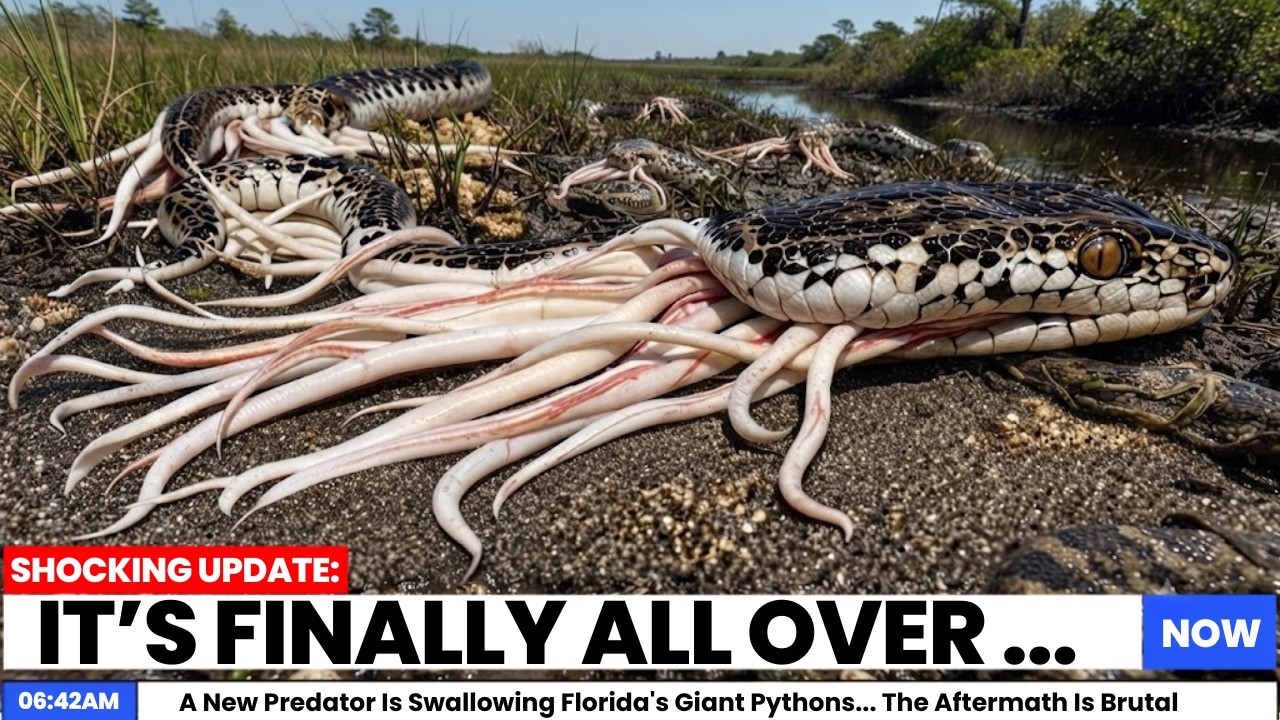
What is reported far less often is what came into Florida alongside the pythons. Imported animals rarely arrive alone; they bring whatever lived inside them. The parasite Faroh found is a pentastomid, commonly called a tongue worm, though it is not a worm in the biological sense. Pentastomids are parasitic arthropods, distant relatives of crustaceans, that evolved to live inside the respiratory tracts of reptiles. Adults settle in the lungs of their host, feed, and reproduce, releasing eggs that the host coughs up and excretes into the environment.
The specific species established in Florida, Raillietella orientalis, evolved alongside Burmese pythons in Southeast Asia. In that native range, the relationship between parasite and host is close to an evolutionary balance. A wild Burmese python carrying a light to moderate worm burden typically shows few signs of illness. Millions of years of shared history shaped both species into something the python’s body could tolerate.
Pentastomids were not new to Florida before the python arrived. A few native pentastomid species existed in some native snakes, generally at low prevalence and rarely considered a conservation concern. Raillietella orientalis was different from the start because of scale. It arrived already established in a population numbering in the tens of thousands, each carrying a heavier worm burden on average than anything documented in Florida’s native species. The parasite arrived inside a host that was actively expanding its range.
### Spread Through Native Snake Populations
Surveys of wild-caught Burmese pythons across South Florida found infection rates exceeding 70 percent in some populations. In the heaviest infected individuals, researchers recovered more than a hundred adult pentastomids from a single set of lungs. The parasite established itself in the invasive host population and initially appeared to be one more unremarkable feature of an established invasive species.
What remained unclear was whether the parasite could jump from pythons into native snake species with no evolutionary history with it. It could. Once researchers began testing specifically for it, they found it had moved further and faster than expected.
Since then, Raillietella orientalis has been documented in at least a dozen native Florida snake species, including water snakes, black racers, cottonmouths, and several rat snake species. It has spread well beyond the core python range into parts of the state pythons themselves have never reached. The parasite does not require direct contact between a python and a native snake to spread. Its life cycle typically runs through an intermediate host, likely small reptiles, amphibians, or arthropods that both pythons and native snakes prey on. The infection moves through a shared food web, spreading faster and further than the python population expanding on its own ever could.
Researchers have found parasite larvae in several common lizard and frog species. These are animals that native snakes prey on constantly as part of their normal diet. That helps explain how the infection reached snake populations well outside the python’s established range within a relatively short number of years.
### Disproportionate Harm to Native Snakes
In native hosts, the relationship looks nothing like the manageable balance seen in pythons. Researchers at the University of Florida compared infection severity between pythons and native snakes carrying the same parasite species. The results ran opposite to what is typically expected in such cases. Usually, a parasite introduced alongside its original host causes the worst damage in that original host’s close relatives and comparatively little in a genuinely novel host that never evolved alongside it. That is not what happened here.
Native Florida snakes infected with Raillietella orientalis were found to carry heavier parasite loads on average than the pythons the parasite originally arrived with. Individual worms recovered from native snakes grew larger than those found in python lungs. Tissue damage in infected native snakes, including inflammation, lung scarring, and airway obstruction, was consistently more severe than anything found in infected pythons, even when the pythons carried comparable or higher parasite counts.
The explanation researchers propose centers on an evolutionary mismatch. Burmese pythons developed defenses against this parasite over a very long shared history, with immune responses calibrated to limit tissue damage. Native Florida snakes have no such calibration. Their immune systems respond to an organism they have never encountered before, and in several documented cases, that response appears to do more damage to the host’s own lung tissue than the physical presence of the parasites would explain.
For most native species, the ecological consequence is difficult to quantify against already healthy, stable populations. A black racer or water snake carrying a heavy pentastomid infection is a genuine welfare concern and in severe cases likely contributes to individual mortality. But these are common, widespread species without immediate extinction risk.
### The Southern Indigo Snake
The eastern indigo snake is a different situation. It is the longest native snake in North America, capable of exceeding two and a half meters, and it has been federally listed as threatened since 1978. Its range is already reduced to a fraction of its historic territory by habitat loss, road mortality, and gopher tortoise burrow destruction. Indigo snakes are also one of the species increasingly documented preying directly on juvenile Burmese pythons. This predation on python hatchlings has been treated as a limited point of ecological hope. A threatened native turning the tables on an invader.
That behavior also makes the indigo snake one of the native species most likely to be exposed to Raillietella orientalis, either through direct consumption of an infected python or through shared intermediate hosts. Confirmed infections in wild eastern indigo snakes have been linked to respiratory illness and, in some documented cases, mortality. The species’ total wild population is estimated in the low thousands across its entire range. Researchers studying recovery efforts now have to factor in a parasite risk that did not exist in indigo snake conservation planning a decade ago.
### A Broader Pattern
The pattern of an invasive species arriving with a parasite that jumps into naive native hosts and causes disproportionate harm is not unique to Florida. Wildlife biologists point to comparable cases elsewhere. Introduced crayfish spread a fungal plague that native crayfish never evolved defenses against. Invasive amphibians introduced chytrid fungus strains into naive frog populations with catastrophic results. In most cases, the parasite or pathogen turned out to matter more for long-term native population decline than the direct competition or predation from the invasive species itself, because a novel disease can spread through an entire regional population years after the original invader’s numbers plateau.
Florida wildlife agencies and university research teams have started monitoring for the parasite as part of broader native snake health surveys. There is no meaningful treatment or control program for a respiratory parasite spreading through a wild reptile population across an area the size of South Florida. Antiparasitic treatment exists and works in captive settings, used by zoos and wildlife rehabilitation centers on individual animals. There is no version of that intervention that scales to a wild population spread across thousands of square miles.
Removing infected pythons through existing control programs may modestly reduce the parasite’s overall reservoir over time. But with infection already established in a dozen or more native species and spreading through shared prey rather than direct contact with pythons, culling the original host does little to slow a transmission chain that no longer depends on the python population at all.
Much of the remaining eastern indigo snake range in Florida overlaps directly with core Burmese python territory. Both species depend on the same intact wetland and upland corridor systems that have survived development pressure across South Florida. The conservation land set aside to give the indigo snake a chance at long-term recovery is often the same land where python density and pentastomid exposure risk run highest.
### Complicating a Hopeful Narrative
The predation of native species on pythons is real. Bobcats raid nests, cottonmouths and king snakes take hatchlings, and alligators and indigo snakes account for a share of juvenile mortality. That predation represents a wild ecosystem doing something none of the twenty years of python control programs achieved through direct human intervention.
The parasite finding complicates that version of the story. An indigo snake eating a python hatchling is, in the same biological transaction, a plausible route of infection for a parasite that appears to hit native snakes harder than it hits the pythons it evolved alongside. The exact behavior documented as a hopeful sign of ecological resistance may be one of the mechanisms actively spreading a disease risk into the most vulnerable native species.
Researchers are careful not to overstate what is known. Infection surveys remain limited in scope. Population-level mortality data for wild indigo snakes specifically attributable to pentastomid infection is still sparse. It is possible that native populations will develop some degree of tolerance over a longer timeline, as python populations did. But that kind of tolerance, if it develops at all, would likely take many generations, measured in decades or longer.
The result is an unresolved picture. The disaster narrative that dominated the first two decades of python coverage and the more recent cautiously hopeful narrative about native wildlife pushing back are both true at once, and they are now tangled together. The same predation that represents the most promising sign of native ecological resistance may also be the exact mechanism spreading a respiratory parasite into a federally threatened species.
No one planned for a parasite from Southeast Asia to end up in the lungs of one of North America’s rarest snakes. It is happening quietly, spreading through a food web that connects the invader to exactly the native species working hardest to resist it. Whether that turns out to be a footnote in an otherwise encouraging story or the reason the encouraging story stops being one remains an open question.
Recommended Stories

New York City’s pigeons are vanishing at an alarming rate, and scientists just identified the predator behind it. For decades, the city’s iconic flocks seemed unstoppable, adapting to every corner of urban life.
For 22 years, Frank Sorrentino drove an early morning delivery route through Midtown Manhattan. He knew the streets well, having...
Burmese pythons are vanishing from Florida, and scientists say seven other species are already hunting them back. The invasive snakes once thrived unchecked across the Everglades, wiping out native wildlife.
A wildlife researcher tracking invasive Burmese pythons in the Florida Everglades has documented what appears to be a significant shift...

Antarctica’s freezing waters hide something enormous—creatures that should be tiny growing into true giants. Scientists call it polar gigantism, and the colder the water, the bigger the animals seem to get.
Two hundred meters beneath the permanent ice of the Southern Ocean, the seafloor is not the lifeless plain one might...