Beavers released into a toxin-laden English creek weren’t expected to survive, but their response to the filthy water shocked researchers. Faced with a channel polluted by agricultural runoff, the animals began building dams and packing mud and sticks with startling urgency.
On 13 January 1992, a drainage tunnel collapsed beneath the abandoned Wheal Jane tin mine in Cornwall. Over the following day, around 50 million litres of acidic water containing cadmium, arsenic, copper and zinc entered the Carnon River. The water turned orange, fish died, and the contamination spread through Restronguet Creek into the Fal Estuary and Falmouth Bay. It remains the largest water pollution incident in UK history.
Engineers responded by building emergency treatment lagoons, pumps, settling ponds and chemical dosing systems. By 2002, the cleanup had cost more than £20 million. Despite that investment, the Carnon River is still the most metal-polluted river in England.
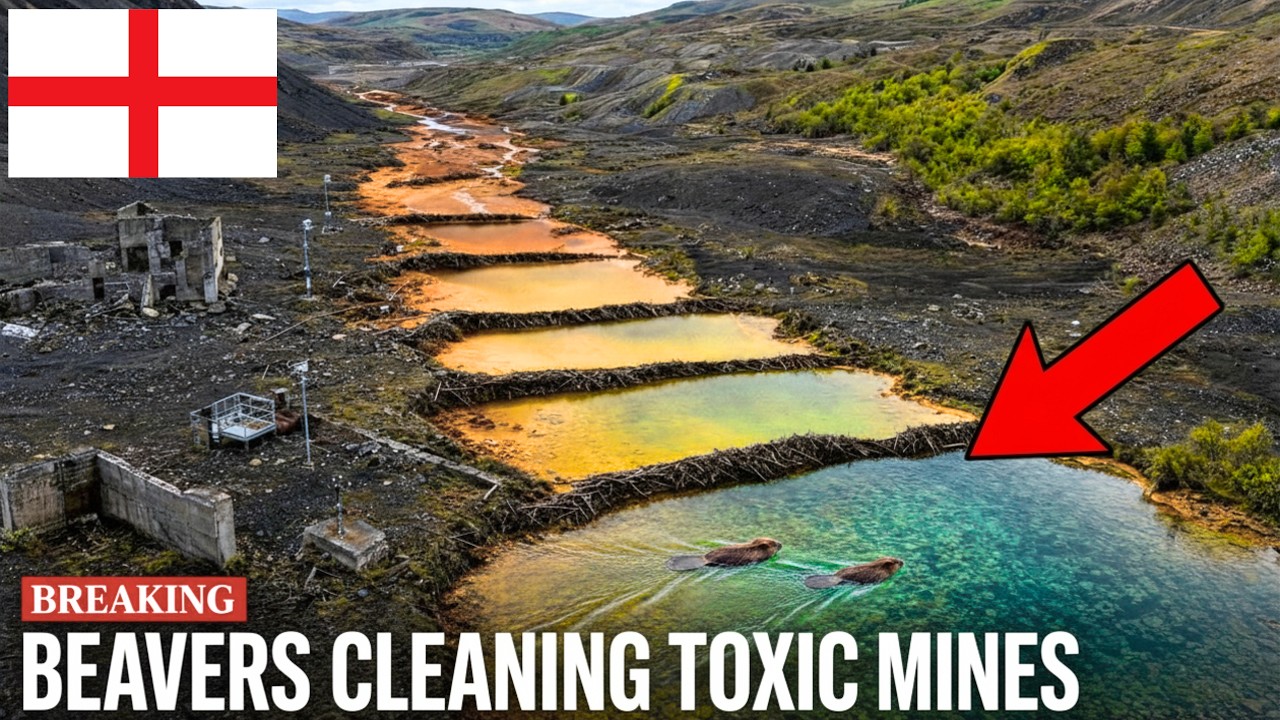
About 80 kilometres away in Devon, a family of beavers had meanwhile attracted the attention of researchers at the University of Exeter. In a 2.5-hectare enclosure, the beavers captured more than 100 tons of contaminated sediment and filtered nitrogen and phosphorus at rates that surprised the scientists. They created wetlands that trapped pollutants before they could reach downstream communities. The beavers required no pumps, chemicals or maintenance contracts. They simply built dams.
The Devon beavers were filtering agricultural pollution, primarily nitrogen and phosphorus from farm runoff, which differs from the heavy-metal contamination in Cornwall. Research from North America, however, suggests that beaver ponds can also trap heavy metals at rates significantly higher than normal stream reaches. This raises the question of whether a combination of engineering and natural systems could address Cornwall’s poisoned rivers.
Cornwall and Devon sit on some of the most mineralised geology in Europe. For more than 4,000 years, from the Bronze Age to the 1990s, miners extracted tin, copper, lead, zinc and arsenic from these hills. By the mid-1800s, the region was the largest producer of tin and copper in the world. The Great Consols mine complex in the Tamar Valley became the largest copper producer in Europe, and by the 1870s Cornwall was responsible for half the world’s arsenic production.
The waste left behind has proven persistent. More than 2,000 abandoned mines dot the Cornish landscape, with spoil heaps exposed to rain and wind. Water seeps through them, picks up dissolved metals, and carries them into streams, rivers and estuaries. This process, known as acid mine drainage, does not fade with time.
A 2024 study published in the Journal of Hydrology analysed three Welsh mines abandoned more than a century ago. Researchers expected some natural attenuation after 100 years, but found no significant reduction in metal concentrations at any of the three sites. At Parys Mountain, zinc levels had actually increased by 2% between 2004 and 2020.
In Cornwall, the Carnon River receives drainage from multiple abandoned mines through a 65-kilometre network of tunnels known as the Great County Adit. In Wales, the 50 highest-priority mines discharge approximately 200 tons of zinc, 32 tons of copper and 15 tons of lead into rivers every year. The estimated cost to remediate contaminated rivers from abandoned metal mines across England and Wales is £400 million over 10 years, assuming conventional treatment works.
In 2011, a landowner in West Devon agreed to let Devon Wildlife Trust introduce two Eurasian beavers into a fenced 2.5-hectare enclosure on his property. The site was deliberately chosen because it was problematic. A small stream ran through it, carrying sediment and agricultural runoff from intensively managed grassland upstream. Professor Richard Brazier of the University of Exeter led the scientific monitoring, installing weirs to measure water flow and sampling sediment entering and leaving the site.
The beavers built 13 dams over the following years, creating a cascade of ponds along what had been a simple stream. When the team analysed the results in 2018, they found that the beaver ponds had trapped more than 100 tons of sediment, 70% of which had eroded from agricultural fields upstream. Chemical analysis revealed high concentrations of nitrogen and phosphorus in the sediment, nutrients that cause algal blooms, oxygen depletion and fish kills when they reach rivers and estuaries. The water leaving the enclosure was measurably cleaner than the water entering it.
Beaver dams clean water partly through chemistry rather than simply slowing the flow. When water moves quickly through a stream, it carries particles in suspension, including fine sediment and organic matter. Many pollutants attach to sediment grains and travel with them. A beaver dam slows the water, reducing its carrying capacity and allowing suspended particles to settle. Attached to those particles are the pollutants.
Studies from the Intermountain West of the United States have examined how beaver ponds interact with heavy metals. These studies found that beaver pond sediments trapped heavy metals at rates two to four times higher than normal stream reaches. The older the pond, the more metals it captured. The process is known as sequestration: the metals do not disappear, but are locked into the pond bottom and buried under layers of new sediment.
These studies were conducted in different geological contexts than Cornwall. Whether the same mechanisms would work with Cornwall’s specific mix of arsenic, cadmium, copper and zinc remains an open question that would require site-specific research. But beavers offer one advantage over engineered wetlands: adaptation. When a storm hits, dams may be damaged and sediment can move, but beavers rebuild, patch and create new channels and ponds. The system is self-repairing in a way that engineered solutions cannot match. At Wheal Jane, the treatment plant requires constant maintenance, chemical inputs and skilled operators, costing hundreds of thousands of pounds per year. Beavers maintain themselves and reproduce.
In 2014, a family of wild beavers was discovered living on the River Otter in East Devon, the first wild beavers in England in 400 years. The government chose to study them rather than remove them, and in 2015 the River Otter Beaver Trial began. By 2020, the beaver population had grown from two family groups to 15. Professor Brazier’s team measured water storage across four beaver territories at 24 million litres held in beaver-created wetlands. That storage provided flood attenuation and drought resilience, releasing water slowly during dry periods.
The water quality improvements seen in the enclosed trial held true in the wild. In August 2020, the UK government allowed the River Otter beavers to stay, making them the first legally sanctioned wild beaver population in England since the species was hunted to extinction in the 16th century. Peter Burgess of Devon Wildlife Trust called beavers nature’s engineers with an unrivaled ability to breathe new life into rivers.
The question now is whether beavers could help with mining pollution in Cornwall. Agricultural pollution and mining pollution are different. The Devon trials demonstrated that beavers excel at capturing sediment-bound nutrients like nitrogen and phosphorus, but mining pollution is primarily heavy metals. Some of these travel attached to sediment, which beaver dams could theoretically capture, while others travel in dissolved form, which is harder to trap.
American research suggests beaver ponds can sequester heavy metals effectively under certain conditions. Cornwall’s rivers have different chemistry, flow patterns and metal concentrations than the streams studied in Montana or Utah. Beaver dams do create conditions that favour metal sequestration: slow-moving water, organic-rich sediments and anoxic bottom conditions that reduce metal mobility. Based on principles of aquatic chemistry, there is reason to believe beavers could contribute to reducing metal loads in Cornwall’s rivers.
The River Tamar, which marks the Devon-Cornwall border, already has beavers in its upper catchment. Cornwall has a pilot beaver project at Ladock on a tributary of the Trecillian River. But these projects are small and experimental, and none are specifically designed to test beaver effectiveness against mining pollution.
Conventional remediation proceeds at enormous cost. The Abbey Consols mine in Wales discharges approximately 1,200 kg of dissolved zinc per year into the River Teifi and is being treated with a carbon-neutral, gravity-fed sodium carbonate dosing system. It is one site out of 1,300 abandoned mines in Wales alone.
Cornwall and Devon’s mining landscape is a UNESCO World Heritage Site covering hundreds of square kilometres. The Wheal Jane treatment plant prevents the worst contamination from reaching Falmouth Bay, but it does not restore the Carnon River to health. One beaver family in Devon, over seven years, captured 100 tons of sediment and stripped nitrogen and phosphorus from the water. The enclosed trial cost a few thousand pounds to set up, with no ongoing cost.
Beavers will not solve everything. They cannot neutralise acid or remove dissolved metals from groundwater before it surfaces. They are not a replacement for source control at the most toxic sites. But every beaver family creates new wetlands, and every new wetland has the potential to capture more sediment.
The UK has committed to restoring 30% of its land and sea for nature by 2030, and beaver reintroduction is part of that vision. So far it has been treated primarily as a conservation project, a way to bring back a lost species, create habitat and provide flood management. Whether beavers could meaningfully contribute to mine water remediation has not yet been rigorously tested.
For 30 years, Cornwall’s mining legacy has been managed with concrete, chemicals, pumps and settling lagoons. The technology works, but it is expensive and struggles to scale. Eighty kilometres away, a family of beavers has demonstrated what natural systems can do. The Devon trials are a proof of concept for an approach that works with natural processes rather than against them. Whether that approach could extend to Cornwall’s toxic rivers remains untested, but the research is promising enough to warrant serious investigation.
Recommended Stories

They found something ALIVE near Antarctica’s ice wall, and its arrival defies every expectation of what can survive in that frozen void. Scientists initially believed the discovery was frozen debris, until movement was detected deep within the ice.
About 310 million years ago, the area that is now Illinois was covered by shallow coastal waters and muddy shores....

Fishermen in the Pacific recorded something out of this world near the Mariana Trench, and the footage has scientists rethinking what lurks in the deepest ocean. The crew’s sonar suddenly lit up with an enormous, unidentified shape moving far below their boat—larger than anything known to inhabit those crushing depths.
The water pressure at the bottom of the Mariana Trench reaches roughly eight tons per square inch. No commercial fishing...
A US biologist made scientists laugh out loud. They mocked his rocks-based method.
In 1982, an oil company transferred ownership of a valley in northern New Mexico to the U.S. Forest Service. The...