A robot was sent 31,000 feet to the ocean floor on a routine mission, and what it recorded left the entire research team silent. The descent took hours, passing through pitch-black waters where sunlight has never reached.
A Chinese submersible has completed its latest mission in the Mariana Trench, marking the fourth time the vehicle has descended beyond 10 kilometers in the Pacific Ocean. At roughly 31,000 feet below the surface, researchers found an ecosystem thriving in conditions once considered too extreme for complex life.
The remotely operated vehicle made 23 separate dives into the trench, an area where pressure exceeds 1,000 times that at sea level, sunlight never reaches, and water temperatures hover just above freezing. Despite these conditions, cameras captured dense communities of organisms living across the seafloor.
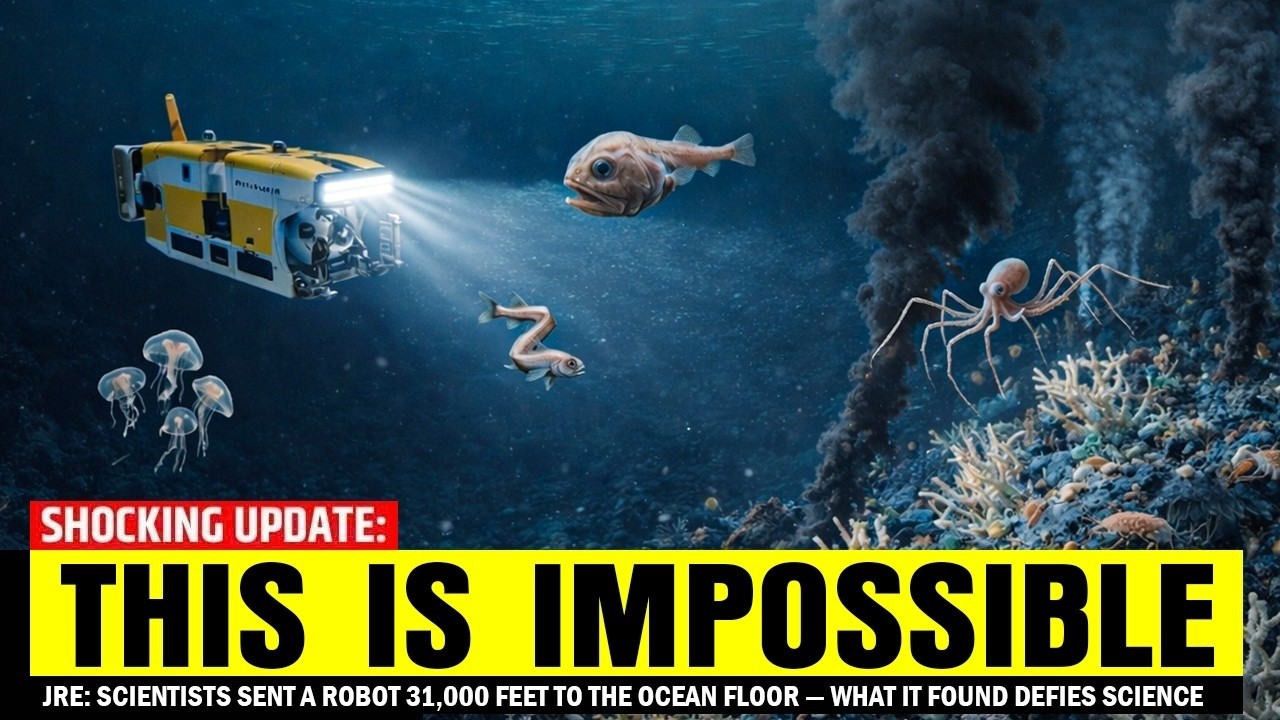
Scientists refer to this region as the hadal zone, named after Hades from Greek mythology. These areas form where tectonic plates collide and one slides beneath another, creating depths greater than the height of Mount Everest. Pressure there reaches about eight tons per square inch, comparable to balancing a fully loaded SUV on a fingertip.
Researchers from the Chinese Academy of Sciences expected to find geological formations, sediment, and perhaps a few scavengers surviving on organic material drifting down from the surface. Instead, they documented tube worms standing in dense clusters, thousands of mollusks buried in sediment, and shrimp and crustaceans moving through the area in numbers no one had anticipated.
The discovery extended across more than 2,500 kilometers of the trench floor, making it the deepest documented colony of complex animal life on Earth.
What made the finding significant was how these organisms obtained energy. The animals were not feeding on debris falling from sunlit waters above. A process called chemosynthesis was powering the ecosystem. Cracks in the Earth’s crust release methane and hydrogen sulfide, and specialized microbes have evolved to convert these chemicals into usable energy, performing a role similar to plants but without requiring sunlight.
Tube worms gather around thick microbial mats while mollusks bury themselves in sediment rich in hydrogen sulfide, positioning themselves near their food source. The entire food web operates without a single photon of sunlight. One marine geochemist described the environment as a thriving oasis in a deep-sea desert, running entirely on chemistry rather than light.
The discovery has implications beyond marine biology. Scientists have long suspected that some moons in the outer solar system may harbor conditions suitable for life beneath their icy surfaces. Europa, a moon of Jupiter, is believed to contain a vast liquid ocean hidden under miles of ice. Enceladus, a moon of Saturn, has been observed ejecting water vapor plumes into space, suggesting it also has a subsurface ocean.
Both moons may contain the same chemical ingredients that fuel chemosynthesis on Earth, including methane and hydrogen compounds. NASA and the Jet Propulsion Laboratory have developed specialized autonomous underwater robots designed to explore Earth’s deepest ocean trenches partly for this reason. The extreme pressure at the bottom of Earth’s oceans provides a useful comparison for conditions in the deep ocean of Europa, which may reach about 80 kilometers deep, far deeper than anything on Earth.
Researchers at institutions such as the Woods Hole Oceanographic Institution have suggested that studying these extreme seafloor environments may help answer whether life is unique to Earth or whether the universe produces life wherever the right chemistry and conditions exist.
A separate large-scale research project focused on cataloging organisms in the deepest parts of the ocean documented nearly 7,000 distinct microbial species living in these ecosystems, roughly 90 percent of which were previously unknown to science.
Researchers also studied amphipods, small shrimp-like crustaceans thriving at depths between 6,800 and 11,000 meters. A compound called TMAO helps protect proteins from damage under extreme pressure. Scientists had assumed that organisms living deeper would need increasing amounts of this compound as pressure rose. But measurements inside these amphipods showed levels stopped increasing at a certain depth, suggesting the animals developed another biological method for surviving pressures that should have caused molecular damage.
Near Papua New Guinea, researchers using a remotely operated vehicle found a field of scorching hydrothermal vents directly adjacent to frozen methane leaks, two environments usually separated by vast distances. The area was densely populated with mussels, tube worms, shrimp, and sea cucumbers, with researchers unable to find a single exposed patch of rock, and many species there may also be new to science.
The findings point to a larger pattern: each time researchers send cameras into unexplored parts of the deep ocean, they encounter something that challenges established ideas. This raises questions about how much of what scientists believe about life on Earth is based on what they have actually been able to observe.
A major study examining tens of thousands of deep-sea dives dating back to the late 1950s produced a striking estimate. Across all of human history, people have directly observed between roughly 0.001 percent and 0.006 percent of the total deep ocean floor. The total area humans have seen with their own eyes is roughly equivalent to a small American state, while deep ocean covers most of our planet’s surface.
About 97 percent of deep-sea dives have been conducted by a small number of countries. Most nations have never sent a vehicle to these depths, meaning vast portions of the ocean floor have simply never been seen. Even modern mapping projects using sonar typically reveal the shape and structure of the seafloor but not what lives on it or beneath it.
Researchers have estimated that fully exploring the deep ocean visually at the current pace, even with significant increases in exploration capability, would take about 100,000 years.
Two threats are approaching these ecosystems. Microplastics have already reached the deepest parts of the planet. In the Mariana Trench at depths around 6,700 meters, researchers found thousands of microplastic particles in each cubic meter of water, some of the deepest documented plastic pollution on record. Studies sampling nearly 2,000 sites across the world’s oceans found microplastics in almost every layer of the water column, drifting from the surface toward the deepest trenches. Concentrations of microplastics in the Mariana Trench measured several times higher than levels in open ocean surface water nearby.
When researchers examined amphipods collected from multiple deep ocean trenches, including the deepest areas of the Mariana Trench, they found microplastic particles inside their bodies. The same creatures that reshaped scientific understanding of survival at extreme depths are already consuming plastic waste.
The second threat is deep-sea mining. In 2025, a U.S. executive order aimed to accelerate the pace of deep-sea mining. Agencies have focused on locating valuable polymetallic nodules containing cobalt, nickel, manganese, and rare earth elements, which are important for batteries, electric vehicles, and military technology.
Studies indicate that disturbing the seafloor can sharply reduce animal populations, while sediment plumes can spread beyond mining sites and disrupt the broader food web. The metal nodules targeted by companies take millions of years to form, meaning their destruction would effectively be permanent on any human timescale. Some proposed mining areas are near the same deep-ocean regions where scientists are discovering unknown species and ecosystems that operate without sunlight. Countries continue to debate international rules, with some supporting mining and others calling for a moratorium until more research is available.
The deep ocean is connected to the health of the entire planet. Phytoplankton, which feed partly on nutrients that travel from the deep ocean, produce a substantial share of the oxygen people breathe. The deep ocean has absorbed most of the excess heat generated by human activity over the past century, along with a significant portion of the carbon dioxide released into the atmosphere. Disturbing the deep seafloor could release carbon stored in sediment for millions of years back into an already stressed climate system.
Deep-sea organisms have already provided chemical compounds used in treatments for serious diseases, including certain types of cancer and viral infections, despite researchers having explored only a small fraction of the environments where these organisms live.
A submersible descended into darkness and found thousands of creatures thriving on chemical energy rather than sunlight. After decades of deep-sea exploration, humanity has still seen only a small fraction of the ocean floor. Thousands of species remain unknown. Plastic pollution has reached the deepest parts of the ocean, and mining is approaching these fragile ecosystems. Scientists have learned that life can exist in places once considered impossible, and these same environments may offer clues about life on other worlds. The question now is whether these discoveries will be protected or destroyed before they are fully understood.
Recommended Stories

Iceland planted millions of trees for decades, yet every single one died for 50 years—until scientists finally spotted one overlooked detail. The island was once nearly bare, stripped of its forests centuries ago.
Iceland receives more rainfall than London, yet for more than a century, the government's large-scale tree-planting efforts largely failed. At...
A research team reported a live object moving beneath Antarctica’s ice—and no one has returned since. The discovery came during a routine deep-ice survey, when sensors suddenly detected biological activity far below the surface where life should be impossible.
In 2021, a team drilling for sediment samples on the Filchner-Ronne Ice Shelf in Antarctica made an unexpected biological discovery....

A giant arachnid spotted deep in the Congo rainforest is fueling a terrifying mystery that just took a chilling turn. For years, locals described encounters with J’Ba Fofi, a spider supposedly large enough to prey on small animals.
In 1938, a couple driving on a forest road in the Belgian Congo stopped their car because something crossed the...