A hundred million years of ocean history surfaced off a tiny fishing boat, and the crew instantly knew something was wrong. The creature they hauled up was a frilled shark, a deep-sea “living fossil” almost never seen alive, and it was gasping in shallow water where it had no right to be.
On the morning of January 21st, 2007, a fisherman at a small port in Numazu, on the coast of central Japan, noticed an unusual animal drifting near the surface of Suruga Bay. The bay is among the deepest enclosed bays in the world, with a seafloor that drops to nearly 2,500 meters within sight of the coastline. The fisherman was familiar with the local marine life, but what he saw that morning did not match any of the species he knew.
The animal was roughly five feet long, eel-like in shape, brown on top and pale underneath. It moved slowly and appeared disoriented. Along the sides of its head were six pairs of gill slits. The first pair extended in a continuous frill across the throat. Its mouth sat at the front of the head, and inside were rows of needle-fine, three-pronged teeth.
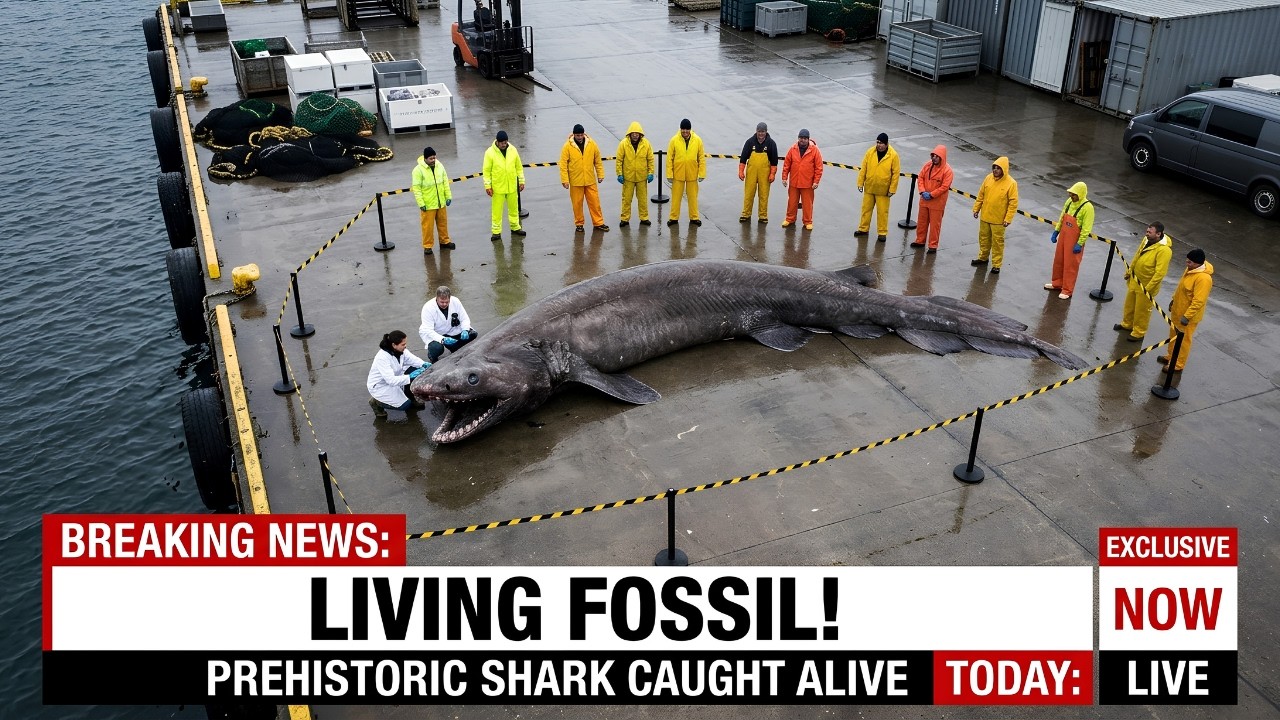
The fisherman contacted Awashima Marine Park. Staff captured the animal and moved it to a seawater pool for observation and filming. They identified it as a frilled shark, a species whose body plan has remained largely unchanged for roughly 95 million years. The species normally lives at depths between 600 and 1,000 meters, in the cold, dark waters of the upper deep ocean.
The shark was visibly unwell and died within hours. However, the footage captured by the Awashima staff became the most widely circulated video of a live frilled shark in marine science. It has been viewed millions of times and broadcast in dozens of countries. For most people, it remains the only live frilled shark they have ever seen.
The frilled shark was first formally described in 1884 by American ichthyologist Samuel Garman, working from preserved specimens collected in Japanese waters. He placed it in its own genus, Chlamydoselachus, and gave it the species name anguineus, meaning eel-like. The classification was notable because the frilled shark differs from most modern sharks in several fundamental ways.
Almost all modern sharks have five pairs of gill slits arranged behind the jaws. The frilled shark has six. The first pair extends across the throat in a single continuous frill, a feature that gives the species its name. This six-gill arrangement is shared only with a small group of sharks in the family Hexanchidae. It is an ancestral configuration, one that appears in the fossil record of the earliest shark lineages from more than 300 million years ago. Most shark species eventually moved to a five-gill arrangement. The frilled shark did not.
The fossil record shows representatives of the family Chlamydoselachidae from approximately 95 million years ago, during the late Cretaceous period. The body plan has remained essentially recognizable since then. In marine biology, the term “living fossil” refers to this kind of long-term stability in body design. Individual frilled sharks live roughly 25 years, similar to many other shark species. But the species itself has persisted through major planetary changes, including the mass extinction that ended the age of dinosaurs.
The frilled shark grows up to roughly two meters in length. Its body is elongated and ribbon-like, closer in proportion to an eel than to a typical shark. The head is broad and flattened, with jaws at the very tip. This is called a terminal mouth, another ancestral characteristic. Most modern sharks have jaws set underneath the head.
The frilled shark has approximately 300 teeth arranged in about 25 rows. Each tooth is three-pronged, with needle-fine points that curve inward toward the throat. This arrangement is suited for catching soft-bodied prey, particularly squid. The inward-pointing teeth make escape difficult once prey is bitten. The hunting style is believed to involve anchoring the rear of the body and striking with a sudden, snake-like lunge, similar to an eel or moray.
The depth range of the frilled shark is central to understanding why the 2007 encounter happened at the surface. The species typically inhabits depths between about 120 and 1,280 meters, with a preferred range of 600 to 1,000 meters. At those depths, the water is near freezing and stable year-round. Deep-sea fish are physiologically adapted to these conditions. When brought to the surface, the temperature change alone is usually fatal within hours, even if pressure changes do not immediately damage the body.
The shark seen in Numazu was not at the surface by choice. Illness, injury, disorientation, or unusual currents likely brought it up from the depths. Suruga Bay’s steep underwater topography makes such events slightly less improbable there than elsewhere. Within a short horizontal distance from the harbor, the water is deep enough to be within the frilled shark’s normal habitat. A sick or disoriented animal carried by currents along the bay’s steep slope could reach shallow water quickly.
The Awashima staff moved the shark to a seawater pool, though the water was at surface temperature rather than the cold deep water the animal required. The pool was the best available option. They filmed the animal while it was still alive. The footage shows the shark swimming with a slow, snake-like motion, its gill slits opening and closing, its mouth occasionally opening to reveal the rows of teeth. The shark died within hours. The body was preserved and entered the scientific record.
The documented record of frilled shark encounters is extremely limited. According to a 2025 paper by marine biologist Maria J. Indurain and colleagues, the total number of documented specimens worldwide is approximately 40. This spans the entire 140 years since the species was first described. The knowledge base on frilled shark biology, behavior, and ecology rests on this small number of encounters, plus information from preserved specimens and bycatch from commercial fishing.
Frilled sharks are believed to have one of the longest known gestation periods of any vertebrate, estimated at about three and a half years. Females produce litters of two to fifteen pups. The reproductive cycle is slow, and litter sizes are small. The IUCN Red List classifies the species as least concern globally but notes a decreasing population trend. Across most of its range, it is considered data deficient. Population estimates are uncertain, and sustained deep-water surveys have not been conducted.
The primary documented threat is bycatch. Deep-water commercial fishing operations occasionally catch frilled sharks unintentionally, often alongside target species. The frilled shark is not commercially fished and is not eaten. When caught, it is usually dead or dying by the time it reaches the surface. Given the species’ slow reproduction, even incidental bycatch is biologically significant.
Several notable encounters have occurred since the 2007 Awashima video. In January 2014, fishermen off the coast of Victoria, Australia, captured a two-meter frilled shark in trawl nets. It was dead. The specimen entered a regional museum collection. In November 2017, researchers from the Portuguese Institute for the Sea and Atmosphere captured a live frilled shark off the Algarve coast at a depth of approximately 700 meters. The encounter was studied briefly and documented.
In 2009, shark taxonomists David Ebert and Leonard Compagno formally described a second species in the genus, Chlamydoselachus africana, the Southern African frilled shark. The two forms had previously been considered the same species, but morphological and genetic analysis showed they were distinct. In February 2025, Indurain and her colleagues published findings extending the known range of Chlamydoselachus anguineus in the South Pacific by approximately 850 kilometers, based on a single specimen from Chile.
The 2007 Awashima video remains the central piece of public footage on the species. No other encounter has produced comparable material. The 2014 Australian capture produced a dead specimen. The 2017 Portuguese encounter produced a brief observation. The 2025 Chilean record produced a single specimen and a range extension. None of them provided the sustained, clear footage that the Awashima staff captured in those few hours.
The frilled shark has also been connected to historical sea serpent reports. Samuel Garman noted in his original 1884 description that the species’ eel-like body, rare surface occurrences, and unusual appearance fit many historical accounts. Bernard Heuvelmans, a Belgian-French zoologist, made the case in detail in his 1968 book In the Wake of the Sea Serpents. The frilled shark is long and ribbon-shaped, has visible toothed jaws, and moves with a snake-like undulation. A sailor in earlier centuries who saw such an animal at the surface might well have described it as a sea serpent. This is not to say every historical sighting was a frilled shark, but the species is one of the more plausible biological candidates for at least some reports.
The Awashima encounter did not produce a scientific revolution or a major paper. It did not answer the standing questions about frilled shark biology. The cumulative record nearly 20 years later remains about 40 documented specimens. Reproduction is still inferred rather than directly observed. Population estimates remain uncertain.
What the encounter provided was a sustained visual record of a living frilled shark, something the public had never had before. It gave the species a cultural visibility that no number of preserved specimens could have achieved. It gave marine researchers a visual baseline against which later encounters could be compared. And it gave the public a rare direct view of an animal whose lineage predates the extinction of the dinosaurs.
The fisherman in Numazu made a phone call. Staff from Awashima came to the port. The shark was moved to a pool, and a camera was turned on. For a few hours, a species whose body plan has persisted for tens of millions of years was visible in a seawater pool in central Japan. The shark died that afternoon. The deep ocean keeps its species, and very rarely, one of them surfaces. The footage from that day outlived the animal, and the species continues at depth.
Recommended Stories
Kentucky released 1,500 elk into forests many considered dead—what came back 25 years later stunned researchers. After being wiped out over a century ago, the herd was reintroduced as an experiment in a landscape battered by mining and logging.
In December 1997, around 4,000 people gathered on a cold morning in eastern Kentucky to watch seven elk step off...

Deep beneath Mexico, divers found a flooded chamber sealed since the Ice Age—but its contents defy the story that made it famous. The pit, called Hoyo Negro, trapped giant sloths, saber-toothed cats, and a teenage girl named Naia.
In 2007, cave divers mapping underwater passages near Tulum, Mexico, discovered a large submerged chamber they named Hoyo Negro. Inside,...

Grey squirrels have dominated Britain for a century and a half, but an ancient native predator just ended their reign. The invasive rodents outcompeted red squirrels, spreading unchecked across the entire country.
Gray squirrel numbers have declined in some Irish woodlands where pine martens have recovered, a pattern that researchers say reflects...