Wolves vanished from this region for a century are suddenly thriving in the most radioactive soil on Earth. After the 1986 Chernobyl explosion forced hundreds of thousands of people to flee, researchers expected ecological collapse.
In late April 1986, an explosion at the Chernobyl Nuclear Power Plant in Ukraine contaminated large areas of forest in Ukraine and Belarus. Officials evacuated hundreds of thousands of people from the surrounding region over the following years, and experts expected the area to remain largely uninhabitable for a very long time. In 2014, researchers installed 94 motion-activated cameras on trees in some of the most contaminated zones. Over five weeks, the cameras captured images of 14 mammal species, including wolves, foxes, wild boars, and raccoon dogs, moving through both heavily polluted and relatively clean areas. The footage showed that large predators were not just visiting the exclusion zone; they were thriving there.
To understand why, it helps to look at the state of the region before the disaster. The Polesia region, which spans the border between Ukraine and Belarus, had been managed intensively by humans for generations. Soviet authorities paid bounties for killing wolves, farmers drained wetlands, loggers worked the pine forests, and the floodplain was plowed to the river’s edge. When the evacuation began, people left with little notice, expecting to return within days. They never did. The sudden removal of human activity had an immediate effect on the landscape. Drainage ditches silted up, water pooled across former fields, meadows turned to brush, then to birch and willow, and eventually to young forest. Roads cracked as roots grew beneath them.
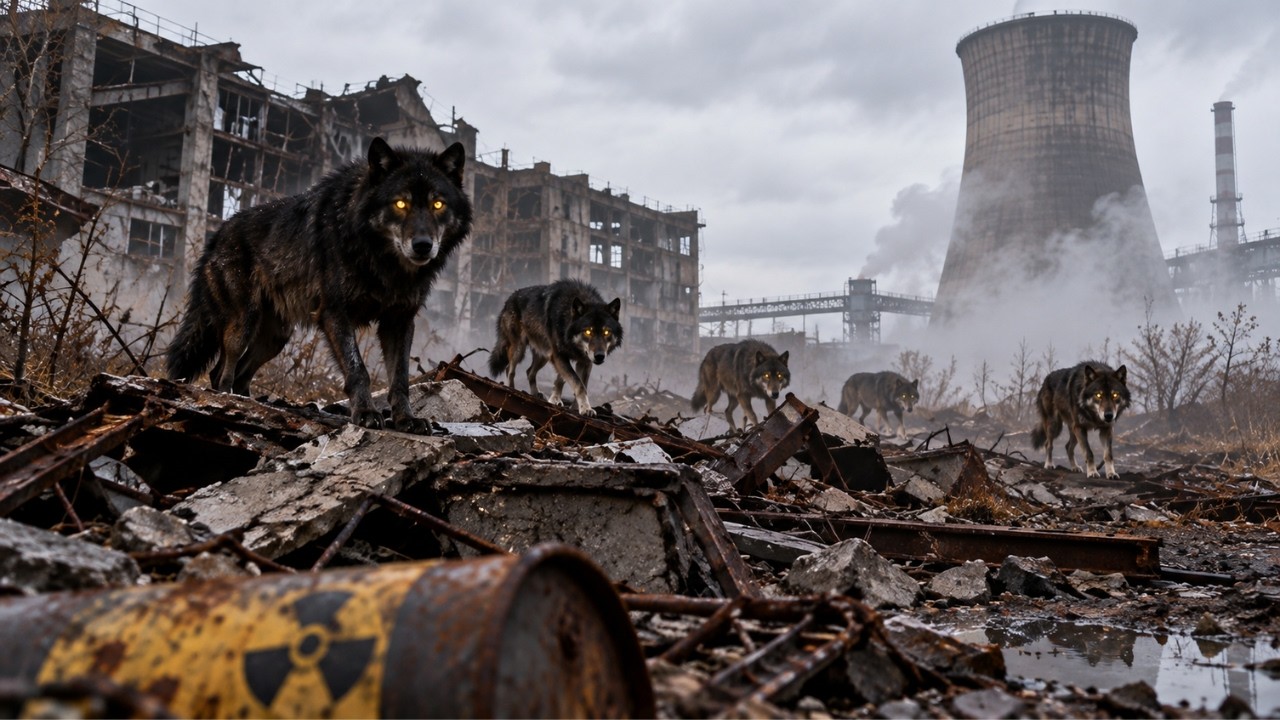
In the early years, the most contaminated areas did look dead. Pine trees closest to the reactor absorbed heavy radiation doses, turned rust-colored, and died standing. The area became known as the Red Forest. Crews bulldozed and buried much of the dead timber, and the ground there remains among the most contaminated in the zone. In those first months, bird song was nearly absent. But the scientific models that predicted a long-term ecological collapse had a blind spot. They accounted for radiation but not for the fact that centuries of farming, hunting, and logging had shaped this ecosystem more than any single disaster.
Once that human pressure disappeared, the landscape rebounded faster than expected. Over the following decades, researchers counted animals from helicopters, tracked footprints in snow, and set up camera traps at hundreds of sites. Some teams fitted animals with small dosimeters to measure what roaming predators actually absorbed over a season. By the 1990s, wildlife surveys in Belarus showed that populations of deer, elk, and wild boar were not declining. They were comparable to populations in uncontaminated reserves nearby. In 2015, a study led by ecologist Jim Smith at the University of Portsmouth found that wolves in the contaminated part of Belarus were about seven times more abundant than in comparable uncontaminated reserves.
Camera studies confirmed the pattern. A team led by Jim Beasley, a wildlife biologist at the University of Georgia’s Savannah River Ecology Laboratory, placed 94 camera traps across areas with varying contamination levels. After five weeks, the cameras had recorded 14 mammal species. The four carnivores in the group, gray wolves, red foxes, wild boars, and raccoon dogs, were among the most frequently photographed. The images also captured lynx, a shy cat that has disappeared from most of Europe, as well as European bison, roe deer, and hares. Black storks, secretive birds that rarely appear in populated areas, have been seen breeding in the quiet marshes. Several species recorded in the zone are rare or struggling elsewhere on the continent. A patch of land considered unsafe for humans has become a de facto refuge for animals that do poorly near people.
Beasley has been careful not to overstate what this means. Cameras show presence, not health. A photo of a wolf confirms only that the animal was alive when the shutter triggered. The footage does, however, demonstrate that a predator population can establish itself in contaminated territory without any feeding, protection, or management. For wolves, the zone offered two things they need most: space and prey. With hunters gone, boar and deer numbers rose, and wolves moved into a landscape full of game with few humans carrying rifles. Their return has also affected other species. Wolves keep deer and boar moving, which changes grazing patterns and relieves pressure on young trees. Their kills feed foxes, crows, and eagles. Ecologists have observed similar dynamics wherever large carnivores return.
Researchers have also begun studying how animals respond physiologically to living in contaminated areas. Biologist Cara Love, now at Texas Tech University, led a team that fitted wolves with tracking collars and analyzed their blood. Preliminary results presented at a 2024 conference showed unusual patterns in the activity of immune-related genes, similar to patterns studied in human cancer research. The work had not yet undergone full peer review at the time of presentation, and it remains an open line of inquiry. If confirmed, it would suggest that natural selection is responding to radiation within a human lifetime.
A 2016 study led by Germán Orizaola at the University of Oviedo in Spain found that eastern tree frogs living in the zone were noticeably darker than frogs in uncontaminated areas, with the darkest individuals found closest to the most contaminated sites. The leading hypothesis involves melanin, the dark pigment in skin, which can absorb radiation energy and may neutralize some of the harmful molecules radiation creates in tissue. If that is correct, darker frogs may have lived longer and passed on their coloration, shifting the whole population over a few decades.
Some internet claims about the zone are not supported by the evidence. Videos of enormous catfish swimming in the plant’s cooling water have often been described as mutant monsters. They are actually wels catfish, a species that grows continuously throughout its life. In an area where no one fishes and food is plentiful, they simply live long enough to reach very large sizes. The biology of the zone is not about deformed creatures. It is about slow selection and which animals live long enough to reproduce.
Some large animals are also reshaping the landscape. Around 30 Przewalski’s horses, the last surviving wild horse species, were released on the Ukrainian side of the zone in 1998. The population has since grown to more than 100. By grazing in abandoned fields, the horses keep patches of grassland open, providing habitat for plants and insects. No one planned this outcome. Belarus designated its side of the zone as a radiation-ecology reserve in 1988, and Ukraine established a biosphere reserve in 2016. The stated purpose of both was to keep people away from dangerous soil, but the result resembles a large-scale rewilding project.
The radiation itself has not disappeared. Cesium-137 and strontium-90 dominate the contamination, each with a half-life of about 30 years, meaning they will remain hazardous for generations. Below them sits plutonium-239, with a half-life of about 24,000 years. Plutonium-241 decays into americium-241, a more radioactive element whose levels in the zone are expected to peak in the coming decades. In other words, some of the worst chemical interactions may still be ahead.
Inside the ruined reactor, conditions remain unstable. In the days after the explosion, molten fuel mixed with sand and concrete and hardened into lava-like masses. One of these, known as the Elephant’s Foot, was intensely radioactive in 1986, but it has cooled considerably since then. In 2021, Ukrainian scientists monitoring a sealed chamber in the rubble reported that neutron counts were rising slowly, a sign that fuel buried beneath the debris may be reacting. No one can enter to inspect it directly.
The long-term picture is not fully clear. No one has followed a single wolf pack across enough generations to determine whether the population is stable, declining, or being replenished by animals arriving from cleaner territory outside the zone. A region that attracts animals and then quietly loses them is different from a region that sustains them. Meanwhile, contaminated animals carry radioactive particles beyond the zone’s borders. Cesium resembles potassium, so cells absorb it readily. Strontium resembles calcium, so it ends up in bones. Each step up the food chain concentrates these elements, a process called biomagnification. Apex predators carry more than the grass at the bottom.
Wild boar in Bavaria, far to the west, still exceed safety limits for cesium decades after the accident. In 2023, researchers from Austria and Germany reported that about two-thirds of the cesium in their samples actually came from nuclear weapons tests in the 1950s and 1960s, not from Chernobyl. Boars eat underground truffles, which retain cesium for decades. The forests of Europe have been silently preserving a record of every nuclear event, and wild boars are reading it aloud.
Even the Red Forest has changed. Young trees and shrubs have grown in parts of the area, and the ground that once looked scorched is now covered with a thin layer of green. It is not healthy by any natural standard, and the soil beneath it remains dangerous, but the contrast with the dead trees of 1986 shows how persistent plant life can be when pressure is reduced, even in the worst locations.
There is genuine scientific disagreement about the effects of radiation on wildlife in the zone. Timothy Mousseau of the University of South Carolina and Anders Møller have spent two decades studying the most contaminated areas. They have reported fewer birds, insects, and spiders where contamination peaks, along with birds showing tumors, cataracts, and smaller brains. They also measured that leaf litter decomposes more slowly because the organisms that normally recycle it are less abundant. Other researchers have disputed these findings, arguing that dose estimates were rough and that habitat differences were not fully separated from radiation effects. A scientific journal once summarized the situation with a headline stating that scientists cannot agree on what Chernobyl has done to wildlife.
The most balanced interpretation is that both groups describe something real. In the most contaminated areas, small, short-lived creatures that live in the soil and reproduce quickly appear to suffer the greatest harm. A wolf can range across hundreds of square kilometers and move through a hot spot quickly. A spider cannot. For large, mobile animals, the disappearance of human activity has been a greater benefit than the cost of radiation exposure. Radiation is not kind to life in the zone, but human activity, over a long enough period, was harder on it.
The two sides of the zone also operate under different conditions. The Belarusian side has been effectively left alone as a government reserve. The Ukrainian side still has researchers, guards, cleanup crews, and the plant itself requires a permanent staff. Wildlife on each side experiences different levels of human noise, and comparisons between them remain complicated.
This is not an isolated pattern. After the 2011 Fukushima disaster in Japan, researchers placed cameras in evacuated towns and photographed wild boar, raccoon dogs, and macaques moving through empty streets. When people leave, wildlife returns quickly, as if it had been waiting at the edges of human settlement. The broader lesson is not that disasters are good, because they are not. The largest variable in wildlife populations may simply be how much space humans leave for other species.
The zone remains fragile. In 2020, one of the largest wildfires in the area’s history swept through thousands of hectares, and fires can lift contaminated particles back into the air. In 2022, Russian forces controlled the site for more than a month, and Ukrainian officials said soldiers dug trenches in the Red Forest. The details of that incident are disputed, and independent experts said it was difficult to determine actual doses, but it showed how quickly human activity can disrupt the area again. In February 2025, a drone struck the massive steel arch covering reactor No. 4. That arch, taller than the Statue of Liberty, was built beside the reactor and moved into place in 2016 at a cost of about 1.5 billion euros, with a design life of 100 years. Its purpose was to protect workers long enough to dismantle the aging shelter beneath it and eventually the remains of the reactor. After the drone strike, the International Atomic Energy Agency said the arch had lost its primary safety function, including its role as a containment barrier.
The arch has a 100-year design life, but the contamination beneath it will last for thousands of years. No one has solved the Chernobyl problem. The structure buys time, and nature has been making use of it. No one funded a wolf recovery program, released any animals, built corridors, or wrote a management plan. The animals simply moved into the space humans left behind.
Recommended Stories
A bloated, pale corpse floats face-down in a Florida swamp, its skin sloughing away in the murky water. Deputies arrived after anonymous tips, expecting a drowning victim, but the disturbing footage revealed something else entirely.
Researchers reviewing camera-trap footage in the Big Cypress section of the Everglades found something unexpected near the end of a...
A great white shark was eaten whole, and scientists finally identified the predator. For months, researchers tracked a massive pregnant great white off the Southeast coast, only for its tag to suddenly surface in the deep ocean.
Off the eastern coast of Australia, there is a place where the seabed drops abruptly from shallow to deep. At...
A fishing crew in the Mariana Trench scanned the ocean floor when their sonar suddenly lit up with something massive lurking below. They weren’t hunting fish—they were testing deep-sea gear, and the reading was far larger than any known species.
In April 1977, a Japanese fishing trawler working off the coast of New Zealand pulled up a large, badly decomposed...