Beautiful Best Friend Moved In for One Week… By Day Three, We Were Arguing Like a Married Couple
At 12:07 A.M., My Neighbor Arrived Wearing One Sock—Then Asked to Stay the Night, and Every Excuse Between Us Began to Collapse
At 12:07 a.m., Maya Bennett appeared on my porch wearing one sock, carrying a toothbrush, and asking to sleep in my house.
Her furnace had died—but the heat between us had been building for nearly two years.
By sunrise, one quiet sentence would force us to confront everything we had hidden behind jokes, distance, and perfectly reasonable excuses.
Part 1 — The Knock at Midnight
Someone struck my front door hard enough to make me think the neighborhood was on fire.
I had been asleep on the couch with a set of bridge calculations open on my laptop, and the sudden pounding sent a cold pulse through my chest before I was fully awake.
When I pulled the door open, Maya Bennett stood beneath the porch light in plaid pajama pants, a winter coat thrown over a thin T-shirt, and exactly one fuzzy sock.
Her other foot was bare against the freezing wood, and she carried a toothbrush in one hand and an overnight bag in the other.
“Before you say anything,” she warned, her breath turning white in the December air, “my furnace died.
My bedroom feels like a meat locker, and every hotel within ten miles is booked because of the college game.” I leaned against the doorframe and looked from the toothbrush to the bag, then down at her missing sock. “That still doesn’t explain the toothbrush.” Maya’s eyes narrowed before her mouth curved into the dangerous smile she wore whenever she was about to make my life more interesting.
“Can I sleep at your place tonight?” she asked.
Then, because she had never once allowed a simple sentence to remain harmless between us, she added, “I promise I’ll behave—unless you give me a reason not to.” For the first time in two years of living next door, I forgot every clever answer I had ever prepared for her.
That was a serious problem, because Maya and I had become experts at pretending we were only neighbors.
My name is Daniel Mercer.
I was twenty-nine, a structural engineer, and by that winter I had developed an embarrassingly detailed theory about Maya Bennett.
She was twenty-five, lived in the blue Craftsman house twenty yards from mine outside Raleigh, North Carolina, planned events for nonprofit organizations and arts groups, and had been flirting with me for at least a year.
To be fair, I had spent that same year returning every challenge, smile, and suspiciously unnecessary visit with interest.
Maya borrowed tools she did not need and returned them with handwritten reviews.
My cordless drill once came back with a yellow sticky note that read, “Good torque.
Terrible emotional availability.” I had kept the note inside the cabinet above my workbench, which was the kind of evidence no reasonable man would preserve if he truly believed the woman next door meant nothing to him.
Still, I had never asked her out, and she had never forced me to explain why.
I stepped aside and said, “Come in before your remaining sock files for separation.” Maya glanced down at her bare foot as she crossed the threshold. “I lost the other one during the emergency evacuation.” When I reminded her that she had walked only twenty yards, she said, “It was a dramatic twenty yards,” as if distance should be measured by emotional hardship rather than feet.
She was shivering beneath her coat, and the sight killed most of my jokes.
I turned up the heat, wrapped a blanket around her shoulders, and made cinnamon tea because I did not have hot chocolate.
She held the mug between both hands, took one cautious sip, and announced, “You’re halfway to being useful.” I told her that was generous for midnight, and the smile she gave me made the room feel warmer than the thermostat could explain.
Her furnace had started making what she described as “a washing machine full of golf balls” before dying completely.
The emergency repair company could not send anyone until morning, and the outside temperature had already dropped below thirty degrees. “So, one night,” I said, emphasizing the temporary arrangement because I needed at least one of us to sound sensible.
Maya repeated, “One night,” but her eyes traveled around my living room with open curiosity.
“I’ve never been inside your house,” she said.
I reminded her that she had stood in my garage many times while criticizing my shelving system, but she dismissed that as neutral territory. “You reorganized my screws,” I said, and she answered, “They were crying out for leadership,” with such complete confidence that I almost believed hardware possessed feelings.
She settled onto the couch, blanket tucked beneath her chin, and pointed out that I had given her a spare key three weeks earlier “for emergencies.” I reminded her that she did not own any plants, pets, or vulnerable appliances that required me to enter her house. “You were planning ahead,” she said.
Her eyes met mine over the rim of the mug, and we fell into the pause we had perfected—the fraction of a second after a joke when neither of us looked away quickly enough.
Maya broke first. “So, where am I sleeping?” When I told her I had a guest room, she blinked with exaggerated disappointment and said, “That is inconveniently responsible.” I reminded her that I was an engineer and responsibility was our only marketable personality trait, but she claimed she had expected at least a little panic. “That sounds like a personal problem,” I said, even though panic was already moving through me with excellent structural efficiency.
The guest room was small but comfortable, with clean sheets, a heavy quilt, and a dresser I had inherited from my father.
On top of it sat a photograph of him and me beside a half-built treehouse when I was twelve.
Maya picked up the frame carefully and asked, “Your dad?” I nodded, prepared for the sympathetic questions people usually asked when they learned he had died five years earlier.
But Maya did not ask how it happened or tell me he looked kind.
She did not use the softened voice people reserved for grief, as though loss might break if handled at normal volume.
She simply returned the photograph to the exact place she had found it and said, “Thank you.” When I asked what for, she answered, “For letting me stay—and for not making tonight weird.”
“You opened with ‘Unless you give me a reason not to behave,’” I reminded her. “You introduced the weird.” Maya insisted it had been strategic because she was cold and needed leverage, and I told her she could have tried saying please. “That would have left me defenseless,” she said, pulling the quilt back with one hand.
I wished her good night and had almost reached the hallway when she called my name.
When I turned, the teasing had disappeared from her face, leaving something quieter and more vulnerable beneath it. “Seriously, Daniel,” she said, “thank you.” I answered, “Anytime,” and meant it far more deeply than I should have.
At a.m., the smell of burnt toast woke me.
I followed it into the kitchen and found Maya standing at the counter in my gray sweatshirt, her hair gathered into a loose knot and her bare legs disappearing beneath the oversized hem.
I stopped in the doorway, and she lifted one hand before I could speak. “I spilled tea on my shirt,” she explained, as if that answered every question created by the sight of her wearing my clothes in the middle of the night.
“That is my favorite sweatshirt,” I said.
Maya glanced down at it and replied, “It likes me better.” A slice of toast on the counter had been burned almost completely black, and she handed it to me with a solemn expression. “Yours.” I took it, asked whether she was trying to kill the man providing shelter, and she informed me that the toast was artisanal.
I bit into it anyway. “It needs less fire,” I said, and her laugh filled the kitchen before fading into a tired silence.
Only then did I notice the shadows beneath her eyes. “Couldn’t sleep?” I asked, and she admitted my house did not make the right noises.
“My refrigerator clicks at one-thirty,” she explained. “The vent rattles whenever the heat starts, and the third stair complains.
I know every sound my house makes.
Yours feels too quiet in the wrong places.” There was something unexpectedly intimate about hearing her describe the language of the home twenty yards from mine, and I found myself wondering how long it would take to recognize all her sounds too.
I refilled the kettle and told her to sit. “We’ll talk until boredom knocks you unconscious.” Maya climbed onto a stool at the island, and for several minutes we discussed nothing important—the weather, a neighborhood cat that had declared war on Mr.
Holloway’s Christmas decorations, and why my kitchen contained three kinds of mustard but no cocoa.
Then I asked the question that had been bothering me since she appeared at my door.
“Why me?” Maya’s eyebrows lifted, so I clarified that she had friends, a sister, and people in her life who probably owned guest rooms.
She explained that her sister was out of town, Rachel had twin toddlers, and Jenna lived forty minutes away. “That explains why not them,” I said. “It doesn’t explain why you came here.”
Maya looked down at her hands, turning her mug slowly against the countertop.
When she met my eyes again, there was no flirtation in her expression. “Because I trust you,” she said.
It was a simple sentence, delivered without drama, but it landed with enough force to rearrange something inside me.
I tried to cover the impact with a joke. “That seems reckless.” Maya pointed at me and said, “Don’t make the Daniel face.” When I denied having one, she described it as the expression I wore whenever I suddenly experienced feelings and resented everyone for noticing.
I laughed, but the sound came out less steady than I intended.
To redirect the conversation, I asked what time the furnace technician was supposed to arrive.
Maya said the appointment window began at eight, then added that she had a site walk at eight-thirty.
When she told me it was at the Marlo Theater, I became fully awake.
My firm had been hired by the city to investigate cracks near one of the Marlo’s balcony supports.
I was part of the structural team, and until an independent review was finished, every recommendation we made could determine whether the venue remained open.
Maya saw the change in my face and winced. “I found out yesterday that you were assigned.”
“You’re planning their winter arts fundraiser,” I said.
She nodded and reminded me it was scheduled in three weeks.
I set down my mug, suddenly aware of the hour, the borrowed sweatshirt, and the woman sitting barefoot in my kitchen while her event depended partly on my professional judgment. “Then we need boundaries.”
Maya stared at me before glancing at the burned toast between us. “We’re eating charcoal at two in the morning, and now you want to discuss boundaries?” When I explained that I meant the theater, she said, “Oh,” with enough disappointment to make my pulse jump.
I told her I could not share confidential findings, give her organization special treatment, or do anything that might make our relationship appear improper before the independent review was complete.
The playfulness vanished from her face. “Daniel, if that balcony isn’t safe, you tell them it isn’t safe.” I assured her I would, but she leaned forward and made me hear the seriousness beneath her words. “I can solve logistics.
I can move tables, change schedules, call donors, and rebuild an entire event in a parking lot if I have to.
I cannot solve somebody getting hurt.”
That mattered to me more than she knew.
I told her I had never believed she would ask me to compromise, and some of the tension left her shoulders.
Then I asked what the fundraiser meant to the theater, and she explained that it paid for almost half of the Marlo’s annual free youth arts program—weekend classes in music, acting, lighting, and set design for children whose families could not afford private lessons.
My father had volunteered at the Marlo years earlier, helping restore pieces of the aging building with a community crew.
I did not tell Maya that yet; the memory felt too personal to bring into a professional conversation at two in the morning.
Instead, I promised that once the report became public, she would receive the information at the same time as everyone else. “That’s all I want,” she said.
Maya extended her hand as if we were closing a formal agreement.
I took it, but neither of us let go when the agreement should have ended.
Her thumb rested against the side of my hand, and the kitchen seemed to contract around the place where our skin touched.
Maya looked down and murmured, “Appearances,” though she made no effort to pull away.
I released her and told her to go back to bed. “Yes, sir,” she said, sliding from the stool.
When I warned her not to call me sir, she smiled and accused me of panicking.
I called it irritation, but she was still smiling when she disappeared down the hallway wearing my sweatshirt.
By seven the next morning, Maya was dressed for work and pretending the night had changed nothing.
She stood at the kitchen island scanning emails while I made coffee, and when her phone rang, I recognized the name of Lara Whitmore, the Marlo’s executive director, on the screen.
I tried not to listen, but the kitchen was small and Lara’s voice carried through the speaker whenever Maya moved the phone away to type.
Photographs of the balcony cracks had circulated online.
Donors were becoming nervous, a city council member wanted the entire balcony closed immediately, and rumors were spreading that the building might be condemned.
Maya remained calm, telling Lara not to cancel anything yet and to secure an alternate venue without making an announcement until they had facts.
When the call ended, I handed Maya a travel mug.
She studied it and asked, “Is this a bribe?” I told her it was coffee, and she replied, “That is how bribery starts.” Then, before I could reconsider, I said, “If the furnace isn’t fixed today, stay here again.”
Maya turned toward me very slowly. “Daniel Mercer, it is twenty-eight degrees outside, and that sounded suspiciously like an invitation.” I claimed I was concerned about public safety and reminded her that I was a licensed professional. “Obviously,” she said, collecting her bag. “For a man worried about appearances, you’re very bad at hiding when you want me around.”
She stepped outside and crossed the narrow strip of frozen grass between our houses.
At that exact moment, Mr.
Holloway walked past with his beagle and saw Maya leaving my home with an overnight bag.
He looked at her, then at me, and I pointed at him through the open doorway. “Don’t.”
Mr.
Holloway raised both hands and said he had not spoken.
His beagle, however, stared at me with the calm condemnation of a creature who already knew the entire story.
I closed the door before either of them could make the situation worse, but Maya’s final sentence remained in the kitchen long after she had gone.
The Marlo inspection lasted most of the day.
The damage was serious but not catastrophic: an old roof leak had allowed water to reach one steel connection beneath the balcony, causing corrosion around a critical joint.
The balcony needed to remain closed, but the main floor and stage could still be used if temporary shoring was installed and total capacity was reduced.
Because Maya’s fundraiser was the only major event scheduled before the permanent repair, the city required an outside engineering firm to review our temporary support plan.
Professionally, that was the correct decision.
Personally, it meant Maya and I would spend several more days pretending the previous night had not placed a live wire between us.
I found her near the loading dock during lunch.
She stopped several feet away, glanced at the distance between us, and asked, “Is this approved, or should I find a measuring tape?” I lifted the one clipped to my belt, and she sighed. “Of course you have one.”
I told her only what had officially been released: the balcony was closed, the main floor could probably remain open under specific conditions, and the final capacity would be approximately sixty percent if the outside firm approved the shoring.
Maya listened without arguing or asking me to soften the conclusion.
Her eyes moved toward the stage doors while she rebuilt the fundraiser in her head.
“What will you do?” I asked.
Within seconds, she had a plan: donor dinner on the main floor, youth performances remaining onstage, heated courtyard tents carrying a live stream, and the silent auction moved online. “We turn reduced capacity into exclusivity,” she said.
When I pointed out that she had created the strategy in thirty-eight seconds, she replied, “That is why people pay me.”
“I thought they paid you for table linens,” I said.
The look she gave me could have cut structural steel, and I apologized while trying not to laugh.
Her phone buzzed, but before she left, she lowered her voice and told me the replacement furnace part would not arrive until the next day.
“You know where the guest room is,” I said.
Maya tilted her head and called that a very professional invitation. “Same rules,” I warned.
She walked backward toward the door and replied, “I don’t remember agreeing to any rules.”
That evening, she arrived carrying Thai food, sparkling water, clean clothes, and both socks.
She announced that she was contributing, although the amount of food she brought could have fed six adults.
When I pointed out that she was five-foot-four, she told me not to restrict her dreams.
We ate at the kitchen island while she explained how she was redesigning the fundraiser around the smaller capacity.
I listened without offering any confidential information, and at some point the conversation drifted away from the theater.
Maya asked why I had chosen my house, and I admitted my father had loved the neighborhood and brought me to inexpensive matinees at the Marlo when I was a child.
Maya became still. “He volunteered there, didn’t he?” I looked at her, surprised, and she explained that a photograph of the 2012 restoration crew hung in the backstage hallway.
She had recognized my father from the picture in the guest room.
“He loved old buildings,” I said.
Maya’s expression softened. “And you became a structural engineer.” When she said it was not a coincidence, I did not argue, because she had seen something I rarely allowed myself to say aloud: every building I kept standing was a conversation I was still having with my father.
After a moment, Maya admitted her mother considered event planning a temporary distraction rather than a real career. “She loves me,” Maya said quickly. “She just believes I’ll eventually become tired of chaos and choose something stable.” The care with which she defended the person who diminished her told me the criticism had been repeated many times.
“You manage six-figure budgets, contractors, permits, donors, vendors, and two hundred people who each believe their problem is the only problem in the room,” I said. “You once got three hundred guests fed after a catering truck broke down on Interstate 40.” Maya asked how I knew that, and I reminded her that she had complained about it in her driveway for forty-five minutes.
“I was processing,” she insisted.
I reminded her that she had threatened to fight a refrigerator, and she said, “It knew what it did.” I smiled before telling her the thing that should have been obvious to everyone who had ever watched her work. “Your job is real, Maya.”
Her expression changed.
It was an ordinary sentence, but apparently no one had given it to her that directly.
She thanked me, and when I told her she did not need my permission, she said, “I know—but it matters that I have your respect.”
The kitchen became very quiet.
Maya met my eyes and asked, “Are we still worried about appearances?” I answered yes, then added that no one could see us at that moment. “That is not what I asked,” she said.
I put down my fork. “Then ask me what you mean.” Maya drew a slow breath before asking, “Do you want me here?” I had spent eighteen months hiding behind banter, timing, and reasonable circumstances, but suddenly I was exhausted by the sound of my own excuses.
“Yes,” I said.
No joke followed it, and no careful explanation weakened it. “I wanted you here before your furnace broke.”
“Then why didn’t you ask me out?” Maya asked.
I told her the truth in pieces: she had just moved in, then she was dating someone, then my father’s estate became complicated, then work turned ugly.
Eventually, so much time had passed that we had become whatever strange, unfinished thing existed between us.
“Badly managed tension,” she suggested.
I called that accurate, and her smile faded as she stepped closer. “If you kissed me tonight, would that create an appearance problem?”
“It could create several problems,” I said.
Maya sighed and called it an engineer’s answer. “You asked,” I reminded her, but she shook her head. “No, Daniel.
I asked whether you wanted to.”
I came around the island and stopped close enough to feel the warmth of her without taking the final step.
I told her I wanted to kiss her, but I would not allow the first real thing between us to happen while an inspection connected to her event was still under my professional responsibility.
Disappointment flashed across her face, followed almost immediately by reluctant understanding.
“I hate that you’re right,” she whispered.
I said I heard that often, and she warned me not to ruin the moment.
Then she hooked one finger into the front pocket of my shirt, and every useful thought disappeared from my mind.
“This is allowed, right?” she asked.
I told her it was barely allowed, which seemed to satisfy her.
Maya rose onto her toes and pressed her lips against my cheek—slowly enough to make it clear the choice had been deliberate.
When she stepped back, she wore the pleased smile of a woman who had discovered exactly how much trouble one restrained kiss could cause. “That was for the tea,” she said.
I called her a menace, and she reminded me I had known that before inviting her into my home.
At the entrance to the hallway, Maya turned and waited until I looked at her. “And Daniel?” she said softly. “You have officially given me a reason not to behave.”
Then she disappeared into the guest room, leaving me alone in the kitchen with the terrifying certainty that once the review ended, neither of us would have an excuse left.
Part 2 — What Happened When We Ran Out of Reasons
Maya’s furnace was repaired the next morning.
For the next several days, we became aggressively responsible adults who did not eat dinner alone, did not discuss the theater outside official channels, and did not acknowledge the kiss that had landed on my cheek like a promise.
We did, however, text about nearly everything else, which allowed us to maintain the illusion of discipline while destroying it one message at a time.
On Monday, I found my gray sweatshirt folded neatly on Maya’s porch.
A note rested on top: “Hostage negotiations begin at noon.” When I finally recovered it, I discovered that she had sewn a tiny label into the collar reading, “Property of Daniel Mercer, temporarily improved by Maya Bennett.”
My coworker Ben caught me smiling at the label in the office. “That is not a work face,” he said.
When I claimed I did not have a work face, he informed me that I had several and that the one I was wearing was embarrassing.
On Tuesday, the independent reviewers agreed with our temporary shoring plan but requested one additional brace.
The change was reasonable, yet it delayed final approval for another day.
Maya texted a single word—“Rude”—and I answered, “Structural steel has no respect for romance.”
Three dots appeared on my screen, vanished, and reappeared.
Then she wrote, “So we are calling it romance now?” It was exactly the kind of question we usually buried beneath another joke, but that morning I typed one honest word: “Yes.”
Her answer arrived almost a minute later. “Good.” I read it twice, then placed my phone facedown because Ben was already watching me from across the conference table with the expression of a man who intended to become unbearable.
Late Wednesday afternoon, the city approved temporary occupancy for the main floor and stage.
The outside firm signed off on the revised support plan, and the decisions directly affecting Maya’s fundraiser were officially closed.
I called her before I had even returned to my desk.
“Tell me something good,” she said.
When I told her the main floor had been approved, there was silence, followed by a breathless laugh.
She made me confirm that the independent review was finished and our conflict of interest was effectively over.
“Come outside,” Maya said.
I reminded her that I was at work, and she replied, “So am I.” Through the glass doors of the lobby, I saw her standing beside my truck with two coffees in her hands.
I was out of my chair before I remembered that normal people usually walked.
As I passed Ben’s desk, he looked toward the parking lot, saw Maya, and said, “Oh.
That explains everything.” I did not slow down long enough to ask what he thought everything included.
Outside, Maya handed me one of the coffees and congratulated me on successfully refusing to compromise my ethics.
I called that a low standard, but she shook her head and said, “I’m proud of you.” The sincerity in her voice reached a place none of her teasing ever had.
“And I successfully avoided manipulating you,” she added. “Also a low standard, but I deserve recognition.” I told her she did, and we stood there smiling like two people who knew the barrier between them had just been removed.
“The review is complete,” Maya said.
I confirmed it, and she reminded me that I had insisted we wait.
When I said we had waited, she looked far too pleased with herself.
I took both coffees and placed them on the hood of my truck.
Her eyebrows rose. “Oh,” she said, and that one syllable carried every conversation we had postponed.
I stepped closer and asked whether she had any objections, professional concerns, or remaining questions.
Maya said she had one. “What took you so long?”
I kissed her before I could offer another explanation.
Her hands rose to the front of my coat, and the kiss was warm, certain, and entirely different from the half-serious tension we had been building for more than a year.
Nothing about it felt accidental, and nothing about it felt temporary.
When we separated, Maya was smiling. “That was worth four days,” she said.
I suggested it might have been worth five, but she told me not to become greedy and kissed me again.
Someone inside the office slapped both hands against the window.
I refused to turn around, and Maya laughed against my mouth. “Appearances,” she murmured.
“Too late,” I said.
Our first real date took place the following evening at a neighborhood Italian restaurant.
Maya accused me of selecting our table because I could see every exit, and when I said it had simply been open, she pointed out that I had inspected the ceiling before sitting down. “I always check ceilings,” I told her.
“That is deeply romantic.” Maya opened her menu, but I reached across the table and took her hand. “Then let me try something less structural.”
I told her I was not interested in treating us like a four-day reaction to a broken furnace.
Her teasing faded, and she said she did not want that either.
I admitted I could not predict exactly what we would become, because anyone who claimed certainty after one kiss was probably selling something, but I knew I wanted to find out.
Maya squeezed my fingers. “That was almost smooth.” When I asked why only almost, she said, “You mentioned the furnace.”
“It brought us together,” I argued.
Maya replied that it had betrayed her in her hour of need, and I suggested sending it a thank-you card.
She threatened to leave if I did, but I told her, “No, you’re not.”
Her eyebrows lifted.
The old version of me would have softened the statement with humor or given her space to escape from its meaning.
Instead, I held her gaze until she smiled and answered, “No, I’m not.”
For the next two weeks, we dated quietly while the fundraiser approached.
Maya began appearing at my house with increasingly weak excuses: her porch light looked lonely, she had made too much pasta, her Wi-Fi felt judgmental, or I owned the superior screwdriver.
I encouraged this behavior with equally ridiculous reasons to cross into her yard, including a mailbox that leaned two degrees, a thermostat that might require inspection, and the continued disappearance of the fuzzy sock I had never owned.
We ate dinner twice at restaurants and once on my living-room floor because Maya insisted the coffee table offered “better emotional geography.” We spent a Sunday morning walking around the lake, arguing about fictional characters, furniture assembly, and whether instructions were a sign of wisdom or weakness.
She reached for my hand halfway around the path without looking at me, and the naturalness of the gesture unsettled me more than the kiss had.
The frightening part was not how exciting being with Maya felt.
It was how ordinary it felt.
I liked hearing her complain about traffic, watching her leave hair ties beside my kitchen sink, and learning that she sang the wrong lyrics to every song while insisting her version was better.
I had spent years believing that love announced itself through catastrophe or unbearable longing.
With Maya, it appeared in grocery lists, shared chargers, and the fact that she knew which cabinet held the tea.
I liked ordinary with her so much that I began waiting for something to take it away.
Three nights before the fundraiser, I came home and found Maya sitting on her front steps without a coat.
The temperature had fallen sharply, and she was staring at her phone as if it had delivered a physical blow.
I crossed the lawn and asked what had happened.
One of the major donors had withdrawn a twenty-five-thousand-dollar pledge.
Nothing new had gone wrong with the building, but the old balcony photographs remained online, and the donor’s company did not want its brand connected to a venue undergoing repairs.
Maya spoke in the flat, controlled voice she used when allowing herself to feel the full weight of a problem would make it impossible to solve.
“How bad is it?” I asked.
She said the event itself could survive, but the youth program could not absorb the loss.
Then she stared toward the empty street and whispered, “I spent two weeks solving every problem.
I thought eventually the universe would get bored.”
“The universe never gets bored,” I said, sitting beside her.
Maya gave a humorless laugh before admitting that her mother had called that afternoon and asked whether this was finally the moment Maya would accept that she needed a more stable career.
Anger rose in me, but Maya did not need me to be angry on her behalf.
She needed someone to understand what the sentence had done to her after a day of swallowing panic for everyone else.
I handed back her phone and said, “Losing one donor three days before one event does not retroactively make your career fake.”
Maya looked at me with a tired smile. “That is annoyingly good.” I told her I practiced, and she warned me she did not need me to fix the situation.
“I know,” I said. “I’m not rescuing you.
I’m asking what you need.” For several seconds, she stared at her hands before answering, “Ten minutes where I don’t have to know the answer.”
So we sat on the cold steps without advice, strategy, or forced optimism.
I took off my coat and placed it around her shoulders, and for ten minutes neither of us said a word.
Cars passed at the end of the street, dry leaves scraped along the pavement, and Maya gradually stopped holding her body as if she were personally responsible for preventing the world from falling apart.
At the end of the ten minutes, she leaned against my shoulder and released a long breath. “Okay,” she said. “Now I need a whiteboard.”
We moved into her dining room and turned it into a command center.
For two hours, Maya wrote possible sponsors, budget adjustments, auction changes, and outreach strategies across the board while I asked questions and refilled our coffee.
I resisted offering solutions unless she asked because the victory needed to remain hers.
By nine-thirty, she had abandoned the idea of replacing one corporate donor with another.
Instead, she developed a sponsor-match challenge in which three smaller local businesses could collectively replace the missing gift.
The theater would frame it as a community-backed arts fund rather than a corporate rescue, making each donor’s contribution feel essential and giving the audience a reason to participate.
At ten-thirty, Maya had written the pitch.
At ten-forty, she had prepared a prioritized contact list.
At ten-fifty, she capped the marker, looked at the board, and said, “I can do this.”
“I know,” I answered.
She crossed the room and stood between my knees where I sat at the table. “You are very good at not rescuing me,” she said.
I told her I remained available for spiders, but she accused me of sexism because she rescued herself from spiders too.
“Acceptable,” I said.
Maya kissed me slowly, and when she pulled back, I kept my hands at her waist because I was not ready to lose the warmth of her.
“Maya,” I said, and the seriousness in my voice made her open her eyes. “I don’t want to be your emergency contact only when your furnace breaks.”
She searched my face while I told her I wanted the ordinary parts too—bad Tuesdays, grocery runs, Sunday coffee, and her continued attacks on my hardware organization. “Your screws remain vulnerable,” she warned, but her voice had softened.
“I want this when nothing is on fire,” I said.
Maya’s expression changed into something open and almost painfully hopeful. “Good,” she whispered. “Because I don’t want to date you only in secret.”
I pulled back slightly.
I had believed we were simply being careful, but Maya reminded me that careful could become convenient.
I understood exactly what she meant: I was excellent at finding legitimate reasons to postpone the things that frightened me.
“You think I’ll keep finding another excuse,” I said.
Maya did not look away. “I think you’re very good at reasons.”
She was not wrong.
After my father died, I had become the dependable person in my family—the one who handled the estate, checked on my mother, steadied my younger brother, and returned to work before anyone could accuse grief of changing me.
I worked more, risked less, and gradually turned caution into a personality I called maturity.
“No,” I said.
Maya studied me, waiting to see whether I would hide the promise inside a joke. “No more reasons.
When the fundraiser is over, I’m taking you somewhere close enough for Mr.
Holloway to see us.”
She laughed. “That is commitment.” I promised I might even hold her hand in front of the beagle, and she called it scandalous.
Then I became serious again. “I mean it.” Maya placed her hand over mine. “I know,” she said. “So do I.”
By Friday morning, all three smaller sponsors had accepted the match proposal.
Maya texted me a photograph of the signed pledges with the message, “Universe: zero.
Me: one.” I answered, “Engineering review: one.
Universe: still zero,” and she immediately told me not to make her victory about myself.
Saturday arrived clear and cold.
By late afternoon, the Marlo looked better than it had in years, because Maya had transformed every limitation into part of the design.
Elegant draping concealed the closed balcony, warm lights softened the scaffolding near the rear wall, and donor tables filled the main floor without making the reduced capacity feel like a compromise.
Heated tents lined the courtyard, each fitted with screens broadcasting the youth performances and backstage interviews.
The silent auction had moved online, allowing guests who could not attend to participate from home.
What might have looked like a venue struggling through repairs now felt intimate, deliberate, and alive.
I was required to remain on-site for the first hour to monitor the temporary shoring.
Professionally, I watched digital gauges and recorded measurements.
Personally, I watched Maya.
She moved through the theater in a dark green dress with a headset in one ear, solving problems before most people knew they existed.
When a microphone failed, she produced a backup.
When a donor arrived with two unregistered guests, she found seats without embarrassing anyone.
A teenage performer froze near the stage entrance, hands shaking around the knot of his bow tie.
Maya knelt in front of him, straightened it, and said something I could not hear.
The boy laughed, took a deep breath, and walked toward the stage with his shoulders higher.
At , Lara stopped beside me and followed my gaze. “Your father would have loved this,” she said.
I looked toward the backstage hallway where the restoration photograph still hung.
“He used to say this building was stubborn,” I told her.
Lara smiled. “I remember.
He also said good buildings survive because people keep choosing them.”
My eyes moved back to Maya.
She was listening to three people at once, holding a clipboard beneath one arm and pointing a volunteer toward the courtyard doors.
I realized my father’s words were true of more than buildings.
At eight o’clock, my monitoring responsibility ended.
I transmitted the final readings to the project lead, received confirmation that everything remained stable, and removed my visitor badge.
For the first time in weeks, I was no longer standing inside the Marlo as an engineer.
I bought a ticket at the front desk and walked across the lobby.
Maya saw me coming, noticed the missing badge, and looked back at my face. “You’re off duty?”
“Completely,” I said. “The final readings are filed, and the building is behaving—unlike certain people.” Maya claimed she could not speak to that accusation, but her smile betrayed her.
“Do you need something, Daniel?” she asked.
I told her I needed a dance.
Her eyebrows rose. “You dance?” I admitted that I danced poorly and had concealed it for public safety.
Maya glanced toward the donors, volunteers, theater employees, and other people who knew both of us.
“This is a professional event,” she said.
I reminded her that it was her professional event and I was now a paying guest.
When she accused me of purchasing the ticket that afternoon, I called it a contingency rather than a plan.
“That is the most engineer-like way anyone has ever described asking me to dance,” she said.
I extended my hand and asked whether the answer was yes.
For one second, I saw the same caution in her face that had controlled my life for years.
Then Maya placed her hand in mine. “Yes.”
We stepped onto the floor while a jazz trio played something slow enough to survive my limited skill.
Maya rested one hand on my shoulder and told me I was tense.
I explained that I was concentrating on not stepping on the event planner because it would generate paperwork.
She laughed, then noticed I was still carrying the ticket stub in my pocket. “You really bought a ticket.” I reminded her that I wanted the regular parts of her life too, and she pointed out that nothing about that evening was regular.
“No,” I agreed. “This is me choosing not to hide behind another reason.” Maya’s fingers tightened against my shoulder.
“What about appearances?” she asked.
I reminded her that the review was closed, the city had approved the venue, the outside firm had signed off, and my company knew I had purchased a ticket only after my responsibility ended.
“You thought this through,” she said.
I told her I was still me, unfortunately, and offered to leave if that made her uncomfortable.
Her hand moved behind my neck.
“You absolutely cannot leave.”
Halfway through the song, I noticed Mr.
Holloway standing near the courtyard doors with his wife.
He spotted us and lifted his glass with the triumphant expression of a man who had been waiting weeks to win an argument no one else knew existed.
Maya followed my gaze and whispered, “Oh no.
He knows.”
“He knew the morning after the furnace,” I said. “The beagle knew too.” Maya laughed and rested her forehead briefly against mine. “The beagle is observant.”
When the lights dimmed for the final youth performance, we returned to our seats.
A sixteen-year-old girl named Sophia walked onto the stage carrying a guitar.
Maya whispered that Sophia had almost left the program the previous year when her family could no longer afford lessons, but a Marlo scholarship had kept her there.
Sophia began to play.
Her hands trembled during the first few notes, then steadied as the theater became silent around her.
By the end of the song, she was no longer a nervous teenager under bright lights; she was an artist who knew the room belonged to her.
The audience rose when she finished.
I looked at Maya and realized she was not watching the stage.
She was watching the crowd, absorbing the proof that the night mattered and that every frantic phone call, revised floor plan, and lost hour of sleep had protected something real.
I reached for her hand beneath the table.
Maya laced her fingers through mine without looking away from the audience.
After the applause, Lara announced the results of the community sponsor match.
They had not merely replaced the missing twenty-five thousand dollars.
Donations had exceeded the original goal by eleven thousand.
Maya closed her eyes.
For one second, she looked as if she might cry, but she drew a breath and held herself together.
I leaned closer and whispered, “Universe?”
She opened her eyes. “Still zero.”
After the guests left, I stayed to help with cleanup.
Maya objected that I was wearing a suit and had already purchased a ticket, but I told her I could move chairs in formal clothing. “Now I’m getting my money’s worth,” I said.
“That is not how fundraisers work.” I picked up another box of programs. “It is tonight.”
We stacked chairs, packed auction materials, collected centerpieces, and carried equipment into storage.
Near midnight, the final volunteers left, and the theater became so quiet that our footsteps echoed through the main floor.
Maya stood alone onstage, looking out at the empty seats.
I joined her and told her she had done it, but she answered, “We did.”
I reminded her that the engineers had kept the building open, the outside firm had verified the plan, and the donors had shown up—but she had given them a reason to care. “The kids performed because you protected their stage,” I said. “That part was you.”
Maya looked at me with tired, shining eyes. “Are you always this argumentative after midnight?” I told her I reserved it for women who stole my clothes, and her familiar smile returned.
Then she checked the time.
It was 11:42 p.m.
Maya folded her arms and asked, “Can I sleep at your place tonight?” I laughed, but she continued with eyes bright beneath the stage lights. “I promise I’ll behave—unless you give me a reason not to.”
It was the exact sentence she had spoken at my door, except this time there was no dead furnace, no freezing bedroom, and no emergency left to blame.
Part 3 — The Reason We Finally Chose Each Other
The first time Maya had asked to stay, she had been cold, stranded, and using flirtation as armor.
Now she stood in the theater she had fought to save, asking the same question without any crisis to protect her from the answer.
The repetition was playful, but the vulnerability beneath it was not.
“My furnace works,” I said.
Maya nodded seriously. “Good.”
“My guest room is available.” Her face fell with theatrical disappointment. “Less good.”
I raised an eyebrow, and she laughed. “Fine.
I walked into that.” When I took her hand, the laughter softened into something quieter.
“You don’t need an excuse anymore,” I told her.
Maya held my gaze for several seconds before answering, “I know.”
“If you want to stay, stay.” She asked whether it could truly be that simple.
I said it could, because after two years of inventing complications, I was ready for one uncomplicated truth.
“I want to stay,” Maya said.
We left the Marlo before midnight, walking through the cold parking lot with our shoulders touching.
There was no rushing, no desperate declaration, and no attempt to turn the night into something grander than it was.
For once, neither of us needed drama to make the choice meaningful.
At home, we changed into comfortable clothes and sat on my living-room floor eating leftover chocolate mousse from plastic containers.
Maya wore my gray sweatshirt again, and I pretended not to notice that it looked more natural on her than anything in my house had before.
The night did not become a reckless fantasy; it became two exhausted people sharing dessert while the heater hummed and the clock moved quietly toward morning.
After several minutes, Maya pointed her spoon at me. “I’ve been thinking something dangerous.” I told her that sentence had never improved my life, but she said I owed her a confession.
“I have confessed several things,” I protested.
Maya shook her head. “Not enough.
When did you start liking me?”
I considered inventing a respectable answer that would make me sound thoughtful rather than hopelessly observant.
Then I remembered my promise to stop hiding behind reasons. “The ladder,” I said.
Maya frowned. “What ladder?” I reminded her of the week she moved in, when she had decided to hang string lights from her porch while standing on the highest step of a cheap aluminum ladder.
She claimed the ladder had been stable, and I reminded her that it had been visibly bending beneath her.
“It had character,” she said. “It had a death wish,” I answered.
Maya covered her face with one hand as the memory returned.
I had run across the yard because she was six feet above concrete on a ladder that looked ready to fold itself in half.
She remembered me shouting that she was violating at least three laws of physics while she calmly continued attaching lights to the porch beam.
“You acted as though I were falling off a bridge,” she said.
I reminded her that she had been one bad decision away from an emergency-room visit. “And that was when you started liking me?”
“No,” I said.
Maya lowered her hand and demanded to know why I had brought it up.
I explained that after I stabilized the ladder, she had made me hold the remaining lights while she finished the job.
When she climbed down, she handed me a beer and sat beside me on her porch steps.
We remained there for two hours, talking while the new lights glowed above us and unopened moving boxes crowded the windows behind her.
At some point, she asked about my father without knowing he had died.
“You didn’t use the sympathy voice when I told you,” I said. “You didn’t say everything happens for a reason or try to explain grief to me.
You just listened.”
Maya became quiet.
Her eyes shone for a moment before she recovered and said, “So I seduced you with emotional maturity.” I told her the beer had also played a significant role.
“Important detail,” she said.
I agreed that history demanded accuracy.
Maya moved closer across the rug. “When did you know you wanted more?” This answer required less thought.
“The first morning you stayed here,” I said. “The burned toast.”
She stared at me. “The burned toast?
That is deeply unromantic.” I told her she had been standing in my kitchen wearing my sweatshirt, and despite the smoke, the missing sock, and the terrible food, the scene had felt normal.
Maya’s smile softened. “And that scared you?” I admitted it had.
“Why?” she asked.
The truth felt almost embarrassingly simple. “Because I liked normal with you too much.”
Maya put down her dessert and took my hand. “Do you know what scared me?” I waited, and she said, “How safe I felt here.”
That word reached deeper than desire.
Safe was not passive for someone like Maya.
She was accustomed to being the competent person, the problem solver, and the one others expected to remain calm when plans collapsed.
“I like being capable,” she said. “But that first night, I showed up wearing one sock, carrying a toothbrush, and having no real plan.” I reminded her that she had also brought skin care products, and she said, “I had priorities.”
Then her expression became serious again. “You didn’t treat me like I was helpless.
You didn’t take over.
You just made room.”
“I can do that,” I said.
“I know.”
For years, I had confused love with the ability to prevent disaster.
After my father died, caring for people had meant handling documents, making calls, repairing what broke, and remaining useful enough that no one would ask whether I was all right.
Maya was showing me another kind of care—the kind that did not need to fix a person before letting them stay.
The microwave clock changed to 12:07.
Maya noticed at the same moment I did.
“Apparently, that’s your hour,” I said.
A mischievous smile appeared on her face as she stood and walked toward the front door.
“What are you doing?” I asked.
She answered with one word: “Tradition.”
Maya opened the door, stepped onto the porch, and pulled it closed behind her.
A few seconds later, she knocked three times.
I stared through the glass before opening it.
“You cannot be serious,” I said.
She was trying not to laugh, but I leaned against the doorframe exactly as I had the first night and asked, “Do I know you?”
“I live next door,” she said.
I told her I had heard things, probably from the beagle.
Maya called him a highly credible source.
Then the teasing left her face. “My house is warm.
Hotels have vacancies.
My phone is charged, and I’m wearing both socks.”
“Congratulations,” I said.
“Can I sleep at your place tonight?” I asked why she needed to when every original problem had already been solved.
Maya looked directly at me. “Because I want to wake up here.”
Some sentences change the temperature of a room.
That one did.
It held no joke, no emergency, and no escape hatch—only the possibility of a morning we would choose together.
I extended my hand. “Then come inside.”
Maya placed her hand in mine and crossed the threshold.
The next morning was almost aggressively ordinary.
Sunlight entered through the blinds, the refrigerator clicked at one-thirty exactly as Maya had predicted, and she discovered that the third stair did, in fact, complain.
We made coffee, divided the last piece of fundraiser cake, and argued about whether burned toast had become part of our history or remained evidence of a crime.
Nothing dramatic happened.
That was precisely why it mattered.
Maya did not disappear once the emergency ended, and I did not retreat once closeness became real.
We stood at the kitchen counter in yesterday’s clothes, talking about errands and Monday schedules, and I understood that commitment was rarely built from one fearless act.
More often, it was constructed from a series of small decisions not to run.
Three months later, Maya still technically lived next door.
In practice, her coffee lived in my kitchen, her shoes appeared near my front door, and at least four of my sweatshirts had crossed the yard without authorization.
My drill had migrated permanently into her garage, and the twenty yards between our houses had become less a boundary than a running joke.
Some nights we stayed at my place because my kitchen was larger.
Other nights we stayed at hers because she had the better couch and refused to admit it.
Mr.
Holloway stopped pretending not to notice, while his beagle continued observing us with the grave satisfaction of an animal whose suspicions had been confirmed.
The Marlo reopened its repaired balcony in the spring.
Maya invited me to the first performance, and this time there was no inspection, no professional reason to sit apart, and no excuse to hide.
We entered through the front doors holding hands.
During intermission, Lara introduced us to a donor simply as “Daniel and Maya.” No explanation followed.
Maya tightened her fingers around mine, and I looked toward the restored balcony where the new steel connection sat hidden behind plaster and paint.
Most people would never see the work that kept it standing.
They would see only the finished space—the lights, the music, and the people trusting the floor beneath them.
I thought relationships might work the same way: their strength lived in quiet choices no audience ever applauded.
Later that evening, Maya and I walked home after dinner and stopped on the sidewalk between our two houses.
She looked from her blue porch to mine and announced that she had a question.
I called it dangerous before she could continue.
“If one of us eventually moves into the other person’s house, what happens to the second house?” she asked.
My face must have changed because she immediately lifted a hand. “This is not a proposal.
Don’t make the face.”
“I don’t have the face.” Maya shook her head. “You absolutely have the face.”
We considered turning one house into a guesthouse, but Maya thought that sounded too formal.
I suggested a workshop, and she said my screws did not deserve that much space.
An office seemed too practical, while renting it to strangers felt strangely wrong.
Finally, I looked at the two porches facing the same quiet street. “Maybe we keep both houses so whenever you’re angry with me, you can storm twenty yards away dramatically.”
Maya considered the idea. “That has value.”
“And when you calm down, you can come back and knock.” I told her 12:07 would be preferred.
“What if you don’t answer?” she asked.
By then, I understood something I had missed for years.
The most important doors in a life were rarely the ones opened only once.
They were the doors people kept choosing to open when it was inconvenient, when they were tired, and when the person standing outside arrived with one sock and a sentence designed to destroy their concentration.
“I’ll answer,” I said. “Because it’s you.”
Maya rose onto her toes and kissed me beneath the streetlight between our houses.
When she pulled away, she smiled and said, “Good answer, engineer.” Then she took my hand and led me toward my porch.
At the door, she knocked even though I was standing beside her with the key.
I stared at her, and she said, “Tradition.”
I unlocked the door.
This time, when Maya stepped inside, neither of us pretended she was there because she needed somewhere to sleep.
She entered because we had chosen each other after every emergency was solved, every professional obstacle was removed, and every sensible excuse had finally run out.
And if she ever knocked again—at midnight, at sunrise, or in the middle of any ordinary hour—I already knew my answer.
I would open the door.
Because it was her.
Recommended Stories

My Girlfriend Says She Loves Me… But She’s Out Partying With A Coworker At 1 AM
She Said He Was “Just a Friend”—Then I Asked If She Wanted Him Instead of Me, and Her Answer Changed...
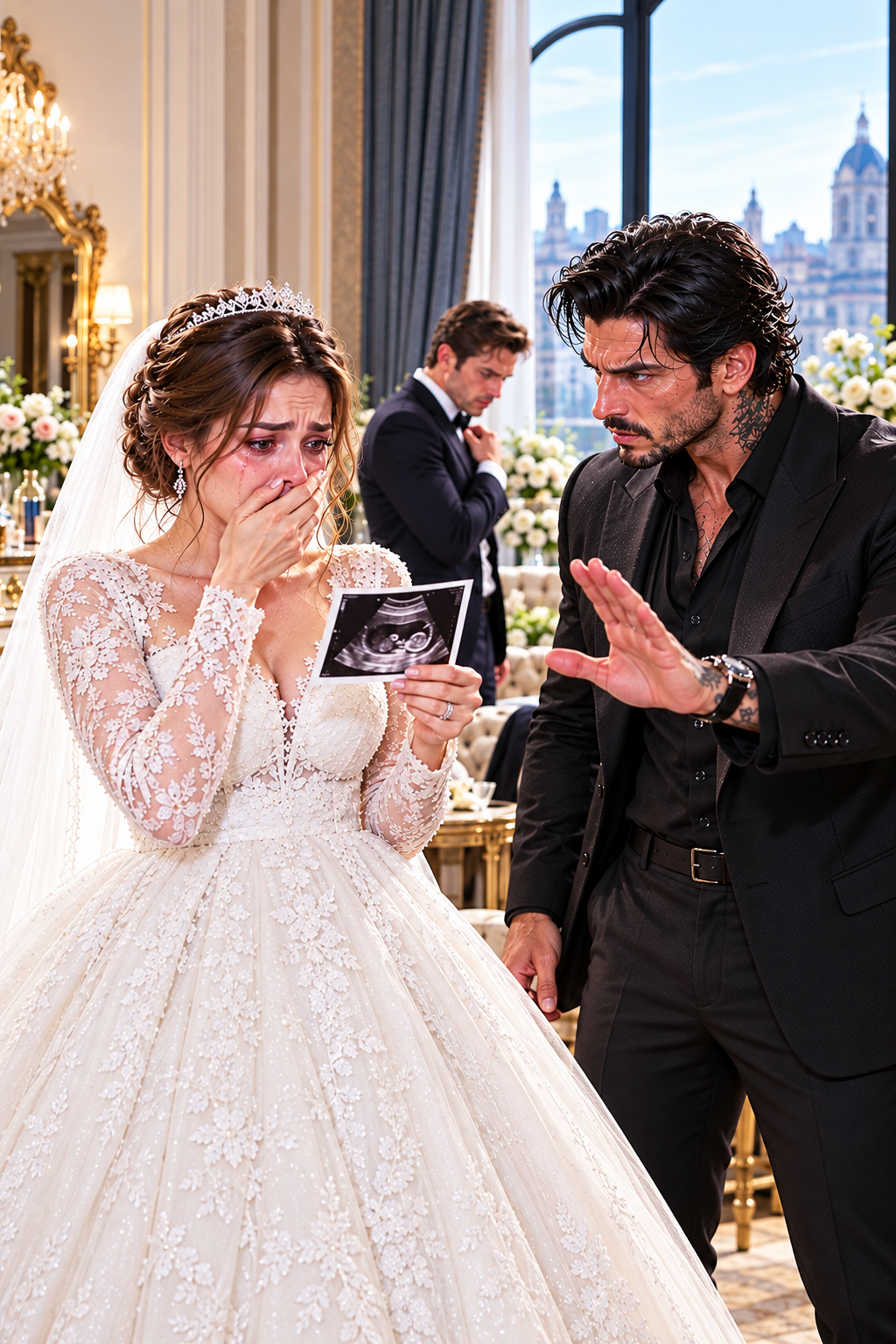
She Found an Ultrasound Before Her Wedding—Mafia Boss Warned Her, “Don’t Marry Him”…
She Found an Ultrasound Before Her Wedding—Mafia Boss Warned Her, “Don’t Marry Him” Twenty-four hours before her wedding, Viviane Mercer...

My Wife Told Our Friends I Couldn’t Get Hard… So I Changed Tables…
My Wife Told Our Friends I Couldn’t Get Hard… So I Changed Tables, and the Secret Behind Her Joke Ended...