Divers off Australia’s southern coast were filming a tagged white shark when her behavior shifted from relaxed to panicked, forcing the seventeen-foot predator to flee for the surface. In thirty combined years of experience, none had seen a great white run from anything.
In the waters off Australia’s southern coast, sunlight penetrates only about sixty feet before fading into darkness. Below that depth, professional divers work in cold, dark conditions where the continental shelf drops away into a canyon roughly two thousand feet deep.
The animals that live along that edge are not the kinds seen on postcards. They tend to be older and larger than their shallow-water counterparts. On one afternoon, a team of four experienced divers descended into these waters to film a large white shark they had previously tagged and tracked for two seasons.

What they brought back was a brief underwater clip that the team could not immediately explain. In the footage, one diver begins to speak and then stops abruptly. Visible on the side of the shark, which measured about fourteen feet long, was a clean, crescent-shaped bite wound. Something had taken a large bite out of one of the ocean’s top predators.
To understand why the footage mattered, it helps to understand the setting. The current in this area does not flow gently along the coastline. It rises from the deep canyon in slow, cold eddies, pulling nutrient-rich water toward the surface. That attracts bait fish, which in turn draws large female white sharks during the colder months when seals gather on the rocks.
For decades, this stretch of water was known as one of the most densely populated white shark habitats in the region. The crew that filmed the footage were not tourists or thrill-seekers. Three were professional divers with a combined forty years of experience. The fourth ran the tracking program and had personally logged more than 150 white sharks in that bay.
The shark in the footage had been given an identification number and a nickname that developed naturally among the team. They called her the Mother. She was an adult female, roughly sixteen feet long from nose to tail. She had a scar on her left side and a healed notch in her dorsal fin, and the crew could identify her by the rhythm of her movement from a considerable distance.
The water that day offered visibility of about twelve to fifteen meters, enough to see shapes but not everything. The dive team deployed a cage, though the lead diver chose to work outside it, tethered, with a camera mounted on his chest. He knew the shark and was not afraid of her specifically. He was mindful of the things that cannot be practiced for.
The shark approached slowly, circling twice in a manner consistent with white shark behavior. The footage captured her gill slits opening and closing, remora fish attached to her belly, and the old scar on her flank catching the light. For ninety seconds, it was normal footage of a known animal.
Then her behavior changed. In one frame she was swimming in a relaxed exploratory arc. In the next, her entire body moved sharply downward. Her tail struck once, twice, then she headed toward the surface at a speed the divers had not seen from an animal that size.
The lead diver later said he felt something before he understood it, a change in pressure and a current of displaced water moving past him from below. He did not turn to look. His instincts told him not to.
The camera recorded roughly three seconds of empty blue water and the fading wake of the shark’s escape. Then, from below and to the left, the light changed. Not a shape, but a dimming, as if something had passed between the camera and the depths, blocking a portion of the water the way a cloud blocks a field. It appeared, then disappeared, and the footage swings upward as the diver followed the shark to the surface.
Back on the boat, the six crew members did not speak about what they had seen. They removed their equipment, stowed the camera, and made coffee. Only later, back at the dock, did the second diver break the silence. She said the large female had not been fleeing from them. In fifteen years of diving, she said, she had never seen a white shark flee from anything. She asked what it would take to make the largest predatory fish in that ocean turn and head for the light like a frightened animal.
The crew did not yet know that another group, on a separate boat in the same waters at roughly the same time, was examining evidence that would prove difficult to explain.
That commercial boat had been longline fishing for tuna and swordfish. The captain had worked these waters for thirty-one years and had long since stopped being impressed by sharks. That morning, the line came up heavier than expected. What broke the surface was a shortfin mako shark, one of the fastest creatures in the sea, estimated at around nine feet in length.
The shark was missing its entire rear half, cleanly removed from behind the dorsal fin. The captain had seen sharks attack other sharks before. Those bites are typically jagged, repeated, and torn, reflecting a struggle. This wound was different. It was a single smooth arc, with a clean edge along the cut line.
The crew member who processed fish for a living examined the wound. He measured the bite radius by extending his arms and could not span the two furthest points where teeth had entered. He had to take a step to reach both ends. The individual tooth marks were wider and flatter at the head than the fine serrated marks a white shark typically leaves, and the spacing between them did not match any jaw he had dealt with before.
The crew photographed the fish on deck with a rusty hook placed next to the wound for scale. None of them could name what had made the bite. They kept the fish on ice in the hold for the trip back to port, with one crew member noting that discarding it would be like throwing away the only evidence that the morning had happened.
For weeks, no one connected the two events. The fishing crew had no knowledge of the research team. Neither group had any reason to invent a story that matched the other’s. When the dates were finally compared, both incidents had occurred within the same three-day window, along the same stretch of continental shelf.
When the dive team reviewed their footage and counted frames, they found something near the edge of visibility in the final seconds before the large female fled. It was not clear, but it was present. A darker mass moving in the blue water below and behind the tagged shark. It was not moving quickly. It moved with a patience that suggested it had no need to hurry.
The female shark, a seventeen-foot predator, placed her entire body between that shape and the open water and left.
One of the divers was visible in the frame when the object passed, providing a reference point. When the team calculated the geometry, using the most conservative estimates they could agree on, the passing shape measured more than twice the length of the large female shark. They adjusted for the way water magnifies objects. They adjusted for the way fear magnifies objects. The number that survived every correction had no place in that ocean on that morning.
The team then worked through the ordinary explanations. Was it another white shark, unusually large? That was the first candidate because it was the least troubling explanation, but it failed on movement. A white shark that size still swims with the familiar side-to-side tail motion. The shape in the footage did not move like a fish. It moved smoothly and continuously, with no visible propulsion.
Could it have been a whale, a sperm whale or beaked whale foraging at depth? That was a stronger candidate, because whales are large, real, and unremarkable. But whales breathe. A mammal that size in shallow water cannot stay submerged indefinitely. Two boats had been monitoring the surface above the dive site for most of the morning. Nothing had surfaced. No spout, no roll, no back breaking the light.
Could it have been a distortion caused by cold water layers bending light? That explanation requires one object appearing as two. Here, there were clearly two animals. The tagged shark was in the upper part of the frame, fully lit and identifiable. Below her, moving at its own pace, was the larger shape.
The process ended without the answer any of them had wanted. The footage showed something in known waters, recorded with calibrated equipment, that they could not identify.
It is worth noting that an unidentifiable object is not proof of anything beyond the limits of a brief video. It may well have been a deep-diving animal filmed from an unfortunate angle, or a species behaving in a way none of the divers had previously witnessed. The rare is not the same as the impossible, and the unexplained is not the same as the unexplainable.
For that reason, the file remains open rather than being published as a discovery. The team recorded the coordinates, archived the raw footage, and noted the water temperature recorded by the tracking device that morning, about sixty degrees Fahrenheit, colder than a breathing animal would be expected to tolerate without surfacing. Then they stopped short of writing the conclusion others might have wanted.
The researchers also noted that the waters where the tagged shark was tracked are not static. The colder currents are shifting, and prey follows the cold. Larger predators follow the prey into passages and depths they previously did not use, sometimes closer to shore and closer to the narrow band of water where divers work. If something large enough to make a seventeen-foot white shark look like the second-largest animal in frame is moving up from the depths because those depths are warming, this footage might be the first of many similar sightings rather than the last.
As of now, the file on the server contains coordinates, temperature readings, and a short clip ending with two shapes. The tracked, tagged, and well-understood white shark swims in the light near the top of the frame. Below her, something moves without pausing, without surfacing to breathe, and without a name.
The team does not claim it was a monster. They report something harder to sit with. The ocean remains large enough and dark enough to return an image that experienced professionals cannot resolve.
Recommended Stories

America poured half a billion dollars into battling kudzu, the invasive vine that smothers millions of acres across the South. Chemical sprays and bulldozers barely slowed its relentless climb over trees, power lines, and abandoned homes.
In the red clay country of North Georgia, a hillside that was once covered by a dense wall of kudzu...
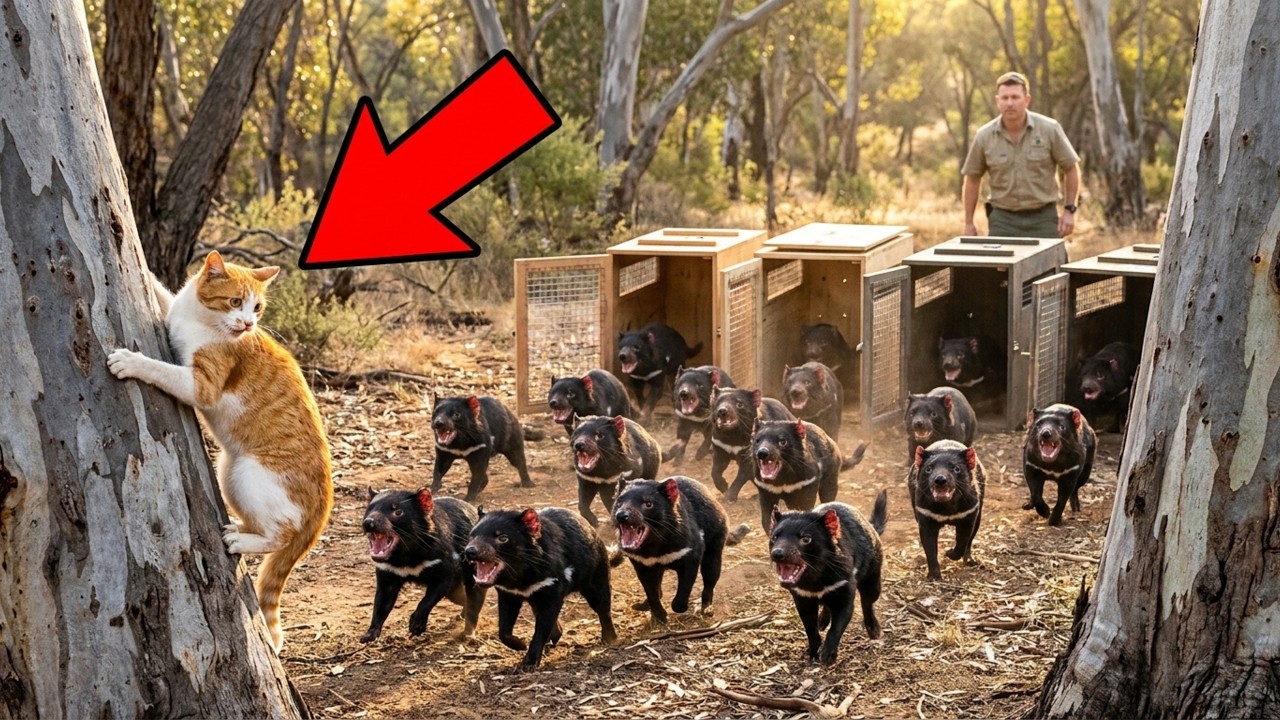
Australia released 26 Tasmanian devils into mainland bushland teeming with feral cats, betting their bone-crushing jaws could shift the balance of an ecosystem under siege. Scientists watched these scavengers move through predator territory, tracking how they hunted, fed, and left carcasses stripped bare.
In November 2020, two Tasmanian devils named Lisa and Lenny were released into the Barrington Wildlife Sanctuary in New South...

Ted Turner reintroduced a tortoise extinct in America for 10,000 years, and now the species faces survival without its founder. The billionaire turned conservationist launched a bold rewilding project, breeding giant tortoises on his private land to restore a lost ecosystem.
On the evening of September 22, 2023, biologists placed 20 tortoises in a large desert enclosure at Ted Turner's Armendaris...