Their own survey numbers in the 1990s told the story—a Wisconsin riverbed that once held 149 mussels per square meter had collapsed to fewer than two. The species that filtered the Mississippi for centuries was vanishing.
Efforts to restore freshwater mussel populations in the upper Mississippi River have shown measurable progress. For roughly two decades, federal and state agencies have worked to rebuild a species that once filtered the river on an enormous scale. The project, centered at the Genoa National Fish Hatchery in Wisconsin, has involved breeding and releasing more than 500,000 juvenile mussels into the river since the early 2000s. Recent surveys indicate that in some areas, the mussels are reproducing on their own again.
Historically, dense beds of freshwater mussels lined hundreds of miles of the upper Mississippi. At their peak, they functioned as a natural water treatment system. A single adult mussel can process 8 to 15 gallons of water per day, pulling out algae, bacteria, and fine sediment. A healthy stretch of riverbed six miles long could remove roughly 25 tons of suspended material per year. The mussels also stabilized the riverbed, and their waste fed bottom-dwelling insects, which supported fish and waterfowl.

By the late 20th century, that system had largely collapsed. According to surveys conducted in the 1990s, mussel density at one of Wisconsin’s most productive beds fell from 149 animals per square meter to fewer than two. In several reaches, field teams found no living mussels at all.
The decline unfolded over more than a century and involved three main factors. In the late 1800s, mussel shells were harvested heavily for use in clothing buttons. In Wisconsin alone, 16 million pounds of shell were collected in 1899, stripping beds that had taken centuries to develop. The button industry eventually declined, but the river itself had been altered. The lock and dam system built in the mid-20th century turned free-flowing stretches into a series of slow-moving pools. This fragmented the migratory routes of fish species that mussels depend on for reproduction and covered the clean gravel and sand they need with layers of sediment.
The third factor arrived in the 1980s. Zebra mussels, introduced to the Great Lakes through ship ballast water, spread into the Mississippi within years. They attach to hard surfaces, and on a muddy riverbed, the only hard surface available is often the shell of a native mussel. Thousands of zebra mussels can pile onto a single native animal, eventually sealing it shut and preventing it from feeding or breathing. In the most affected areas, native mussel populations dropped by 80% within a few years.
The species at the center of the recovery effort, the Higgins eye pearly mussel, saw its range shrink by more than half. By 1999, sampling at formerly abundant sites in the upper Mississippi yielded no living specimens.
The mussel’s reproductive cycle made natural recovery difficult. Females release larvae that must attach to a fish’s gills to survive. In the wild, a female uses a fleshy flap of tissue shaped like a small minnow to attract predatory fish. When a fish strikes, the mussel releases a cloud of larvae into the fish’s mouth, and the larvae clamp onto the gill tissue. The fish’s immune response then seals each larva inside a pocket, where it feeds on the host’s blood and transforms into a juvenile mussel. The juvenile eventually drops off and settles into the riverbed.
By the late 1990s, this cycle had broken down. The water was too cloudy for fish to see the mussel’s lure, dam systems had disrupted fish movement, and juvenile mussels that reached the bottom were often smothered by sediment or colonized by zebra mussels before they could grow.
In 2000, a coalition of federal biologists, hatchery staff, and state wildlife agencies began manually recreating each stage of the mussel’s life cycle. Workers collected egg-carrying females from the few remaining populations and gently flushed larvae from their gills using a syringe filled with river water. The females were returned to the riverbed. In the hatchery, bass and walleye were placed in holding tanks with a solution containing thousands of larvae per liter. As the fish breathed, the larvae attached to their gills. Biologists then tracked water temperature carefully, since the larvae’s transformation into juveniles is driven by accumulated heat. When the transformation completed, the juveniles dropped off the fish into collection trays.
Even after producing juvenile mussels, early survival in the river was poor. Direct release produced survival rates in the single digits. To address this, a biologist named Chris Barnhart designed a device called a mussel silo, a concrete dome about 30 centimeters across with a central chamber covered in fine mesh. Juvenile mussels were loaded inside, and the dome was lowered to the riverbed. Water flowing over the curved surface creates a low-pressure zone that draws water up through the chamber, supplying the developing mussels with oxygen and food while shielding them from predators and sediment. Survival inside the silos ranged from 81% to 92%.
The project faced setbacks. Early batches of juveniles died because their dietary needs were not fully understood, and some silos clogged with sediment during hot summer flows. Protocols were revised, and the hatchery eventually began producing and releasing over 500,000 juveniles per year.
The results were not immediately visible. Freshwater mussels grow slowly, sometimes just a few millimeters per year, and can live for 50 to 100 years. For several years, the only sign that the project had not failed was the absence of large-scale die-offs. Biologists continued to check silos and measure shell growth in fractions of a millimeter. At one mussel bed in Cordova, Wisconsin, dive teams continued an annual effort to scrub zebra mussels off surviving native mussels by hand, involving about 75 people each year.
In 2005, evidence of natural reproduction appeared. At Prairie du Chien, Wisconsin, in a stretch of the river where surveys in 1999 had found no living Higgins eye mussels, biologists found untagged juveniles that had not come from the hatchery. These animals had been born in the river, attached to a wild fish’s gills, transformed, and survived without human help. At Cordova, the population was reclassified as reproducing and self-sustaining.
The restored mussel beds have also begun affecting the river environment. Water clarity has improved in some areas, allowing sunlight to reach deeper. Underwater plants such as wild celery have returned to stretches where they had not grown for decades. The plants provide habitat for fish and food for diving ducks.
The improved clarity also supports the mussels’ own reproduction, since fish can more easily see the female’s lure in clearer water. This creates a self-reinforcing cycle, where healthier mussel populations lead to clearer water, which supports more successful reproduction.
The project’s total cost was under one million dollars in state funding. By comparison, replicating the water filtration provided by the mussels with mechanical treatment plants would cost tens of millions of dollars annually. The restored mussels provide that filtration continuously, without electricity, for decades.
The recovery is not complete. Mussel populations remain far below historical levels, and zebra mussels are still present throughout the river. But the evidence from the upper Mississippi shows that a species once considered functionally extinct in parts of its range is reproducing on its own again. The system that kept the river clean for millennia is being rebuilt, one small, sedentary animal at a time.
Recommended Stories
A massive creature just surfaced near fishermen, leaving them scrambling for cameras as it began hunting giant crocodiles. The footage captures the predator moving through the water with eerie precision, targeting apex reptiles that usually fear nothing.
A group of fishermen on a remote stretch of the Amazon River — appearing on the Rio Negro, near Manaus...
A new predator is hunting the ocean’s giants, and the footage left marine biologists stunned. Researchers tracking a massive whale suddenly captured something that changed everything they thought they knew about the deep.
In 2017, several great white sharks washed up dead along the coast near Gansbaai, South Africa, a town known as...
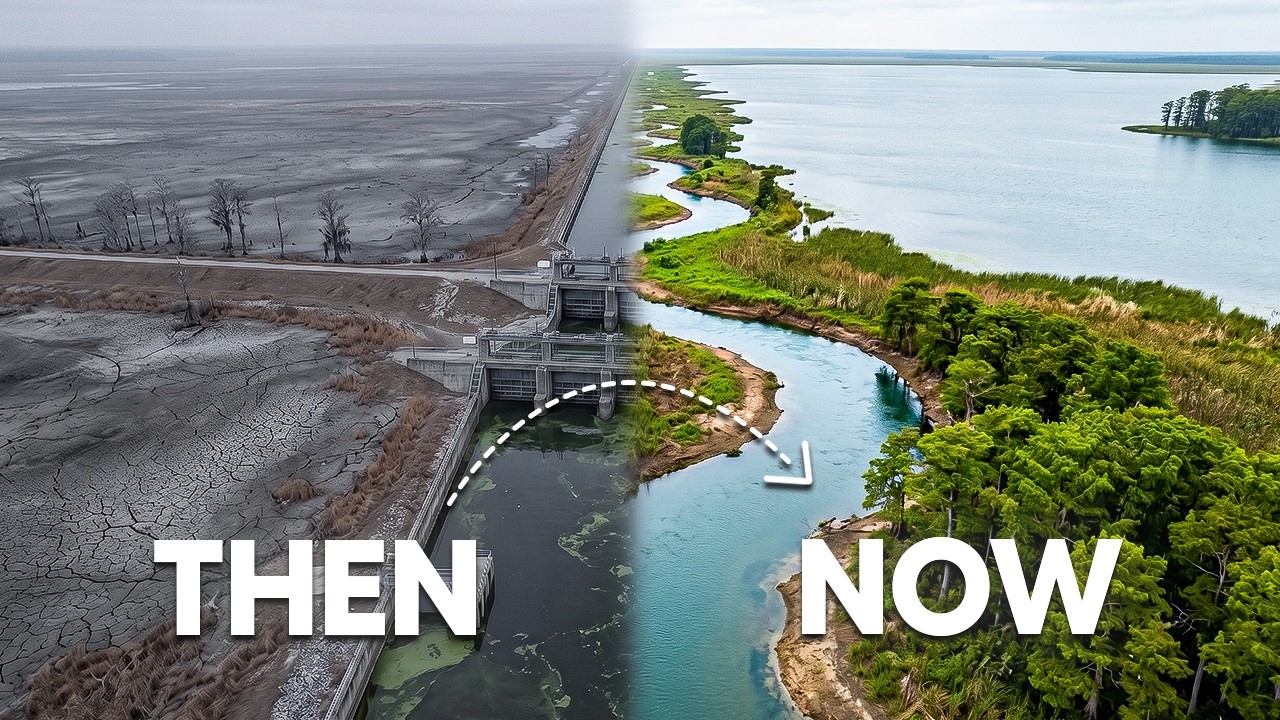
Florida spent nearly $1 billion tearing out a canal it built to fix a disaster the canal itself created. Before being channeled in 1971, the Kissimmee River meandered through 45,000 acres of marshland supporting over a million winter birds.
Between 1999 and 2021, the U.S. Army Corps of Engineers carried out one of the largest ecological restoration projects in...