Florida quietly admitted no honey badgers exist here—yet trail cameras near Miami recorded a low, striped animal dragging a snake through the Everglades. The state agency issued no response, then or since.
Night reports from the levee roads began arriving not from researchers but from airboat guides who had worked those waters for two decades. Something had torn three Burmese pythons apart along a canal outside Homestead and left the remains on the bank instead of swallowing them. The method did not match any native Everglades predator. Alligators typically drown and consume prey in the water. Hawks and owls strike from above and carry prey away intact. The pattern on the bank was different: the snakes had been dismantled before parts were eaten, a style consistent with the mustelid family.
The guides also found tracks in soft mud near the canal edge. They were not alligator drag marks or raccoon prints. The tracks showed five toes, widely spaced and deep, suggesting an animal heavy enough to press well into saturated ground. According to official Florida species lists, no such animal should exist there. Later, a trail camera near Tamiami Trail recorded a four-second clip of a low, muscular, striped animal pulling a small snake through shallow water before turning toward the lens and leaving the frame. Online commenters named it the Florida honey badger within hours. The state wildlife agency issued no response, then and since. The Everglades, quiet for roughly twenty years, had become noisy again.

To understand what may be happening in the canals at night, it helps to understand what the pythons did to the Everglades over two decades of invasion without meaningful resistance.
The Everglades was once one of the noisiest ecosystems in North America. Through the 1990s, dawn at Anhinga Trail brought constant sound from wading birds, frogs, and alligators moving off the banks. By the mid-2000s, longtime residents noticed the quiet before scientists produced data. In 2012, a U.S. Geological Survey study confirmed what locals described. Raccoon sightings in the park had fallen by 99 percent from baseline. Opossum sightings fell by 98 percent. Bobcat sightings fell by 87 percent. Marsh rabbits had largely vanished from large sections of habitat that had previously supported healthy numbers. In the most heavily invaded parts of the park, the snakes had not merely reduced wildlife—they had removed it entirely.
Burmese pythons reached Florida the way many invasive species do: gradually, then suddenly. In the 1990s, they were common exotic pets, appealing in small enclosures until they outgrew both the tank and the owner’s ability to manage them. Owners released them into the wild. Hurricane Andrew in 1992 destroyed a python breeding facility on the edge of the Everglades, releasing dozens of animals into the marsh at once. The environment suited them perfectly. The Everglades offered warmth, water, abundant prey, and no predator capable of killing an adult python, which can reach 18 feet in length and 250 pounds in weight.
The species’ biology made control difficult. A single female can lay up to 100 eggs at a time and can store sperm to fertilize a clutch months after mating. Removing males from the population therefore does not slow reproduction the way it does for many vertebrates. A small group of escaped pets and hurricane survivors became a self-sustaining breeding population before any official response was organized. By the time Florida acknowledged the scale of the problem, the snakes had reached every corner of the park.
The response that followed spanned two decades of serious effort with limited results. Florida spent more money removing pythons than any other state had spent on any invasive reptile management program in North American wildlife history. The state offered bounty programs paying hunters per foot of snake. Specially trained dogs tracked python scent through sawgrass that humans could not see through. Researchers developed Judas technology, fitting captured male pythons with radio transmitters and releasing them to lead teams to breeding aggregations. Aerial thermal surveys, hunting programs, ground surveys, and organized removal operations were all deployed. Each method removed some snakes. None removed enough.
The Everglades covers one and a half million acres, mostly submerged terrain that ground teams cannot survey efficiently. The Burmese python’s camouflage is so effective that experienced hunters have walked past snakes over 15 feet long without noticing them. The number of snakes removed through all programs represents a small fraction of the estimated total population. In the late 2010s, the tone shifted from optimism to a quieter admissions that the available tools were not sufficient. The breeding population in such a vast environment outpaced the funded removal programs.
At that point, some began proposing an unconventional solution: introduce a predator that hunts on the python’s own terms but more effectively. The honey badger, Mellivora capensis, became the focus of that discussion.
The honey badger is built for this kind of work. Its skin is thick and loosely attached to the underlying muscle, allowing the animal to twist inside its own skin and bite an attacker that has grabbed it. Its tissues have partial resistance to snake venom, developed over millions of years of hunting venomous prey on two continents. Documented behavior includes deliberately hunting and killing African rock pythons, puff adders, and black mambas. When a honey badger encounters a snake, it treats the encounter as a meal rather than a threat. One South African wildlife warden described the management philosophy this way: you do not train a honey badger; you show it what you want, then get out of its way and hope for the best.
In spring 2022, leaked documents circulated on a small Florida conservation forum describing something called Operation Badger. The documents read like an internal research proposal rather than a hoax. They included GPS coordinates for release zones, dates, and radio collar frequencies. The plan proposed releasing a small number of collared, chipped honey badgers into high-density python corridors. The population size was intentionally small, based on the theory that honey badger territorial behavior would act as biological containment. The species is fiercely solitary. A single male controls several hundred square miles and actively drives off other honey badgers. The argument in the documents was that a colony was unnecessary—a handful of solitary predators distributed across the most concentrated python breeding areas would be enough. Pythons had never encountered a predator that hunted in the same manner they did. The bet was that novelty alone would change the dynamics.
The photograph attached to the leaked documents was blurry enough to be dismissed and specific enough to be difficult to ignore: a collared, low, heavy-bodied animal standing over a dead snake in shallow water. Internet discussions continued for weeks. The agency said nothing.
What the agencies could not suppress was data from monitoring stations in the corridors nearest the alleged release zones. Active python nests fell by nearly a third in a single breeding season. Egg clusters that biological models predicted would produce hundreds of hatchlings were found attacked and abandoned. Hidden cameras in those areas recorded small python carcasses showing the specific damage pattern associated with mustelid predation. One wildlife scientist working on the levee roads described the season’s monitoring data as the marsh exhaling for the first time in a decade.
There is a broader principle that matters here. When wolves were reintroduced to Yellowstone National Park in 1995, they killed only a small fraction of the elk population. What changed was where the elk went. Elk avoided river valleys where wolves hunted effectively, which allowed willow and cottonwood plants that had been stripped by overgrazing for 70 years to regrow. Beavers returned. Songbirds returned. Riverbanks stabilized. The wolves did more by their presence than by their hunting. Ecologists call this a landscape of fear, one of the most powerful documented forces in ecosystem management. A predator does not need to eliminate its prey to restructure its behavior. It only needs to be present and recognized as a threat.
If something in the Everglades is generating that recognition among the python population, the effect would not appear in body counts. It would appear in nesting behavior, movement patterns, and the distribution of breeding aggregations across available territory. That is what monitoring data from those corridors began to show.
Then, animals that had been absent returned. Marsh rabbits appeared in levee sections that had been empty for three consecutive surveys. Raccoon sightings increased on trail cameras in areas directly north of documented python retreat zones. Wading bird colonies that had abandoned traditional nesting sites after years of python predation returned to those sites. The sound returned before census data confirmed it, just as guides had described the quiet arriving in the first place.
Nobody was prepared to say conclusively that honey badgers caused this. The correlation existed. Causation was the exact point of active dispute.
The counterargument is not weak. The modern history of introduced predators is a graveyard of confident plans. Mongooses brought to Hawaiian sugarcane fields to control rats instead hunted ground-nesting birds and pushed multiple species toward extinction. Nile perch introduced to Lake Victoria in the 1950s to improve fishery productivity eliminated about 200 species of native cichlid fish found nowhere else on Earth. Cane toads brought to Queensland in 1935 to control beetles in sugarcane fields ignored the beetles, spread across 3 million square kilometers, and now kill native predators that attempt to eat them because their skin carries toxins Australian species never developed defenses against. Each of those catastrophes was proposed by competent people with apparently reasonable logic and peer-reviewed support.
Honey badger advocates have one answer to this argument: do nothing, and within 20 years there may be no Everglades left to protect from the animal introduced to save it.
The official position remains unchanged. There are no honey badgers in Florida. Tracking data from Operation Badger, if it exists, has not been released. Agencies have declined press inquiries with responses that read less like denial and more like legally reviewed non-answers. Meanwhile, monitoring data from the corridors continues to produce numbers that python removal programs never achieved. Airboat guides continue to find things in the canal mud at night that are not on Florida’s species list.
The deeper question beneath the honey badger story is one that applies to every major ecological intervention of the past century. When an ecosystem breaks down to a point beyond which natural recovery cannot repair it in any meaningful timeframe, how far are we willing to go? Some see the possible activity in the levee corridors as ecological boldness. Others see exactly the kind of arrogance that created the python problem in the first place. One animal was introduced to solve a problem, and that animal reshaped the Everglades. Now another may have been introduced to solve that problem. Somewhere in the reeds, in the heat, in the darkness before dawn, the marsh is producing its own answer to a question that was never fully resolved the first time.
The honey badger does not know it represents a political debate, a leaked document, an internet conspiracy theory, or a test case for the ethics of predator introduction. It does what honey badgers do: hunt everything in its territory with efficiency and apparent indifference to the size of its opponents. And the Everglades, for the first time in 20 years, is making noise again.
Recommended Stories

England called his method illegal for years, a lonely crusade dismissed by officials. Then beavers arrived, and suddenly nature backed him up.
Ben Goldsmith, a financier and environmental adviser to the British government, spent years trying to farm 300 acres of land...
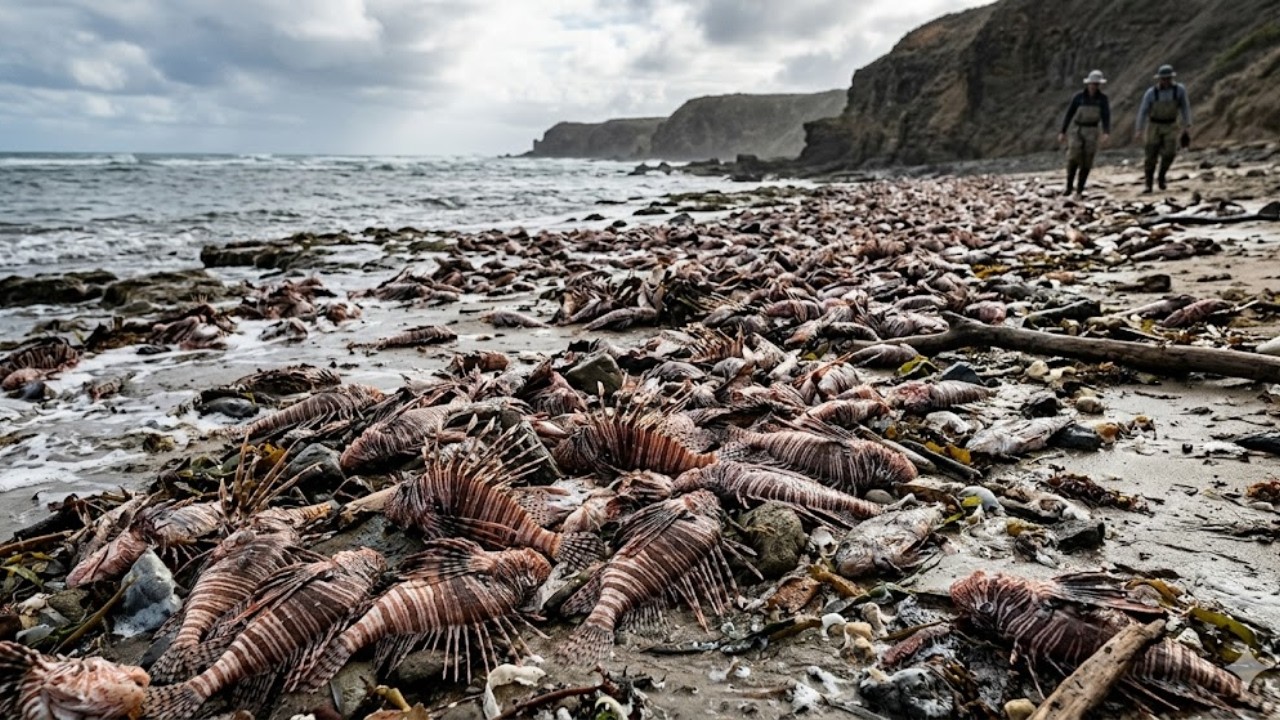
Scientists are baffled—lionfish, the invasive species that overran Florida reefs, are vanishing. Native predators weren’t supposed to touch them; their venomous spines made them almost untouchable.
Between the mid-1980s and the late 2000s, lionfish, a venomous species native to the Indo-Pacific, established themselves across the Atlantic...

A pod of orcas has been ramming and sinking yachts off Europe’s coast, and scientists say they’ve finally cracked why. For years, the attacks have baffled experts, with dozens of vessels damaged near the Iberian Peninsula.
In May 2020, a sailor crossing the Strait of Gibraltar felt his small yacht being pushed from below. Something was...