Scientists are baffled—lionfish, the invasive species that overran Florida reefs, are vanishing. Native predators weren’t supposed to touch them; their venomous spines made them almost untouchable.
Between the mid-1980s and the late 2000s, lionfish, a venomous species native to the Indo-Pacific, established themselves across the Atlantic coast after being released from home aquariums. By the time Dr. James Whitfield had spent 14 years monitoring reef sites in the Florida Keys, the ecological damage was well documented. The keys’ reef systems had lost large portions of their native small fish populations, and the situation appeared stable only in the sense that it was severe.
During a March survey at a site near Looe Key, Dr. Whitfield and his dive partner observed a change in what had been one of the most lionfish-dense areas in his long-term dataset. The site had consistently held between 11 and 14 resident lionfish across 14 years of monitoring. On this dive, he counted three. After searching the structure thoroughly and confirming his baseline notes, he contacted the reef monitoring coordinator. The call marked the beginning of an unexpected shift in local marine ecology.
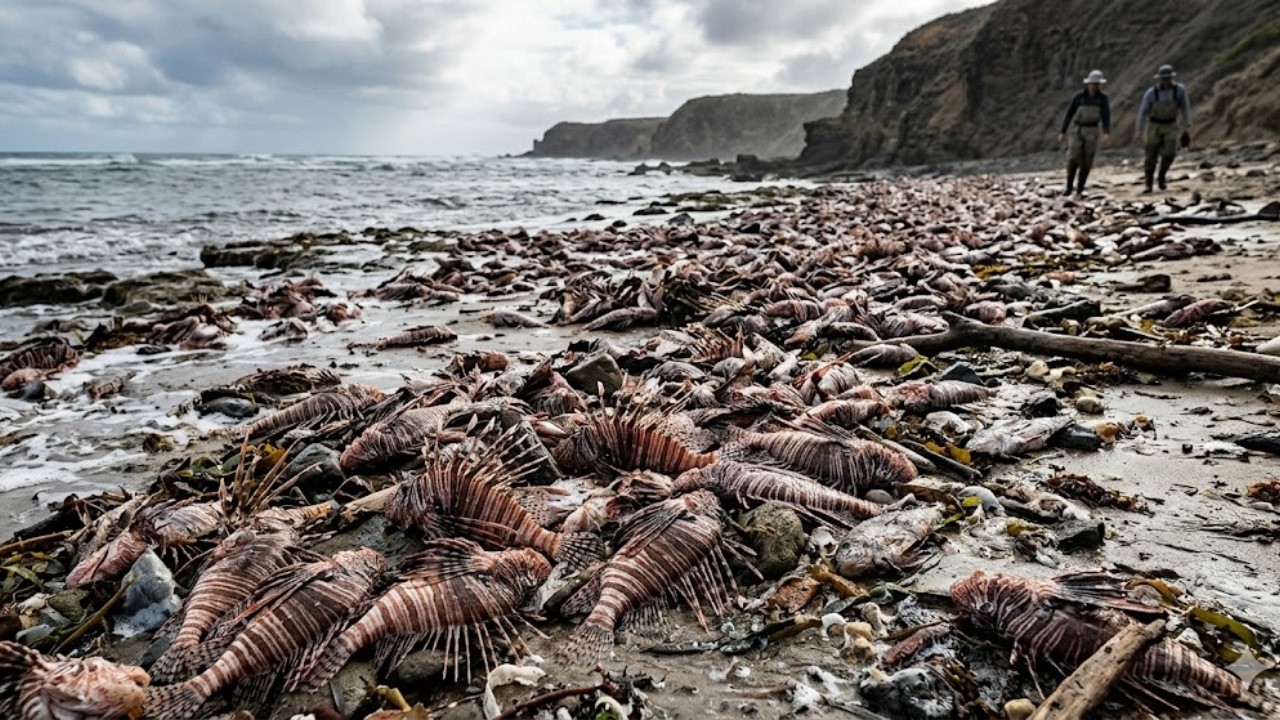
For decades, lionfish posed a serious problem for American reefs. Native Atlantic fish had no evolutionary experience with the species and displayed no avoidance behavior when lionfish arrived. In some documented cases, reef sites lost up to 80 percent of their small native fish populations within five weeks of lionfish appearing. The Atlantic invasion traced back to fewer than 10 founding animals, making the entire population a genetic monoculture with no variation that could drive adaptation.
Florida officials and researchers mounted extensive removal programs. Dive teams with pole spears, tournament derbies, restaurant campaigns, and experimental traps all produced measurable results at specific sites. The population did not change at the broader level because of the species’ reproductive biology. A single female lionfish produces up to 2 million eggs per year and reaches reproductive maturity within one year. When thousands of lionfish were removed at a site, the remaining females replaced them before the next survey season. The fundamental mathematics of their reproduction outpaced human removal efforts, and the invasion continued expanding into deeper water where diver-based programs could not operate.
After years of documentation, the community monitoring these reefs had come to a quiet consensus that removal would not solve the problem. The question had changed to how to reduce lionfish impact below the threshold of irreversible reef collapse. There was no confident answer to that question when the Looe Key data began to move in a direction that defied explanation.
Dr. Rebecca Morales, who analyzed native fish population data across Florida Keys reef zones, spent three months reviewing Dr. Whitfield’s data to rule out alternative explanations. She then went back through camera archives from the monitoring site and began watching the footage for what was moving around the lionfish before and after the density decline began. What she found was that the cameras had documented goliath grouper, the largest native reef fish in American waters, holding resident positions in the same structural zones where lionfish had been concentrated. Goliath grouper adults can reach 8 feet in length and weigh more than 600 pounds. Her footage showed that every site with measurable lionfish reduction had documented goliath grouper activity nearby.
The goliath grouper had almost disappeared from Florida waters by the late 1980s due to decades of overfishing. A 1990 protected species listing prohibited all harvest without exception. The recovery over the following three decades is considered one of the most significant conservation outcomes in Atlantic coast marine biology. By 2010, survey data showed populations rebuilding in protected zones, and younger animals were appearing in reef structures that had not held resident goliath grouper within memory of active divers.
The mechanism connecting the goliath grouper recovery to declining lionfish numbers became clearer through the camera footage. Lionfish spines are venomous and designed to deter frontal attacks. Goliath grouper, as ambush hunters, do not approach from the front. They hold still in reef structure, wait for a lionfish to settle and face away, then strike from behind and above. The suction force of the strike flattens the lionfish’s spines before venom delivery is possible, and the grouper disappears into the reef within seconds. Dr. Morales documented 17 such events across four monitoring sites in a single survey season, each carried out by different individual animals displaying the same approach geometry. The consistency across sites suggested independent development of the same solution, not learned behavior shared between animals.
A secondary layer of predation came from moray eels at the same sites. Eels hunt from inside the reef structure into the crevices and overhangs where lionfish establish territory and where goliath grouper size prevents access. Where both native predators overlapped, the survey data showed the steepest declines in lionfish detection across Dr. Whitfield’s 14-year dataset. The two predators occupied different positions in the reef, one hunting the open water and the other hunting from within, and the combined effect exceeded what either species produced alone.
None of this had been planned as lionfish management. The 1990 protection decision was designed to prevent the extinction of goliath grouper from American waters. The moray eel population in protected reef zones was tracked separately as a native species outcome. The goliath grouper recovery program and the lionfish removal program were funded through separate budget lines and did not share data until the Looe Key survey numbers made the connection unavoidable.
After the initial discovery, Dr. Whitfield returned to Looe Key four times in the following survey season. The lionfish numbers held at the reduced level, and the goliath grouper presence held at the elevated level. On his fourth visit, he positioned himself outside the coral head for 28 minutes and observed a large goliath grouper holding motionless inside the structure before slowly repositioning. He recorded the observation in his dive log. He did not observe the strike itself, but the pattern held.
The key question raised by the data is whether the goliath grouper recovery can expand quickly enough across Florida Keys reef systems to produce population-level effects on lionfish density before the invasion moves into deeper reef zones. Those deeper areas remain a refuge where neither a native predator nor a human removal program has yet applied consistent pressure. The change at Looe Key is the first documented indication that the protection of one species, carried out for its own sake, has produced an unintended and favorable outcome for a separate ecological problem.
Recommended Stories

Everyone said a broken canyon couldn’t be healed—then volunteers rebuilt it by hand, one rock at a time. In northern New Mexico, crews rejected heavy machinery for a simple method developed by retired biologist Bill Zeedyk.
In northern New Mexico, volunteers have worked to restore eroded creek beds using a method that relies on hand-placed rocks...
A deep-sea oil rig sent back footage of a massive, elusive creature scientists thought died out millions of years ago. The crew reportedly watched in stunned silence as the enormous shadow moved beneath the waves, too massive for any known fish.
Fossil evidence indicates that the megalodon, a prehistoric shark that reached an estimated 50 to 60 feet in length, went...
In 1960, British authorities parachuted 23 cats into a rat-infested jungle in Borneo to combat a deadly outbreak, and they shocked everyone by fighting the enemy themselves. The felines were dropped behind enemy lines to clear rats from a far-flung airstrip, saving vital supplies; instead of hunting the rats, they fed on the jungle’s rich wildlife, and when the left booby-trapped the village, the hungry animals started looting local food stores.
In 1960, the Royal Air Force dropped 23 cats by parachute into the remote highland village of Bario in Sarawak,...