The invasive Asian carp that swarmed the Illinois River are suddenly vanishing—and the culprit behind their collapse has stunned scientists. For decades, these fish overwhelmed the waterways, outcompeting native species and threatening the Great Lakes ecosystem.
Bill Drummond had been running commercial nets on the lower Illinois River and the upper Mississippi confluence zone near Alton for 22 years when he hauled in an unusual catch in late October 2021. He had targeted a confined pool near the river’s edge for catfish, but what came up in the net was a 70-pound blue catfish with the tail of an adult silver carp still visible in its throat. The carp weighed close to eight pounds, and the catfish had not finished swallowing it.
Drummond called the research station at Southern Illinois University Edwardsville that same afternoon. The specimen he delivered to fisheries ecologist Dr. Sandra Hale contradicted a central assumption that had guided Asian carp management in the Illinois River for years: that no native predator in the system could take adult carp.

The Asian carp invasion of the Illinois River is one of the most thoroughly documented freshwater invasions in American history. The Illinois Natural History Survey has tracked fish populations in the river since 1957, one of the longest continuous freshwater monitoring programs on the continent. When silver carp and bighead carp moved into the system through the Mississippi River connection in the 1990s and early 2000s, the monitoring infrastructure was already in place.
The data it produced was stark. By 2003, electroshocking surveys in some sections were producing silver carp at 18.4 pounds per minute of sampling effort. By 2007, carp represented 60 to 70 percent of total fish biomass in the most heavily invaded reaches. By 2015, researchers had documented more than 1,200 carp packed into a single kilometer of water in specific corridors of the central Illinois River.
Silver carp and bighead carp are filter feeders. They swim continuously with their mouths open, drawing water through specialized gill structures that remove phytoplankton and zooplankton from the water column. A single adult silver carp can filter between 10 and 20 percent of its body weight in plankton per day. A population measured in thousands of animals per river mile removes the plankton base that native fish larvae and juveniles depend on in their first weeks of life.
The gizzard shad, a native species that had occupied the same plankton niche for thousands of years, declined as the carp consumed the resource base. Bass, crappie, and catfish populations that depended on the shad felt the reduction across subsequent seasons. The native species were not eaten directly. They were removed from below, one link at a time, in a cascade that moved up the food web.
For 15 years, the scientific and management consensus on adult Asian carp in the Illinois River shared one feature: there was no native predator capable of taking them. Juvenile carp in their first six months were vulnerable to multiple species. But adult carp that passed the 12- to 18-inch threshold, where they outgrew the gape geometry of most native fish, were considered functionally immune to biological predation.
This was not a casual assumption. It was based on the documented anatomy of every native predator in the system. The smallmouth bass, largemouth bass, channel catfish, white bass, and crappie all had mouth structures that set a ceiling on the prey size they could physically engulf. A 25-inch adult silver carp moving through open water at sustained speed was above the anatomical reach of anything the river produced.
The management framework built around this assumption was logical. Remove the adults through commercial harvest because no native predator can. Reduce juvenile survival by restoring predator diversity in backwater nursery habitats. Hold the barrier at the Chicago waterway. The biology of the system under this framework required permanent human intervention.
Hale had been working at Southern Illinois University Edwardsville since 2017, studying trophic dynamics in the lower Illinois River and the upper Mississippi confluence zone. Her focus was on the relationship between carp biomass and native fish community recovery in sections where commercial removal pressure had been most sustained. She was comparing sections of river with different removal intensities and different levels of native predator presence.
When she received Drummond’s call, she drove to the landing the same evening.
The blue catfish is the largest catfish species native to the Mississippi River drainage and one of the largest freshwater fish native to North America. Adults in the Mississippi system regularly exceed 60 pounds, and individuals exceeding 120 pounds have been documented in multiple state record books. The species has always been present in the lower Illinois River and the Mississippi confluence zone.
What made Drummond’s specimen significant was the anatomy of its mouth relative to the anatomy of adult Asian carp. The blue catfish is a suction feeder with a jaw capable of opening to dimensions that accommodate prey substantially larger than what most native fish can take. A 45-pound blue catfish can open its jaw to a gape that accepts a fish of 8 to 12 pounds. A silver carp in its third or fourth year of life in the Illinois River reaches 8 to 12 pounds.
Hale requested gut content data from every blue catfish sample the Illinois Natural History Survey had collected from the lower Illinois River and the Mississippi confluence zone across the previous four survey years. The record was not ambiguous. Adult silver carp were present in the stomach contents of blue catfish at a rate of 50 to 70 percent of examined specimens containing carp material, depending on the specific river section and season. Silver carp were the dominant prey item by weight in blue catfish stomachs across multiple sample periods.
The fish that the entire management framework had classified as above the predation ceiling of any native species was being consumed as a primary dietary component by a species that had been present in the system the entire time.
Blue catfish populations in the Illinois River had been declining for decades before the Asian carp arrived. Two forces drove the decline. Commercial fishing pressure targeted blue catfish heavily through the mid-20th century because the species produced the largest individual fish weights in the river and therefore the highest per-fish returns to commercial netters. As commercial effort reduced the population of large adults capable of taking large prey, the average size of the blue catfish population shifted downward. A population with a reduced proportion of large adults has reduced average gape capacity.
The second force was the impoundment and channelization of the Illinois River that began with navigation dam construction in the early 20th century. Blue catfish depend on deep pool habitat and large woody debris accumulations that the channelized river reduced significantly.
The commercial removal program shifted enormous amounts of fishing pressure from native species to carp over 15 years. Netters who had previously targeted blue catfish, buffalo, and drum because those species had market value redirected their effort toward carp because the state’s bounty system made carp removal financially competitive. That pressure shift did not produce an explicit blue catfish recovery program. It produced an implicit one by reducing harvest pressure on a species that responds to reduced harvest pressure by growing older and larger, increasing the proportion of the population that falls into the size class capable of taking adult-sized prey.
The bowfin was a second layer that Hale’s monitoring work identified in backwater sections where native fish community recovery was most advanced. The bowfin is a fish whose lineage extends more than 150 million years into the fossil record. It breathes air through a modified swim bladder that allows it to survive in warm, low-oxygen backwater habitats through summer conditions that would kill most other large fish. It is an ambush predator that holds motionless in aquatic vegetation and flooded timber and strikes at passing fish in less than one-tenth of a second.
In the Illinois River’s backwater lakes and connected sloughs, the bowfin has always occupied the top of the local predator hierarchy. It was considered a trash fish for most of the 20th century, killed routinely by anglers who blamed it incorrectly for reducing bass and crappie populations. The bowfin is an ecological balancer that consumes the most abundant prey available in its territory. In a backwater system with high densities of juvenile Asian carp settling from the main channel into nursery habitat, the most abundant prey is the invader itself.
Hale’s gut content sampling from bowfin collected in backwater sections adjacent to main channel zones where commercial removal was most active showed juvenile carp material in a percentage of specimens consistent with the bowfin targeting carp preferentially in environments where carp density was high. The bowfin does not need to learn that a juvenile carp is prey. It needs only for juvenile carp to be present in sufficient density in its territory.
The trophic cascade that both layers of predation are contributing to is not yet complete, but it is directional. In backwater sections where blue catfish density has been highest across the commercial removal period, and where bowfin populations were not subjected to significant reduction, submerged aquatic vegetation began showing measurable recovery in survey data collected between 2019 and 2023. Fewer large filter feeders in the water column means less phytoplankton removal, cleaner water with greater light penetration, and regrowth of submerged aquatic plants. Plant bed recovery stabilizes bottom sediment, reduces turbidity, and provides structural habitat for invertebrate communities that support native fish juvenile survival.
In those specific backwater sections, native fish community monitoring showed modest increases in young-of-year largemouth bass, bluegill, and crappie catch rates in the 2022 and 2023 survey periods. Not a restoration to historical baseline, but a directional shift in sections where two specific biological forces were operating alongside the human removal effort.
Drummond still runs nets on the lower Illinois River and the Mississippi confluence zone. His operation is still primarily carp removal because the carp remain in numbers that justify the commercial focus. But he described something to Hale’s field team the following spring that the monitoring data was beginning to support. In the deep pools he had worked for 22 years, the distribution of species in his nets had shifted. He was finding blue catfish in size classes he had not seen consistently in those specific pools in over a decade. Large animals, fish in the 40- to 60-pound range, holding in the deep pool structure the way blue catfish hold when they have found productive hunting ground.
He said the catfish had moved into the carp’s water. He had watched the carp move into the catfish’s water 20 years earlier. He was now watching the reversal.
The Illinois River’s Asian carp problem is not resolved. The commercial removal operation, which has pulled more than 20,000 metric tons of carp from the Illinois River over 15 years, remains the primary quantitative force against the carp population. The electric barrier at the Chicago waterway remains the primary structural defense against Great Lakes entry. Funding battles over the Brandon Road permanent barrier project and periodic interruptions to commercial netting contracts represent ongoing risks to the management system.
What is in question is the framework that classified adult Asian carp as above the predation ceiling of any native species. The blue catfish in the lower Illinois River and Mississippi confluence zone was taking adult silver carp throughout the invasion. The bowfin in the backwater systems was taking juvenile carp. Neither species was directed to do this. Neither was included in any management plan. Neither was funded for this purpose. The carp removal program had the effect of restoring predator pressure on the very prey the removal program was targeting.
Recommended Stories
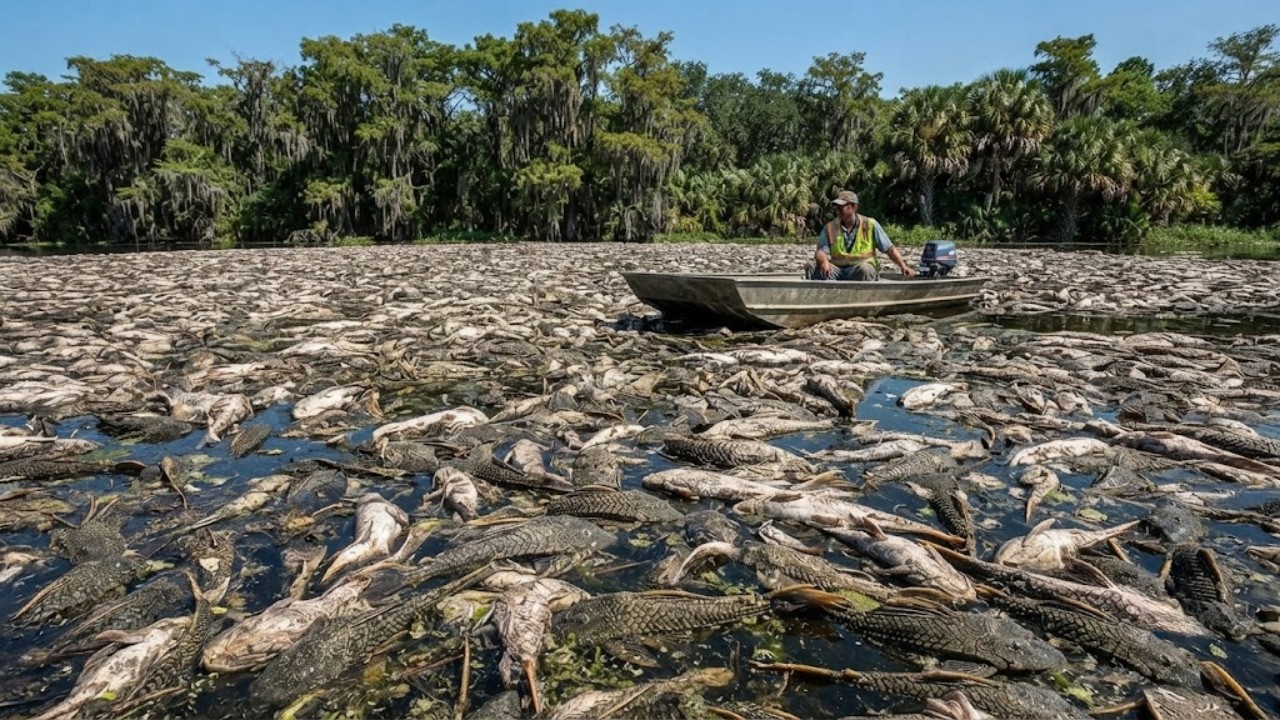
Armored catfish are vanishing from Florida’s rivers, and scientists have finally identified what’s preying on them. These invasive fish, protected by tough bony plates, seemed nearly untouchable in the state’s waterways.
For four years, Dr. Ryan Allisson had been conducting population density surveys in Florida's Peace and Hillsborough rivers. He knew...

Something Bigger Than a Python Is Hunting in Florida — Cameras Captured It. Locals thought the massive tracks belonged to an oversized python, but a trail cam caught something far stranger lurking near the Everglades.
Researchers at the Conservancy of Southwest Florida found a dead Burmese python roughly 15 miles deep in the Everglades. They...

Beavers released into a toxin-laden English creek weren’t expected to survive, but their response to the filthy water shocked researchers. Faced with a channel polluted by agricultural runoff, the animals began building dams and packing mud and sticks with startling urgency.
On 13 January 1992, a drainage tunnel collapsed beneath the abandoned Wheal Jane tin mine in Cornwall. Over the following...