A killer thought to be untouchable is suddenly vanishing from the ocean. Great white sharks, the ocean’s top predators, are disappearing from their usual hunting grounds at an alarming rate.
White shark sightings in False Bay, the wide bay on the southern edge of Cape Town, fell sharply in the late 2010s and then stopped entirely. A program called Shark Spotters, which places trained observers with binoculars on high ground above beaches, recorded an average of 205 white shark sightings a year from 2010 to 2016. In 2018, the spotters logged 50. In 2019, they logged none. The next confirmed white shark appeared in the bay in January 2020, about 20 months after the last one.
Seal Island sits in the bay and is home to a large colony of Cape fur seals. The seals are the reason the sharks came. Researchers and local naturalists ran standardized boat surveys around the island from 2000 to 2018, recording 6,333 white shark sightings and 876 attacks on seals over that period. Their counts showed shark numbers and attack rates falling between 2015 and 2018, with record lows in the final two years. From mid-2018 onward, the standardized counts found no white sharks at the island at all.

Most South African shark researchers attribute the disappearance to a pair of killer whales named Port and Starboard, adult males identified by their dorsal fins, which flop in opposite directions. Reports from the National Scientific Facilities Council and other sources describe the whales killing sharks along the coast. A 2019 paper also recorded 120 sightings of broadnose sevengill sharks at Seal Island, a species that normally stays near the western shore. On 28 March 2018, while the surveys were finding no white sharks, the team saw a sevengill of about 2 meters attack a young fur seal, a hunt that had previously belonged to the white sharks.
South Africa made white sharks a protected species in 1991 after decades of fishing and beach nets. However, a 2021 article in the South African Journal of Science counted 1,073 white sharks killed in KwaZulu-Natal beach nets between 1976 and 2008. It also noted that sightings at Gansbaai, a cage-diving town east of Cape Town, began falling in 2013, years before any orca was tied to a white shark death on that coast. The island numbers alone cannot explain whether the sharks died or left.
Port and Starboard first appeared in False Bay in 2015, though orcas in general had been visiting more often since 2009. Over 2015 and 2016, researchers recorded two orca attacks on sevengills at the species’ main gathering spot. A 2019 paper described the method: the whales forced the pectoral fins until the cartilage girdle split apart, then ate the liver and left the rest. Tagged sevengills fled the gathering site at Miller’s Point within 24 hours of a kill and stayed away for up to 290 days. After four confirmed attacks, the sharks abandoned the site entirely.
White sharks came next. During 2017, five dead white sharks came ashore around Gansbaai, each missing its liver and bearing tooth marks pointing to orcas. A 2022 paper linked orca predation to the white shark’s absence at Gansbaai. On 16 November 2020, Bloomberg reported that a government-appointed panel had found orca attacks the likely reason white sharks were gone from the waters off Cape Town.
Footage of an attack followed on 16 May 2022, when a drone pilot tracked five orcas off Hartenbos Beach near Mossel Bay, roughly 400 kilometers east of Cape Town. Starboard was among them. During about 30 minutes of filming, one orca pushed a white shark of roughly 3 meters ahead of its snout, rolled it over, and bit into it near the pectoral fins. A paper described the clip as direct observation of killer whales preying on white sharks and evidence of a flight response.
The most detailed kill came on 18 June 2023, when people on shore at Mossel Bay spotted Port and Starboard. A research boat that went out after them crossed a slick on the surface that smelled of shark liver oil. A young white shark roughly 2.5 meters long broke the surface ahead of Starboard, which clamped onto its pectoral fin and ripped its body open. Researchers reported that the shark was disabled and its liver eaten in under two minutes. Port held back roughly 100 meters away and never joined in. A day later, a different white shark, a female about 3.5 meters long, lay dead on the sand at Hartenbos. A necropsy found tooth rake marks, a long tear across the belly, and no liver or reproductive organs. As of October 2026, the June 2023 attack stood as the first recorded instance in South Africa of a single orca taking a white shark.
For False Bay, the status is different. In their 2025 paper, the Seal Island team wrote that orca kills of white sharks had not yet been recorded inside the bay. The bay that emptied most completely has no orca-killed white shark to show for it. That gap is where the argument starts.
The widest test so far merged six abundance indices from cage-diving boats, research vessels, shore anglers, and the KwaZulu-Natal shark control program. Sightings in False Bay dropped from 2.5 sharks an hour in 2005 to 0.6 in 2017. At Gansbaai, they peaked at 3.8 an hour in 2011 before sinking to 0.2 in 2020. Mossel Bay climbed to a high of 2.8 sharks an hour in 2017 and then slid to 1.1 in 2019.
The clearest eastern signal came from Algoa Bay beside the city of Gqeberha in the Eastern Cape. Shore anglers there caught and released six individual white sharks in the 2013 season and 59 in 2019. A doctoral student studying the whole coastline had pointed out by 2020 that Eastern Cape sightings rose as Western Cape sightings fell. Fishermen around Algoa Bay said they had never seen so many white sharks. When blended into one trend reaching back to 1991, the six series came out close to flat. The group found no sign of a systematic rise or fall in white sharks across South Africa since protection began. The same model explained only 5.4 percent of the variation in the data, a number both sides cite. It means the flatline averages are noisy and most of the swings at each site come from causes the model left out, such as weather, boat effort, or orca visits.
Orca encounters elsewhere point the same way. At the Farallon Islands off San Francisco, 17 tagged white sharks cleared out in 2009 when orcas passed through, and could stay away for as long as a year. When a different orca pod without Port and Starboard reached Mossel Bay in late 2019, one researcher said the count around the cage-diving boats fell overnight from seven to ten sharks to none.
The sevengill that attacked a young seal in March 2018 was an early sign of what the white sharks’ absence did to the bay. In 2025, researchers showed that seals and sevengills both grew more common at Seal Island after the white sharks left. That is the kind of chain reaction ecologists call a trophic cascade. The pajama catshark, a small striped shark that sevengills eat, fell 72 percent in winter relative abundance between the years with white sharks and the years without them. Summer counts of smoothhound sharks fell 42 percent, and Cape horse mackerel, a schooling fish eaten by seals, declined too.
The evidence carries gaps that can be stated as facts. No tagging study has followed individual Seal Island sharks to Algoa Bay and shown the same animals arriving there. The Algoa Bay angler counts start in 2013, leaving no long eastern baseline. The Gansbaai boat data reach back only to the early 1990s and the False Bay records only to 1996 for an animal thought to live about 70 years. Those gaps narrow the question for the experts. The orcas clearly kill white sharks and clearly scare them off. Whether the east holds enough sharks to account for everyone missing from False Bay, and how many died on hooks rather than in the jaws of Port and Starboard, is where the scientists split.
The main challenge came in 2024. A group of researchers argued that the data as analyzed could support neither a stable population nor a move east. One of the authors, Enrico Gennari, also co-authored the 2024 paper on Starboard’s solo kill, so one of the people who documented the orca attack is among those arguing that orcas are far from the whole story. Timing sat at the core of the critique. The decline at the old gathering sites began before any shark-eating orcas showed up. A predator that arrived later cannot explain how the slide started. The authors added that a simple shift of the whole population eastward would have left Algoa Bay with roughly tenfold the sharks the anglers recorded.
One researcher, Sarah Andreotti, told Daily Maverick that orcas could play a temporary role and that too much attention had gone to sporadic events, about ten in total since 2017 by her count, while people kept removing white sharks year after year. Her genetic work put the population at around 300 breeding adults from 2009 to 2011 against a rough minimum of about 500 thought necessary to avoid inbreeding. The original group answered later in 2024 that its conclusions stood. Regional abundance had shown no systematic rise or decline since 1991, and the shift in incidents fit a partial move along the coast. Both camps shared one point: a protected species should have grown over three decades, and the lack of any increase was concerning.
In 2025, researchers put a number on the human toll. They estimated that from 2000 to 2023, the demersal shark longline fishery could have killed about 24 white sharks a year. Lethal beach protection run by the KwaZulu-Natal Sharks Board using nets and drum lines accounted for about 20 a year. That comes to about 44 white sharks a year from a population the authors placed at roughly 500 to 1,000, or 5 to 10 percent removed annually, a rate they called clearly unsustainable. The same paper accepted that orcas had pushed white sharks east for varying stretches and that real orca kills likely outnumber recorded ones, but argued that a fear response cannot explain a permanent absence from sites the orcas visit only now and then.
Supporters of the orca explanation point to a pattern that every documented case has followed. At Miller’s Point, the Farallon Islands, Gansbaai, and Mossel Bay, whenever orcas killed sharks or simply patrolled, the surviving sharks left within a day or two, and those absences showed up as empty counts far more often than as carcasses. One researcher has also warned that not every pod has that effect, telling Mongabay that some orcas enter a gathering site with no change in white shark sightings.
The cascade at Seal Island shows the shark’s absence carries its own cost, whatever caused it. With its top predator gone, the bay now holds more seals and more sevengills, and considerably more pressure falls on the small fish and small sharks those animals eat. Few places offer two decades of matching surveys to measure what a marine food web does when its largest shark leaves.
The argument over numbers shapes policy. If the sharks mostly moved, the empty Western Cape sites reflect fear and the overall population is holding at a level that has never recovered. If a large share died on hooks and in nets, the 44 a year estimated in 2025 is a direct, controllable cause. The authors listed non-lethal ways to protect bathers, including drone patrols, spotter programs, electrical deterrence, and smart drum lines that alert a crew so a caught shark can be freed alive.
By October 2026, the bay status carries a date. A young white shark cruised beside a boat belonging to African Shark Eco Charters of Simon’s Town on 23 September 2026 just north of Seal Island. The company said its crew had not met a white shark at the island since 2018. Managing director Karen Lawrence said the crew was celebrating, but that one young shark did not mean the species was back for good. David Hurwitz of the Simon’s Town Boat Company, a co-author on the 2024 paper about Starboard’s solo kill, told Daily Maverick that the exact reasons the sharks left False Bay were still unclear. He pointed to a mix of causes, from specialist orca predation to the local fishing industry and captures in the KwaZulu-Natal bather nets.
Several open questions are concrete. No published study has tracked individual False Bay sharks to the Eastern Cape, and no one has estimated how many white sharks Port, Starboard, and other shark-eating pods kill in a year. Standardized long-term monitoring still does not cover the Eastern Cape. Whether the September 2026 shark is a passing visitor or the first of a return depends partly on whether the hunters stay out of the bay too.
The records from Seal Island, Miller’s Point, Mossel Bay, and Algoa Bay already settle whether False Bay sharks were killed in place or driven away. False Bay’s white sharks went from about 205 spotter sightings a year between 2010 and 2016 to zero in 2019. The Seal Island boat surveys found none from mid-2018 onward. Orcas killed sevengill sharks inside the bay in 2015 and 2016, and along the coast, Port, Starboard, and other orcas killed white sharks at Gansbaai and Mossel Bay. The sharks of False Bay were mostly driven out. The absence of a recorded orca kill of a white shark inside the bay, set beside sevengills that fled within 24 hours of each attack and Algoa Bay catches that rose from 6 to 59, points to fear as the force that emptied the bay. The orcas were the trigger, and a decline from hooks and nets was already underway before they arrived. What remains unresolved is how many of those sharks survived somewhere to the east and how many were lost along the way. The September 2026 shark at Seal Island is the first test of that.
Recommended Stories
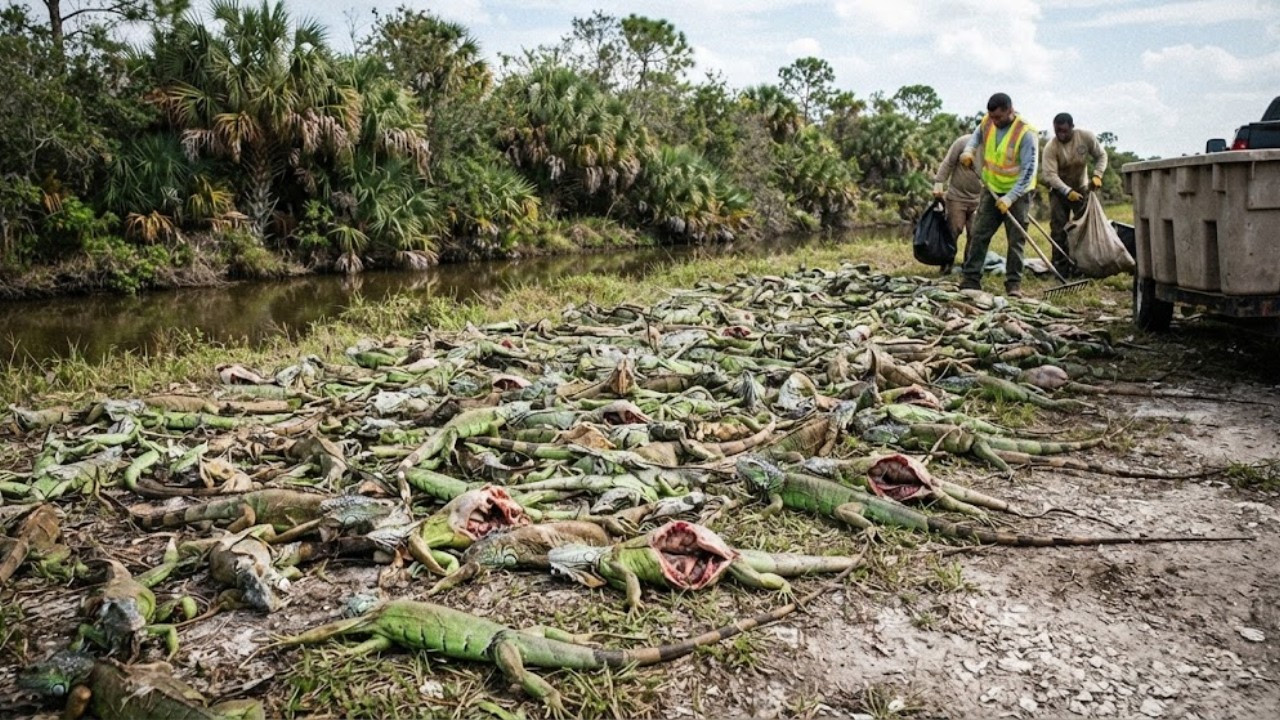
The invasive green iguana is vanishing from Florida’s landscape faster than anyone expected, and scientists say it’s not just because of the cold. For years, residents battled the reptiles tearing up seawalls and gardens, only for the population to suddenly crash in recent years.
Dr. Claire Mats had spent three years conducting green iguana surveys along the canal networks of the central Florida Keys....

They called Ted Turner crazy for 30 years, yet his 51,000 bison on two million acres have done what no one expected. After CNN, he bought broken land across New Mexico, Montana, and Nebraska, swarming it with animals that had nearly vanished by 1889, and skeptics kept laughing.
On a New Mexico plain, a bison rolls in a shallow depression in the dirt, kicking up dust. The animal...
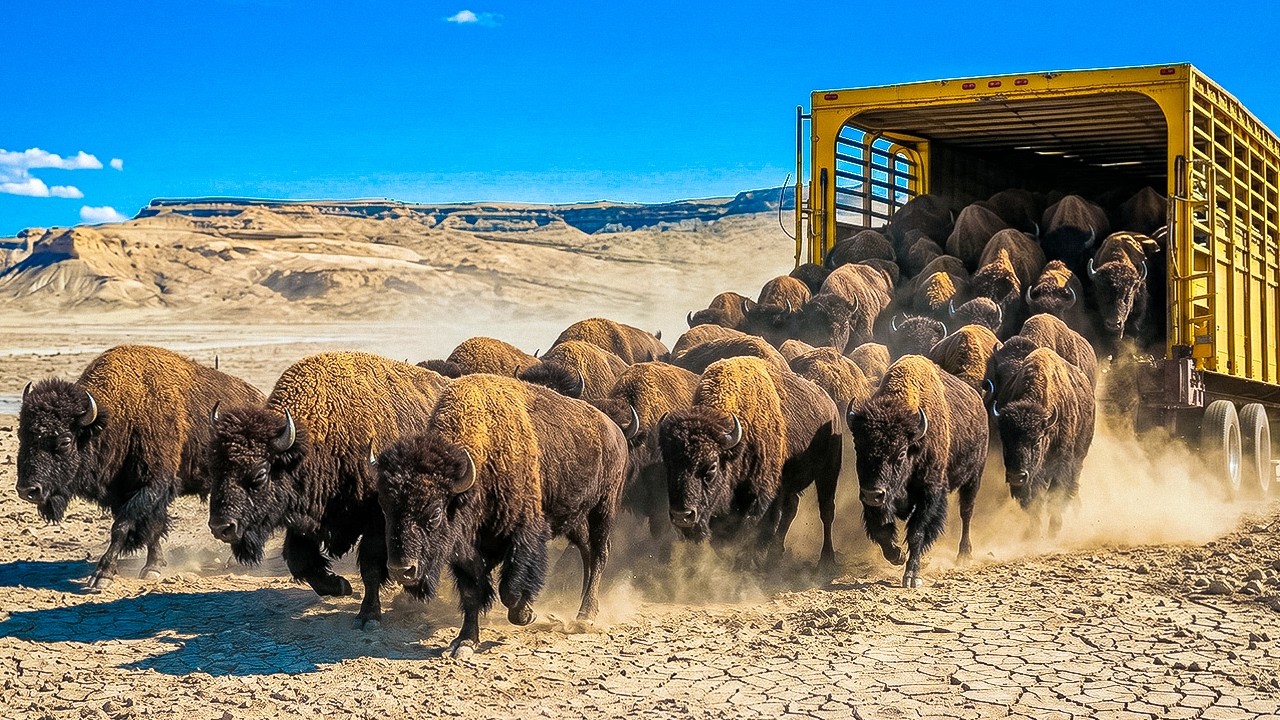
39 bison were released along a nearly vanished river—and within months, something extraordinary unfolded. The river, once drained dry by agriculture and drought, had been restored just enough to support the herd.
In the 1860s, survey crews measured the Platte River at Cozad, Nebraska, at 1,161 meters across. The river was shallow,...