Canada released hundreds of hungry predators into the Pacific, and what they did stunned scientists. These sea otters were reintroduced to restore kelp forests decimated byurchins.
Off the coast of British Columbia, a slow-moving ecological collapse transformed the seafloor. Once one of the most productive habitats on the planet, the ocean bottom became largely barren, covered in purple and red sea urchins with little other life remaining.
Canada’s response was not a chemical treatment or a government cleanup crew. Instead, officials reintroduced a predator that had been absent from those waters for more than a century. The sea otter, once driven to local extinction by the fur trade, was returned to the region and resumed its role at the top of the nearshore food web.

To understand why adding a predator was the preferred solution, it helps to know what was being lost. Along the British Columbia coast, giant kelp forests once stretched for miles underwater. Individual kelp plants grew from the rocky bottom to the surface, reaching lengths comparable to tall buildings. These forests provided shelter, nursery habitat, and food for thousands of species packed into a single water column. Juvenile fish hid among the dense blades, while crabs and shellfish used the holdfasts as nurseries.
For centuries, this was one of the most productive ecosystems on the Pacific coast. By the twentieth century, the balance had broken down. The cause was an animal that appears harmless under normal conditions: the sea urchin. Urchins are slow and not aggressive, but they are patient and equipped with a mouth capable of grinding through the base of a kelp stalk. An urchin does not need to consume an entire 100-foot kelp plant to kill it. It only needs to bite through the holdfast that anchors the plant to the rock. Once that connection is severed, the plant drifts away and dies.
As urchin populations swelled, they moved across the seafloor in dense feeding waves, systematically removing every holdfast they encountered and scraping the bare rock clean of spores and new growth before it could take root. What made the problem difficult to reverse was the urchin’s physiology. When kelp disappeared and food ran out, the urchins did not die as most animals would during a famine. Their metabolism simply slowed dramatically, and they could survive for years on almost nothing, waiting in a dormant state for any organic matter to drift their way.
A barren seafloor covered with hungry but inactive urchins was not an ecosystem recovering its balance. It was a trap that could persist indefinitely, preventing new kelp from establishing itself. From there, the collapse accelerated. Herring and salmon that depended on kelp forests as spawning grounds lost the habitat that sheltered their eggs. Young fish that once hid among the kelp became exposed in open water, and their predation rates rose sharply. As fish stocks declined, seabirds, seals, and sea lions that relied on them also suffered.
Canada’s first response was physical. Divers were sent down with hammers, crowbars, and steel bars to crush urchins against the rocks across miles of seafloor. In some locations, crews dragged heavy chains and dredges across the bottom to smash thousands in a single pass. When that failed, the government turned to commercial harvesting, issuing licenses for dive teams to collect urchins, process their roe, and export it to Asian markets. This did not work either. For every thousand urchins removed by hand, tens of thousands of new larvae drifted in to replace them. The calculations never balanced, and the barrens continued to expand.
Researchers eventually asked a different question: not how to remove the urchins directly, but why their numbers had exploded in the first place. The answer pointed to an animal that once ranged throughout these waters and was simply no longer there.
In 1967, the United States prepared for an underground nuclear test on Amchitka Island in the Aleutians. The surrounding waters held one of the last remaining large sea otter populations on the planet. Concerned that shockwaves from the blast might harm the animals, Canadian biologists arranged an emergency relocation. Otters were captured, placed in transport cages, and flown from Alaska to Checleset Bay on the west coast of Vancouver Island. Between 1969 and 1972, 89 otters were released into Canadian waters.
Sea otter populations grew at a rate of roughly 17 to 20 percent per year once established, turning the 89 founding animals into a self-sustaining population within a few years. The original disappearance of otters from Canadian waters was not tied to disease or habitat loss. It was about fur. Sea otters have the densest fur of any mammal on Earth, and for more than a century, this drove one of the most extensive hunting campaigns in Pacific history. Russian, British, and American fur traders worked the entire North Pacific rim. By 1911, fewer than 2,000 sea otters remained worldwide, scattered in a handful of remote refuges. Along the Canadian coast specifically, the species was completely eliminated.
The removal of this single predator was enough to destabilize the balance that had kept urchin populations in check for thousands of years. It took about 60 years and a nuclear test on the other side of the Bering Sea for someone to restore the missing piece by accident.
Once reintroduced, sea otters proved well suited to the task, driven not by conservation logic but by basic survival. Unlike seals or whales, sea otters have no insulating blubber. The cold water pulls heat from their bodies about 25 times faster than air does. To survive, an otter must eat between a quarter and a third of its body weight every day. This constant need for calories turned otters into methodical bottom feeders.
Sea urchins are not defenseless. Their shells are reinforced and covered with hundreds of independently moving spines that turn toward any approaching threat. Hundreds of tiny tube feet allow them to cling to rocks strongly enough to resist storm waves. None of this stopped the otters. They pulled urchins from the rocks with their forepaws. When an urchin clung too tightly, some otters used a flat stone as a tool, wedging it under the shell to break the grip. The otter would surface with its catch tucked in a loose fold of skin under its arm, float on its back, balance a rock on its chest, and smash the urchin against it until the shell broke. Alternatively, it would flip the urchin over and bite through the thinner shell around the mouth, bypassing the armored top entirely.
The effect on urchin numbers went beyond direct predation. Urchins that sensed an otter nearby retreated into rock crevices and stopped foraging in open areas, surviving on drifting kelp scraps rather than grazing new plants. With this grazing pressure gone, dormant kelp spores finally found clean rock to attach to, and giant kelp, capable of growing more than a foot per day under good conditions, expanded rapidly. Within a few years, stretches of barren seafloor returned to dense kelp forest.
That recovery brought everything else with it. Crustaceans returned to the newly reestablished kelp holdfasts. Flatfish and rockfish took shelter in the vegetation. Salmon resumed using kelp beds as migration corridors. Bald eagles returned to hunt along the shoreline. Dolphins returned, and gray whales began appearing along routes they had largely abandoned.
Then setbacks emerged from unexpected directions. In December 1988, near Grays Harbor in Washington state, a tugboat collision spilled nearly a quarter-million gallons of heavy fuel oil into the ocean. Currents carried the slick north into Chihalis Bay, the protected waters where otters had been reintroduced. The oil penetrated the otters’ fur, which relies entirely on trapped air for insulation, and many died from hypothermia in what was supposed to be their safest refuge.
Three months later, the tanker Exxon Valdez ran aground in Alaska’s Prince William Sound, spilling more than 11 million gallons of crude oil. An estimated 4,000 sea otters died, some from cold exposure and others from internal damage caused by ingesting oil while trying to clean their fur.
Both disasters led to revised coastal shipping regulations. Tankers were required to take routes farther from shore, reduce speed, travel with rescue tugs on standby near sensitive coastlines, and adopt double-hull designs. Oil spill response vessels now remain on constant alert along Vancouver Island, with containment barriers ready for immediate deployment.
Sea otters in Canada are now protected under federal wildlife law within a network of marine reserves, including Checleset Bay, where vessel movement and seafloor disturbance are restricted. Researchers track population health through boat surveys, drone footage, and aerial counts.
While Canada watched its coast recover, a different and in some ways worse collapse was underway in California. There, the task of controlling urchins did not depend on otters alone. Sunflower sea stars, enormous predators reaching about three feet across with dozens of flexible arms, hunted urchins with surprising speed, trapping their prey and digesting it externally.
In 2013, a disease known as sea star wasting syndrome swept the entire Pacific coast, causing lesions, tissue breakdown, and arms that detached from the body. Infected sea stars disintegrated within two to three days, and the outbreak killed more than 90 percent of sunflower sea star populations almost overnight. With both major urchin predators suddenly gone from California waters, urchin numbers swelled and destroyed nearly 95 percent of kelp forests along that stretch of coast within a few years.
Recovery efforts there differ from Canada’s. Biologists collected surviving sea stars, housed them in temperature-controlled tanks, stimulated reproduction with chemical signals, and worked to raise a new generation in the lab with a focus on disease resistance before attempting large-scale reintroduction. California also launched a surrogate mother program for orphaned sea otter pups, pairing them with rehabilitated adult females to teach them foraging and grooming before release, along with bans on gillnets in otter habitats.
Alaska, the source of the Canadian otters, faced a different failure pattern. As warming oceans pushed fish stocks northward away from traditional areas, seals and sea lions that depended on those fish began to starve. This in turn deprived killer whales of their prey. Some killer whale groups responded by switching to sea otters, a prey item about a tenth the size of a seal and less efficient in terms of calories, but apparently sufficient when nothing else was available. Alaska’s otter population collapsed under this pressure, and urchins emerged from hiding almost immediately. Wildlife managers focused on restoring fish stocks rather than directly addressing the otters, restricting or banning commercial fishing in newly defined critical habitats, hoping that restoring fish numbers would eventually move seals and then whales away from the otters entirely.
A stranger conflict developed on the other side of the Pacific in Hokkaido, Japan, where sea urchin roe, known as uni, is a delicacy selling for hundreds of dollars per pound. When sea otters began expanding naturally into Japanese waters from the Kuril Islands, they discovered the same prized urchins that local dive fisheries depended on and began consuming them at a rate that threatened a centuries-old industry. Because sea otters hold protected status under international agreements, Japan could not eliminate the problem through hunting. Instead, it devised a zoned solution: otters were allowed to forage freely in open water, while commercial urchin production moved to underwater farm sites, fenced to keep otters out, where urchins were fed supplemental kelp to enhance roe quality under controlled conditions.
The Canadian success story came with a local cost that took years to surface. Coastal Indigenous communities had harvested shellfish, urchins, and crabs along this coastline for thousands of years. The sudden introduction of a highly efficient, fast-metabolizing predator depleted many of those traditional harvesting areas within a few years. Tribal leaders noted that before European fur traders exterminated sea otters, their communities managed otter numbers directly through limited, intentional hunting, which prevented population densities from reaching the levels that modern conservation laws now protect automatically. Federal protection that bans all otter hunting effectively removed a tool those communities had relied on for generations. The resulting dispute moved from coastal negotiations to federal courtrooms, pushing toward co-management arrangements still under discussion between government agencies and Indigenous representatives.
Commercial fishing took a similar hit. Sea otters proved to have a refined taste for the shellfish that generated the highest revenue. Geoduck clams, which can weigh up to 11 pounds and bury deep in sediment with only a narrow siphon exposed, were once considered safe from predation until otters learned to locate the exposed siphon tip, dig rapidly through the sediment, and pull the clam free. Dungeness crab populations declined everywhere otter colonies became established; their shells cannot withstand the force of an otter’s bite.
Some in the fishing sector began referring to the animals as “furry lobsters,” accusing them of eliminating a coastal economy worth millions of dollars built over decades. What replaced part of that lost income was not fishing at all, but tourism. Sea otters are visually striking, highly active, and easy to film floating on their backs. Commercial boats that once carried shellfish began organizing wildlife-viewing tours, charging visitors to watch otters forage in the wild. This tourism did not fully compensate for fishing losses, but it gave many coastal towns a second economic path that did not exist 30 years ago.
Technology plays a small and growing role as well. Underwater drones equipped with cameras and robotic arms are used to crush or collect sea urchins in areas otters have not yet reached, although the process remains slow and costly at scale. To offset that cost, biotechnology projects in Canada and California now collect hungry, low-value urchins from the edges of barren zones and transfer them to onshore tanks, where they are fed a controlled diet of kelp until their quality returns for sale, turning an environmental burden into a modest secondary industry.
The central lesson is not simply that a furry predator repaired an environmental disaster. It is a demonstration of how much impact a single missing species can have on an entire coastline, and how unpredictable the consequences can be once that species is brought back. Restoring sea otters repaired the kelp forests, but it immediately created new problems no one had fully anticipated: exposure to oil spill risks, disputes over Indigenous rights, and the collapse of shellfish industries that had grown up in the otters’ absence. These complications do not erase what the reintroduction achieved. They simply show that returning one piece to a broken system rarely happens smoothly, and that the ocean, given the chance, moves faster and further than anyone managing it from the surface expects.
Recommended Stories
The Illinois River’s invasive Asian carp are disappearing, and the reason has stunned researchers. For years, these fish overwhelmed the waterway, outcompeting native species and leaping into boats by the thousands.
Asian carp, a fast-growing invasive species in lakes and rivers across the Mississippi River basin, became a major problem in...
Illinois spent nearly a billion dollars on electric and steel barriers to stop invasive carp, yet its most powerful weapon arrives by truck. The state has quietly reintroduced alligator gar, a predator hunted to local extinction in Illinois by the 1960s, with release sites deliberately kept secret from the public.
Illinois has spent close to a billion dollars on concrete, electricity, and steel barriers meant to stop the spread of...
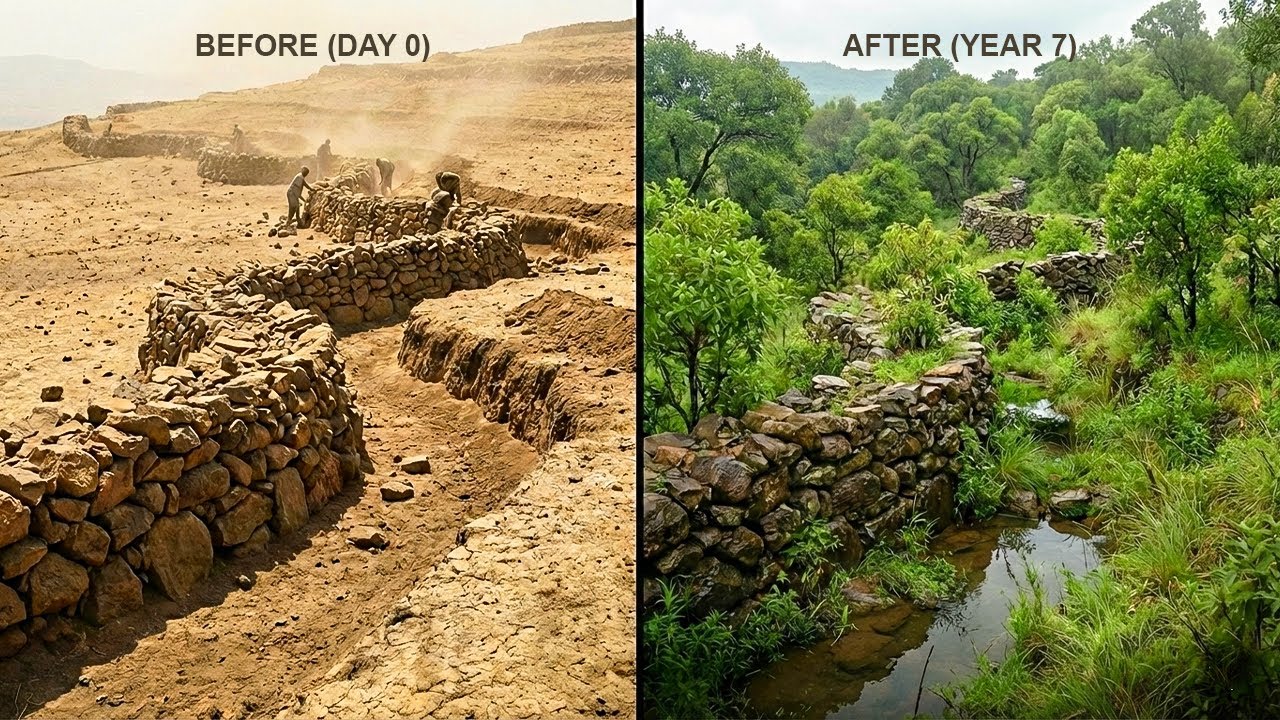
Ethiopia halted its massive desert tree-planting campaign, and what happened next stunned everyone who had dismissed the project. For years, the nation pushed millions of seedlings into arid land, with critics calling it a doomed spectacle.
In the highlands of northern Ethiopia, villagers began a large-scale effort to restore the Desa forest, an area that had...