Scientists turned AI loose on thousands of crow calls, expecting to decode bird chatter. What the algorithm surfaced instead has researchers reexamining how we study animal intelligence.
Crows have lived alongside humans for thousands of years, adapting to human environments more successfully than almost any other wild bird. Researchers have long documented their use of tools, their ability to solve complex problems, their capacity to recognize human faces, and their tendency to hold grudges across years. Studies have also shown that crows pass learned information to their offspring.
For decades, scientists recorded and analyzed crow vocalizations, cataloging the range of sounds and attempting to decode their structure. More recently, a research team trained an artificial intelligence system on the largest collection of crow sounds ever assembled. The AI was asked to find patterns that human analysis had missed. What it discovered about the structure of crow communication raised questions not only about the birds themselves but also about the relationship between crows and the human communities they live in.
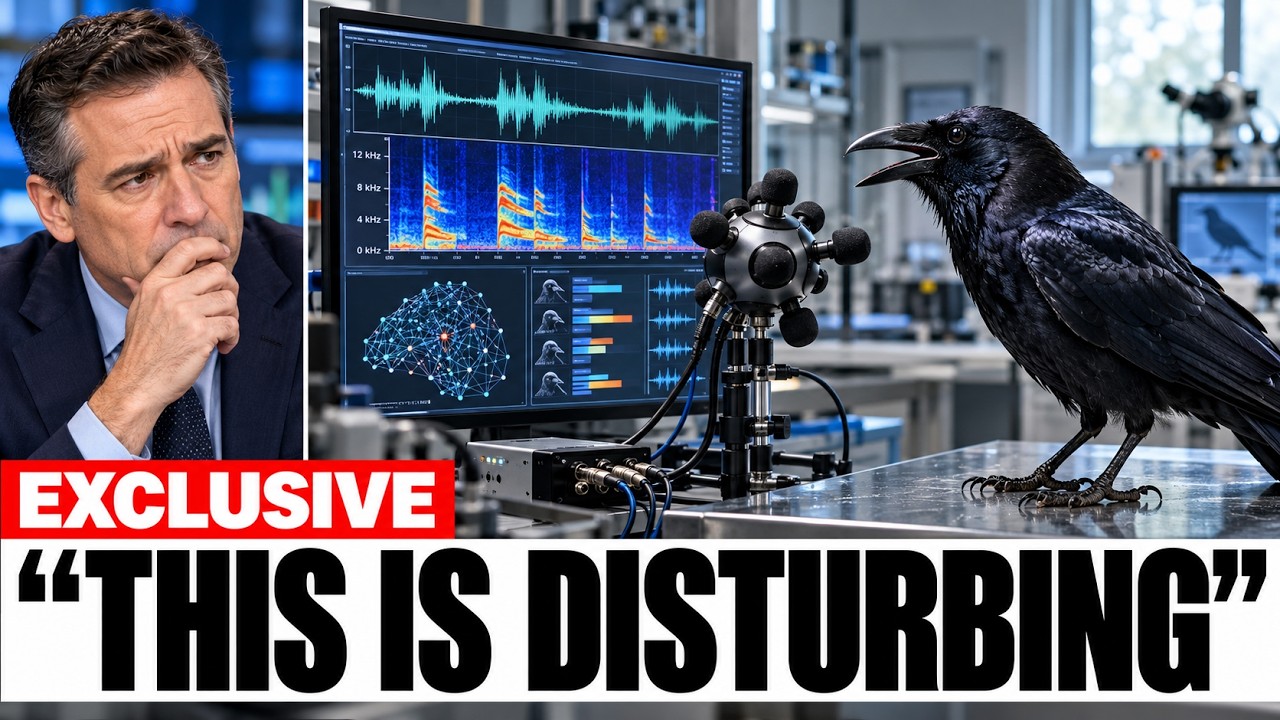
The analysis suggested that crows actively monitor, encode, and transmit information about human behavior in ways that the humans being observed were not aware of.
The scientific case for crow intelligence is among the strongest in the field of animal cognition. Decades of research have produced results that repeatedly exceeded what investigators expected when designing their studies. The documented cognitive abilities of corvids, the bird family that includes crows, ravens, jays, and magpies, have reshaped scientific understanding of what kinds of minds are possible in the animal world. The importance of this research lies not only in the specific abilities documented but also in the consistency with which new studies uncover capabilities that earlier work had not anticipated.
Crows use tools in advanced ways. They manufacture tools from raw materials to solve specific problems, use one tool to obtain another, and carry tools to locations where they will need them later. New Caledonian crows have been documented making hooked tools from plant material with a precision suggesting a real understanding of the relationship between tool design and function. This behavior is not simple learned response but creative problem-solving that was once considered a marker of distinctly human or great ape intelligence.
Crows recognize human faces and retain those identities across years of separation. Research conducted primarily at the University of Washington found that crows not only remember specific people who mistreated them but also pass this recognition to other crows, including those that never encountered the person themselves. A flock that gathers around a perceived threat may include birds responding entirely to transmitted information rather than direct experience. This finding was striking when first published and remains among the most cited results in crow cognition research.
Crows transmit learned information across generations. Chicks of parents who learned to exploit specific human environments or avoid specific people inherit not only genetic material but also cultural information about how to navigate the human world. This cultural transmission, documented through close observation of multi-generational crow families in urban settings, places crows among the few non-human animal groups with demonstrated cultural inheritance.
These documented abilities raised a specific question. If crows can remember individual humans, warn other crows about them, and pass on learned information about human behavior across generations, what communication system supports this information transfer, and how sophisticated is it? The observed behaviors implied a communication system capable of transmitting specific and organized information. Traditional analysis of crow sounds had not been able to characterize this system with the precision its complexity required.
The challenge of analyzing crow vocalizations is not a problem the field of animal communication ignored or failed to address seriously. The difficulty is structural and reflects genuine limits in the human capacity to process data of this complexity and volume.
Crows produce a vast range of sounds. A single bird can make dozens of distinct calls, which vary in duration, pitch, amplitude, temporal pattern, harmonic structure, and the specific sequence in which different sound elements are produced. Analyzing whether these differences carry meaning requires simultaneous attention to all these dimensions across a huge number of vocalization events in different contexts, from different individuals, in varied social environments. The human perceptual system, no matter how skilled the researcher, is not equipped to systematically process this volume and variety of information at the level needed to identify structural patterns that might indicate a true communication system rather than a limited set of context-dependent signals.
Research on crow vocalization has a long history and has produced genuinely valuable results. Specific call types have been identified and linked to specific contexts. Alarm calls warning of aerial predators have been distinguished from those warning of ground predators. Contact calls, food-related calls, and calls associated with mating and territorial aggression have been classified. This is real scientific progress. But cataloging call types and their associated contexts is not the same as understanding whether crow vocalizations form a structured communication system with grammatical rules, compositional meaning, and the ability to encode and transmit new information. These questions require a different level of analysis that examines relationships between call elements across large numbers of sound sequences rather than individual call types in isolation.
The gap between what human analysis achieved and what the AI achieved is not a gap in effort or in the quality of researchers. It is a gap in the analytical tools available to them.
The dataset assembled for the AI analysis was the largest and most geographically diverse collection of crow vocalizations ever compiled for a single analytical project. Recordings came from university research archives in the United States, Canada, the United Kingdom, Japan, and Australia, from the personal archives of field ornithologists who had spent decades recording crow behavior in specific study areas, and from a new systematic recording program conducted in urban environments in six cities across three continents during the two years before the analysis.
Compiling this collection was itself a significant scientific undertaking. It required negotiating data-sharing agreements with multiple institutions, standardizing recording formats across archives that used different technical specifications, and developing a quality assessment protocol to ensure that only recordings of sufficient technical quality supported AI acoustic analysis. The complete collection included recordings of hundreds of crows of different species, spanning recording periods from a few weeks to several decades for specific individuals or study groups. Recordings were made in contexts ranging from controlled laboratory conditions to field environments where crows were observed in their natural social and ecological settings.
The geographic diversity of the dataset was a deliberate methodological choice. It was designed to allow the AI to distinguish between crow vocalization features common across different populations and features that vary locally. This distinction is critical for evaluating whether specific structural features reflect fundamental properties of crow communication or are products of specific local conditions.
The AI was given the full acoustic dataset and tasked with performing a multi-level structural analysis. At the basic level, it was asked to segment continuous audio into discrete call elements and characterize each element’s acoustic properties. At the intermediate level, it was asked to identify patterns in how elements sequence together, including statistical regularities in which elements follow which, and in what contexts. At the highest level, it was asked to evaluate whether the identified sequential regularities show the properties associated with linguistic structure: compositionality, recursion, and context-dependent meaning.
The result at the highest level of analysis established the foundation for everything that followed. The AI identified regular statistical patterns in crow sound sequences consistent with compositional structure. This means the information conveyed by a sound sequence is a function of the identities and ordering of its constituent elements, not merely a function of the presence or absence of specific elements. This property distinguishes a communication system capable of expressing new meanings from a limited system of fixed signals with fixed meanings. The discovery of this property in crow vocalizations changed the course of the research and directed the later levels of analysis.
The distinction between a signal system and a communication system is not always explained clearly in popular accounts of animal intelligence research, but it is essential for evaluating the results of the crow call analysis. A signal system is a set of fixed signals with fixed meanings, where each signal reliably indicates a specific internal or external state, and the meaning of any signal is independent of its relationship to other signals. Many animal communication systems appear to operate this way. Vervet monkey alarm calls, for example, have specific acoustic properties that reliably indicate the type of predator present, and the meaning of each call type is largely independent of the calls that precede or follow it.
A communication system with compositional structure works differently. In such a system, the meaning of a signal depends on its relationship to other signals, and new meanings can be generated by combining existing signal elements in new arrangements. This is how human language works. Whether any non-human animal communication system possesses this property has been one of the most debated questions in animal communication for decades. Evidence has pointed toward it in several species, but it had not previously been demonstrated with the statistical precision the AI analysis achieved on the crow vocalization dataset.
The specific properties the AI identified in crow sound sequences include consistent ordering effects, where the same element carries different meanings depending on its position in the sequence; combination rules, where specific elements co-occur predictably and the combination carries meaning no single element carries alone; and context-sensitive interpretation, where the same sequence carries different meanings in different social and ecological contexts in ways systematically predictable from context rather than random. Together, these properties are the hallmarks of compositional structure.
The result does not prove that crow communication is language in the full human sense. It demonstrates that the system can generate new meanings through combining and ordering elements, a system fundamentally different from a collection of fixed signals and capable in principle of encoding and transmitting a much wider range of information.
The later stages of the AI analysis addressed the question of what kind of information the system is used to encode. The answers to this question were what unsettled the research team. They expected to find interesting information about crow communication. They did not expect to find a structured system used specifically to discuss humans.
The discovery that troubled the research team was not about crows’ general communicative abilities but about a specific category of crow vocalizations that the AI identified as directed at human activities and individuals, and what the analysis revealed about the content of these calls and how they are transmitted. The team described the discovery as shifting the project from analyzing crow communication in general to something more personal, as it became clear that the crows themselves were paying far more attention to the researchers than anticipated.
The AI identified a subset of sound sequences in the acoustic corpus that were consistently produced in contexts involving human presence and human activity and that showed structural properties different from sequences produced in contexts without human presence. This was not surprising at a general level. Crows produce alarm calls in response to many types of perceived threats, and humans in some contexts represent a perceived threat. It would be expected that human-related contexts produce distinctive sound patterns.
What was unexpected was the specificity and complexity of the human-related sound patterns the AI identified. The analysis distinguished between sound sequences associated with humans in general, sequences associated with specific individual humans, sequences associated with specific categories of human behavior, and sequences associated with specific human tools, vehicles, and activities. The precision of this discrimination, documented across different sites within the dataset and involving multiple crow populations, suggests that crows are not simply producing a general warning signal toward humans in response to their presence. They are producing structured sound sequences that encode specific information about specific human individuals and specific human behaviors.
The evidence that this information is transmitted between crows is the most significant element of this finding for the research team. The AI identified sound sequences that function as information broadcasts about specific humans. These sequences are produced by crows with direct experience of a specific individual and correspond structurally to the transmission of information to crows lacking that direct experience. This is the communicative basis for the phenomenon of crows gathering around humans that flock members have never directly encountered. The transmitted information is not merely a general threat signal. The structural analysis indicates it encodes specific characteristics of the human individual that enable other crows to recognize that person in later encounters.
The existence of a vocabulary specific to human behavior, embedded in an organized communication system, is the discovery that researchers found difficult to present without overstatement. In their publications, they were careful to note that the analysis does not prove crows consciously discuss humans in any way that implies reflective self-awareness. What it shows is that the crow communication system contains specific structural elements for encoding and transmitting information about individuals and their behavior, and that this information is actively used by crow communities in ways that shape their collective responses to humans in their environment. This restraint is appropriate. It is also, as several researchers noted privately, difficult to maintain when absorbing the full implications of what the analysis shows.
The AI analysis of sounds related to crows’ memory of individuals produced the finding with the most direct implications for the humans receiving crow communication, because it defines the scope of information crow communities retain about specific individuals and how long it persists. This is not an abstract finding. It describes a phenomenon that occurs specifically to particular people in particular places and lasts longer than those people realize.
Earlier research had established that some crows remember specific people across long time spans. The AI sound analysis adds an explanation of how this memory is encoded and maintained at the group level rather than only the individual level. The analysis identified structured sound sequences called recognition broadcasts. These are produced by crows with direct experience of a specific person and encode distinctive characteristics of that person in a way other crows can use for later recognition. The acoustic characteristics encoded in recognition broadcasts about specific people include aspects of gait, movement patterns, sounds associated with specific human activities, and visual characteristics translated into vocal signals crows produce about human appearance.
The AI analysis could not directly link encoded acoustic features to the specific human characteristics they represent, because that would require a translation key the analysis did not produce. What it could demonstrate is that recognition broadcasts encode information with sufficient precision to allow a crow community to recognize the same individual across different contexts, different clothing, and different behaviors.
The geographic spread of recognition broadcast information among crow populations was the specific finding that prompted extensive discussion within the research team. The dataset includes recordings from crow populations in urban environments where human populations are an established part of the social fabric of the crow community. The analysis identified recognition broadcast sequences produced by crows that had never been observed in direct interaction with the specific individuals the sequences appeared to encode. The sequences spread among crow communities in ways that spatial and temporal analysis of the dataset indicated are similar to the spread of other culturally transmitted information in crow populations.
For the humans involved, the research team was careful to clarify what this means. Specific individuals in communities where crows are present may be the subject of active information transmission within the crow community, known to crows they have never directly met, and evaluated based on information from crows that did meet them. The human residents of these communities were not aware of this, while the crows were. The research team described this asymmetry as one of the findings that stayed with them after the work was complete.
The category of human behavioral information the AI analysis revealed crows are encoding and transmitting extends beyond individual identity recognition to what the research team described as behavioral pattern tracking. The encoding is not limited to the identity of a particular human but includes what that human distinctively does and how that behavior relates to the interests of the crow community.
Sound sequences associated with specific human behaviors showed a level of categorical precision the research team did not expect. The analysis distinguished between sequences associated with humans who feed crows and sequences associated with humans who threatened or harmed crows. Within each of these general categories, the analysis identified further differentiation corresponding to more specific behavioral characteristics. Sequences associated with humans who feed crows show variation related to factors such as regularity of feeding, type of food provided, and the specific location of feeding behavior. Sequences associated with negative human behavior show variation corresponding to the specific type of negative interaction, whether direct threat, indirect disturbance, or destruction of nesting sites.
The temporal dimension of behavioral encoding was the most striking feature for the researchers. The analysis identified sound sequences that appear to encode information about human behavioral patterns over time rather than merely recording specific incidents. Sequences associated with specific individuals in the dataset show variation linked to changes in those individuals’ behavior during the recording period, suggesting that the crow community updates its information about specific individuals as their behavioral history accumulates rather than recording a single fixed first impression. This indicates a dynamic cognitive model of human behavior within the crow community. Crows do not simply classify humans as threats or non-threats based on a single encounter. They continuously update a record of their behavior, allowing the community to refine its assessment of those individuals over time.
The existence of this kind of dynamic behavioral tracking, encoded in a structured communication system and circulated among members of a crow community, is what the research team found difficult to discuss in precise scientific language, because the language of animal cognition research was not designed to describe something this complex in a non-human animal.
The most philosophically unsettling finding from the AI analysis of crow vocalizations is not about what crows can do but about the relationship between what crows do and what humans do. The analysis revealed for the first time, at the level of sound structure, a specific similarity.
Humans observe animal behavior, record it, classify it, determine its significance, transmit this information to other humans, update their understanding of specific animals based on accumulated behavioral information, and use this understanding to guide their interactions with the animals concerned. This is what naturalists, ecologists, and wildlife biologists do. It is considered a distinctively human intellectual achievement: the systematic study of other species.
The AI analysis of crow vocalizations documented that crows, in their interactions with human communities, do something structurally similar. They monitor specific human individuals, encode information about those individuals’ identity and behavior into their communication system, transmit this information to other crows, update their collective understanding of specific humans based on accumulated behavioral experience, and use this understanding to guide their interactions with the humans concerned.
The similarity is not exact. The crow communication system is not scientific in any formal sense, and the information it carries does not constitute a research program. But the structural similarity between what crows do with humans and what humans do with animals is close enough that the research team described it as the finding they had the most difficulty absorbing.
The scientific study of animal behavior has always been understood as a human activity directed at other species. The AI analysis suggests that at least one species has been conducting a similar activity toward humans for longer than humans have been studying crows, using a communication system humans did not know was structured enough to support it.
The implications of the AI analysis of crow vocalizations extend across multiple fields. For animal cognition research, the confirmation of compositional structure in crow vocalizations changes the framework within which future research on crow intelligence will be designed. Future research questions will no longer be about whether crow communication is sophisticated but about how sophisticated it is and what specific capabilities it supports. The AI results provide a new foundation for this research and a new set of specific questions about identity encoding, behavioral patterning, and temporal information that field research can study directly.
For linguistics and communication science, the finding adds crow communication to a very short list of non-human communication systems with documented compositional properties. This list has been the subject of ongoing debate in the field for years. Adding a well-documented new case, supported by the statistical confidence that AI analysis provides at the corpus level, is a genuine contribution to a substantive scientific question about the distribution of complex communication in the animal world.
For conservation biology and human-wildlife management, the finding has practical implications that the research community has begun to outline. If crow communities maintain dynamic, inherited knowledge about specific human individuals and their behaviors, then the quality of the relationship between a crow community and a specific human or human community depends on the accumulated history the crow community has stored about those humans. This has implications for how conservation programs involving crow populations are designed and for how conflicts between crow communities and human communities are understood and managed.
The finding that the research team was most reluctant to discuss publicly does not concern crows or science. It concerns what it means that crows have a communication system that tracks human individuals, encodes patterns of their behavior, and transmits that information across their community. It concerns how we understand our relationship to the non-human communities we live alongside.
The common understanding of this relationship is that humans observe, study, and manage other species. The AI results suggest that the relationship, in at least one case, is far more reciprocal than this understanding allows. The adjustment required to absorb this finding is not merely scientific but conceptual, concerning the nature of the world we live in and who is paying attention to us within it.
Crows have lived alongside humans in towns and cities for thousands of years. During that time, as the AI analysis of their vocal structure documented, they developed a system for talking about us. Not metaphorically, but in a communication system with compositional structure, transmitted information, and dynamic updating. Crows have encoded and shared knowledge about specific human individuals and specific human behaviors in the communities they inhabit. The humans in those communities were largely unaware of this.
We have observed crows, studied them, been impressed by their intelligence, and occasionally felt uneasy about the way they look at us as though evaluating us. The AI analysis confirmed that this sense of being evaluated is accurate. We are being evaluated. Our behavior is being recorded. Our identities are being transmitted. A crow community in any urban environment where crows have settled for generations holds collective knowledge of the human community that is comparable in structure, if not in content, to the knowledge wildlife biologists have built about crow populations.
The fact that it took an AI trained on the largest dataset of crow vocalizations ever assembled, asked to find what human analysis had missed, to reveal this is itself significant. Human analysis of crow calls had been underway for decades before the AI identified compositional structure in the data. The dataset existed. The recordings existed. The pattern existed. What did not exist was an analytical tool capable of processing the full complexity of the dataset at once.
What crows have been saying about us all those years is a conversation we did not know was happening. The AI revealed its structure. The content, what is specifically said about particular individuals and communities, is the next question. It is a question the crows have already answered, if the analysis is correct. We have not yet developed the tool needed to hear their answer.
Recommended Stories
California captured Earth’s last 27 condors, and what they did with the wings and bones stunned researchers. The birds were gone from the wild by 1987, their survival hanging on a desperate captive breeding plan.
In April 1987, a biologist captured the last known wild California condor on a hillside in Kern County, California. With...

Florida’s giant pythons were disappearing—then scientists finally discovered the predator behind it. For years, invasive Burmese pythons had devastated the Everglades, swallowing everything from raccoons to alligators, and researchers assumed nothing could challenge them.
Burmese pythons had dominated southern Florida for roughly twenty years, preying on deer, wading birds, and even alligators. They helped...

Wildlife managers in the greater Yellowstone ecosystem have documented a previously underestimated pattern of natural mortality among adult grizzly bears. Research indicates that wolves, mountain
Wildlife managers in the greater Yellowstone ecosystem have documented a previously underestimated pattern of natural mortality among adult grizzly bears....