Deep in the Mariana Trench, Earth’s most mysterious abyss, explorers made a discovery they claim is more terrifying than space itself. Cameras descending past 10,000 meters captured something no one expected lurking in the crushing, lightless dark.
The question that sits at the center of the Mariana Trench story is not about its depth, which is known to be roughly seven miles. It is whether the people who have been there agree on what they found. Two of the most credible witnesses in the history of deep-sea exploration returned with conflicting accounts. One spent three hours at the bottom and described it as barren and featureless. Meanwhile, a team of scientists who never went there suggested he may have been looking in the wrong place, because the actual story of what lives at the bottom of the trench is more complicated than emptiness. Both accounts cannot be entirely correct, and the answer changes how the ocean is understood.
The first discovery of the deepest point on Earth was accidental, and the official story of that accident was incomplete for a long time. In December 1872, the British naval ship HMS Challenger sailed from Portsmouth on what became one of the largest scientific expeditions in history. The crew included 243 sailors, officers, and scientists. The ship carried roughly 180 miles of Italian hemp rope. The mission was to cross the world’s oceans, stop at regular intervals, lower the rope, and measure what lay beneath. Over three and a half years, they did this nearly 500 times, about every 200 miles. The routine drove some men to desert; at least 60 sailors left the ship at various ports rather than continue.

On March 23, 1875, the Challenger was southwest of the Mariana Islands in the western Pacific. The rope went over the side as it had hundreds of times before. This time it kept going. At 4,000 fathoms it was still extending. At 4,475 fathoms, more than 26,000 feet, the weight finally touched bottom. The scientists were confused. The thermometers attached to the rope were crushed by pressure before they could record temperatures. They did not realize they were above a trench. They named the location Swire Deep, after the ship’s navigation lieutenant, and sailed on. The reading was the first recorded encounter with what would later be recognized as the deepest geological feature on Earth, but the crew did not understand what they had found. The depth they recorded, about 26,850 feet, was less than half the actual depth now known. They had found the edge of the trench, not its deepest point.
For decades after the Challenger voyage, the Mariana Trench remained an unusual mark on maps. The pressure at the bottom is estimated at more than 16,000 pounds per square inch, roughly a thousand times the pressure at sea level. Building a vessel that could withstand those conditions and carry people seemed reckless, possibly impossible. The Cold War changed that. The U.S. Navy decided that reaching the ocean floor had strategic value. The bathyscaphe Trieste, an unusual craft resembling a balloon attached to a metal sphere, was designed by Swiss physicist Auguste Piccard, who had previously built high-altitude balloons. The Navy purchased it in 1958 and assigned 26-year-old submarine lieutenant Don Walsh to command it. Walsh later recalled that when he first saw the Trieste, he thought he would never board it. He did board it.
On the morning of January 23, 1960, Walsh and Jacques Piccard, Auguste’s son, climbed into the steel sphere that would carry them down. The sphere was about 6.5 feet in diameter, leaving the men in a space so tight they could barely move their arms. During the descent, at around 30,000 feet, they heard a sharp cracking sound. Walsh asked Piccard if they had landed. Piccard said he did not think so. They continued down. Hours later they learned that a Plexiglas viewing window in the outer hull had cracked under the pressure. It was serious, but not immediately fatal. The sphere itself held. They reached the bottom after 4 hours and 48 minutes. Walsh radioed the surface ship that they were at the bottom of Challenger Deep at 6,300 fathoms.
The trench itself is a distinct environment. It forms where the Pacific tectonic plate slides beneath the Mariana plate, a process called subduction. This creates a crescent-shaped gash in the Earth’s crust roughly 1,580 miles long and about 43 miles wide at its broadest point. Challenger Deep, the deepest section, sits at the southern end. The pressure there is about a thousand times greater than at sea level. Temperatures are barely above freezing. Sunlight does not reach it. For years, biologists assumed that the physical conditions required for complex life did not exist there.
That assumption began to change in the 1980s and 1990s, and accelerated in the following decades, as scientists sent remote devices, uncrewed landers, cameras, and thick-walled glass spheres into the trench. What they recovered were living organisms. In 2011, researchers from the Scripps Institution of Oceanography sent cameras to a depth of about 34,800 feet. They filmed xenophyophores, giant single-celled organisms often exceeding 10 centimeters in length. A single cell the size of a plum was living at the bottom of the darkest, coldest, most pressurized place on the planet. These organisms are known to concentrate heavy metals, including lead, uranium, and mercury, at levels that would be lethal to most life forms. They also build complex shells from sand grains and minerals.
Another inhabitant is the Mariana snailfish, Pseudoliparis swirei, a translucent creature with a soft, scaleless body. In 2017, researchers confirmed it lives at depths of about 8,178 meters, roughly 700 meters deeper than any other fish. Its gelatinous body, lacking hard structures, is adapted to function under extreme pressure. Scientists have only recently begun to understand its biochemistry.
James Cameron, the director of Titanic, spent more than seven years building a submersible called Deepsea Challenger, designed to descend vertically. He reached Challenger Deep on March 26, 2012, becoming the third person in history to visit the bottom and the first to do so alone. He spent about three hours there. A robotic arm failed midway through the dive due to a hydraulic problem, cutting the mission short. He described the bottom as a flat expanse of soft, nearly gelatinous clay, featureless in every direction. He saw small amphipods, shrimp-like creatures about the size of a fingernail, moving through the mud. He later said the place felt like the moon, desolate and completely isolated, and that he had expected life to have adapted to the depths, but found the bottom empty of large features. He saw nothing larger than about an inch.
Oceanographer Lisa Levin of Scripps noted at the time that the value of Cameron’s dive might lie as much in public interest in deep-ocean science as in what he found. Her point was that what Cameron saw at one specific location may not represent the trench as a whole. Challenger Deep is a single site within a structure that stretches nearly 1,600 miles. The trench has gradients of depth, walls, slopes, shallower plateaus, fields of hydrothermal vents, and mud volcanoes. What has been found in those other areas is considerably more diverse than a barren plain.
In the middle depths of the trench, between 6,000 and 8,000 meters, researchers using remotely operated vehicles have documented an ecosystem that does not depend on sunlight or photosynthesis. The energy source is chemical. Microbes feed on hydrogen and methane seeping from the seafloor, and other organisms feed on those microbes. The food chain runs on geology rather than light. Near the trench, researchers from the University of Bremen investigated mud volcanoes and found bright blue clay with a pH of 12, similar to the alkalinity of bleach. Life was not supposed to exist there. Yet analysis of organic compounds in the clay found fatty molecules that can only be produced by living biological activity. Lead researcher Nicole Schubotz said the team believes primitive life may have originated at sites like this one. The deepest part of the planet, where old rocks are recycled into the mantle, may also be one of the places where life on Earth began.
Marine biologist Alan Jamieson of Newcastle University specializes in the ecology of deep trenches. In the mid-2010s, he began sending uncrewed landers to the bottoms of six deep trenches in the Pacific and South Atlantic, including the Mariana Trench. His primary goal was to study differences among amphipods, small crustaceans that act as deep-sea scavengers. Amphipods are found in all oceans and at all depths, especially in trenches, wherever organic material falls to the bottom. On a whim, Jamieson decided to examine the amphipods for pollutants. He tested for PCBs, synthetic chemicals banned in most of the world since the 1970s because of their toxicity, and found concentrations in Mariana Trench amphipods fifty times higher than those found in a heavily industrialized river in China.
He and his team, including student Lauren Brooks, then examined the amphipods for microplastic particles. They found fibers and fragments in 72 percent of all amphipods collected from the six trenches surveyed. The deeper the trench, the higher the percentage. In the least contaminated location, the New Hebrides Trench, half the amphipods contained plastic. In the Mariana Trench, the deepest site, the figure reached 100 percent. Every animal examined had plastic in its gut. Jamieson described the trenches as sinks. Whatever enters the ocean, from synthetic fibers to packaging fragments to chemical waste, eventually falls. Gravity acts on plastic as it acts on anything else, so the deepest part of the ocean becomes the final repository.
One of the amphipod species collected from the Mariana Trench was later confirmed to be new to science. It was formally named Eurythenes plasticus. The name was chosen deliberately, because the animal had plastic in its body. Jamieson said the researchers missed the chance to study the animal in a pristine environment; it entered the scientific literature already contaminated.
In April and May 2019, Victor Vescovo, a retired U.S. naval officer and private equity investor, made five separate dives to Challenger Deep as part of his Five Deeps Expedition, an attempt to reach the deepest point in each of the world’s five oceans. His submersible, the Limiting Factor, was a Triton 36000/2 model built for the purpose. On his first dive, on April 28, 2019, Vescovo reached a recorded depth of 10,928 meters, sixteen meters deeper than any previous human dive. He found, as Cameron had, a relatively barren muddy plain at the bottom. He also saw a plastic bag and candy wrappers among the benthic animals. A photograph from after the mission shows Don Walsh, then in his late eighties, shaking Vescovo’s hand.
A dispute followed about the depth record. Cameron’s 2012 dive reached 10,908 meters according to his team’s measurements, twenty meters less than Vescovo’s. Cameron said publicly that the bottom of Challenger Deep is completely flat and that there is no terrain that could explain a 52-foot difference. Vescovo’s team responded that their sonar system, a Kongsberg EM 124 multibeam unit previously used in mineral and oil exploration, was more precise than what Cameron used. Cameron acknowledged that the Five Deeps measurements might be more reliable, while noting that the margin of error in deep-sea measurements is substantial. Vescovo’s own team adjusted their figure during the expedition, from 10,928 to 10,924 meters, then back toward 10,934 meters depending on methodology.
The disagreement over the exact depth points to a larger issue. Researchers have been sent to the bottom of the deepest trench on Earth repeatedly, and there is no scientific consensus on precisely how deep it is. Different surveys, using different sonar techniques and different sound velocity data, have produced estimates ranging from 10,863 meters to 11,034 meters, a spread of more than 550 feet. The Soviet research vessel Vityaz recorded 11,034 meters in 1957. A 2010 survey by the Center for Coastal and Ocean Mapping at the University of New Hampshire estimated 10,994 meters, plus or minus 40 meters. Vescovo’s team settled on about 10,934 meters. HMS Challenger 2 in 1951 measured 10,863 meters. These are not rounding errors. Measuring depth seven miles down, through water columns with varying temperature, density, and salinity, is a problem that has not been fully solved. The surface of Mars is mapped in more detail than the bottom of the Mariana Trench. NASA’s Mars Reconnaissance Orbiter has produced images with 25-centimeter resolution. The best available maps of Challenger Deep, even after the 2010 survey, have a resolution of about 100 meters per pixel. The ocean column distorts every measurement, and no one has gone to Mars and returned to say there was nothing there.
Don Walsh died on November 12, 2023, at his home in Myrtle Point, Oregon, at the age of 92. He spent sixty years watching the place he visited for twenty minutes in January 1960 become the subject of new expeditions, disputed depth records, new species discoveries, and pollution studies. In his later years, he said the ocean remains vast and mysterious, and that very little is known about the sea. He lived to see an amphipod named after plastic.
During the twenty minutes Walsh and Piccard spent at the bottom of Challenger Deep, they looked through the window of their steel sphere. What Piccard saw, or believed he saw, was a flatfish, something like a sole about a foot long. Sediment stirred up by the Trieste’s landing obscured visibility immediately, and neither man had a way to photograph it. Skeptics later dismissed the flatfish as a hallucination or a misidentification. The prevailing scientific view has held that no true fish live at the bottom of Challenger Deep, because the pressure is too great. The Mariana snailfish, confirmed at depths just below 27,000 feet, does not appear to reach the very deepest levels. Walsh and Piccard may have seen something no one has seen since, or they may have seen nothing at all. The record is genuinely uncertain, and the question has never been resolved.
The more complete picture of the Mariana Trench is neither a sterile void nor a world of monsters. It contains single-celled organisms the size of small fruits. It contains snailfish adapted to pressure so extreme that scientists have only recently begun to model their biochemistry in the laboratory. It contains crustaceans carrying concentrations of PCBs and plastic fibers higher than those found in estuaries near factories. It contains microbes living in alkalinity comparable to bleach, potentially operating under the same chemical principles that produced life on this planet four billion years ago. And somewhere in the eastern pool of Challenger Deep, there is a question no one has answered: what did Piccard see?
The mechanism by which the trench acts as a repository for surface pollutants is now well understood. Dense particles settle. The topography of the trench directs falling material toward its lowest point. Currents in the hadal zone move slowly, trapping material instead of dispersing it. The PCBs Jamieson found entered the ocean from factories in the mid-twentieth century, moved through the water column over decades, accumulated in organic particles that sank, and concentrated at the bottom of the food chain in the deepest ecosystem on Earth. The trench is a collector. Whatever is put into the ocean eventually ends up there. Some researchers argue that the pollution levels, while striking, do not prove a catastrophic ecosystem collapse. The amphipods are still present. The trench still functions. The lack of obvious harm does not mean no harm is occurring; it means the long-term data needed to know are not yet available. Anela Choy of the University of California, San Diego, has described the deep sea as the largest potential reservoir of plastic waste on the planet. Susan Brander, a toxicologist at Oregon State University, identified amphipods specifically as vectors for moving plastic into the food chain above them. Alan Jamieson has noted that no one has ever seen the Mariana snailfish as it existed before plastic was invented. There is no baseline data for these species in an uncontaminated state. They entered the scientific record already altered.
The significance of the Mariana Trench findings is not primarily about monsters or mysteries, although both are involved. It is about the reach of industrial activity. Human manufacturing, conducted on continents thousands of miles away, has altered an ecosystem that no one can visit without years of engineering and significant expense. The change was not intended. It resulted from producing waste on a large scale, and the ocean did what oceans do: it moved the material downward. The lowest point, ultimately, is the Mariana Trench. The trench survived four and a half billion years of geological formation without being visibly affected by any form of life. Then, within roughly seventy years, the decades in which plastic became a global commodity, the deepest animals on Earth were found carrying human waste in their bodies.
The official depth record remains contested. Guinness World Records recognizes Vescovo’s dive of April 28, 2019, at about 10,928 meters, later revised to approximately 10,934 meters in some tables. Cameron disputes the significance of the difference. NOAA and the University of New Hampshire list a depth of 10,994 meters, based on the 2010 multibeam sonar survey, with a margin of error of plus or minus 40 meters. No one knows the exact number. That has been true since 1875.
The story began with HMS Challenger lowering a hemp rope into the Pacific on an ordinary March morning. The rope went down slowly. The scientists recorded the number and continued without understanding what they had found. The number was wrong, measuring the side of the structure rather than its deepest point. The name they gave the location did not survive. But that ordinary Tuesday morning, when the rope descended through sunlit water into darkness, was the first time humans reached the deepest point on Earth. Everything that followed, from the possible flatfish, to Cameron’s empty plain, to the candy wrappers Vescovo collected, to the plastic-filled amphipods, began with a rope that no one expected to run out. The trench has not changed. The measure of human influence on it is now visible in the gut of an animal seven miles underwater, discovered only because researchers were looking for something else entirely.
Recommended Stories
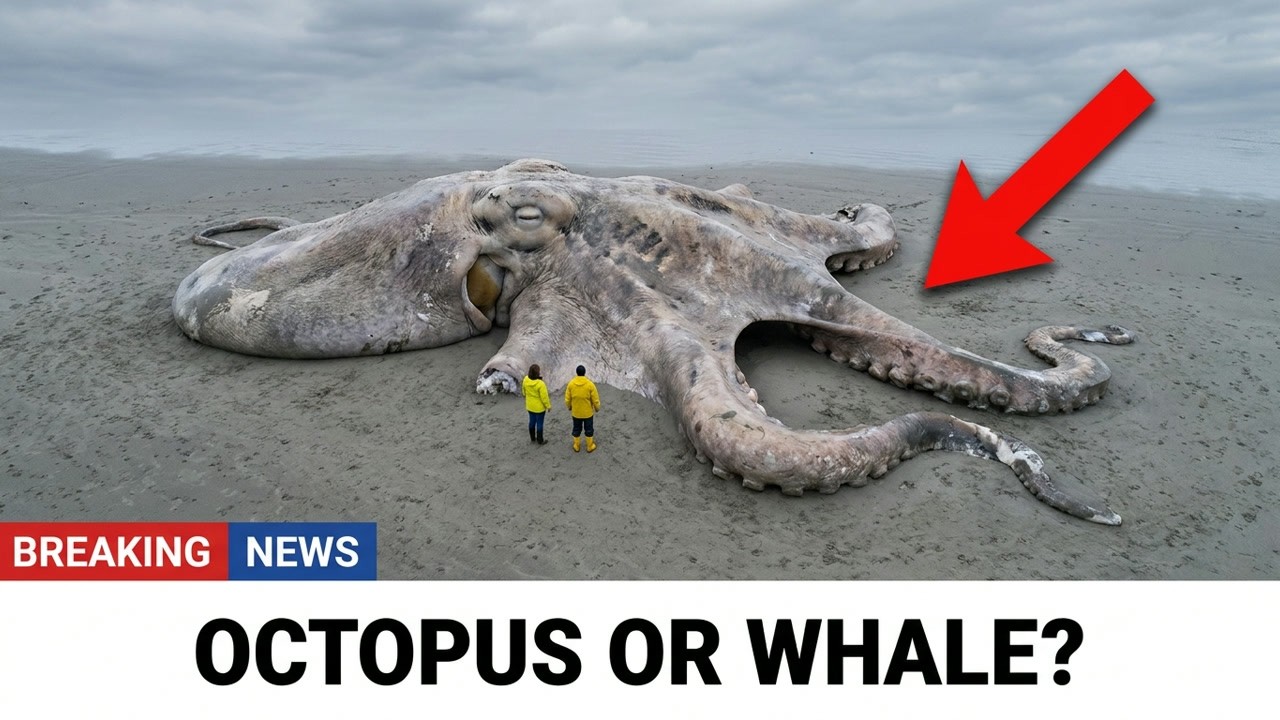
A giant sea monster washed ashore in 1896, sparking a scientific feud that lasted a full century. The remains were massive, with strange tentacle-like appendages, and it was found in St.
On November 30, 1896, two boys riding bicycles along the beach of Anastasia Island, near St. Augustine, Florida, found a...
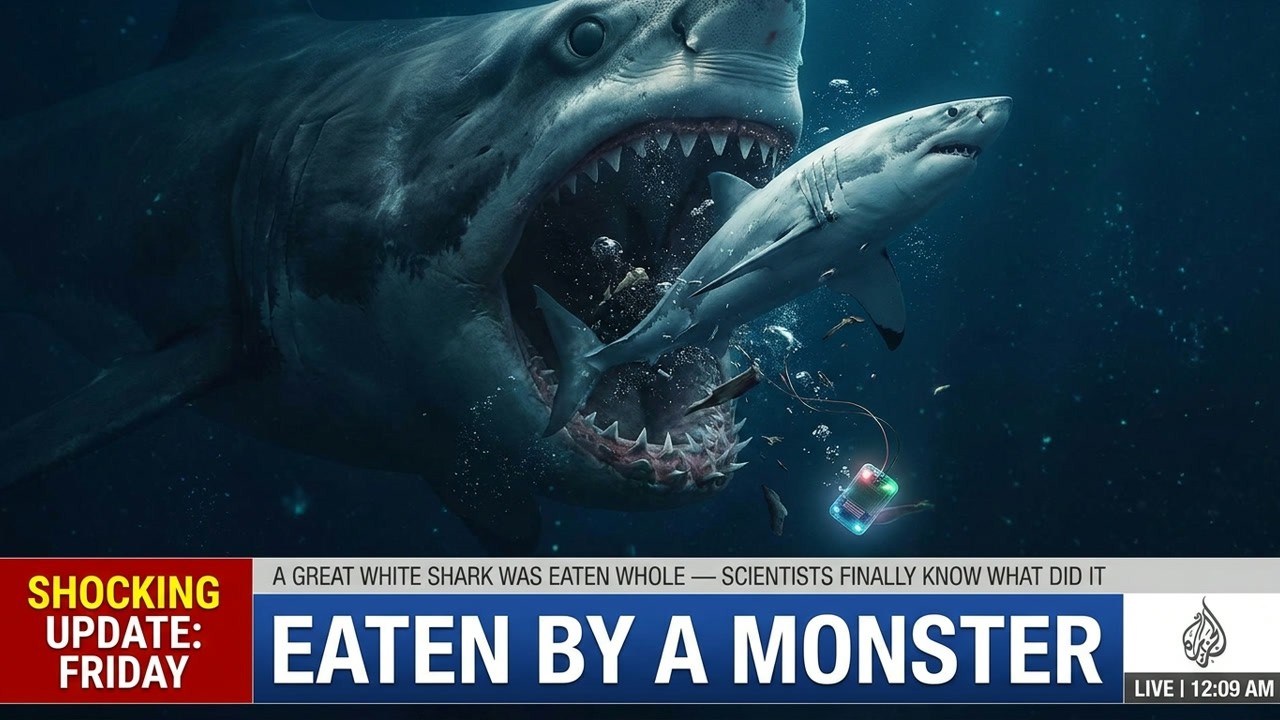
A nine-foot great white shark’s tracking tag washed ashore months after it vanished, revealing the predator had been eaten whole—but by what? The signal pointed to something far larger, and researchers followed the tag’s data deep into uncharted waters where the trail suddenly went cold.
In 2003, researchers studying great white sharks off the southern coast of Australia recovered a data tag that had washed...
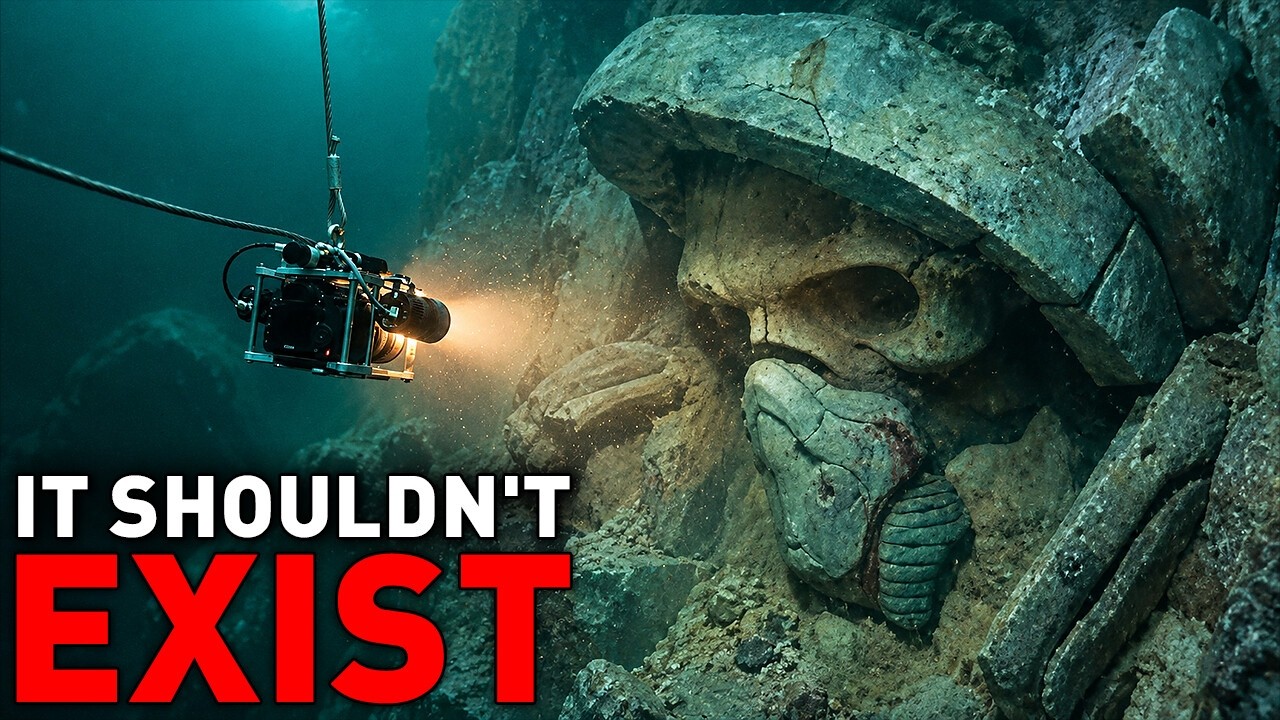
Scientists lowered a camera into a lake with no visible bottom, and the feed went dark. Then, hundreds of feet down, something massive moved past the lens.
A flooded sinkhole in Russia’s Kabardino-Balkaria region has been the subject of a 300-year-old myth claiming it has no bottom....