Pennsylvania’s coyotes just revealed a genetic secret—one ancient ancestor that should have vanished long ago is still quietly thriving in their blood. Researchers DNA-tested hundreds of coyotes across the state, expecting the usual mix of western coyote and wolf lineage.
In the spring of 1907, on a hill called Brush Mountain near Hollidaysburg in central Pennsylvania, a farmer named Jacob Royer saw a large gray fox killing one of his lambs in his pasture. That was how he described it, at least. But the animal was unusually large.
Farmers in the area had lost between 40 and 50 sheep over the previous three years, with no one able to identify the predator responsible. Royer and two of his neighbors tracked the animal and killed it. When they examined the body, it was not a fox. It was an old, emaciated female wolf, weighing about 27 kilograms and measuring more than a meter and a half from nose to tail tip.
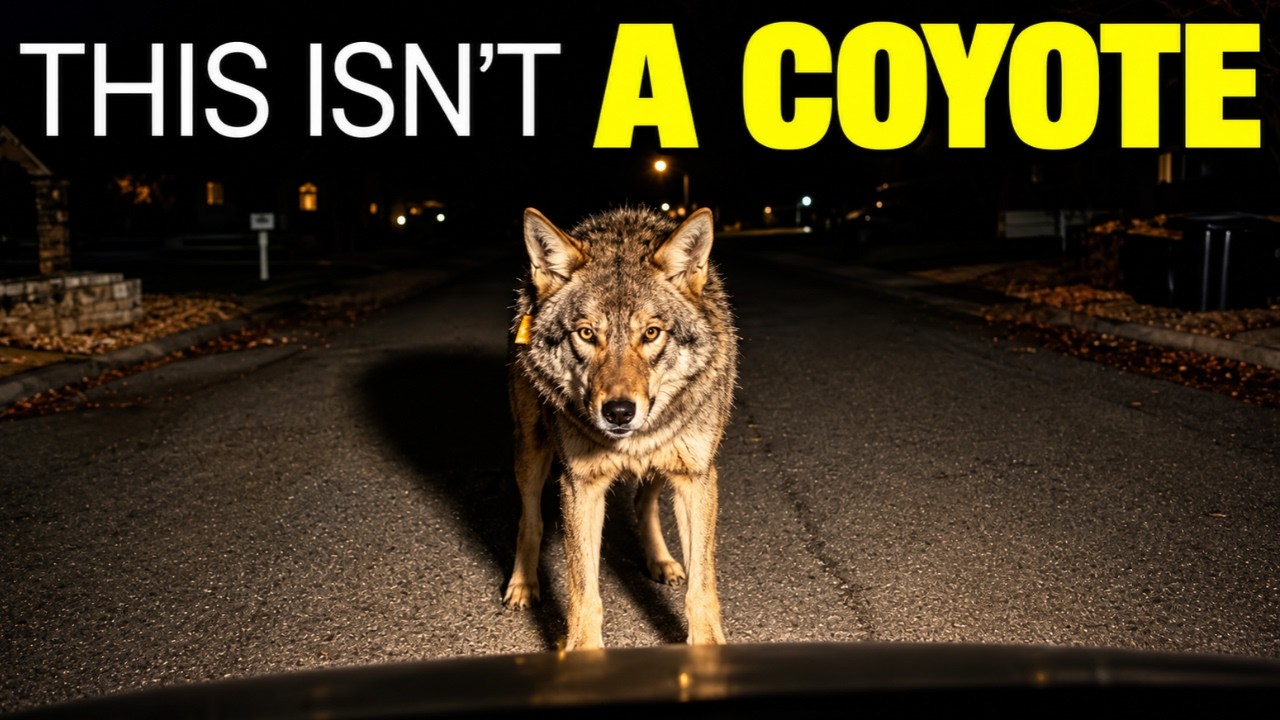
This presented a problem. According to most available records, wolves were no longer present in Pennsylvania by that time. Bounty hunting and steel traps had eliminated them more than a decade earlier. The state’s natural history museum dates the disappearance of wolves to around 1892. Yet this wolf existed.
Her body was sent to the Carnegie Museum in Pittsburgh. A brief report of her death appeared in the state’s game magazine. Then the story faded. For most of the twentieth century, nothing like her appeared in those mountains again, until something did.
Today, in the same mountain regions, hunters gather each winter in volunteer fire halls and weigh animals on scales. Cash prizes go to the heaviest animals. In one recent major competition across the border in New York, before the state banned such contests, the winning animal weighed just under 24 kilograms.
Nobody in those competitions uses the word “wolf.” On official paperwork, the animal is classified as a coyote. But over the past fifteen years, biologists have extracted DNA from hundreds of these animals. They have measured skulls, compared genes, and traced the routes their ancestors took to reach this region. What they have found is that the animal on that scale is not one creature at all. It is a combination of several creatures blended together. And one of those blended components, by any natural logic, should no longer exist.
To understand what roams Pennsylvania today, it helps to understand what was missing. Pennsylvania was founded as a colony in 1681. Bounty records for wolves date to 1683, just two years after settlement began. That is how quickly new arrivals started paying people to kill the forest’s top predator. Over the next two centuries, they did not really stop.
Ohio eliminated its wolves by around 1842. Pennsylvania followed in the early 1890s, with the exception of that one old female on Brush Mountain. The last known wolf in the West Virginia mountains was shot by a seventeen-year-old in 1897.
Here is a part of the story that often goes unconsidered. Coyotes were not present in those eastern forests either. In 2018, Roland Kays and fellow researcher James Hody returned to fossil records, archaeological digs, museum drawers, and the writings of early naturalists to determine where coyotes had historically lived. Their conclusion confirmed what a few earlier naturalists had suspected. Throughout the nineteenth century, coyotes did not inhabit the forests of the eastern United States. They were animals of open land: grasslands, deserts, and brush country. Slender and fast, they were built for hunting mice, rabbits, and anything else they could catch. Most adults weighed between 10 and 14 kilograms, roughly the size of a lightly built kelpie dog.
By the early twentieth century, the eastern forests had a gap at the top of the food chain. As the century progressed, that gap became more valuable. White-tailed deer, hunted nearly to extinction in many eastern areas, rebounded strongly. By the late twentieth century, deer herds in Pennsylvania had grown so large that forest officials warned they were eating the understory down to the roots.
An empty niche, an enormous food supply, and no predator to claim either one.
Then photographs began to appear. Starting in the 1930s, the state game magazine occasionally printed images of strange wild canids that no one could identify with certainty. In 1940, an animal matching what is now called the eastern coyote was killed in Tioga County along the New York border. For a while, they remained rare. Then they stopped being rare.
Sightings crept south from New York’s Catskill Mountains into the northern tier of Pennsylvania. Within a few decades, coyotes were documented in every county in the state. As each new animal appeared, a story emerged to explain it. People said the game commission released them, or insurance companies did to reduce deer numbers and lower car accident costs, or foresters did to protect young trees from deer browsing.
One rumor had compelling evidence. In the late 1980s, a wildlife officer trapped a coyote pup on a farm in Greene County in the far southwest of the state, where coyotes had been killing sheep. The pup was fitted with a radio collar and an ear tag. The tag assigned to it happened to be intended for bobcats. A deer hunter later shot that coyote. Approaching a wild coyote and finding a government tag in its ear looked to many hunting camps like proof of intentional release.
The game commission spent decades denying it. They never released coyotes, they said, and never held and relocated them. They offered to interview anyone who could provide evidence of coyote releases over the past century. No one came forward.
The coyotes arrived on their own, and they kept coming. In 1990, Pennsylvania hunters and trappers took an estimated 1,800 coyotes. By the mid-2000s, that number exceeded 20,000. By 2022, it approached 50,000 in a single year. The game commission now states that over three decades, eastern coyotes have become more common in Pennsylvania than black bears, bobcats, or river otters.
It was not the numbers that troubled people, though. It was the animal itself. These coyotes did not look like western ones. Game commission figures put adult male weights in Pennsylvania at roughly 20 to 25 kilograms, about twice the typical Great Plains coyote. Their skulls were broader, their jaws heavier, and their legs looked too long. Their coats came in four color phases, from blond to reddish to gray-brown to dark brown so deep it looked nearly black. And they did something western coyotes were not known for: they hunted deer.
Hunters had names for them. Brush wolf. Coy-dog. Coydog. Officially, the game commission lists “coydog” as a misnomer, an incorrect name. Keep that word in mind, because the science was about to complicate it.
For years, every argument about these animals ran the same way. One person said they were a type of wolf. Another said a type of dog. A third said they were just well-fed coyotes. No one could prove anything.
Then the curator of mammals at the New York State Museum decided to look in the only place no one had properly searched: freezers and drawers. Roland Kays, working with Abigail Curtis and Jeremy Kirchman, collected tissue, hide, and skull samples from hundreds of eastern coyotes. Some came from museum collections. Others were donated by hunters, trappers, and government agencies. Many were from animals killed specifically because people wanted fewer coyotes.
In 2009 and 2010, they published their findings in a short paper in Biology Letters. The study examined mitochondrial DNA from 686 eastern coyotes along with measurements of 196 skulls. Mitochondrial DNA is useful for this kind of story because it is passed down almost entirely through the mother. Think of it as a family name carried only through female descendants. Trace it back far enough and you can identify which population a maternal ancestor came from.
The team found that coyotes reached the northeast not once, but twice, by two different routes. One wave took the short path, moving east below the Great Lakes through midwestern farmland into Ohio and then toward western Pennsylvania. By the time those coyotes arrived, Ohio’s wolves had been gone for nearly a century. There was nothing to meet. The other wave took the long path, moving north of the Great Lakes through Ontario, Canada, where wolves had not disappeared. Along that northern route, and only along that route, the team found clear evidence that coyotes had interbred with wolves.
The maternal lines also indicated that the entire northeastern population had been founded by a very small number of females that crossed the Saint Lawrence River into New York. The coyotes carrying that northern origin were different. Their skulls were larger. The size gap between males and females was wider, as it is in wolves, and they spread across the landscape about five times faster than the coyotes that came through Ohio.
Kays and his co-authors proposed a simple sequence. Wolf genes made larger coyotes. Larger coyotes could hunt deer. Deer were the fuel for a race across New England and New York that smaller animals could not keep up with.
Then the two waves collided. By mapping where each maternal line appeared and when coyotes were first recorded in each location, the team identified the meeting point in western New York and Pennsylvania. During the late twentieth century, Pennsylvania sat on the boundary between two different kinds of coyotes with different family histories. A farmer in one part of the state and a deer hunter a few hundred kilometers away could argue all night about whether local coyotes looked like wolves, and both could accurately describe what was in front of them.
That discovery was remarkable, but it had a blind spot. Mitochondrial DNA only tells you about mothers. It is a single thin line in a much larger family tree. It cannot tell you how much wolf or anything else is actually spread through the rest of the animal’s body.
To answer that, researchers needed to read the entire genome. That is exactly what the next study attempted. At Stony Brook University on Long Island, doctoral researcher Javier Monzon, working with Kays and evolutionary biologist Daniel Dacaissen, took a different approach. Instead of the maternal line, they used a set of genetic markers spread across the entire genome, each chosen because it behaves differently in coyotes, wolves, and dogs. Think of it as a home ancestry test, except the samples were 427 wild canids from across the northeast and Ohio.
The first surprise came from Ohio. Ohio was supposed to be the control group: the southern route, the coyotes that arrived after the wolves were gone, with no one to interbreed with. If any animal in the study would come back as pure coyote, it should have been these. It did not. Ohio coyotes also turned out to be heavily mixed, with wolf and dog ancestry running through their veins. The tidy two-route story had a crack in it. Somehow, wolf genes had found their way into the wave that was never supposed to have touched a wolf.
The second surprise was larger. Every animal in the sample was mixed. Not most of them. All of them. The researchers described eastern coyotes as forming a broad hybrid swarm, a population in which the lines between original species have dissolved into a full spectrum with no clear boundaries remaining.
When they averaged the northeastern animals together, the numbers were striking. Roughly 64 percent coyote. About 13 percent gray wolf, the large forest wolf of the north and the Rockies. About 13 percent eastern wolf, the smaller wolf of the Great Lakes region and Ontario, whose family history remains so tangled that biologists still argue about what to call it. And about 10 percent domestic dog. Four animals woven into one body.
Back to that word the game commission calls a misnomer: coydog. Every eastern coyote in that study carried a genetic signal of past interbreeding with dogs. Every one. In that sense, the old-timers who called them coydogs had grasped something real. But the details matter. Later research placed dog interbreeding in the northeast between 11 and 24 generations back, with no evidence that it is ongoing. The coyote crossing a road in Pennsylvania tonight is not someone’s stray German shepherd pup. First-generation coyote-dog hybrids appear to be rare in the wild. The dog entered early, likely at the leading edge of expansion when coyotes were scarce and territories were vast, and the only animal looking for a mate sometimes took whatever was available. Kays described much of this interbreeding as happening in moments when the animals involved simply could not find a mate of their own kind. Once those genes entered, they spread quietly across generations until they were everywhere.
Another piece of evidence hides in how they spread. The original Kays study, examining hundreds of animals, found just one plausible dog sequence in the maternal line, from a single coyote in Vermont. There is almost no trace of dogs on that side of the family. But across the entire genome, the dog is in everyone. That only makes sense one way: the dogs were fathers, not mothers.
A team from Trent University in Ontario, led by Tyler Wheelen, tested this idea by looking at the Y chromosome, the piece of DNA that passes only from father to son. They found Y chromosome types shared between dogs and eastern coyotes that were absent in western coyotes. Male dogs mated with female coyotes long ago.
The same pattern applies to wolves. At the genome level, there is a lot of wolf. In the maternal line, there is much less. The sex-biased pattern points mostly to male wolves mating with female coyotes. Mostly, because there is one exception, and it may be the most intriguing detail in this entire story.
Across the northeast, hundreds of coyotes carry a female wolf in their maternal line. When researchers looked closely at those lines, nearly all of them were the same type. One type, shared by hundreds of animals spread across multiple states. The simplest explanation traces back to what may have been a single pairing long ago somewhere north of the border: a female wolf and a male coyote. If so, her descendants have carried her line through every daughter and granddaughter since, across the Saint Lawrence River, through the Adirondacks, into New England, and down into Pennsylvania.
Now, it might be tempting to stop here and say the eastern coyote is just a random mixture. But the most interesting part of the Stony Brook work was not the average. It was where the wolf showed up.
Wolf ancestry was not spread evenly. Coyotes living in places with very high densities of white-tailed deer were genetically more wolf-like. Monzon’s own thesis went further. It found that deer density explained a small but real portion of the genetic differences between coyote populations, and that the pattern had formed in just a few generations. The researchers were careful. They did not claim deer were the direct cause. But the pattern fits everything else. In dense forests full of deer, animals carrying more wolf genes appear to do well. In cities and suburbs where food comes from garbage cans and rabbits, the coyote side of the genome tends to hold its own.
This brings back the strange promise from the beginning. Where you stand in Pennsylvania may change the animal you are looking at. It is not just about which wave reached your county first. It may also be about what that animal has been eating for the past twenty generations.
The obvious question is whether the size really comes from the wolf, or whether these are just coyotes that grew large because the east is full of food. In 2016, a team led by geneticist Bridgett von Holdt, now at Princeton, went looking for an answer inside the genome itself. Working with Kays and others, they scanned thousands of genetic markers across the region where coyotes and wolves had mixed. They found 60 regions where genes from one parent species had moved into the other more than expected by chance. In northeastern coyotes, those wolf-derived regions were rich in genes affecting body size and skeletal proportions. One block of wolf DNA carried more than 40 known genes, some of which may help explain why these animals fall halfway between coyote and wolf in build.
So it is not just about good nutrition. Part of what makes a Pennsylvania coyote heavy and long-legged was literally transferred from the wolf.
The borrowing did something else as well. When a species spreads into a new area, biologists typically expect it to lose genetic diversity along the way. A few pioneers carry only a fraction of their population’s genes, and each new territory is built from fewer and fewer founders. In 2018, Elizabeth Heppenheimer and a large team, again including von Holdt and Kays, tested those expectations on the two eastern expansion routes. The expectations did not hold. Coyotes along both fronts maintained surprisingly high genetic diversity, and the most likely reason was the interbreeding itself. Every time they mixed with wolves or dogs, they replenished what the long journey had drained.
The same study identified twelve genetic variants that changed consistently along both routes as coyotes advanced. In other words, candidate genes for the job of traveling, spreading, and being the animal that keeps moving forward.
Meanwhile, the old meeting line did not stay in place. The same research group found that by that time, the two large eastern coyote populations, northern and southern, were meeting much further south, in Virginia and North Carolina. In New York, a separate study found signs that long-distance wanderers carrying wolf ancestry were blurring the old boundaries between the two strains. Pennsylvania is no longer a clear dividing line between two types of coyotes. It is becoming a focal point of the blend.
What does all this mean for people who actually live beside these animals? The most common concern involves deer. If you hunt in Pennsylvania, you have heard it a thousand times: coyotes eat all the fawns.
Researchers went to check. In a study published in 2004, a team including Justin Veland, Duane Diefenbach, and Bret Wallingford placed radio collars on newborn fawns in forested and agricultural areas of central Pennsylvania and tracked the causes of their deaths. Predators accounted for nearly half of the deaths, and coyotes were part of that. But when the team categorized the predator kills, coyotes were blamed for just over a third of them. Black bears were responsible for a similar share. It was nearly a tie.
More importantly, the team found no evidence that fawn mortality was holding back the deer population. Then, more than a decade later, with coyote numbers significantly higher, they repeated the experiment. In the follow-up work, the game commission and Penn State University reported survival rates nearly identical to the first study. Black bears were often the main culprit, and the state’s deer scientists stated clearly that fawn mortality was not causing deer numbers to decline anywhere in Pennsylvania.
Diefenbach, who heads the cooperative fish and wildlife research unit at Penn State, wrote that controlling coyote numbers was impractical and probably impossible. His team’s models suggested that deer numbers would only decline if survival dropped to about a quarter and adult female survival dropped below three quarters at the same time.
None of this means coyotes do no harm. Ask a sheep farmer. Ask anyone who has lost a cat. The farmers of Brush Mountain in 1907 would have recognized the problem immediately. It means the picture is more complex than either side of the argument admits.
Pennsylvania’s laws still treat this animal as the least protected predator on the list. There is no closed season, no bag limit. For years, heaviest-animal bounty contests have run through the winter, some raising money for volunteer fire departments in small towns. Neighboring New York went the opposite direction and banned wildlife-killing contests entirely, including the one where a 24-kilogram coyote had been among the last of its kind there.
People who know these forests well end up on both sides of that line. Some say constant hunting pressure is the only thing keeping numbers in check and protecting livestock. Others argue that coyotes now play part of the role wolves once played, and that killing them does not reduce their numbers the way people expect.
One detail from the past is worth returning to before the end. The old female on Brush Mountain. When Jacob Royer and his neighbors killed her in 1907, the report said she weighed about 27 kilograms, and described her as very thin, old, and hungry. She was likely one of the last of her kind in that area. In better years, she would have weighed more.
Still, place her next to the winning coyote on the scale in New York, which weighed just under 24 kilograms. The gap between the last recorded wolf on that mountain and the heaviest coyote in a recent contest is about 3 kilograms, roughly the weight of a single building brick.
That is how far an animal built for hunting rodents in open country has come in just over a century. Not by becoming a wolf, but by borrowing traits from one.
The honest answer to the question in the title is that Pennsylvania’s coyotes are coyotes. By the numbers, they are more coyote than anything else, and biologists still use that name. But they are also a living record of a collision. A northern wave took the long route, picked up wolf blood in Canada, then came down fast and strong. A southern wave entered through Ohio and turned out to be far less simple than anyone assumed. A trace of dog left by lonely animals at the edge of the map long ago. A single female wolf whose descendants still run in the veins of hundreds of animals. Genes for size and bone that appear to thrive where deer are abundant.
All of it coming together and blending in a state that spent more than 200 years paying people to make sure no wolf ever walked its hills again. The wolves are gone. And yet, in a way, they never fully left.
Recommended Stories
They released 5,000 bison into a Texas desert—years later, their jaws dropped. The massive herd was meant to restore a dying ecosystem, but the vast scrubland offered little of what the animals needed.
In 2019, a herd of approximately 5,000 bison was released onto 150,000 acres of degraded ranchland in Texas. Two years...

A fishing crew off Australia claims they spotted a 115-foot shark they believe was a megalodon—then were allegedly ordered to stay silent. The massive creature reportedly dwarfed their vessel, surfacing just long enough for stunned crew members to capture footage.
In 1918, professional crayfish fishermen working out of Port Stevens on the coast of New South Wales, Australia, stopped fishing...

Scientists dropped a drone into Crater Lake’s depths, and the footage stunned the entire crew before they could even finish reviewing it. The team expected murky water and little else, but the device captured something massive moving below the surface, something that contradicted every official survey of the lake.
Crater Lake in southern Oregon fills the remains of Mount Mazama, a volcano that collapsed after a major eruption roughly...