They released 5,000 bison into a Texas desert—years later, their jaws dropped. The massive herd was meant to restore a dying ecosystem, but the vast scrubland offered little of what the animals needed.
In 2019, a herd of approximately 5,000 bison was released onto 150,000 acres of degraded ranchland in Texas. Two years later, satellite imagery of the property showed changes so rapid that standard processing software flagged the data as an error. The readings were accurate. Conventional restoration models had predicted that a recovery of this scale would take around 50 years. The land showed significant improvement in roughly 24 months.
The project has drawn attention from ecologists and ranchers because it suggests a large herd of a native species can reverse decades of soil degradation more effectively than expensive mechanical or chemical interventions. The key, according to researchers, was not building anything on the land, but restoring a grazing pattern that the prairie ecosystem evolved with and had been missing for over a century.
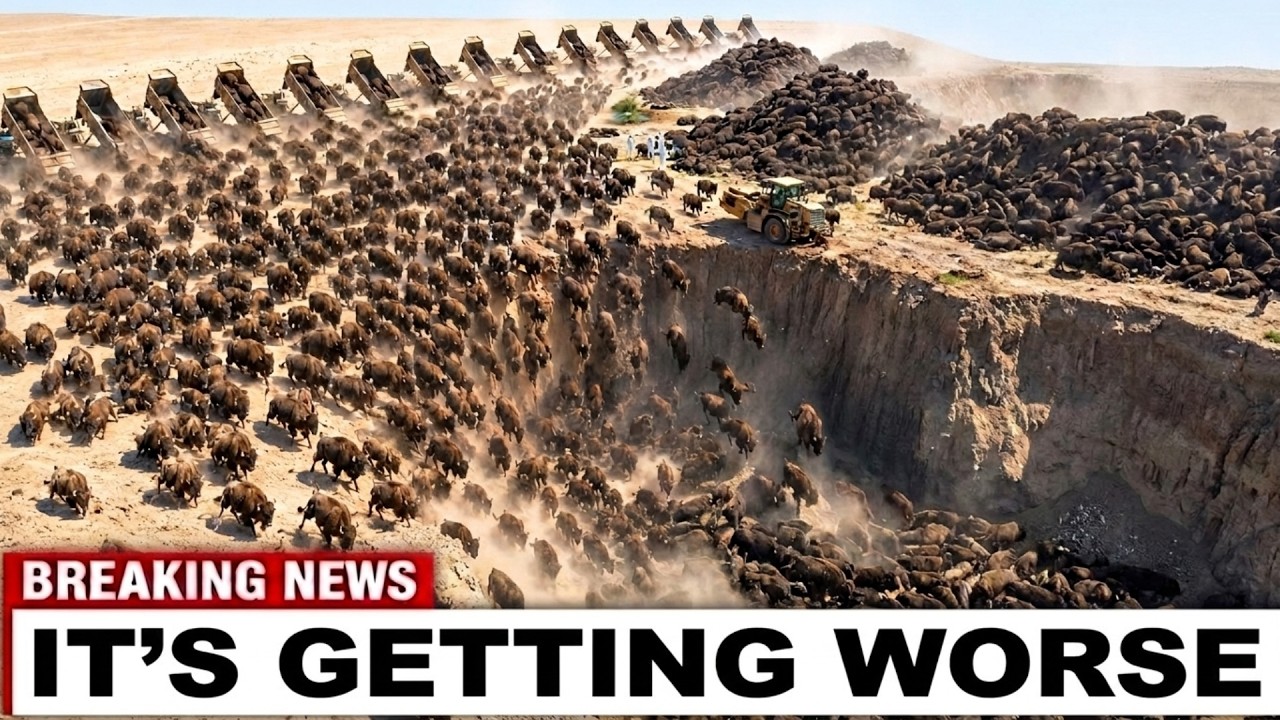
Before the bison arrived, the land had been classified as semi-arid scrubland. Years of cattle ranching had compacted the soil, reduced native grass cover, and allowed honey mesquite, a woody shrub, to spread across a significant portion of the property. Cattle tend to graze selectively, returning repeatedly to preferred plants and staying close to water sources. This concentrated pressure weakened the grass and left hardpan soil that could not absorb rainfall effectively. Creeks that once ran seasonally had dried up, and water tables were dropping.
Previous efforts to restore the land involved bulldozing mesquite, applying herbicides, and reseeding with native grasses. These measures provided only temporary relief. The underlying cause, the absence of a migratory grazer, remained.
The bison herd changed the land through several physical processes. Unlike cattle, bison move in large groups and graze an area hard before moving on. This gives the grass time to recover between grazing periods. Bison also rub against and lean on mesquite trees, which reduced mesquite cover by roughly 30 percent in the first year in heavily used areas. Their hooves broke up the compacted soil crust, and their weight, combined with rolling behavior, created shallow depressions known as wallows. These wallows collected rainwater and created temporary wetlands that supported plant and insect species not previously found on the property.
The herd also produced a large amount of dung, which fertilized the soil and supported insect populations. Researchers at the Konza Prairie in Kansas, where bison have been studied for over three decades, have documented similar effects. A 2022 study based on that data found that bison grazing roughly doubled plant diversity compared to cattle-grazed or ungrazed prairie.
Within a year of the Texas release, soil compaction had fallen by 40 percent. After 18 months, plant cover had increased from 30 percent to 65 percent, with native grasses such as blue grama and buffalo grass spreading across the range. Plants not recorded in the area since the 1950s reappeared near the wallows. The recovery of plant life supported a wider food web. Coyote numbers tripled, golden eagle sightings increased, and a mountain lion was observed on the property. Insect species counts rose from 47 to over 300 within three years.
The most significant finding involved soil carbon. Two years after the bison were released, soil samples showed a 40 percent increase in carbon content. The project team initially suspected equipment failure and sent samples back for repeated testing. The results were confirmed. The increase was estimated to represent roughly 75,000 tons of carbon dioxide removed from the atmosphere annually, equivalent to the yearly emissions of about 16,000 passenger cars.
Grasslands store most of their carbon underground in root systems, which makes them more resilient to fire than forests, where carbon is held in above-ground wood and leaves. Prairie roots can extend several feet deep, and carbon stored at that depth can remain in the soil for long periods if the land is managed properly. Before the bison arrived, the degraded land was releasing carbon. After the herd was introduced, the trend reversed.
The results raise questions about the role of bison in large-scale restoration efforts across the Great Plains, a region spanning roughly 500 million acres. Much of that land faces similar challenges, including soil erosion, declining groundwater, and reduced native grass cover. Some researchers have proposed using bison on a fraction of that land to restore water cycles and sequester carbon, but the practical barriers are significant. The plains are home to working ranches and a food production system built around cattle.
Cattle grazing remains the dominant land use, and ranchers manage their herds according to established practices. One alternative under study is adaptive multi-paddock grazing, which involves moving cattle frequently between smaller pastures to mimic the movement patterns of wild herds. Early results indicate this approach can improve soil health, though it requires more labor and fencing than conventional grazing.
A report by William Hornaday of the Smithsonian in 1889 counted only 256 bison in captivity in the United States and abroad. A small wild population remained in Yellowstone National Park. The Texas herd, which was assembled from multiple sources, is similar in size to the entire Yellowstone population today.
The recovery of the Texas ranchland suggests that the soil retained the biological capacity to regrow native prairie. The missing element was the grazing pressure and disturbance pattern that bison provide. The mechanism behind the rapid recovery is not fully understood. Some soil scientists have proposed that the vibration of a large moving herd may stimulate dormant soil microbes, and that seeds may respond to chemical cues in bison dung and urine. These theories remain under investigation.
What is documented is the outcome: on land that had been written off as scrub, a large herd of bison restored native grass cover, improved water infiltration, increased biodiversity, and sequestered a measurable amount of carbon in the soil over a relatively short period.
Recommended Stories

Marine biologists finally found out why great white sharks abandoned an entire coastline, and the reason is shocking. Tracking data revealed the predators vanished from a region they’d dominated for years.
Between February and June 2017, five white shark carcasses washed ashore near Gansbaai, a fishing town on South Africa's Western...
Nevada dropped five beavers into its most barren desert, but what they did to the water stunned scientists. The state released the rodents into a dry creek bed, hoping to restore a dying landscape.
In the summer of 2013, Sandra Okafor, a wildlife biologist with Nevada’s Department of Wildlife, traveled to Huntington Creek in...

The Illinois River’s invasive Asian carp are disappearing, and the reason has stunned researchers. For years, these fish overwhelmed the waterway, outcompeting native species and leaping into boats by the thousands.
Asian carp, a fast-growing invasive species in lakes and rivers across the Mississippi River basin, became a major problem in...