Four bison were just released into a dead forest in England, and what they did with bark and hooves was unbelievable. Once the ecosystem’s largest animals, these beasts had vanished from the region for centuries, leaving the woodland unable to heal.
In July 2022, four European bison were released into a woodland near Canterbury, marking the first time the species had lived wild in Britain in about 6,000 years. The animals were introduced as part of a conservation project aimed at restoring the health of an ancient woodland that had been gradually declining under a closed tree canopy.
The bison were not brought to the site because they needed protection in England. They were brought because the woodland needed active management, and the bison were identified as a suitable natural mechanism for that work. Within weeks of their release, the animals began altering their surroundings. They stripped bark from trees, pushed over others, rolled in the soil, and grazed selectively. These behaviors created gaps in the canopy, allowed light to reach the forest floor, and produced the kind of open ground and dead wood that support a wide range of plant and animal species.

The project site, West Blean and Thornden Woods, covers about 560 hectares and forms part of the largest continuous block of ancient woodland in southern England. Before the bison arrived, the trust managing the land had relied on conventional methods such as coppicing and mechanical clearing. These approaches worked temporarily, but the canopy tended to close again within a few years, and the cost of repeating the work across such a large area was not sustainable.
The European bison is the largest land animal native to Europe. Adult males can weigh close to 900 kilograms. The species once shaped forests across the continent, but hunting and habitat loss eliminated it from the wild over centuries. The last wild European bison was shot in the Caucasus in 1927. At that point, only 54 individuals remained in zoos, all descended from 12 founding animals.
A carefully documented breeding program followed. The European Bison Pedigree Book, first published in 1932, has tracked every living bison since then. The first captive-bred animals were released into Poland’s Białowieża Forest in 1952. Over the following decades, reintroduction programs spread across several European countries. Today, the population stands at roughly 7,000 free-roaming bison.
The Kent project, a partnership between Kent Wildlife Trust and Wildwood Trust, released three females in July 2022. A bull arrived from Germany in December of that year, delayed by post-Brexit paperwork. The herd’s genetics trace directly back to the 12 founding animals.
The bison are managed as wild animals. They receive no supplementary feeding and only basic veterinary care. Their behavior is monitored, but they are not directed or trained. The herd has grown since the initial release. The first calf was born in September 2022, and additional calves followed in 2023 and 2024.
Early results have been measurable. The bison opened corridors through dense vegetation, including areas of rhododendron. Dung beetles and fungi appeared in their droppings within weeks. Surveys recorded increases in slow worms, grass snakes, and plant species that had not been seen in parts of the woodland for years. Dead wood produced by bark stripping and tree knockdown provides habitat for thousands of invertebrate, bird, bat, and fungus species.
The project is not without complications. Britain has little genuine wilderness, and the woodland is crossed by public footpaths. Dangerous wild animal legislation requires that the bison remain separated from visitors, which led to the construction of bridges allowing people to walk above the animals. The appearance of a bison-managed woodland, with fallen trees, bare soil, and damaged bark, also differs from the tidy look many people associate with well-managed land.
Expansion beyond fenced sites would require resolving questions about land ownership, liability, and public safety near an animal that can weigh close to a ton. Those questions remain open. The project’s monitoring program is scheduled to run until 2050.
The reintroduction of the European bison to this part of England does not represent a return to some earlier state of the landscape. It is an experiment in letting a large herbivore perform ecological work that human management has struggled to sustain. The early signs suggest the woodland is responding, with new plant growth, increases in certain animal populations, and the gradual formation of dead wood habitat. Whether the approach can be expanded beyond the current fenced area remains uncertain, but the bison continue to shape the woodland in ways that would be difficult to replicate by other means.
Recommended Stories

A deep-sea camera at 27,000 feet in the Mariana Trench just recorded something alive—something scientists say has no business being there. The footage shows a creature moving in total darkness, where crushing pressure and freezing cold were long believed to make such life impossible.
In May 2017, a research vessel operated by the Japan Agency for Marine Earth Science and Technology lowered a baited...
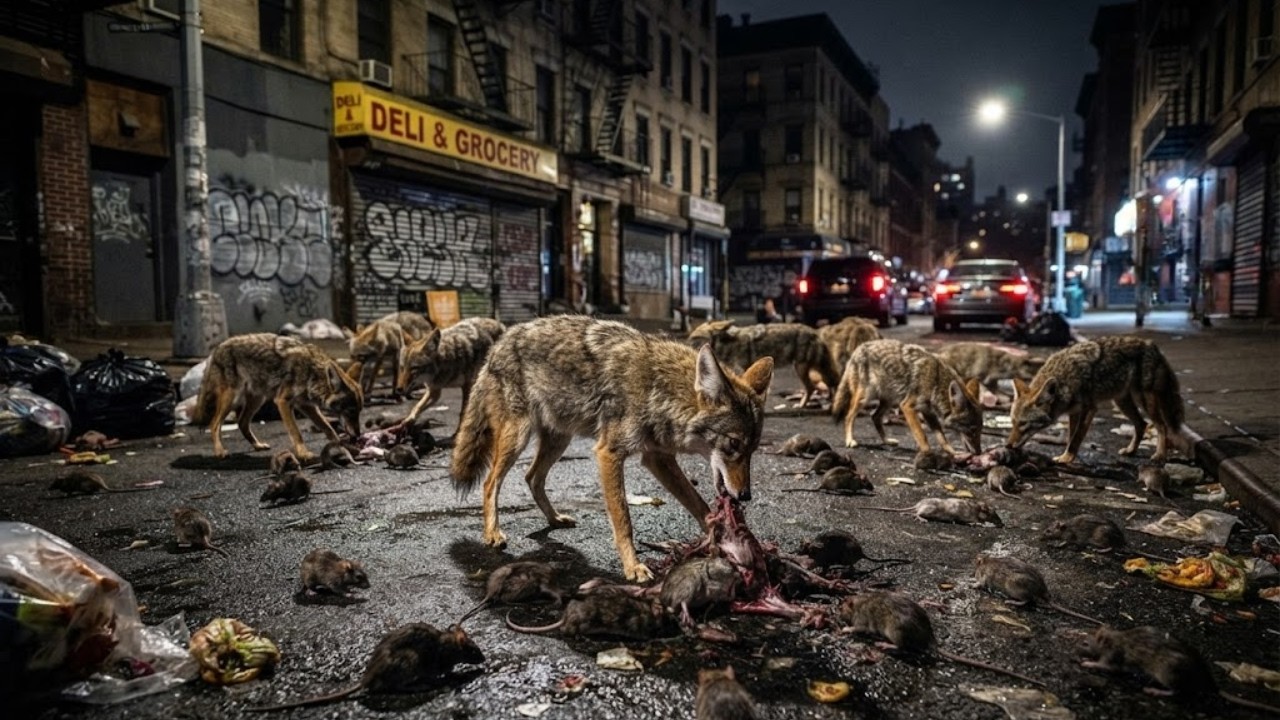
A predator scientists never expected has been silently hunting New York City’s rats at night, and the rodents are vanishing in staggering numbers. Researchers tracking the city’s estimated three million rats noticed entire colonies collapsing without any obvious cause.
Dominique Russo has lived in the same neighborhood in Throggs Neck, Bronx for 31 years. He works the night shift...

A camera plunged 36,000 feet into the pitch-black Mariana Trench, and what it captured has scientists deeply unsettled. The mission aimed to document unknown deep-sea life in the ocean’s most extreme zone.
The deepest part of the ocean floor, the Challenger Deep in the Mariana Trench, sits at approximately 10,935 meters below...