A decades-long Loch Ness investigation claims the mystery has finally been decoded, and the experts’ conclusion is shocking: they say the monster is real. After years of sonar scans, underwater cameras, and water samples, researchers believe a massive creature genuinely inhabits the deep, dark loch.
No scientific organization has confirmed the existence of a creature in Loch Ness, and decades of searches have produced no physical evidence. In 2019, geneticists from several universities tested water samples from the loch, a method that yielded unexpected results without closing the case.
The earliest written reference connected to the modern legend comes from a biography of the Irish monk Columba, written about a century after his death. The text describes an encounter in 565 AD in which Columba came across people burying a man reportedly killed by a creature in the River Ness, which flows from the loch. According to the account, Columba ordered a companion to swim across the river, and when the creature surfaced, he commanded it to retreat. It reportedly did so and caused no further harm. Historians generally treat this passage as a standard religious narrative demonstrating a saint’s authority, a common convention in early Christian biographies, rather than a literal record of wildlife. Similar stories from the same period appear in other texts.
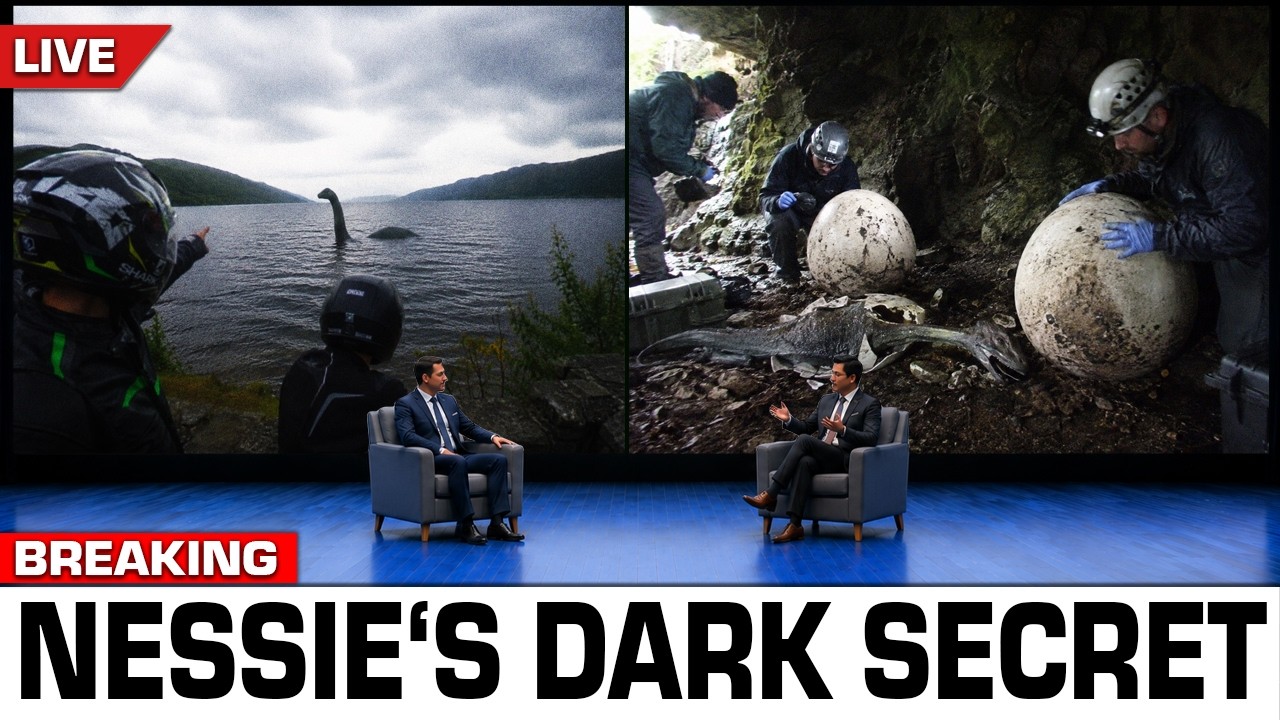
Records show only a small number of additional reports over the following centuries. These included a claimed encounter in 1527 and roughly two dozen scattered reports between 1500 and 1800, none of which attracted lasting attention at the time. The old story might have remained a historical footnote if not for a road built along the loch in 1933, which gave drivers a clear, elevated view of the water for the first time.
A few earlier reports had been logged, including one from a Scottish doctor in 1871 describing an odd object moving across the water, and a 1930 account of fishermen whose boat was disturbed by a creature estimated at six meters long. These drew only mild curiosity. In 1933, a hotel manager and her husband reported seeing a large creature rolling near the shore, and a local paper published the story in May of that year. The editor’s wording helped establish the now-familiar phrase “Loch Ness monster.” The story spread quickly. Later that year, George Spicer and his wife reported watching a long-necked animal cross the road in front of their car before entering the loch. National papers covered the reports, and tourists began arriving in large numbers. A local man took the first photograph claimed to show the creature that November, though skeptics suggested it showed a dog or an otter.
The most famous image associated with the legend appeared in 1934. The Daily Mail published a photograph credited to London physician Robert Kenneth Wilson, showing a long neck rising from the water. Known as the surgeon’s photograph, it was reprinted for decades as the closest thing to proof. In 1994, a man named Christian Sperling confessed before his death that the photograph had been staged. He said his stepfather, big-game hunter Marmaduke Wetherell, had recruited him to build a small model head and neck from plastic wood, attach it to a toy submarine, and photograph it in a way that hid its scale. Wetherell had been publicly mocked by the Mail after footprints he presented as evidence were identified as having been made from a dried hippopotamus foot, a common umbrella stand. The confession has been widely accepted, despite some inconsistencies in the retelling.
The loch itself is difficult to search. Loch Ness sits along the Great Glen fault, a crack in the Earth’s crust formed roughly 400 million years ago, and glaciers later carved it into a long, narrow trench. It stretches about 23 miles and reaches a maximum depth of about 755 feet. By volume, it holds more fresh water than every lake in England and Wales combined. Peat washed in from the surrounding hills gives the water a dark tint that cuts visibility to just a few inches in many places. The steep basin leaves almost no shallow shelf, and the loch has no islands except one small exception. Its volume keeps the water at a fairly steady temperature year-round, so it rarely freezes.
In 1960, aeronautical engineer Tim Dinsdale filmed a large hump moving across the water near Foyers. The footage convinced him enough that he made 57 further visits to the loch over the next 27 years. In 1965, the RAF’s Joint Air Reconnaissance Intelligence Centre concluded the object was probably animate and neither a boat nor a submarine. Later researchers, using better video technology, spotted what looked like a small figure at the stern of a small boat and argued the original analysis had overestimated the object’s size and speed. Some researchers continue to disagree, and the footage remains disputed.
A 1972 expedition led by American lawyer Robert Rines combined sonar with an underwater camera in Urquhart Bay. When sonar detected a large moving object, the camera captured a blurry image that Rines later enhanced with computer processing. The enhanced picture showed what looked like a large flipper, and it became one of the most widely cited pieces of evidence. Presented in 1975 to a gathering of scientists and journalists, it generated considerable excitement. Later scrutiny found that the original unenhanced photographs looked nothing like the published image and appeared to have been retouched by hand. A separate photograph from 1975 showing a head-like shape was identified in 1987 as a rotting tree stump on the lake floor, which has since been recovered and put on public display.
Operation Deep Scan in 1987 was the most ambitious search up to that point. Organized by researcher Adrian Shine, it deployed 20 boats with sonar equipment in a coordinated line across the loch. The project also aimed to study general fauna and map the loch’s deepest sections. Over ten days, the operation detected several unusually strong sonar contacts at depth. Most turned out to be fixed objects on the lake floor, though a small number had disappeared, suggesting they may have been capable of movement. Shine has suggested some might be seals, which are known to visit the loch occasionally. A BBC-backed expedition in 2003 using extensive sonar equipment concluded it had found no evidence of any large unidentified animal.
In the summer of 2018, a team led by Professor Neil Gemmell, a geneticist at the University of Otago in New Zealand, collected 250 water samples from across the loch to test for environmental DNA, the biological traces shed by every living creature. The team processed and sequenced the samples against global genetic databases. The results, announced in September 2019, found no evidence of DNA resembling a plesiosaur or any other reptile, and also ruled out sturgeon, catfish, and Greenland sharks, three species previously proposed as possible explanations. The samples did contain a very significant amount of eel DNA, appearing in practically every sample location. Gemmell noted that the quantity of eel material meant his team could not discount the possibility that some unusually large eels might live in the loch, though the data offered no way to confirm their size. The eel DNA was matched to the European eel species. This idea had been proposed as far back as 1933 but had lost popularity over the decades.
Critics of the giant eel theory point out that even unusually large eels of two or three meters cannot easily explain reports describing long upright necks, humps breaking the surface for sustained periods, or creatures seen on land. That gap between the confirmed abundance of eels and the more elaborate eyewitness accounts remains unresolved.
Loch Ness is not the only lake with such a legend. Canada’s Okanagan Lake has a similarly long tradition, and Lake Champlain in North America has its own creature, often described in similar terms. Researchers have proposed comparable natural explanations for these legends, including logs, misidentified fish, wave patterns, and otters or beavers mistaken at a distance. Each legend also generates tourism revenue, with Loch Ness estimated to contribute over four million pounds annually to the Scottish economy.
Since researchers began formally tracking reports, more than 1,100 sightings have been logged, with new ones still being submitted. Common natural phenomena, including standing waves, floating logs, otters, and diving birds, likely explain many of these reports. The low-visibility water makes it easier for ordinary objects to look unfamiliar at a distance. The psychological phenomenon of pareidolia, in which the brain imposes familiar shapes onto ambiguous visual information, also plays a role. The tourism economy gives the legend a practical incentive to remain alive.
Adrian Shine, who has taken part in essentially every major modern investigation, has stated he never believed a prehistoric monster lived there, while remaining open to the idea that an unusually large fish might explain some sightings. Gemmell’s 2019 study found no genetic evidence supporting a surviving plesiosaur or any other reptile, and ruled out several proposed large fish species. What it found was overwhelming evidence of the European eel in enormous quantities throughout the loch.
A 2016 sonar survey briefly suggested the existence of an unusually deep crevice in the loch bed, but further research determined the reading was a sonar anomaly rather than a genuine geological feature.
The current position is straightforward. The legend traces back to a seventh-century religious biography that historians treat as a storytelling convention. The modern version began in 1933 with the construction of a road. The surgeon’s photograph was confirmed as staged in 1994. Dinsdale’s film remains disputed. Rines’s flipper photographs were retouched beyond what the originals showed. The head-shaped object was a tree stump. The sonar sweeps produced unexplained contacts but no confirmed creature. The 2019 environmental DNA study found no evidence of any reptile, catfish, sturgeon, or shark, while confirming a large amount of eel DNA. No credible scientific organization has declared the Loch Ness monster real, and the researchers who have spent their careers investigating the loch have consistently said so. What exists is a long-standing legend, a difficult body of water to search, one confirmed hoax, one misidentified tree stump, one disputed film, and an unusually large amount of eel DNA that remains unexplained.
Recommended Stories
The Appalachian Mountains harbor predators most hikers never expect, and one encounter in the dense underbrush can turn a scenic trail into a nightmare. While black bears dominate the headlines, the region’s real threat lurks in the shadows, striking with almost no warning.
The Appalachian Mountains are the oldest on the planet, and over time, weather has worn down their peaks into rounded...

Canada released hundreds of hungry predators into the Pacific, and what they did stunned scientists. These sea otters were reintroduced to restore kelp forests decimated byurchins.
Off the coast of British Columbia, a slow-moving ecological collapse transformed the seafloor. Once one of the most productive habitats...
Florida’s crocodiles were vanishing for months, and researchers couldn’t explain why. The reptiles, once thriving in the state’s waterways, had seemingly vanished from their usual habitats, leaving scientists scrambling for answers.
The American crocodile is one of the most elusive large predators in the United States. Unlike its more common relative,...