They reintroduced 35 pine martens into the Forest of Dean—and two years later, grey squirrels are facing the unthinkable. Conservationists hoped these predators would naturally control the booming grey squirrel population, protecting native reds and endangered woodlands.
Between 2019 and 2021, a team from the Gloucestershire Wildlife Trust captured 35 wild pine martens in the Scottish Highlands, fitted each with a radio collar, and transported them roughly 600 miles south to the Forest of Dean, an ancient woodland on the English-Welsh border. The species had not been seen in that forest for more than 160 years.
The animals are nocturnal, elusive, and about the size of a house cat, so few local residents ever saw them. But the forest began to change soon after their arrival. Within months, gray squirrels in the area altered their behavior, expanding their home ranges in what researchers interpreted as a sign of increased caution. Gray squirrel remains began appearing in pine marten droppings, accounting for about 14 percent of their diet.

In Scotland and Ireland, where pine martens had recovered decades earlier, the pattern now emerging in England had already played out more fully. Gray squirrel populations had declined substantially, and native red squirrels, which had been retreating across Britain for over a century, had begun reclaiming territory they had not occupied in generations.
This is the story of a long-running ecological conflict between two squirrel species, one native and one introduced, and the role a native predator may now play in managing it. A report published by Natural England in April 2026 stated that under current conditions, red squirrels could disappear from mainland England within 25 years. The pine marten, the report suggested, may be one of the few viable tools available to prevent that outcome.
The account below is drawn from the Natural England Red Squirrel Recovery Strategy, a peer-reviewed study by Dr. Emma Sheehy and Professor Xavier Lambin published in Proceedings of the Royal Society B, and monitoring data from the Gloucestershire Wildlife Trust.
The gray squirrel is familiar to most Americans as the common squirrel of city parks, college campuses, and suburban backyards. In its native range, it is abundant and generally unproblematic, having evolved alongside local predators for millions of years. In Britain, the same animal is regarded very differently.
Gray squirrels were first introduced to England in 1876, when a landowner released a small number at Henbury Park in Cheshire. Further releases followed at estates across the country. They were fashionable imports at the time, kept as curiosities on private grounds.
Gray squirrels are larger, more aggressive, and more adaptable than native red squirrels. They can digest acorns that reds cannot, and they outcompete reds for food, nesting sites, and territory. They also strip bark from broadleaf trees, causing damage estimated at 37 million pounds per year across English and Welsh woodlands.
They carry squirrel pox virus, which is harmless to grays but usually fatal to reds. In areas where the virus is present, red squirrel populations have declined up to 25 times faster than elsewhere.
The result, over 150 years, has been one of the most complete ecological displacements in European history. Red squirrels once occupied every county in Britain. Today, fewer than 40,000 remain in England, while the gray squirrel population is estimated at 2.7 million. Red squirrels have lost roughly 95 percent of their former range.
The government modeled nearly 20 different approaches to saving the red squirrel, including trapping, shooting, and oral contraceptives under development. Most failed to deliver recovery. One approach, however, stood out.
A study published in March 2018 by Dr. Sheehy and Professor Lambin, conducted across Scotland and Ireland, showed that where pine marten populations recover, gray squirrel populations decline and red squirrels return. The pattern was consistent: the higher the pine marten density, the fewer gray squirrels, and the more red squirrels.
The finding that drew particular attention was the asymmetry of the effect. Pine martens prey heavily on gray squirrels while leaving red squirrels largely unharmed. Even at the highest marten densities in the Scottish Highlands, the study found no negative association between pine marten numbers and red squirrel occupancy.
The reason appears to be evolutionary. Red squirrels evolved alongside pine martens across Europe for hundreds of thousands of years. They are lighter, faster in the canopy, and have escape behaviors refined over millennia. Gray squirrels evolved in eastern North America, where no equivalent arboreal predator exists. They are considered predator-naive. They spend more time on the ground, where martens can catch them, and they are heavier and clumsier in the thin outer branches where red squirrels typically escape.
The same dynamic is seen elsewhere in nature, such as when invasive rats arrive on Pacific islands where native birds have no experience with mammalian predators. In Britain, the pine marten reverses the usual outcome: the native species retains its evolved defenses, while the introduced species is the one unable to cope.
The pine marten was hunted to near extinction in England by Victorian gamekeepers, who classified it as vermin. The last confirmed sighting in the Forest of Dean was in 1860. The species survived mainly in the Scottish Highlands, where it slowly recovered after receiving legal protection in 1988. In Wales, it was functionally extinct until the Vincent Wildlife Trust translocated 51 martens from Scotland between 2015 and 2017.
The Forest of Dean sits on the English-Welsh border, close enough that an English population could eventually connect with the Welsh one, creating a corridor of pine marten territory across southwest England and Wales. That strategic location made the reintroduction a logical choice.
Thirty-five pine martens were released in two phases. Each was radio collared and tracked daily. By spring 2020, the team confirmed the first wild-born pine marten kits in England in over a century. By 2022, the population was estimated at just over 40 animals, with at least four confirmed litters. The martens were staying, breeding, and beginning to disperse into neighboring counties.
Early monitoring data from the Forest of Dean are tracking the pattern documented in Scotland and Ireland. Gray squirrel remains in marten scats appear at rates consistent with established data. Gray squirrels show behavioral shifts, including expanded ranges and altered activity patterns, already visible in the forest.
Researchers expect it will take years, possibly a decade, before the full picture is clear. Pine martens operate at low densities and reproduce slowly, producing only two or three kits per year. But the trajectory established over 20 years in Scotland and Ireland is consistent, and the Forest of Dean is the first place in England where that trajectory is being deliberately set in motion.
The effort is expanding. A third reintroduction in Devon on Dartmoor began in autumn 2024. The Welsh population continues to grow and spread southward. Each new territory occupied by pine martens is a territory where gray squirrels face a predator they have not evolved to escape. And where gray squirrel numbers decline, red squirrels, if populations are close enough to colonize, have a chance to return.
For American readers, there is a particular irony. The gray squirrel, an animal so common it is barely noticed at home, is recognized in Britain as a serious ecological problem, one that has pushed a native mammal toward extinction. The solution being tested in an English woodland is not poison, not traps, and not a genetically engineered contraceptive. It is a native predator, roughly the size of a cat, that occupied these forests for hundreds of thousands of years before humans removed it.
Recommended Stories
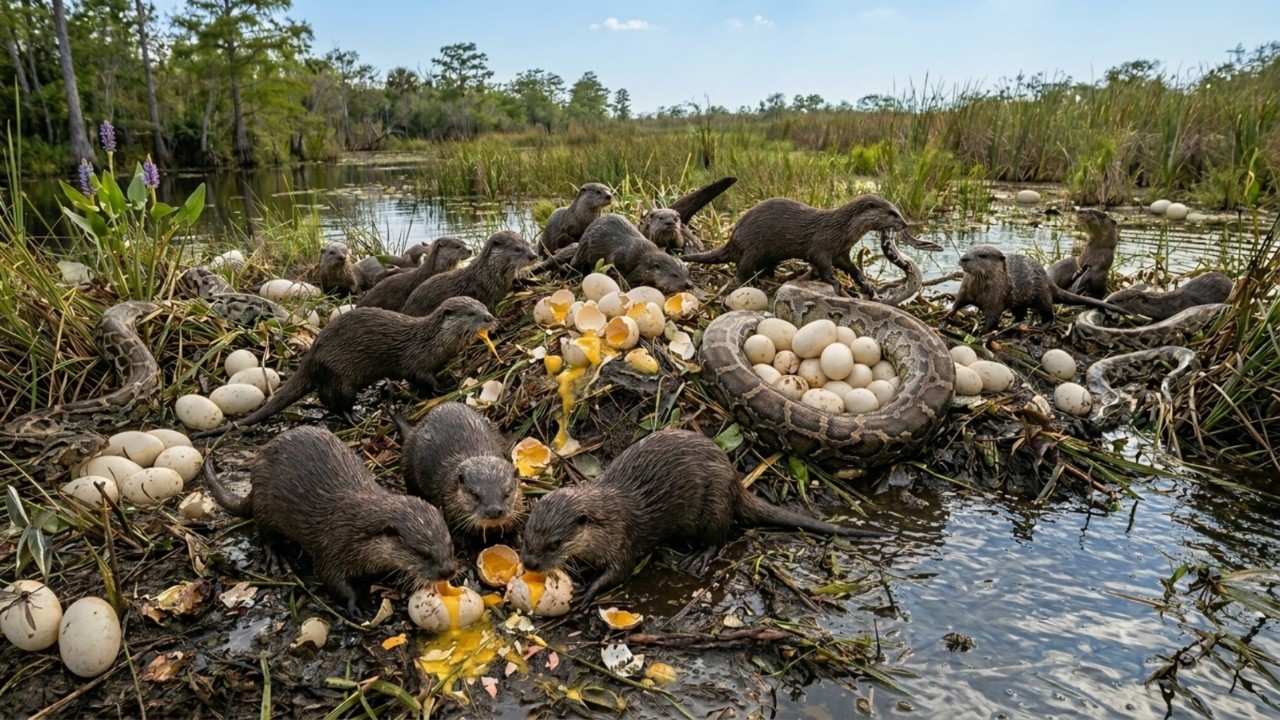
Scientists are watching Florida’s Burmese python nests vanish at an alarming rate, and the culprit isn’t what anyone expected. These massive invasive snakes, already notorious for devastating local wildlife, are suddenly seeing their eggs disappear before they can hatch.
A python nest camera deployed in the Loxahatchee River corridor of the Florida Everglades recorded 37 hours of footage during...

The Southern Ocean is so poorly mapped that we know the moon’s surface better than parts of its floor—and somewhere in that frozen darkness, crews claim they saw something massive. Since the mid-2000s, Japanese research and fishing vessels reported a pale figure the length of a small trawler, moving against the current with what looked like a head, shoulders, and forward-facing eyes.
The Southern Ocean is a rare body of water: it circles the planet without touching any continent. This geography has...

In the world’s deepest abyss, fifteen hundred meters below even the Titanic’s grave, divers captured footage researchers say rewrote ocean science. The Mariana Trench’s crushing pressure was supposed to make life impossible, yet the cameras revealed something thriving where nothing should survive.
On January 23, 1960, Swiss engineer Jacques Piccard and U.S. Navy Lieutenant Don Walsh climbed into the bathyscaphe Trieste and...