A furniture heir spent a fortune trying something nobody had attempted on a bare Scottish hillside that had stayed empty for 400 years. He began planting thousands of native trees on land stripped long ago, aiming to restore a lost forest.
In 2003, a man stepped off a helicopter onto 23,000 acres of Scottish hillside and announced he was going to shoot most of the deer. Not to eat them, not to sell the stalking rights, to get rid. The neighboring landowners called him an idiot. The hunting industry, which had been charging clients £4,000 a week to shoot those same deer, called him worse.
And they had a point, because the man making this announcement had no background in ecology, no degree in conservation, no history with this land or any land like it. He had spent his entire career selling flat-pack furniture. What he had was £50 million, a memory of Southern Africa, and a single question that nobody in the Scottish Highlands establishment was willing to ask out loud. Why, in a country with some of the highest rainfall in Europe, on soil that has grown forest for 8,000 years, why won’t a single tree survive here?
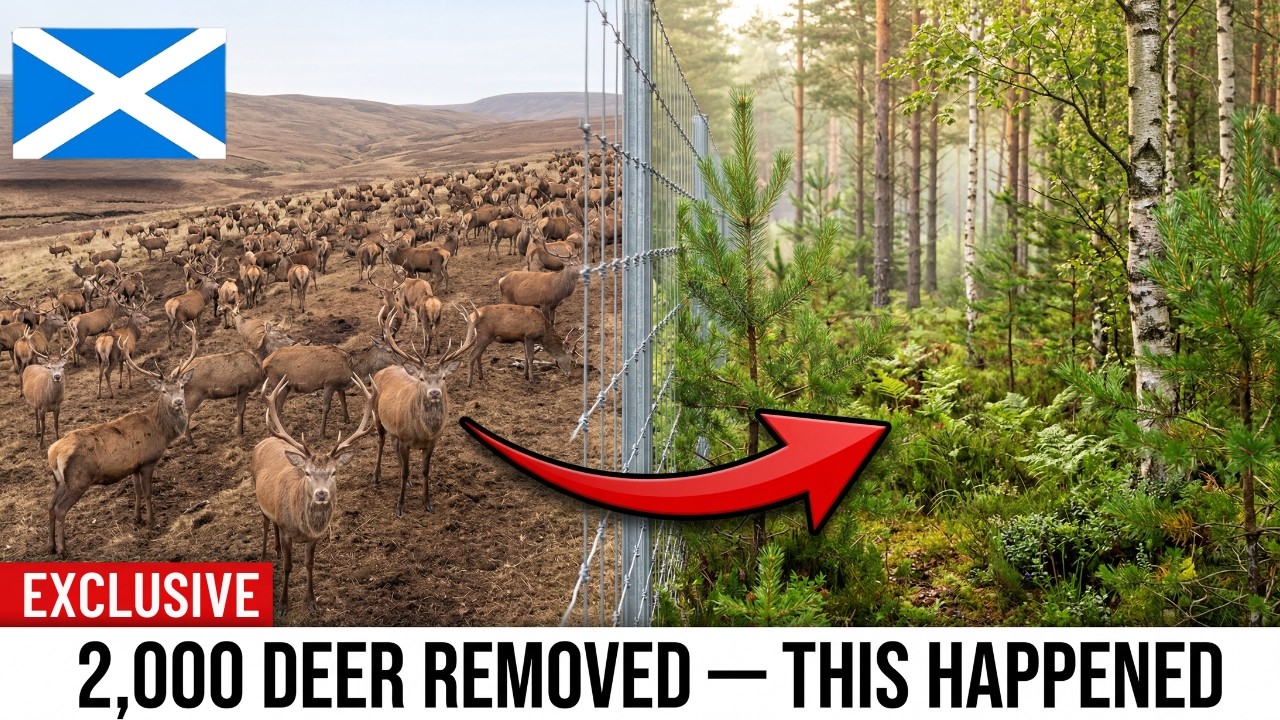
The answer was obvious once you saw it. Nobody wanted to see it. Today, at Alladale Wilderness Reserve in Sutherland, more than 1 million native trees are growing on ground that was bare moorland 20 years ago. The rivers run cleaner than anyone alive has seen them. Species absent from the region for decades are back, and nobody reintroduced a single one of them. They found their own way in.
But before I reveal the solution, there is a question sitting at the center of all of it that has been dividing Scotland for 20 years. Should there be wolves here?
The Scottish Highlands were not always this empty. They were made this way, and it took four centuries to get there. Medieval agriculture and shipbuilding stripped the lower hillsides first. Then came the Highland clearances in the 18th century, when landlords evicted entire farming communities to make way for sheep. Villages that had managed the landscape for centuries were emptied in a generation.
The human knowledge of the place, which trees to protect, which streams to maintain, which soils to leave alone, went with the people who left. Victorian sportsmen finished the job. They discovered that empty Highlands made perfect hunting estates. Red deer were no longer a wild animal, they were a product. Estates competed for the highest deer counts.
Predators, wolves extirpated by the mid-1700s, and lynx gone even earlier, had already been removed. Without them, deer populations did what populations always do without pressure. They grew, and grew, and grew. By the time Lister arrived, Scotland had an estimated 750,000 red deer, the highest density in Europe.
And here is the critical detail that explains why nobody had fixed this before. High deer counts were not a problem for the people who owned the land. They were the business model. An estate with 2,000 deer was worth more to a stalking client than an estate with 200. Every economic incentive pointed toward more deer, always more deer. The ecological damage was invisible on a balance sheet.
Then the Forestry Commission and private landowners planted vast areas of the Highlands in Sitka spruce, a conifer from the Pacific coast of North America. It grew fast. It could be harvested in 30 years. And it was ecologically a disaster. A Sitka plantation acidifies the soil beneath it, blocks light completely, and supports almost no native wildlife. It looks like a forest. It functions like a parking lot.
What Lister bought in 2003 was the end product of 400 years of systematic decisions, each one rational in its own moment, each one removing another layer. The deer were everywhere. The soil was damaged. The trees that existed were the wrong ones. And the system that owned the land had every reason to keep it exactly as it was.
The land was not dead, but it had been held down for so long that almost nobody believed it could come back.
Paul Lister was not an ecologist. He was the son of Noel Lister, co-founder of MFI, a British furniture retailer valued at over 1 billion pounds at its peak. When his father fell seriously ill, something shifted. He walked away from the furniture business, inherited 50 million pounds, and started asking a different question. He had traveled in Southern Africa. He had seen intact ecosystems. The way wolves shaped the behavior of prey, which shaped the vegetation, which shaped the water, which shaped everything downstream.
He came back to the Highlands and saw the gap. The problem was not that the trees were gone. The problem was that the conditions for trees to survive had been destroyed. And the most immediate condition was this. There were far too many deer. Every spring, thousands of Scots pine and birch seeds germinated across Alladale’s hillsides. Within days of breaking the surface, a red deer eats them. This had been happening every single year for three centuries.
Remove the deer and the seedlings survive. Surviving seedlings become ground cover. Ground cover stabilizes soil. Stable soil clears the rivers. And clear rivers start rebuilding everything downstream. That was the whole theory. Almost embarrassingly simple. You do not start by planting trees. You start by removing the thing that is preventing trees from existing.
In 2003, Alladale carried approximately 2,000 red deer across 23,000 acres. Lister’s team began a sustained cull managed by professional stalkers on the estate. The carcasses went straight to the estate kitchen, served at every meal in the lodge. Alladale would feed its guests on the very animals that had been preventing the forest from existing.
The reaction was hostile and immediate. Estate managers who had spent careers maintaining deer counts felt their expertise dismissed by a man who sold wardrobes. The hunting operators who ran stalking weeks at Alladale lost their contracts overnight. And then it got worse. Alladale’s boundaries were not walls. Deer from neighboring estates, maintained at Victorian densities, walked freely across the land. Reduce the herd at Alladale, and within a season, the neighboring deer filled the gap.
The pressure returned. The seedlings got eaten. Nothing changed. Years of work, significant money spent, and the land looked almost identical to the day he arrived. The ecologists who had called it a fantasy were, at that point, not entirely wrong.
But here is the detail that changed everything. The culling was not the project. The culling was the preparation. The project was the fence. 80 km of high-tensile deer fencing, steel posts, wire mesh, designed to last decades, installed around the core restoration zones. The fence is the part of Alladale that nobody photographs. It does not appear in the BBC footage of ospreys or the camera trap images of otters. But take it away, and within 18 months, none of those species have habitat to return to. Every species recovery at Alladale exists because of that wire mesh, the least photogenic infrastructure in Britain, and the most consequential.
Inside the fenced zones, two operations ran simultaneously. The first, removal. 250,000 Sitka spruce were felled. Their root systems left to decompose back into the soil, feeding the fungi, releasing the nutrients, and breaking the compacted layer that decades of needle drop had created. For the first time in decades, light reached the ground. The second, planting. Over 1 million native trees were introduced in sequence, birch and willow first as pioneer species, Scots pine and rowan behind them as the climax species that will eventually define the forest. Not a plantation, a succession.
Every tree was propagated from seed collected within the local area, carrying the genetic adaptations to Sutherland’s specific conditions. Planting stock from southern England would have been faster and cheaper. It would also have produced trees that were strangers to the place they were asked to restore.
One important caveat, a fully mature Scots pine takes 80 to 100 years to reach its characteristic form. The trees planted since 2009 are at most teenagers. What visitors see today is the first chapter of a story that will not resolve for a century. The financial investment in the first decade was approximately 10 million pounds of Lister’s own money. No significant government subsidies, no guaranteed return. What he was buying was the reconstruction of relationships between tree roots and soil fungi, between insects and bark, and between birds and seed.
Get the order right and you create the conditions for a forest to plant itself. The ecologists estimated visible canopy development in 20 to 30 years. Mature forest in 80 to 100 years. They were wrong. Within 5 years of the fence going up, natural regeneration inside the protected zones was outpacing the active planting program. Seeds already in the soil, germinating and dying for decades, eaten before they could establish, was suddenly surviving. The seed bank had not gone anywhere. The moment the pressure lifted, it responded.
Ground cover returned. Peat erosion slowed. The rivers began to clear. Wild Atlantic salmon returned to spawn in the River Carron, a recovery supported by both riparian tree planting and the Carron’s own long-running conservation program. The improvement in water quality, as riverside tree cover expanded, almost certainly contributed to conditions becoming more favorable for the fish.
Bird surveys at the estate documented species not recorded in the region in living memory. Based on the pattern seen in comparable Highland restoration sites, bird density within fenced woodland zones is expected to be substantially higher than on adjacent open moorland, and the species returning to Alladale suggests that trajectory is already underway. Crossbills appeared, feeding on pine cones. Ospreys began nesting. Black grouse returned to the woodland edge.
Pine martins have been recorded on the estate, though sightings remain infrequent. The woodland is still young, and their establishment at Alladale is ongoing rather than complete. Otters extended their range along the recovering rivers. Red squirrels, reintroduced with support from Trees for Life, began using the new woodland.
The soil chemistry shifted. The pH, pushed acidic by decades of Sitka needle drop, began recovering. Mycorrhizal fungi, the underground networks connecting tree root systems, began reestablishing in soils that had been functionally dead for tree growth. The system had not forgotten how to function. It had simply been prevented from doing so. The trees did not just bring shade back. The trees brought the chemistry back. And the chemistry brought everything else.
Innes MacNeill first came to Alladale in 1991 as a deer stalker. His job was to manage the herd, track the animals, and maintain the counts that justified the estate’s income. When Lister arrived in 2003 and announced that the deer were the problem, McNeil was one of the people who had spent his career ensuring there were plenty of them. Today, he is Alladale’s reserve manager, walking the same ground, reading the same weather, but looking for pine martins on the camera traps, osprey activity on the loch, and the water clarity in the River Carron after heavy rain. Same man, same land, entirely different mission.
Stand at any high point on Alladale today and that line is visible from kilometers away. Open hillside on one side, brown, flat, the same texture it has had for 200 years. Canopy at multiple heights on the other, the vertical layering that ecologists use as shorthand for ecosystem complexity. The argument about what deer density does to a landscape can be read just by standing in one place and looking left, then right. Tree cover has risen from 5% to 15% of the estate, with the trajectory still climbing. More than 1 million native trees in the ground. Wild salmon in the River Carron. Otters confirmed. Red squirrels established.
The estate now earns from wildlife tourism, research partnerships, and conservation accommodation, no longer dependent on maintaining high deer densities to function.
And then there is the wolf question, which refuses to go away. Lister has lobbied for permission to reintroduce wolves to a fenced zone at Alladale since the mid-2000s. His argument is operational. The fence costs money to maintain, requires staff, and can be breached. Wolves would do the same job continuously for free. The Scottish government has said no, and the reasons are more specific than farmer resistance. Scotland’s Land Reform Act of 2003 gives every citizen the legal right to access all land in the country. A fence large enough to contain wolves would block that right for a significant area of Highland landscape.
The Ramblers Association and Mountaineering Council have both opposed the plan. It is not just farmers blocking the wolf, it is hikers. In a public address to the National Farmers Union, Scotland’s then rural economy minister stated that wolf reintroduction would happen over my dead body. The Scottish government’s formal position, confirmed in a 2025 Freedom of Information release, is that there are no plans to reintroduce wolves or any other large carnivore. No wolves at Alladale, not yet. The fence holds the line that wolves would hold naturally at significantly higher cost and significantly less elegance.
Alladale is no longer alone. Cairngorms Connect is coordinating restoration across 200,000 hectares, one of the largest rewilding projects in Europe. Trees for Life has planted millions of native trees across the Northwest Highlands. The Scottish government has shifted its land use strategy toward native woodland and peatland restoration. And Lister’s own structure, the European Nature Trust, the charity he established in the year 2000, 3 years before buying Alladale, exists specifically so the project outlasts him. TENT is an institution with a board and mission that exist independently of any single owner. The forest is a 100-year project. The legal scaffolding is in place for it to continue.
Here is the uncomfortable part. Alladale worked because Paul Lister had 50 million pounds and could absorb losses for a decade without consequences. The farmers and crofters who manage most of the surrounding land do not have that option. The lessons are real. The conditions under which they were generated are not, on their own, a policy. Drive 30 minutes from Alladale in any direction and 95% of the Scottish Highlands looks exactly as it did when Lister arrived. Brown hillsides run to the horizon. High deer density. Rectangular blocks of Sitka spruce, dark and structurally dead. They are locked inside an economic logic that made sense in 1880 and has not been seriously re-examined since.
The fence at Alladale is not just a physical boundary. It is a boundary between two different ideas about what land is for. The Caledonian forest did not disappear because the land rejected it. It disappeared because every mechanism that would have let it exist was removed, one decision at a time, each locally rational, the cumulative damage invisible until it was almost complete. What Alladale proved is that the land had not forgotten. The seeds were in the soil. The fungi were dormant. The salmon were waiting for the water to clear. The system was not dead. It was suppressed. Sometimes recovering a landscape does not require new technology or new science. Sometimes it requires removing what you put there, stepping back, and letting the logic of the place reassert itself. The forest knew what it was doing. It just needed someone to get out of the way.
Recommended Stories
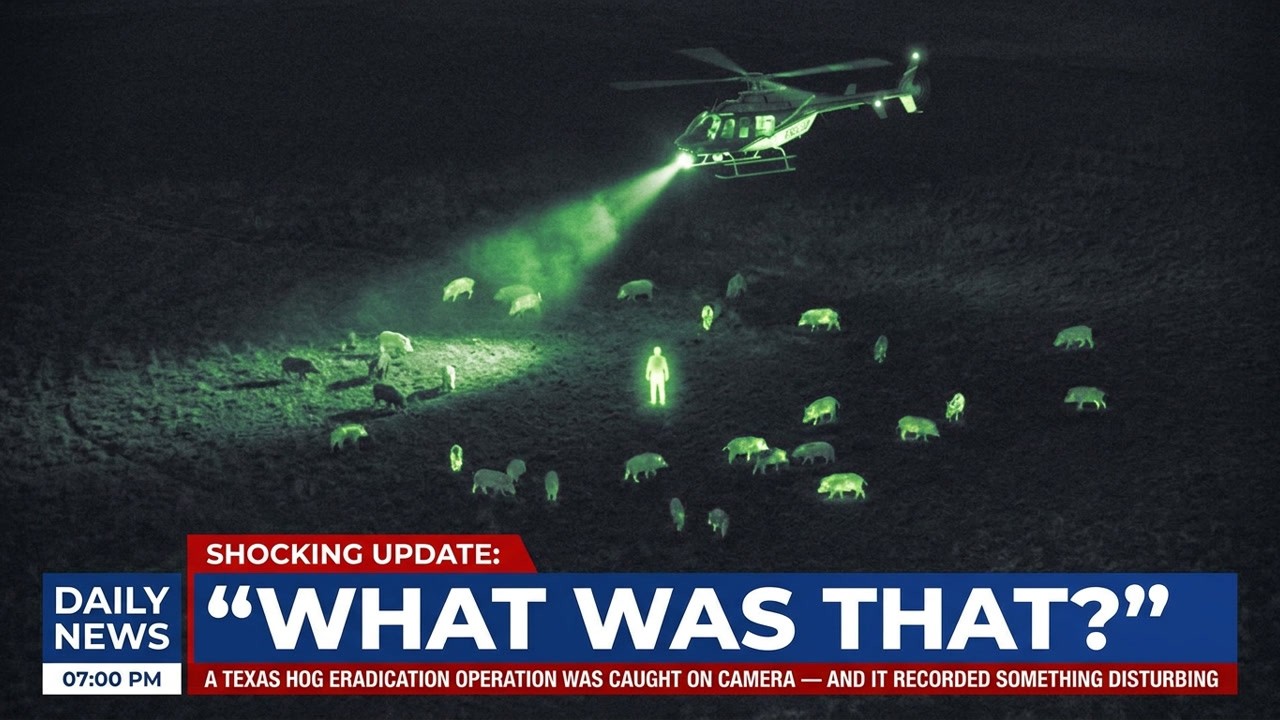
A Texas hog eradication operation was caught on camera in a way no one expected. The team was hired to control the exploding feral pig population, which causes millions in damage across the state.
In Blanco County, Texas, wildlife technicians conducted an operation that looked like a success on paper. Over the course of...
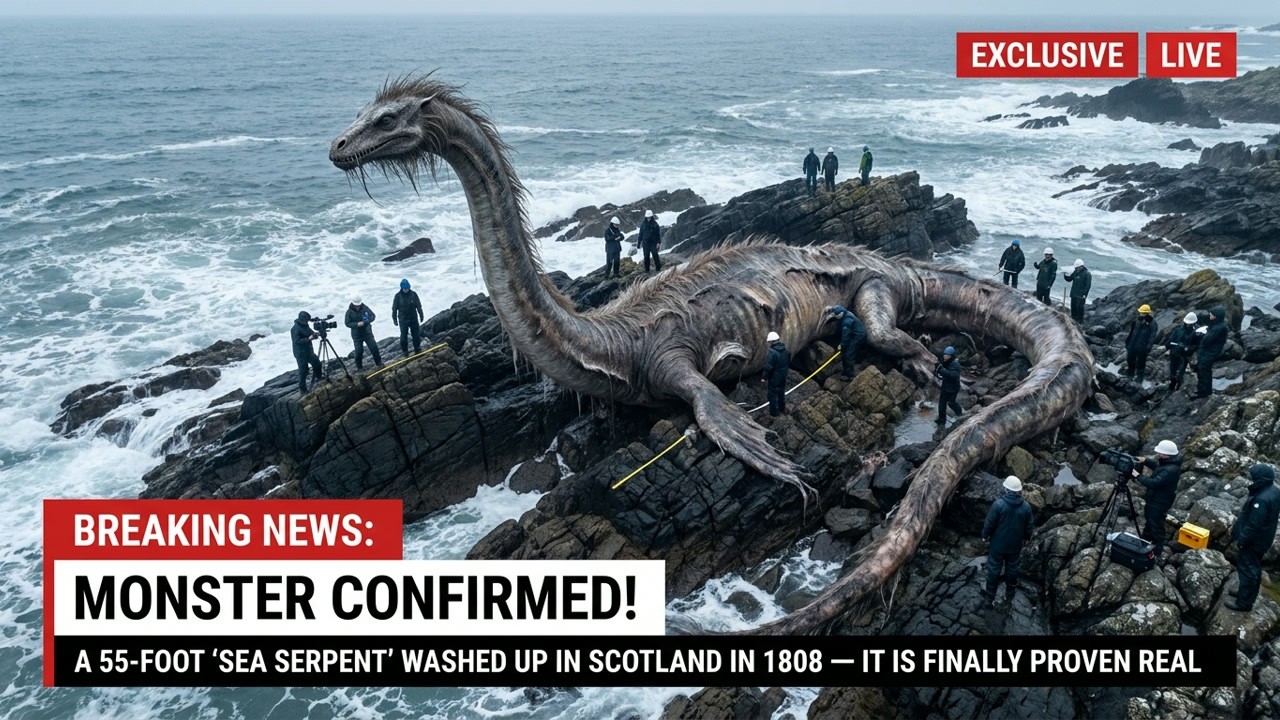
A 55-foot “sea serpent” washed ashore in Scotland in 1808, dismissed for two centuries as a myth. Now, new analysis of the original eyewitness sketches and preserved skeletal fragments suggests the discovery may have been entirely genuine.
In September 1808, after a three-day storm, residents of Stronsay, an island in Scotland's Orkney chain, found a large animal...

They found something ALIVE near Antarctica’s ice wall, and its arrival defies every expectation of what can survive in that frozen void. Scientists initially believed the discovery was frozen debris, until movement was detected deep within the ice.
About 310 million years ago, the area that is now Illinois was covered by shallow coastal waters and muddy shores....