Scientists are baffled as lionfish, the invasive predator that devastated Florida’s reefs, are suddenly dying en masse. These venomous fish had no natural enemies in the Atlantic, allowing them to devour native species unchecked for decades.
Marcus Reeves has run fishing charters in Key West for 19 years. His knowledge of the reef waters comes from decades of watching the same stretch of ocean rather than from charts. Clients paid him to take them to productive fishing spots, and his method relied as much on knowing where fish were absent as where they were present.
Over the years, he had written off certain reef structures where snapper had grown scarce. Those areas had become densely populated by lionfish, a venomous invasive species with no natural predators in the Atlantic. The fish had consumed much of the native stock, leaving little for anglers to catch.

In the summer of 2024, a client on an afternoon trip asked to free-dive at one of these old structures. Marcus anchored nearby and allowed it. About 20 minutes later, the diver surfaced with an unusual observation. He reported seeing lionfish along the edge, but not many. The ones he saw appeared unwell in a way he could not quite describe.
The next morning, Marcus went down himself with a camera. What he recorded that day marked the beginning of something researchers are still trying to explain. He sent the images to a marine laboratory contact in Sarasota. Within 48 hours, the researcher called to ask how widespread the condition was in the area.
Marcus spent the next three weekends photographing shallow reefs along his usual route between Key West and the East Saddle Bunch reefs. He catalogued what he found, location by location, and emailed the full set to the researcher. The researcher later traveled to Key West to see the situation firsthand.
To understand the significance of that visit, it helps to know how lionfish arrived in the Atlantic. They are native to the Indo-Pacific, and they did not cross the ocean naturally. They came from home aquariums, released or escaped from private tanks along South Florida’s coast in the 1980s.
Once in the western Atlantic, lionfish entered a reef system that had no evolutionary experience with them. The venomous spines that deter predators in the Indian and Pacific Oceans meant nothing to Atlantic fish that had never encountered them. Small native fish such as snapper did not recognize lionfish as a threat, and lionfish consumed them readily.
The reproductive capacity of lionfish is extreme. A female reaches sexual maturity within her first year and can produce egg masses every few days throughout her adult life. Studies in the early years of the invasion estimated each female could release around two million eggs per year. In a system with no natural checks on that number, the population did not grow slowly. It exploded across reefs from the Carolinas to the Caribbean in under a decade, reaching densities higher than those recorded in their native range.
Control efforts have been extensive but limited. Fishing tournaments organized by marine conservation groups removed tens of thousands of lionfish from the water. Chefs developed recipes to make them marketable, and dive operators promoted spearfishing trips. But the numbers never added up. A single female remaining after a tournament could replace what had been removed within weeks.
Commercial harvest was proposed and rejected for practical reasons. Lionfish shelter inside reef structures and do not approach bait the way snapper or grouper do. Nets cannot be dragged across the terrain without destroying the reefs that depend on it. The only proven removal method is a diver with a spear, locating each fish individually and taking it one at a time. The time required, the depth limits of scuba diving, and the cost of putting trained divers on the water daily made commercial-scale removal economically impossible.
Lionfish had found something close to an ideal situation. No natural predators, no commercial fishing pressure, abundant naive prey, and a reproductive rate that overwhelmed every organized removal effort.
Dr. James Karrl, a researcher at the marine laboratory, had been reviewing scattered reports of skin lesions in wild lionfish for two years before Marcus sent him photographs. Individual observations at specific sites could be explained away as minor injuries from contact with coral or territorial disputes between fish. Marcus’s photo set suggested something broader.
Marcus photographed 11 separate sites across a 30-meter span of reef. At nine of them, the majority of lionfish present showed open skin lesions. In many cases, the wounds exposed muscle tissue. The fish moved slowly through the water column rather than maintaining the stationary hovering posture typical of healthy lionfish. Animals that would normally take a defensive position in response to a camera drifted away slowly, appearing not to notice the diver at all.
Karrl assembled a team and collected samples within two weeks of receiving Marcus’s email. Over the following month, divers around the Dry Tortugas gathered lionfish specimens from a systematic network of reef sites. Laboratory results confirmed what the photographs suggested. The lesions were widespread, affecting animals at sites separated by distances large enough to rule out a localized environmental cause.
Tissue samples showed evidence of bacterial infection consistent with a class of waterborne pathogens. The infections were compatible with what researchers describe as a compromised immune response, a condition sometimes seen in stressed or weakly immunized fish populations in Atlantic waters. Whether the disease stemmed from a single agent, a combination of factors, or an environmental stressor that weakened the fish’s defenses remains under investigation.
What was clear immediately was the population data. Surveys of lionfish density at the studied sites, compared to historical records from the same locations, showed a significant decline at most of them. The decline was not uniform everywhere, and it was not a population collapse across the entire range. But it was a measurable reduction across a larger geographic area than any removal program had ever achieved.
The disease was doing something that human efforts had failed to do. And it was reaching fish that spearfishers could not. Lionfish that settled in deep crevices and dark ledges, beyond the reach of divers, were also affected. The reproductive cycle continued without any human intervention required.
The story shifted from a question about the disease itself to a larger question about what would happen next on the reefs. Lionfish weakened by lesions do not die immediately. The disease develops over days to weeks. Infected fish become increasingly lethargic, and their ability to regulate buoyancy declines. Eventually, they drift toward the surface.
In the clear, warm waters of the Florida Keys, a floating lionfish is visible from a considerable distance. For any predator that feeds above the waterline, it is an easy meal.
In April 2025, the captain of a local charter boat anchored at a marina in the Lower Keys posted a short video to a community fishing group. The clip showed a bald eagle descending to the water’s surface near a lionfish that appeared to be dying, picking it up, and flying away. The video drew more than 40 responses from people across the Keys and the Gulf coast of Florida. Several commenters described witnessing the same behavior repeatedly over the previous few months at widely separated locations.
Bald eagles along the Florida coast have been recovering since the early 1970s, when the pesticide DDT was banned after causing widespread reproductive failure in the species. The recovery has been steady enough that eagles are now a familiar sight in South Florida. They are commonly found along canals, near reservoirs, and around fish-processing facilities. They are opportunistic feeders, attracted to anything that represents an easy meal for the energy required.
A lionfish floating on the surface fits that description exactly. The venomous spines that make lionfish dangerous to a fish approaching from below are not a threat to a bird striking from above and behind. An eagle’s talons are designed to grasp prey with scales and bones much larger than a lionfish’s. No special adaptation was required. An eagle only needed to notice that a lionfish was floating there and that catching it was straightforward.
Documented observations from Key West to the Gulf Coast indicate that a significant number of eagles along that coastline have reached the same conclusion. Karrl has been careful about how to frame this in the larger dataset. Bald eagles do not dive to reef depths to chase healthy lionfish in the water column. Every photograph and video of an eagle interacting with a lionfish involves a fish at or near the surface, one that has already been weakened by disease or removed from the reef by human fishing pressure.
The eagles function as a filtration mechanism in a system where lionfish are already under stress. This is not the same as saying eagles control lionfish populations. But the claim carries consequences. A cleaning mechanism that continuously removes weak and dying animals from the surface reduces the time those animals spend afloat, gives some of them a chance to recover, and adds a constant predation pressure on a segment of the population that previously had none.
Below the surface, separate from the disease story and the eagle observations, another shift is taking shape across protected reef areas in the Florida Keys National Marine Sanctuary and the wider Caribbean.
Nassau grouper, a large reef predator heavily fished commercially until its numbers collapsed across most of its Atlantic range by the end of the twentieth century, is recovering in areas where fishing pressure has been reduced by law and consistently enforced. Goliath grouper, enormous animals capable of weighing several hundred pounds, were listed as threatened species in the 1990s and have been recovering under a comprehensive federal fishing ban.
Large moray eels, powerful animals with the jaw strength and body flexibility to catch lionfish from an angle that avoids the spines, have been documented on night dives across multiple reef systems capturing lionfish that appeared healthy. These observations do not mean the problem has been solved. They point to something more complex: a reef system beginning to generate its own biological responses to an invader that no administrative program managed to contain.
The grouper that benefited from protection did not recover because anyone planned to use them against lionfish. They recovered because a decision was made to stop fishing them commercially. Their response to that decision is what large reef predators do when given space to recover: they eat what they can find on the reef, in whatever size they can handle.
An honest account of the current situation requires stating plainly that none of this should be interpreted as victory. Lionfish density surveys across the full invasion range in the Atlantic still show highly productive populations distributed across depths and geographic areas that no current combination of disease, eagle predation, and grouper recovery can reach.
The surveys showing declines matter because previously no decline was measurable at all. But they do not indicate that the invasion is receding in any general sense. What they demonstrate is that the conditions in which the invasion could not be stopped were not permanent conditions. They were conditions created by the removal of native predators from a system in which those predators had spent millions of years developing the tools and behaviors to function as a controlling force.
As some of those predators return, they bring those tools and behaviors with them. A grouper that learns to approach a lionfish from behind is not doing something that requires a lionfish as a stimulus. It is applying a general predatory ability to a new prey item and discovering that the ability works. Lionfish, with their limited genetic founding population and no shared evolutionary experience with Atlantic predators, have no ready behavioral or physiological defense against a predator that simply finds their weak points.
Marcus Reeves continues to run his charter business out of Key West the same way he has for 19 years. He has started taking clients back to some of the reef structures he had written off. Not because the reefs are clean, but because they have become interesting again in a way they have not been for more than a decade. Native fish are using the structures lionfish once occupied exclusively. Snapper are holding in positions they had abandoned. In the open spaces between the coral, lionfish in their slow, characteristic hover are fewer in number.
More of the fish he sees carry the marks of whatever is now preying on them. On a late summer afternoon, he watched an eagle hunting near a reef he had been monitoring all season. It dove three times within an hour and came up with something each time. He sat in the boat for a while after the eagle left, looking at the water over the reef, thinking about what 19 years of watching the same line of reef had taught him. How these things move slowly, and how quickly they can change once they start.
Researchers collecting field observations in the Florida Keys, the Gulf of Mexico, or anywhere along the Atlantic coast where lionfish have established themselves want to hear from divers and anglers. Documentation of sick or injured lionfish, native predators hunting them, and eagle interactions at the surface all contribute to a picture that published data lags years behind. Specific reef names, depths, and precise descriptions of what was seen are valuable. The story of what is happening to lionfish in these waters is still being written, and the people who spend time underwater are the ones filling in the details.
Recommended Stories
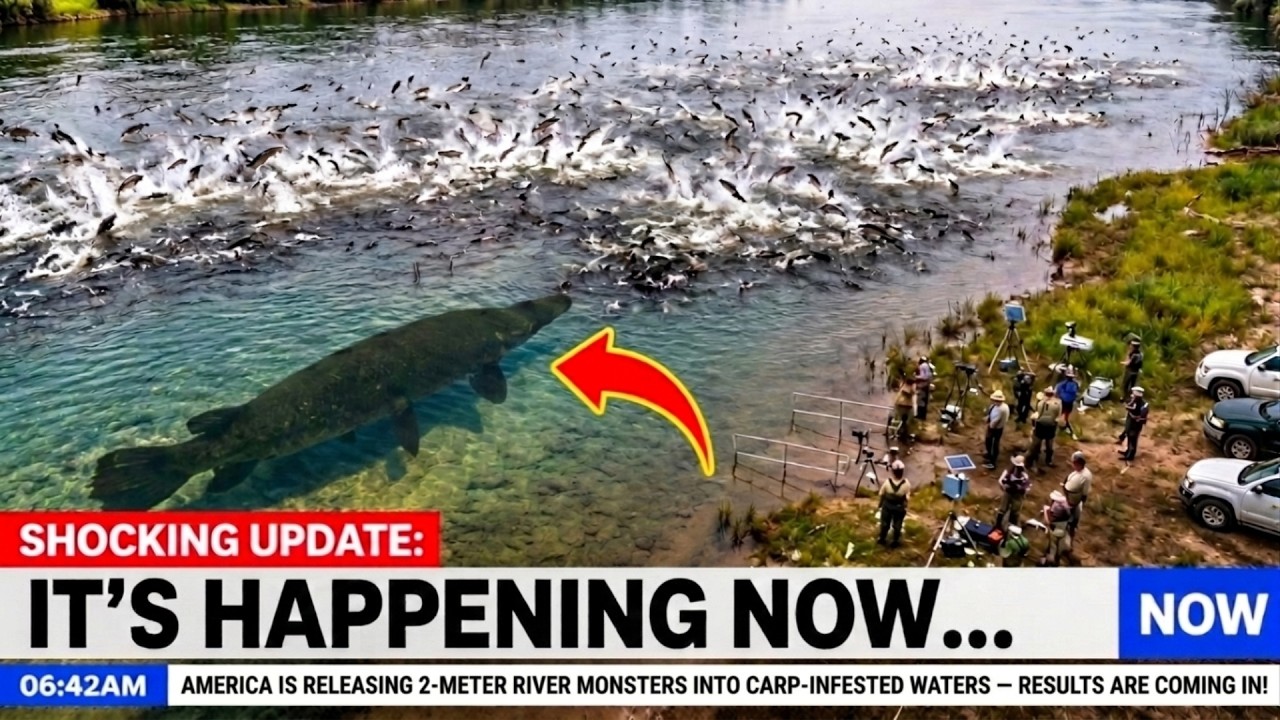
America is releasing 2-meter river monsters into carp-infested waters, and the results are coming in fast. These giant predatory fish were deployed to finally take down the invasive carp species that have been overwhelming entire waterways.
Illinois has been reintroducing alligator gar, a species that disappeared from the state’s rivers half a century ago, with state...
Cameras positioned across the Brazilian Pantanal have captured footage of jaguars reclaiming territory once abandoned by ranchers, and what the cameras revealed is reshaping conservation science. For decades, cattle farming pushed these apex predators to the edges of their habitat, but after land shifted hands, researchers watched the big cats roar back in unexpected numbers.
In November 2025, a camera network operated by the University of Arizona recorded a jaguar at a remote desert water...

The $19 billion tree die-off devastated vast forests, prompting officials to release 24 giant tortoises into the decimated landscape as a desperate restoration experiment. Four years later, the ecosystem had transformed so dramatically that scientists couldn’t believe their own data.
In 2006, researchers released 24 African spurred tortoises into a fenced enclosure in northern Senegal's Ferlo region, an area of...