The monster shark lurking off Alaska’s coast turned out to be far bigger than anyone expected. Marine researchers tracking the apex predator initially estimated its size from brief surface sightings, but new measurements revealed a shocking discrepancy.
The question of what swims in the deep waters of Lake Iliamna, Alaska’s largest lake, has persisted for centuries. The lake, covering roughly a thousand square miles and reaching depths of nearly a thousand feet, holds a permanent dark zone that instruments have never fully mapped. It also connects directly to the Bering Sea through the Kvichak River, a fact that anchors the mystery in geography rather than folklore.
In 1942, a bush pilot named Babe Olsworth flew over the lake and reported seeing more than a dozen large shapes beneath the surface, each roughly the length of his aircraft. Eyewitness accounts of large animals in the lake go back much further. Indigenous communities passed down warnings about a great creature capable of overturning a canoe, with instructions to leave the water when it rippled without wind or darkened without clouds. Russian fur traders in the 18th century recorded accounts of boats struck from below and men lost in the water.

These reports have remained consistent across cultures that shared no language or folklore. In the 1970s and 1980s, witnesses described seeing large shapes between 25 and 40 feet long, sometimes moving in pairs or groups. In 1979, a reward of roughly $100,000 was offered for proof of the animal. Hunters, divers, and researchers spent a summer searching the lake with submarines and sonar. They returned with inconclusive readings, damaged equipment, and no definitive evidence. The reward has never been claimed.
The most plausible candidate, according to some biologists, is the Pacific sleeper shark. This species is a slow-moving predator of cold, dark northern waters, capable of living for a century or more. Its close relative, the Greenland shark, has been aged at over two centuries and has been found with seals and even reindeer in its stomach. Sleeper sharks rely on smell and electrical field detection rather than sight, making them well suited to the lightless depths of a lake like Iliamna.
The published maximum length for the Pacific sleeper shark is around 23 feet. However, that figure is based on animals caught in fishing gear, which operates in the upper few hundred meters of the ocean. Older, larger sharks living in deeper water are not represented in the sample. Biologist Bruce Wright, who studied the region, argued that the recorded maximum may reflect the limits of the fishery rather than the species itself.
The habitat at Iliamna fits the animal’s known preferences in several respects. The lake is cold, deep, and oxygen-rich, which can sustain a large cold-blooded animal indefinitely. It contains an enormous food supply, as the Kvichak River system feeds the largest sockeye salmon run on the planet. The lake also already holds harbor seals living year-round in fresh water, hundreds of miles from the ocean. Their presence demonstrates that marine predators can move through the corridor from the Bering Sea and remain.
The white sturgeon is the most frequently mentioned alternative explanation. Sturgeon are large, long-lived bottom feeders that can exceed 20 feet. However, they are not native to Iliamna, and neither species fully accounts for reports of animals moving together in coordinated groups.
Researchers have begun sampling the lake’s water for environmental DNA, the genetic traces shed by animals as they move. The samples have returned the expected salmon and seal sequences, alongside some signals that have not been clearly assigned to a known species. Those results remain inconclusive.
Recent years have seen an increase in reported sightings, including drone footage from 2019 showing a long, dark shape moving beneath the surface. One plausible explanation is that warming temperatures in Alaska are shifting conditions in the lake. If the deep cold layer is changing, any large animal living there could be moving into shallower water, where it is more visible.
No body, bone, or clear photograph of a large unknown animal in Lake Iliamna has ever been produced. The evidence consists of a deep and largely unsurveyed lake, an open corridor to the ocean, proof that marine animals have used that corridor, a massive food supply, and a long record of consistent eyewitness accounts. The Pacific sleeper shark matches the habitat closely, with the only unresolved detail being the animal’s maximum size, a figure that has never been definitively established.
Recommended Stories
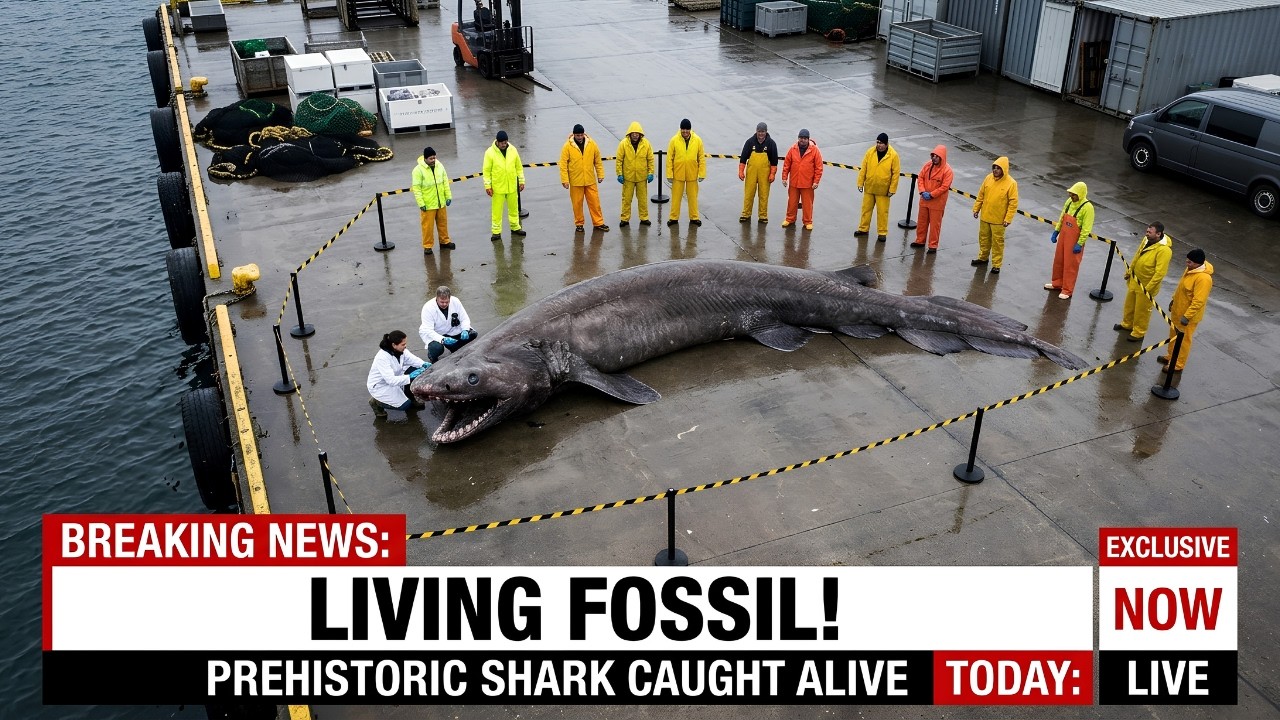
A hundred million years of ocean history surfaced off a tiny fishing boat, and the crew instantly knew something was wrong. The creature they hauled up was a frilled shark, a deep-sea “living fossil” almost never seen alive, and it was gasping in shallow water where it had no right to be.
On the morning of January 21st, 2007, a fisherman at a small port in Numazu, on the coast of central...

The Everglades fires didn’t just scorch the grass—they dragged something hidden into the open, and it wasn’t only the snakes that had everyone talking. As flames tore through the dry marshland, authorities moved in expecting routine wildlife rescues, but what they started finding beneath the ash and smoke shifted the entire operation into something far more serious.
In 2011, researchers in the Florida Everglades found a 15-foot Burmese python that had consumed an 80-pound deer. While alligators...

Hawaii released cannibal snails to kill a pest — but they hunted the wrong species. The predatory snails were introduced to wipe out a damaging invasive slug, a mission they seemed ready to complete.
In 1955, Hawaii introduced a predatory snail to control an invasive pest, the giant African land snail. The rosy wolf...