New York’s subway rats are vanishing from the tracks, and scientists just pinpointed the cause lurking above ground. For decades, the city’s rodent population thrived on discarded food and trash flooding the tunnels, making infestations a permanent fixture of daily commutes.
Maria Castillo has managed the same eight-story residential building on West 96th Street in Manhattan for 11 years. The job comes with predictable seasonal problems. In late summer, heat drives cockroaches up from the basement. In winter, the heating pipes need attention. Year-round, a subway vent in the alley behind the building attracts Norway rats, which she has addressed with traps, bait stations, and quarterly pest control contracts since her first week on the job.
The rats use the vent as a passage between the 96th Street station below and food sources in the alley above. Castillo knows this because she has watched them do it for over a decade. Each extermination cycle produced two or three weeks of reduced sightings at the vent. Then the numbers would return to their usual level.
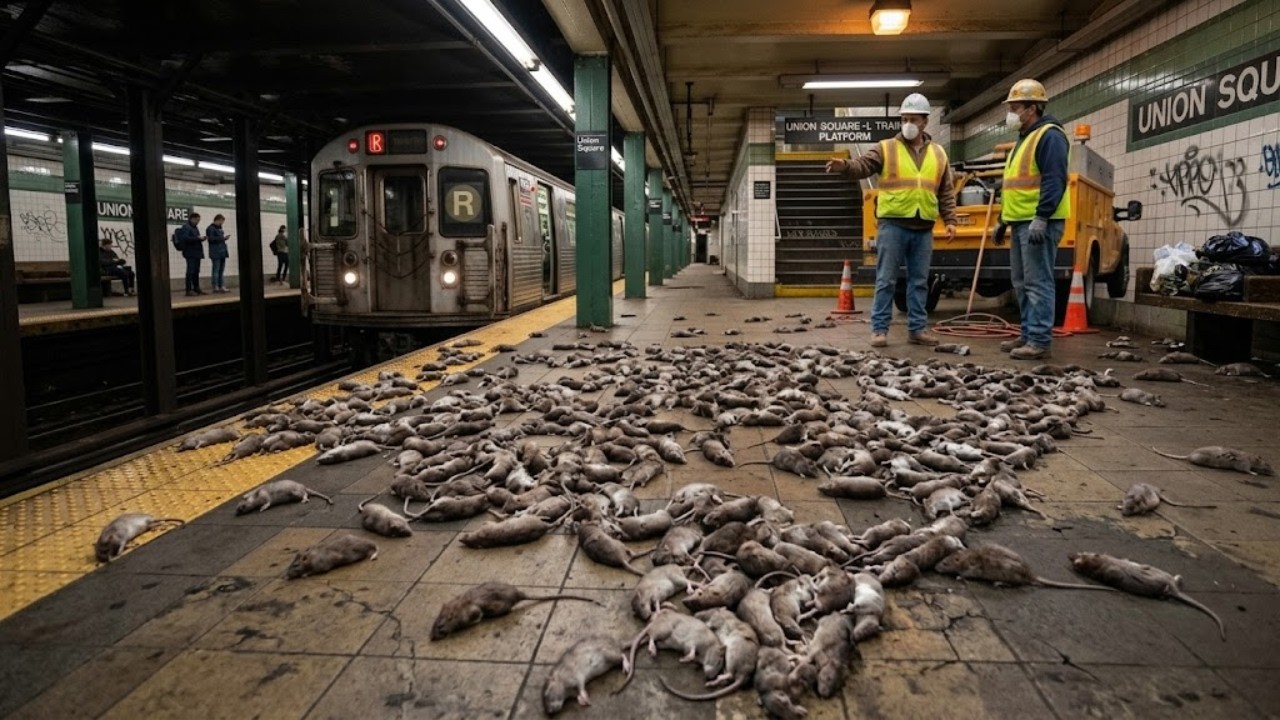
In the fall of 2022, she noticed something that did not fit that pattern. The numbers did not rebound. She reset the same bait station she had used for 11 years, kept the same extermination schedule, and recorded the same monthly sighting counts she had maintained since 2013. The numbers were lower. Not temporarily, but persistently, across three consecutive seasons in a way her baseline data had never shown.
She mentioned it to the exterminator during his latest quarterly visit. He checked his own records and told her he was seeing the same trend in four other buildings he serviced within a two-block radius of that station entrance.
Citywide complaint data began to show a similar pattern. Reports of rat activity near subway station entrances in parts of Manhattan and the Bronx declined noticeably across consecutive seasons. The cause was not underground. It was operating roughly 60 feet above the street, during the same three-hour window each night when subway rats are most active above ground.
To understand what is happening, it helps to know how subway rats actually live. Norway rats in New York’s transit system are not strictly underground creatures. They nest and shelter in tunnels and station infrastructure during the day, then emerge at night through vents, station entrances, and emergency access points to reach surface food sources that the colony depends on.
This surface foraging follows a predictable schedule. Between midnight and 4 a.m., when pedestrian traffic is low and street-level threats are quietest, subway rats make most of their trips above ground. They exit through large vents, move toward food sources in nearby alleys and building perimeters, then return below before dawn and the morning rush.
The trips are short and cover a predictable range around the vent. For most of the 20th century, nothing in New York’s aerial environment was positioned to intercept them.
Dr. Marcus Webb, a researcher who analyzed urban wildlife corridor data across New York for eight years, noticed something unusual when he compared maps of bird of prey territories with complaint data collected by Dr. Rachel Okafor over 11 years. The stations with the largest decline in rat complaints were located directly beneath active hunting grounds for birds of prey. Not adjacent to them. Directly below.
The great horned owl is the largest native owl in New York City, and its hunting window overlaps almost exactly with the peak foraging period for subway rats on the surface. Great horned owls hunt between dusk and dawn, with their most intense activity occurring in the late night hours between midnight and 4 a.m., precisely when rats are most likely to be moving between vents and food sources.
The owl’s silent flight is what makes this overlap effective. Rats detect threats through sound and lateral movement. They watch for shadows at ground level and register the vibrations of approaching footsteps. The leading edge of a great horned owl’s wing feathers is serrated, which breaks up the turbulence that creates flight noise in other birds. It can strike prey in near-total silence.
A rat crossing 40 feet of alley pavement between a vent and a restaurant garbage container at 2 a.m. has no sensory framework for a predator descending from 60 feet without a sound its threat-detection system can register.
Great horned owls have established breeding pairs in Central Park, Prospect Park, and Pelham Bay Park at densities that urban wildlife surveys from 20 years ago would not have predicted. The birds whose absence from New York’s skies during the middle decades of the 20th century left the rat colony’s primary surface foraging window unoccupied have been rebuilding those territories for roughly 40 years.
Peregrine falcons add a second layer of pressure during the dusk window before owl activity peaks. Peregrines hunt until darkness falls and resume at first light, covering the transition periods on either side of the owls’ main window. By 2020, New York City supported more than 30 documented nesting pairs of peregrine falcons, the highest urban density of the species in any North American city. The building ledges where they nest often have direct sightlines toward station entrance corridors where rats appear on the surface.
Urban coyotes complete a third level in outer-borough locations where aerial coverage is less consistent. Coyotes began crossing from Westchester County into the Bronx around 2011, using the Harlem River railroad corridor as a crossing point. The same rail infrastructure that connects to the subway system served as a route for settlement. Coyotes have since been documented across multiple Bronx neighborhoods, as well as in Queens and Staten Island.
A coyote hunting near a station entrance in the Bronx at 2 a.m. positions itself over a subway colony that uses those large exits during peak foraging time. The coyote’s hunting range overlaps with the specific geography a subway rat uses for its surface trip. No one planned the coyotes’ settlement route through the rail corridor toward communities above those stations. The subway infrastructure simply created the passage the coyote followed to reach the hunting ground it now controls above subway rat colonies.
The DDT era did more than remove birds of prey from New York’s skies. It removed the only predator category capable of covering the vertical dimension of rat movement patterns. A Norway rat crossing exposed pavement has no lateral cover protecting it from a bird of prey striking silently from above. Its entire defensive system is designed for ground-level threats only. Three hundred years of adaptation produced a rat nearly impervious to human control programs, but it never developed a response to aerial attacks because no aerial predator existed to require one.
DDT removed the threat from the sky before the subway system reached its current size. Rat populations expanded through transit infrastructure in the mid-20th century in an aerial environment empty of the predator category that targets animals crossing open ground between shelter and food. Federal protections that reversed DDT’s effects in 1972 began rebuilding that aerial predator layer, pair by pair, over the following 50 years. The surface foraging window that subway rats had used since the colony’s establishment is now occupied by predators the rats’ behavioral programming has no reaction to.
The Metropolitan Transportation Authority has spent an estimated $80 million on rodent control in the transit system since 2015. Treatments include dry ice pumped into burrow systems beneath station sidewalks, bait stations bolted to train tracks, and increased cleaning cycles targeting food waste that colonies feed on. Each approach targets the colony at ground level where it shelters. None were designed to address surface foraging trips that occur outside the system’s jurisdiction.
The MTA manages what is underground. What happens at street level above the vents is the city’s responsibility. What happens 60 feet above that, where a great horned owl takes prey each night, was never part of any rodent management plan from either agency. The predator operating between those two authorities did not arrive by invitation. It returned to airspace it had used for thousands of years before a chemical removed it for three decades. The colony below expanded to fill the void that predator left.
Castillo’s exterminator renewed her quarterly contract at his most recent visit and noted in his service log that bait consumption at the alley vent had dropped 40 percent compared with the same period two years earlier. He attributed it to the success of the bait cycles. She pulled out her own 11-year rat-sighting log and showed him the numbers. The decline began in the season before the current poisoning cycle and continued across two full extermination cycles without returning to the 11-year baseline rate.
They stood in the alley for a few minutes. He said he had no explanation for it. She looked at the water tower two buildings away and the roofline where she had begun seeing a large bird at dusk most evenings since the previous spring. She connected the two observations while standing in the alley looking at a bait station attracting fewer animals than at any point in her 11 years at the building.
No one designed the bird of prey recovery program to cover subway station vents. The Migratory Bird Treaty Act made no mention of 96th Street station. Peregrine falcon reintroductions in the 1970s aimed to save the species from DDT-driven extinction, not to intercept Norway rat foraging trips above station platforms. The great horned owl’s expansion through urban park systems was documented by birdwatchers, not by the MTA’s rodent control office. The coyote that crossed the Harlem River rail corridor into the Bronx was following a geographic opportunity, not a transit rodent management strategy.
Three recovered predator populations converged above the foraging grounds of the deepest subway rat colonies in North America. No one funded the aerial suppression layer now operating above those large vents between midnight and 4 a.m. It is working anyway.
Researchers continue to track what this means. Webb continues mapping bird of prey territories, and Okafor continues monitoring 311 complaint data each season to see how subway rat populations respond as great horned owl territory expands through park-adjacent station corridors and urban coyotes continue settling in outer-borough station areas.
Recommended Stories

Florida released eight Texas pumas into its collapsing panther population, a desperate move to save a species on the brink. Within weeks, something impossible appeared in the genetic data, challenging everything scientists believed about the big cats’ survival.
By the early 1990s, fewer than 30 Florida panthers remained in the wild, the last survivors of a cat that...
China released 11 horses into a desert with zero grass—and what they did with their hooves stunned researchers. The herd was transported to a barren, arid landscape where survival seemed impossible, with no visible vegetation or water sources.
In December 1986, eleven Przewalski's horses arrived at the edge of the Junggar Basin in northwestern China, transported from zoos...
Alaska’s version of Jaws is real—and it’s far bigger than anyone imagined. A massive, elusive predator has been terrorizing remote coastal waters, leaving local fishermen baffled and communities on edge.
Lake Iliamna is the largest lake in Alaska, a remote body of fresh water roughly 80 miles long and 25...