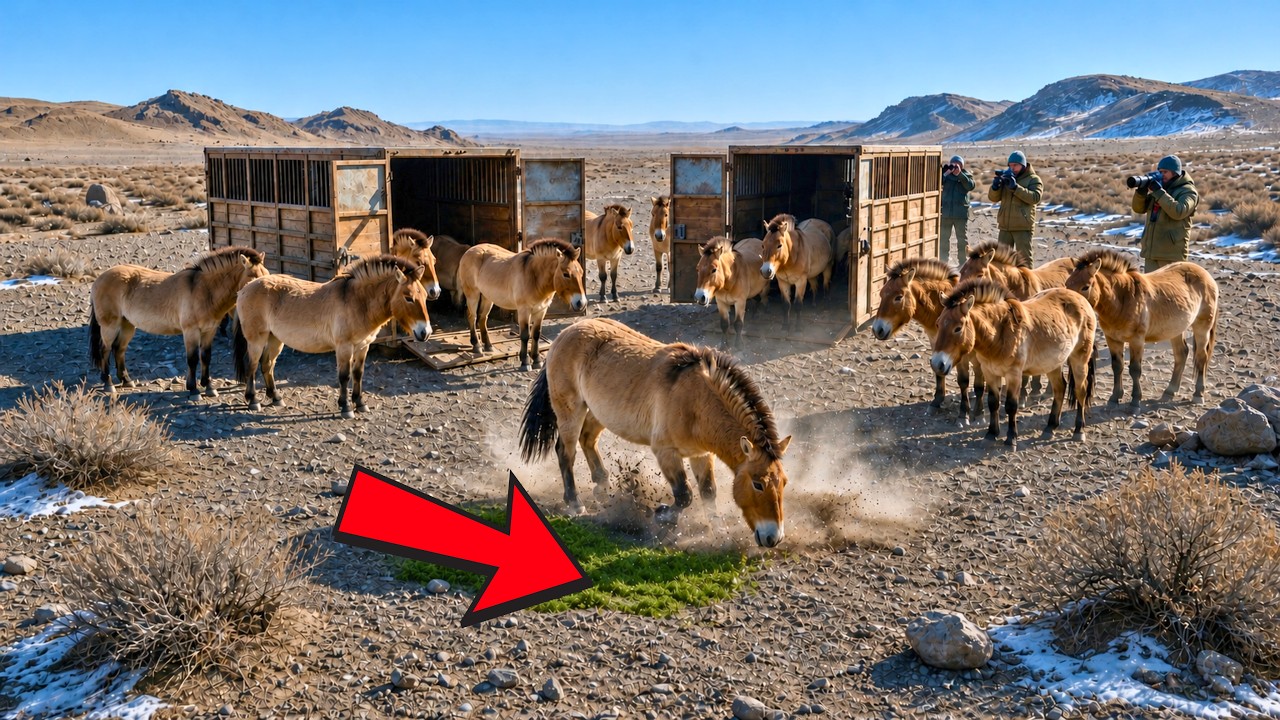
China released 11 horses into a desert with zero grass—and what they did with their hooves stunned researchers. The herd was transported to a barren, arid landscape where survival seemed impossible, with no visible vegetation or water sources.
In December 1986, eleven Przewalski’s horses arrived at the edge of the Junggar Basin in northwestern China, transported from zoos in Germany and the United Kingdom. They stepped onto frozen ground in a semi-desert landscape where winter temperatures regularly drop below minus 30 degrees and annual rainfall barely reaches four inches. The terrain offered little visible forage.
These were the first members of the species to reach Chinese soil in more than fifty years. By 2025, the population in China had grown to more than 900 animals, roughly a third of the global total. Wild herds now range across Xinjiang, Gansu, Inner Mongolia, and Ningxia. In the Kalamaili Nature Reserve alone, free-roaming bands cover thousands of square kilometers of desert steppe.
The International Union for Conservation of Nature has reclassified the species from extinct in the wild to endangered. The recovery is considered one of the most significant in the history of large mammal conservation.
The Przewalski’s horse is the only surviving subspecies of truly wild horse. Its lineage diverged from the ancestor of domestic horses roughly 500,000 years ago. Feral horses such as American mustangs, which descend from Spanish horses brought to the Americas in the 1500s, are not considered wild in the same sense.
The Przewalski’s horse stands about 13 hands, roughly 4 feet 4 inches at the shoulder, and weighs between 550 and 750 pounds. It has a stocky build, a large head, and a short, erect mane. The coat is dun with a dark dorsal stripe. The species carries 66 chromosomes compared with the domestic horse’s 64.
In its native ecosystem, the horse functions as a desert-adapted grazer. Harem bands move across large home ranges, grazing selectively on grasses, sedges, and shrubs. In winter, they dig through snow with their hooves to reach buried vegetation, a behavior known as cratering. Their movement distributes seeds, and their dung creates nutrient-rich patches in barren soil.
The species was first described for Western science in 1881 by Russian geographer Nikolai Przewalski, though herders in Mongolia and China had known the animal for thousands of years. The population was already in decline at that time due to hunting and competition with domestic livestock.
In the early 1900s, European animal collectors mounted expeditions to capture live foals for zoos. The methods were harsh. Herds were chased on horseback until foals fell behind. Of the dozens captured between 1899 and 1903, only a handful survived the journey to Europe. Those survivors became the genetic foundation for the entire species.
The last confirmed wild Przewalski’s horse was sighted in 1969 in Mongolia. After that, the species existed only in zoos. Every animal alive today descends from twelve wild-caught founders, with possibly four domestic horses crossbred into the captive population in the early years.
In 1985, the Chinese government launched a wild horse homecoming plan. The Xinjiang Wild Horse Breeding and Research Center was established in Jimsar County on the southern edge of the Junggar Basin, within the species’ historical range. The program had three phases: captive breeding, semi-wild enclosures, and full release.
The first eleven horses arrived from Germany and the United Kingdom in December 1986. They were held at Urumqi Zoo for sixteen months to acclimatize before transfer to the breeding center. By 2005, twenty-four animals from facilities in Germany, the United Kingdom, and the United States had been installed at Jimsar. The breeding program produced more than 285 foals over two decades.
On August 28, 2001, twenty-seven captive-bred Przewalski’s horses were released into the open desert steppe of the Junggar Basin. It was the first time the species had been free on Chinese soil since the 1960s.
The first year produced casualties. Some horses died in winter. Wolves killed several foals. A highway through the reserve killed five horses in a single autumn. Water sources tested at fluoride and sodium levels up to 60 percent above drinkable standards.
The horses that survived began forming stable harem bands and locating water sources that reserve management had not fully mapped. They cratered through snow in winter and shifted seasonally, moving to higher ground in summer and valley bottoms during the worst of winter.
By the late 2010s, the released animals had become a self-sustaining herd ranging well beyond the boundaries biologists had drawn. The science indicated the horses were not merely persisting in the desert; they were shaping the ecosystem.
In arid steppe systems, the absence of large grazers leads to a specific kind of degradation. Dominant grass species grow unchecked, form dense monocultures, and crowd out other plants. When Przewalski’s horses graze, their selective feeding removes dominant plants, opens gaps, and allows a wider range of species to establish. A 2022 study in PNAS, conducted on bison but documenting the same mechanism, found that this type of grazing nearly doubles native plant richness compared with ungrazed land.
The horses also influence water dynamics. Their movement creates landscape connectivity for other species. Their trails between water and grazing areas become paths used by Asiatic wild asses, gazelles, argali sheep, and foxes. A 2026 study in the Journal of Applied Ecology documented how Przewalski’s horses and Asiatic wild asses coexist by partitioning water sources spatially and temporally.
The cratering behavior creates feeding patches that other herbivores exploit after the horses move on. The largest herbivore in the system creates access for species below it.
The same megaherbivore dynamics are being studied in bison restoration projects across the American Great Plains, including the American Prairie Reserve in Montana, the Tallgrass Prairie National Preserve in Kansas, and tribal bison programs.
The Przewalski’s horse has also become a symbol of international cooperation. The breeding stock that founded China’s program came from zoos in Germany, the United Kingdom, and the United States. An international studbook maintained by the Prague Zoo coordinated the captive programs. Russia’s Republic of Sakha received more than 120 Przewalski’s horses from Canada’s Elk Island National Park beginning in 2006. Alaska received 100 wood bison from the same source in a parallel program.
In Mongolian, the horse is known as takhi, meaning spirit. In Chinese, it is yema, wild horse. For more than fifty years, those names referred to an animal that existed only in zoos.
The animal has returned. With more than 900 in China alone, the horses are breeding season after season across the Junggar Basin, digging through snow for buried grass in a landscape that human observers once considered uninhabitable.
Recommended Stories

A single 40-pound rodent reverse-engineered Britain’s failing flood defenses, beating millions in concrete. After 400 years of extinction, beavers quietly reappeared in Devon, while officials planned to trap and kil*** them over biosecurity fears.
In the winter of 2015, flooding caused an estimated 1.6 billion pounds in damage across England. The government's response focused...

In the world’s deepest abyss, fifteen hundred meters below even the Titanic’s grave, divers captured footage researchers say rewrote ocean science. The Mariana Trench’s crushing pressure was supposed to make life impossible, yet the cameras revealed something thriving where nothing should survive.
On January 23, 1960, Swiss engineer Jacques Piccard and U.S. Navy Lieutenant Don Walsh climbed into the bathyscaphe Trieste and...
The Appalachian Mountains harbor predators most hikers never expect, and one encounter in the dense underbrush can turn a scenic trail into a nightmare. While black bears dominate the headlines, the region’s real threat lurks in the shadows, striking with almost no warning.
The Appalachian Mountains are the oldest on the planet, and over time, weather has worn down their peaks into rounded...