New LED street lights are silently slashing insect populations by nearly half, and the culprit is right above our heads. These modern fixtures emit specific wavelengths that disrupt nocturnal bugs’ navigation and breeding.
Across Britain and much of the world, cities have been replacing their old orange street lights with bright white LED lights. The new lights use less electricity, last for years, and make streets feel safer. They seemed like an easy win for city councils looking to cut costs and carbon emissions.
But in the hedgerows beneath those lights, insect populations began to decline sharply. When scientists investigated, they found that in some areas nearly half of the insects that should have been present had disappeared. The insects vanishing were not the ones flying into the lamps. They were creatures that could not fly at all, living on leaves a few meters away. Most of them had never touched a street light in their lives. Something about the light itself was reaching into their world and changing it.
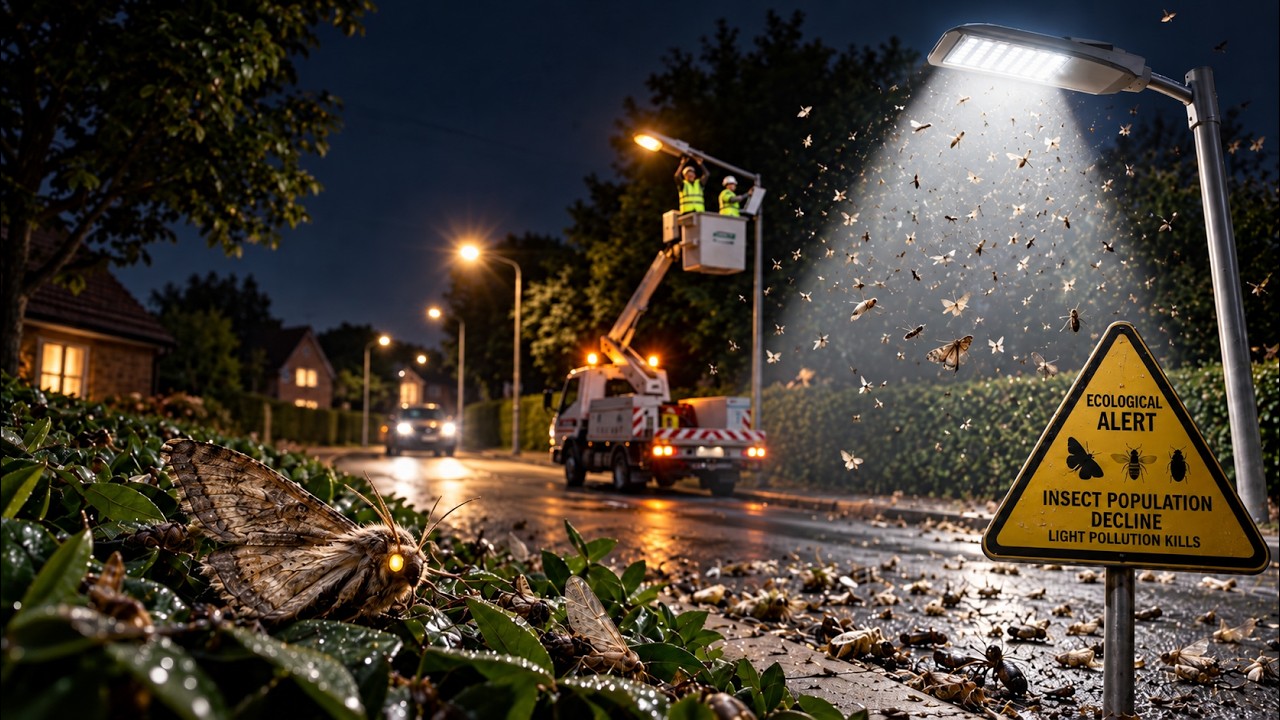
To understand why this matters, it helps to look at moths. Britain has around 2,500 species of moths, dozens of times more than its butterflies. Some are camouflaged so perfectly they vanish against tree bark. Others are brightly colored. Every one of them begins life as a caterpillar.
A caterpillar hatches on a leaf, eats that leaf, moves to the next one, and keeps going until it has grown thousands of times heavier than when it hatched. Many species feed mostly at night, creeping along stems and twigs in total darkness when the birds that hunt them are asleep. That darkness is not a detail. It is the rule they evolved under.
For hundreds of millions of years, night on Earth meant the moon, the stars, and nothing else. Moths built their lives around that rhythm: when to feed, when to mate, where to lay eggs, when to transform.
Caterpillars are one of the main foundations of the food web. A single brood of blue tit chicks can eat thousands of caterpillars before they leave the nest. Bats hunt adult moths through the night sky. Hedgehogs, shrews, beetles, and spiders all depend on them. Adult moths also pollinate flowers after dark, working while bees sleep. Moths are a load-bearing part of the countryside.
For most of the 20th century, Britain’s streets glowed orange. That color came from sodium lamps, which produce a narrow band of yellow-orange light. They were efficient for their time, but everything under them looked flat. In the 2000s and 2010s, a new technology arrived. LEDs use far less electricity, last well over a decade, and produce a bright white light.
Councils across the UK began swapping out their old lamps by the hundreds of thousands. Cities around the world did the same. The switch was reasonable on paper. But white LEDs contain a lot of blue light, the part of the spectrum that many insects are especially sensitive to. What looked like an upgrade to human eyes was, to insects, turning the volume of the night up.
Scientists had long known that lights attract moths. Anyone with a porch lamp knows it. But nobody really knew whether street lights were damaging moth populations or just gathering them in one place for a night.
A team led by Douglas Boyes at the UK Centre for Ecology and Hydrology, working with Newcastle University and the charity Butterfly Conservation, set out to answer that question. Their study, published in Science Advances in 2021, was built around a simple idea. Instead of counting adult moths, which fly around and are drawn toward lights from a distance, they counted caterpillars.
Caterpillars cannot fly and do not wander far from where they hatched. If there were fewer caterpillars under a street light, it would not be because they had been lured there or away. It would mean that fewer moths were being born there in the first place.
The researchers sampled pairs of sites across southern England: one section of roadside hedgerow or grass verge lit by a street light and a nearly identical section nearby left in darkness. They beat the hedges and swept the grass with nets and counted every caterpillar that fell out.
The results were striking. At the lit hedgerows, caterpillar numbers were 47% lower than in the dark ones. At the lit grass verges, they were 33% lower. In some places, close to half of a local moth population had disappeared under the glow.
The researchers were surprised by the strength of the effect. When they compared different kinds of lamps, the old orange sodium lights were harmful, but the new white LED lights had an even stronger effect on caterpillar numbers. The technology cities had rolled out as the greener choice was the one doing the most damage to the insects living beneath it.
This was not just about moths flying into lamps. The common assumption had been that the problem with lights was the fatal attraction everyone has seen: moths circling a bulb until they die or get eaten. That is real, but the caterpillar study showed something deeper.
The light was damaging populations at every stage of the moth’s life. Adult females appeared to avoid laying eggs in lit areas or got pulled away from the plants where they should have been laying them. And the caterpillars that did hatch under the lights seemed to behave differently. In experiments where the team installed lights at sites that had always been dark, caterpillar feeding behavior was disrupted.
A caterpillar that evolved to feed safely in total darkness suddenly sits under something like permanent moonlight. To its body, the danger signal never switches off. It feeds less. It hides more. The rhythm it depends on is broken.
The survivors were also changing. When the researchers weighed the caterpillars, the ones living under lights, especially LEDs, turned out to be heavier than those in the dark. At first that sounds like good news. But the researchers suggested it may be a sign of stress. When conditions feel dangerous, some animals speed up their growth to escape the vulnerable stage as quickly as possible.
The light may have been pushing them to grow up too fast. That rushing has costs. Development in insects is carefully timed to the seasons, to the temperature, to when the plants they depend on are ready. An insect whose internal clock is thrown off can end up out of sync with the world around it.
The street lights were not just thinning the population. They were changing the insects that remained.
The effects reach far beyond moths. Blue tit chicks eat thousands of caterpillars before they fledge. Bats hunt moths all night. Flowers depend on night pollinators. When a street light removes nearly half of the caterpillars from a hedgerow, it removes food and a service. Ecologists call this a cascade. Pull one block from the bottom of the tower, and everything above it shifts.
Fewer caterpillars can mean hungrier bird chicks in spring. Fewer adult moths can mean less food for bats. Fewer night pollinators can mean fewer seeds on the plants that depend on them.
Roadside hedgerows and grass verges are not minor habitats in Britain. In a heavily farmed landscape, they are some of the last green corridors left, lifelines running between fields, woods, and towns. Those are exactly the places where streetlights stand.
According to Butterfly Conservation, Britain’s larger moth species have declined by around a third since the late 1960s. Scientists point to many causes, including habitat loss, pesticides, and climate change. The Boyes study did not claim streetlights explain all of it, but it showed that light pollution is almost certainly one of the drivers, and one that had been underestimated.
Unlike most of those causes, light pollution is growing. It is spreading across the planet, and the switch to cheap LED lights has made it easier than ever to light more places, more brightly, for longer.
But light is one of the easiest pollutants to fix. The moment you switch it off, it is gone. No cleanup, no toxic residue, no decades of recovery in the soil.
The researchers were not calling for dark, dangerous streets. They pointed to simple changes. Dimming lights when streets are empty. Using motion sensors so lamps only turn on when someone is there. Switching lights off in the middle of the night on quiet roads. Using filters that cut out the harshest blue wavelengths or warmer colored LEDs. Shielding lamps so light falls on the pavement instead of spilling into the hedges. Many of these ideas save even more energy and money.
Some scientists see the study as a turning point, proof that light belongs on the same list as pesticides and habitat loss. Others argue that more research is needed across more countries and more species before the full scale of the damage is known. Both sides agree on one thing. The night was changed on a massive scale very quickly, without asking what lived in it.
The street lights did not wipe out the moths. They thinned them and changed them, and in doing so they rewrote the rules of the night in the hedgerows at the edge of the road.
Recommended Stories

Biologists tracking Yellowstone’s top predators just stumbled onto a discovery that upends everything known about grizzly dominance. For decades, the massive bears ruled the park’s food chain, feared by wolves and nearly untouchable.
At least 72 grizzly bears died in and around Yellowstone National Park in 2025, matching the highest yearly total ever...

Something Bigger Than a Python Is Hunting in Florida — Cameras Captured It. Locals thought the massive tracks belonged to an oversized python, but a trail cam caught something far stranger lurking near the Everglades.
Researchers at the Conservancy of Southwest Florida found a dead Burmese python roughly 15 miles deep in the Everglades. They...
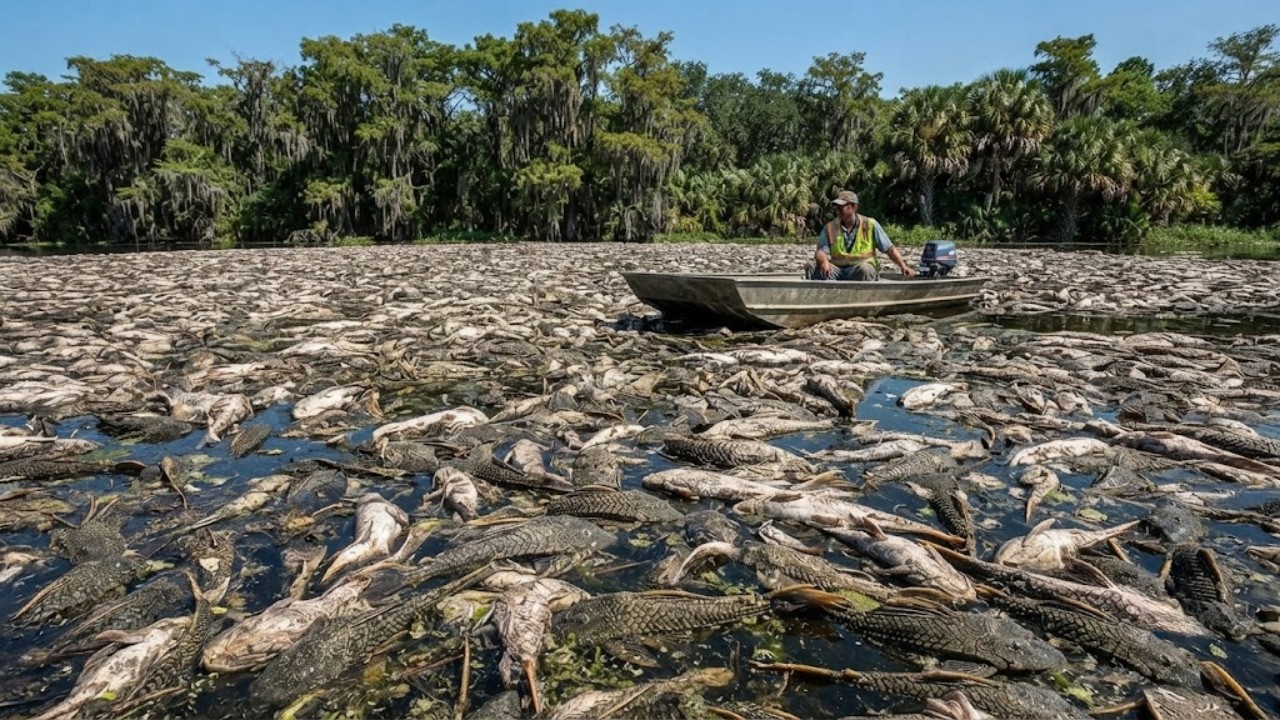
Armored catfish are vanishing from Florida’s rivers, and scientists have finally identified what’s preying on them. These invasive fish, protected by tough bony plates, seemed nearly untouchable in the state’s waterways.
For four years, Dr. Ryan Allisson had been conducting population density surveys in Florida's Peace and Hillsborough rivers. He knew...