Eight months after Canada airlifted 28 bison into the remote Arctic, scientists returned to check on the herd—and what they found completely defied expectations. The animals had been relocated to a vast, barren landscape where survival seemed unlikely, yet their adaptation stunned even veteran researchers.
In June 1980, a Canadian military transport plane landed on a dirt airstrip near Nahanni Butte in the Northwest Territories carrying 28 wood bison. The animals, sourced from a herd in Alberta, were released into a boreal valley that had not supported wild wood bison in over a century.
By 2017, population surveys showed the recovery had exceeded expectations. The herd was not only surviving and breeding, but had expanded into territory the original recovery program never targeted. Bison established satellite populations in three Canadian jurisdictions, hundreds of kilometers from the release site, and began reshaping meadow systems that had functioned without a large grazing herbivore since before the First World War. Human releases ended decades ago, and the herd has been self-sustaining since.

The wood bison is North America’s largest land mammal. Adult bulls can weigh over 2,000 pounds and stand nearly six feet tall at the shoulder. Their broad heads and muscular humps allow them to sweep frozen forage from beneath snowdrifts in conditions that would challenge other large herbivores. Female herds are matriarchal, with calving grounds and migration routes passed down through generations. The animals also create wallow depressions that hold rainwater and support amphibian breeding cycles in otherwise dry boreal terrain.
Ecologically, wood bison serve a dual function. They graze grasses, trample dead vegetation back into the soil, and deposit nitrogen-rich dung across large areas, recycling nutrients that would otherwise remain locked up for decades. Their return to the Nahanni Valley marked the restoration of an ecological process that had been absent for more than a century.
The disappearance of wood bison from the region was deliberate. Beginning in the mid-1800s, commercial hide hunting expanded northward using repeating rifles and organized crews. By the early 1900s, only about 250 wood bison remained across their entire range. Wood Buffalo National Park was established in 1922 to protect them, but between 1925 and 1928, the government relocated more than 6,600 plains bison into the park. By the 1940s, biologists considered the pure wood bison extinct.
In 1957, Canadian Wildlife Service researcher N.S. Novakowski was conducting an aerial survey over a remote part of Wood Buffalo National Park when he spotted a small herd of about 200 bison along the Nyarling River. These animals were larger than the hybrid bison, with higher, more squared humps. They were located roughly 160 kilometers from the nearest hybrid herd, separated by terrain that had prevented contact for decades. Testing confirmed they were disease-free wood bison, the closest thing to pure stock remaining.
Canada moved to preserve this lineage. In 1963, 18 Nyarling bison were captured for the Mackenzie Bison Sanctuary, and 21 more were taken to Elk Island National Park in Alberta in 1965. These animals were fenced, quarantined, and managed as a closed genetic source for the subspecies. When the Elk Island herd grew large enough, 28 animals were flown by military transport and released into the Nahanni Valley in June 1980. The site was chosen for its boreal meadows, mineral licks, and riparian flats along the Liard River.
By 1981, biologists monitoring the herd documented that the bison were already grazing meadows, creating wallows, and trampling willow thickets along the Liard flood plain. In 1989, wildlife managers added 12 more bison from Elk Island to broaden the genetic base. A second release of 59 bison north of Fort Liard followed in 1998, bringing the total Nahanni founder count to 99.
The recovery faced ongoing threats. Tuberculosis and brucellosis remained present in the hybrid herds of Wood Buffalo National Park, kept separate from the disease-free Nahanni population only by distance. Anthrax outbreaks killed dozens of bison in northern Canada in the 1990s and 2000s. Wolf predation reduced juvenile survival in heavy snow winters, and vehicle collisions on the Alaska Highway claimed individual animals.
Between the late 1980s and the 2000s, additional founder herds were established across the Yukon’s Aishihik area, the lower Mackenzie Valley, and British Columbia border country. This spread the risk so that a single disaster could not eliminate the entire subspecies.
The Nahanni herd passed 200 animals by 2000. A comprehensive aerial survey in 2017 counted 962 bison ranging across 10,000 square kilometers, an area larger than Yellowstone National Park. The Committee on the Status of Endangered Wildlife in Canada had already changed the wood bison’s federal status from endangered to threatened.
The herd’s range expansion was its own decision. The Liard River, which biologists had treated as a natural barrier, was crossed by bison swimming bank to bank. They established a permanent population in northeastern British Columbia in habitat no human had selected for them. The Northwest Territories government, in coordination with British Columbia and the Yukon, confirmed that wood bison from the Nahanni lineage now hold territory across three jurisdictions.
The ecological effects are also documented. Meadow systems along the Liard corridor are being maintained by the grazing animals. Wallows collect rainwater again, and amphibian and arthropod communities that depend on these micro-wetlands have returned. Research published in PNAS in 2022 found that bison reintroduction nearly doubles native plant species richness, an effect exceeding the combined impact of fire management, mowing, and cattle grazing.
The recovery also brought cultural consequences. Nahanni Butte, a Dene community, became a destination for researchers and visitors because of the bison. The Liard Valley attracted scientists from across North America. In the Dene language, the wood bison is called eji. The word had remained in use through the more than 100 years without a herd it referred to. It now has its referent back.
The 45-year data set from the Nahanni herd represents one of the longest-running large herbivore restoration records in northern North America. The full scale of the ecological changes is still being analyzed, but the trajectory is clear. A subspecies declared extinct in 1940, rediscovered by chance in 1957, and reintroduced with 28 animals in 1980 is now maintaining itself across the boreal north without further human intervention.
Recommended Stories

Florida’s American crocodiles are growing larger than ever recorded, and wildlife experts cannot explain why. These massive reptiles, once rarely seen beyond the southern tip of the state, are now turning up in new waterways, baffling longtime researchers.
In late 2025, a crocodile was found on the grounds of a private school on Fisher Island, near Miami Beach....
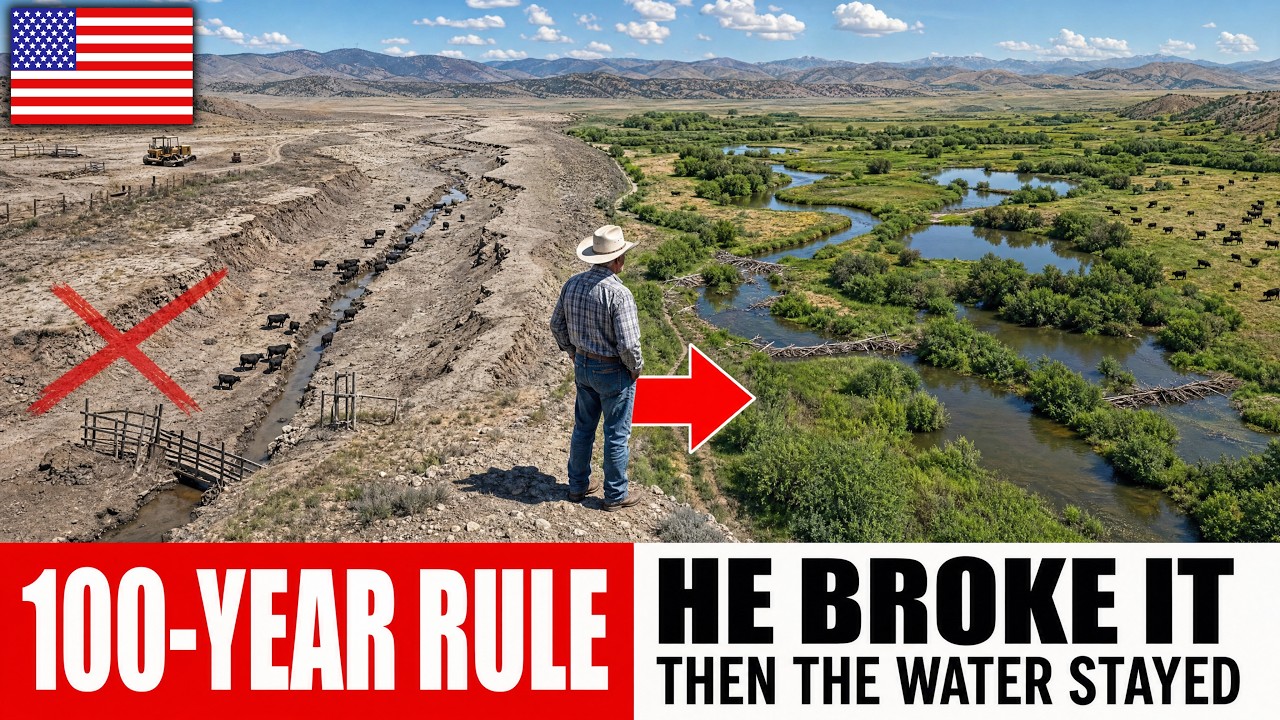
For a century, the Smith family ranch had one ironclad rule: beavers were the enemy, and the patriarch once walked the ditches with dynamite to blow up their dams. His son A.J.
Around a hundred years ago, the rule at this family ranch in the high desert of northeastern Nevada was absolute:...
Deep in Siberia’s frozen wilderness, a fur trapper’s decades-old account still haunts scientists today. He described two massive, dark, hairy animals with inward-curving tusks standing in a river, pouring water over their backs before vanishing into the trees.
The far north of Siberia is a landscape of extremes. In summer, the tundra softens as the permafrost thaws, and...