A deep-sea expedition sent divers to the bottom of the Mariana Trench, equipped with high-definition cameras to document the unexplored abyss. The mission aimed for a clear record of the ocean floor, but what the cameras caught on the descent was entirely unexpected.
The Mariana Trench, located in the western Pacific Ocean east of the Mariana Islands, contains the deepest known point on Earth’s seafloor. A 2020 survey measured the Challenger Deep section at approximately 10,935 meters below the surface, with a margin of error of about six meters. The trench itself stretches more than 2,550 kilometers in a crescent shape and averages about 69 kilometers wide.
If Mount Everest were placed at the bottom of the trench, its peak would remain more than a mile and a half underwater.
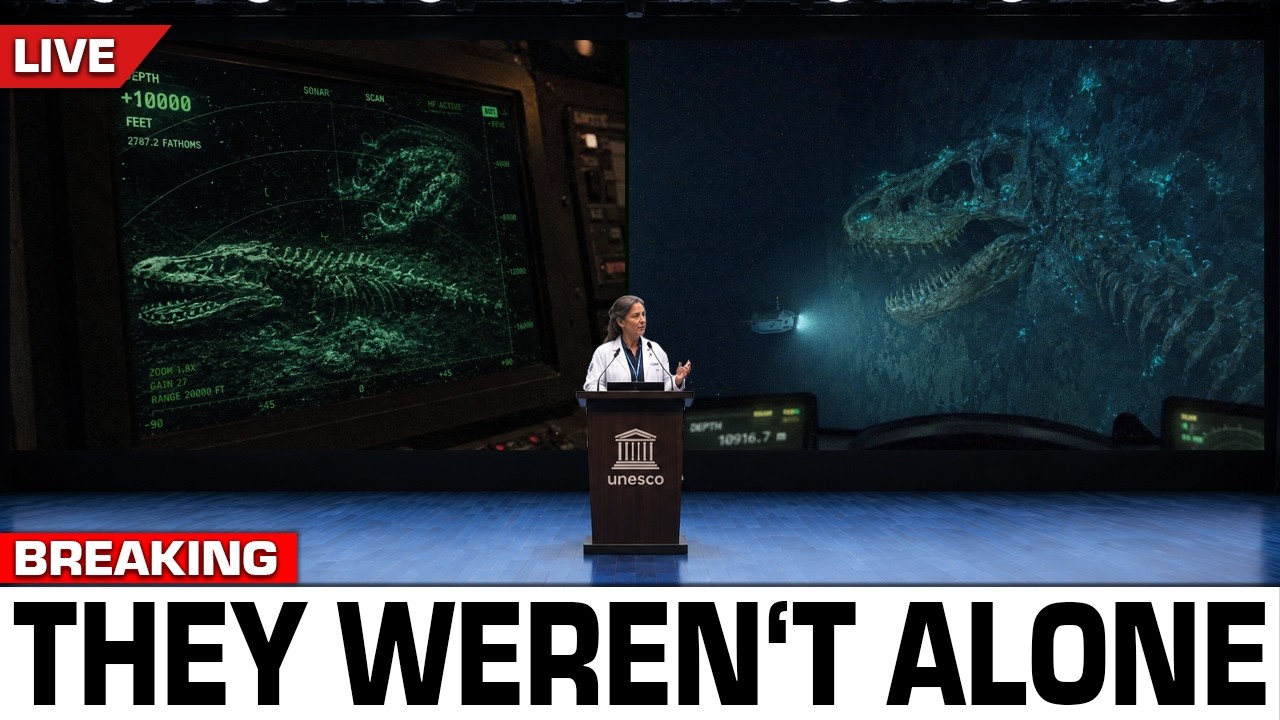
The trench formed through subduction, a process in which the Pacific plate slides beneath the smaller Mariana plate. Because the Pacific plate is older and denser, it sinks as it meets younger rock, creating a crease in the seafloor. The subducting rock melts deep in the Earth’s mantle, and the resulting magma rises to form the Mariana Islands.
Conditions at the bottom are extreme. Pressure reaches roughly 1,086 bar, more than 1,000 times the pressure at sea level. Temperatures sit between 1 and 4 degrees Celsius year-round. No sunlight penetrates below about 200 meters, leaving the trench in permanent darkness.
The first humans to reach the bottom were Swiss oceanographer Jacques Piccard and U.S. Navy Lieutenant Don Walsh. They descended in the bathyscaphe Trieste on January 23, 1960, a journey that took nearly five hours. They spent about 20 minutes on the seafloor at approximately 10,912 meters, where Piccard reported seeing a flatfish-like creature resting on the sediment before swimming away. Researchers later questioned whether he had instead seen a sea cucumber in the disturbed silt, but something was clearly alive at that depth.
No human returned for 52 years. Robotic vehicles filled the gap. Japan’s Kaiko remotely operated vehicle reached the bottom in the mid-1990s, and the Woods Hole Oceanographic Institution’s Nereus arrived in 2009.
Filmmaker James Cameron made the first solo dive to the Challenger Deep in March 2012 aboard the Deepsea Challenger, a submersible that took seven years and roughly $10 million to build. High-definition cameras recorded the seafloor, but the visual record was sparse. Cameron described the scene as a featureless pale desert and called it the loneliest place on Earth. His expedition did recover scientific samples, including evidence of previously unknown microbial communities in the nearby Sirena Deep.
In 2018, retired U.S. Navy reserve officer Victor Vescovo launched the Five Deeps Expedition to reach the deepest point in each of the world’s five oceans. His submersible, the DSV Limiting Factor, reached 10,928 meters in the Mariana Trench in April 2019. Robotic landers deployed alongside him captured more than 500 hours of high-definition footage across 13 locations and appeared to document three new species, including an amphipod found at the bottom of the Challenger Deep. Vescovo spent about four hours on the seafloor, longer than any previous visitor, and described it as peaceful. He also reported finding a plastic bag and candy wrappers on the sediment.
In June 2020, Vescovo returned with NASA astronaut Dr. Kathy Sullivan. She became the first woman to reach the Challenger Deep and the first person to have visited both outer space and the deepest point in the ocean. After surfacing, she described the seafloor as resembling the moonscape she had seen from orbit.
The most significant fish footage from hadal trenches came from baited camera landers. In 2014, researchers filmed an unknown snailfish species at 8,143 meters in the Mariana Trench. The pale, translucent creature had wing-like fins and an eel-like tail and matched nothing in the scientific literature. It was never collected and was given the informal name “ethereal snailfish.”
In 2017, a lander operated by the Japan Agency for Marine Earth-Earth Science and Technology filmed a formally named species, Pseudoliparis, at 8,178 meters. In August 2022, a team led by marine biologist Alan Jamieson filmed an unidentified juvenile snailfish at 8,336 meters in the Izu-Ogasawara Trench south of Japan, the deepest fish footage ever recorded.
The reason any fish can survive at these depths comes down to a molecule called trimethylamine oxide, or TMAO. Proteins begin to lose their correct shape under sufficient pressure, a process that disrupts their function and kills cells. Deep-sea fish accumulate TMAO, which stabilizes the three-dimensional shape of proteins against external pressure.
Biochemist Paul Yancey of Whitman College noted that TMAO levels in fish increase with depth. Working from this correlation, his team published a 2014 prediction that a hard biochemical ceiling exists at roughly 8,200 to 8,400 meters. Beyond that depth, fish cannot accumulate enough TMAO without the chemical itself disrupting cellular processes. The 8,336-meter sighting came close to that limit. Jamieson described the find not as a surprise but as confirmation of what the research had predicted.
The Mariana Trench also hosts other unusual life forms. Supergiant amphipods, scientifically called Alicella gigantea, grow past 30 centimeters, more than 20 times the length of typical shallow-water amphipods. They have been documented at depths approaching 8,931 meters. The leading explanation, called deep-sea gigantism, holds that cold temperatures and extreme pressure slow metabolism enough to allow cells to keep growing for much longer than in warmer water.
Xenophyophores are single-celled organisms that grow to roughly 10 centimeters in diameter, among the largest single cells known to science. They live on the seafloor and construct structures from sand grains, sponge fragments, and shell material. A 2011 Scripps Institution of Oceanography expedition documented them at 10,641 meters in the Sirena Deep. Research suggests these organisms concentrate heavy metals from surrounding water and provide microhabitats for smaller organisms.
Sea cucumbers, stalked crinoids, polychaete worms, and microbial communities also inhabit the trench. Some microbial communities appear to operate through chemical energy rather than photosynthesis, drawing scientific interest for questions about where life can exist.
The trench is not isolated from human activity. A 2017 study led by Alan Jamieson at Newcastle University, published in Nature Ecology and Evolution, examined tissue samples from amphipods recovered from six deep-sea trenches, including the Mariana. Every sample contained polychlorinated biphenyls, or PCBs, and polybrominated diphenyl ethers, chemicals used as flame retardants. PCBs were banned in most countries by the late 1970s. The most contaminated Mariana Trench samples carried PCB concentrations roughly 50 times higher than crabs sampled from the Liaohe River in China, one of the most industrially polluted rivers in the world.
Scientists believe these chemicals reach the hadal zone through marine snow, the slow rain of organic matter that sinks from the surface. Plastic fragments and dead organisms carrying these chemicals are eventually eaten by scavengers at the bottom of the trench. Once there, the chemicals accumulate with essentially nowhere else to go.
A 2018 study using data from the Deep-sea Debris Database documented a plastic shopping bag at approximately 10,975 meters inside the Mariana Trench. Researchers analyzing water samples found microplastic concentrations of up to 2,000 pieces per liter in the most contaminated trench sediments, about four times higher than surface waters in the open Pacific Ocean. Newcastle University stated it was “highly likely” that no marine ecosystems remained unaffected by plastic pollution, and that the hadal zone was likely one of the largest sinks for microplastic debris on Earth.
The picture that has emerged over the past decade contradicts earlier assumptions that the deepest ocean was lifeless and untouched. As recently as 2014, baited camera landers had been sent to regions deeper than 6,000 meters in Pacific trenches many times without photographing a fish. The snailfish and their relatives proved that view incomplete.
The trench is not home to enormous predators. Giant squid are known to dive to roughly 1,000 meters, and sperm whales, the deepest-diving air-breathing animals, have been recorded at depths up to about 2,250 meters. The genuine residents of the hadal zone are small, soft-bodied, chemically specialized animals adapted to manage pressure at the molecular level.
The deepest place on Earth is not empty, and it is not untouched. It contains life forms adapted to extreme conditions, and it also contains evidence of human contamination. The scientific record shows a remote environment that is fragile, biologically active, and increasingly affected by materials that originated far from the ocean floor.
Recommended Stories
A US biologist made scientists laugh out loud. They mocked his rocks-based method.
In 1982, an oil company transferred ownership of a valley in northern New Mexico to the U.S. Forest Service. The...
A seasoned oceanographer’s final log entry has surfaced, and it claims encounters with deep-sea life that defy all known biology. The recording describes creatures resembling mermaids moving near a hydrothermal vent, far beyond any light.
In the North Atlantic, there is a place where the sea floor drops sharply from the continental shelf into deep...

Something Bigger Than a Python Is Hunting in Florida — Cameras Captured It. Locals thought the massive tracks belonged to an oversized python, but a trail cam caught something far stranger lurking near the Everglades.
Researchers at the Conservancy of Southwest Florida found a dead Burmese python roughly 15 miles deep in the Everglades. They...