Scotland planted two million trees across a barren Highland valley, and what returned thirty-five years later defied every expectation. The land, stripped bare and largely lifeless for generations, was seeded in a sweeping restoration effort that few believed could truly succeed.
In 1991, volunteers in northern Scotland planted some of the first new trees in parts of the Caledonian forest in two centuries. It was the opening move in a 250-year restoration plan that Alan Watson Featherstone had announced in 1986. Over the next three and a half decades, more than two million native trees were planted across dozens of sites in a Highland landscape so degraded that many visitors photographed the bare hillsides and assumed they were natural. They were not. They were the result of centuries of clearance and overgrazing, a wound so old it had been mistaken for the original landscape.
By 2025, project staff monitoring the restoration sites were tracking results that the original model suggested should not be possible for another century. The trees were not just establishing. The understory was not just thickening. The food chain was rebuilding itself from the soil up. Fungal networks were reconnecting beneath ancient pines. Native species were returning to ground that had been treeless for so long that most people thought the bare hills were natural. A golden eagle raised a chick in 2020 at a site where no eagle had bred since 1980.
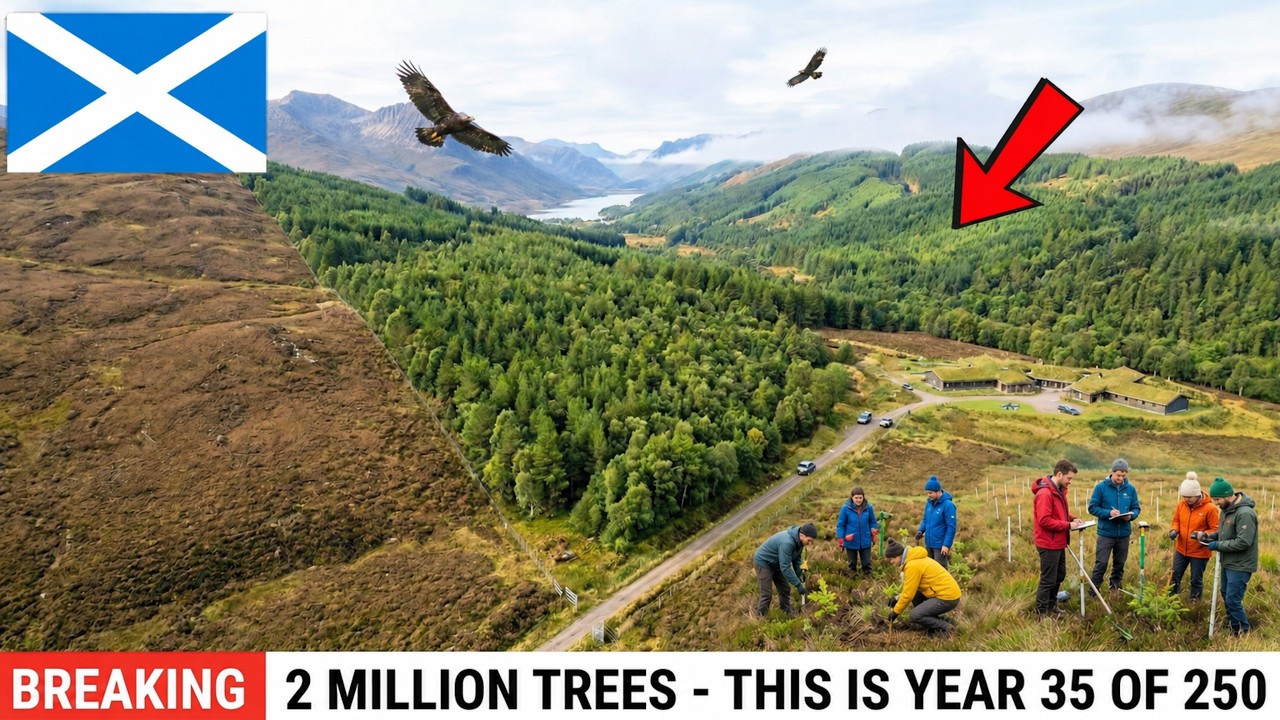
Two million trees in. Two hundred and ten years still to run. What has shown up beneath the recovering canopy is roughly 40 years ahead of the schedule Featherstone laid out. Parts of it the science is still working to explain.
To understand what is happening on the ground now, the loss has to come first. The bare Highland hillsides are not a natural landscape. They are a wound so old it has been mistaken for the original. Roughly 10,000 years ago, when the last ice age ended and glaciers retreated, forest moved in behind them. Not the uniform rows of commercial spruce and pine that cover Highland hillsides today, but a layered system anchored by Scots pine, with individual trees growing for 500 years and reaching 30 meters tall. Beneath the canopy were birch, rowan, juniper, aspen, hazel, and oak. Below those were heather, blueberry, mosses, lichens, and fungal networks so dense that a single teaspoon of healthy forest soil contains more microorganisms than there are people on Earth.
This was the Caledonian forest. It sheltered pine martens, capercaillie, black grouse, red squirrels, and Scottish wildcats. Wolves hunted through it. Brown bears denned in it. Lynx moved silently between its trees. The Gaelic names of the glens and rivers encoded its richness, with place names translating to the Aspen Glen, the Juniper Crag, the Boar’s Run. Names that outlasted any living memory of the animals they described.
What makes the Caledonian Forest irreplaceable is not the tree species. It is the relationships. A 400-million-year partnership between roots and mycorrhizal fungi. The balance between predators and prey that kept any single herbivore from dominating. The seed dispersal between birds and rodents and the trees that fed them. Restoring a forest is not simply planting trees. It is rebuilding a network of relationships.
Scotland erased that forest in stages. First came the great clearances for agriculture. Then systematic felling for timber, shipbuilding, and charcoal. Then the transformation of the Highlands into deer stalking estates, which required keeping the land open and treeless so that wealthy sportsmen could shoot stags against a picturesque backdrop. Finally came the introduction of sheep at industrial scale. These animals eat tree seedlings before they can establish, ensuring no natural regeneration could occur even where the oldest trees still stood.
By the time Featherstone made his speech in 1986, the Caledonian forest had been reduced to less than 2% of its original range. What survived existed in isolated fragments scattered across a landscape that had been treeless for so long that most people assumed the bare hills were natural. When the Roman legions first entered this territory, they named it Caledonia, meaning wooded heights. It was a geographical description. Today, it reads as an irony. The forest that gave Scotland its Roman name is the forest Scotland spent five centuries erasing.
Trees for Life was registered as an independent charity in 1993. Practical work had begun in 1989, with tree guards protecting Scots pine seedlings in Glen Cannich from deer browsing. In 1991, volunteers planted some of the first new trees to grow in parts of the forest for 200 years. The early model was almost naive in its simplicity. Recruit volunteers, negotiate with the Forestry Commission, raise some money. There was no nursery at the start. Seedlings were bought in and planted by hand in terrain so rough and boggy that a reasonable level of fitness was required just to reach the planting sites.
The 250-year vision was always explicit. This was not about planting some pinewoods because they looked nice. It was about restoring a specific ecosystem in all its ecological complexity, every species, every function, every relationship between tree and fungus, between predator and prey, between forest and water.
That ambition required land. In 2008, Trees for Life purchased the 10,000-acre Dundreggan estate in Glen Moriston, a former deer stalking estate managed for shooting for generations. Dundreggan had a small remnant of ancient woodland, extensive heathland stripped bare by overgrazing, and uniform rows of exotic commercial conifers. The estate employed one person. The gap between that reality and the 250-year vision was, by any ordinary measure, enormous.
Planting trees was never the question. Keeping them alive long enough to reach the canopy was. The central problem at Dundreggan and across the wider Highlands was deer. Red deer specifically. Ecologists calculate that a population density of around five deer per square kilometer allows natural tree regeneration. In many Highland regions, the actual density was closer to 20, four times the sustainable level, and every seedling was browsed off before it could grow beyond ankle height.
Managing deer in the Highlands is not straightforward. The animals move across multiple private estates, and none are obligated to coordinate culling. Neighboring landowners, whose income depends on deer stalking, have little incentive to reduce the animals that pay their bills. Trees for Life proceeded carefully, reducing deer on their own land through targeted culling, opening dialogue with neighbors, and erecting deer-proof fencing around the most critical regeneration zones. They even tried unconventional approaches, including deploying bagpipe-playing volunteers as nocturnal deer scarers. That detail captures something real about the difficulty of restoring an ecosystem when its central problem crosses property lines no single organization controls.
Monitoring was rigorous. Permanent vegetation plots, tree survival counts each spring, wildlife transects, soil chemistry samples. The deer pressure dropped behind the fences. The seedlings grew beyond ankle height. Then the data started compounding. The project stopped being a planting program and became an ecological one.
The monitoring records describe more than recovering tree cover. They describe an ecosystem reorganizing itself faster than the original timeline projected. Dundreggan now supports 1,000 hectares of native forest and more than 4,000 species of plants and animals. When Trees for Life bought the land in 2008, it was managed as a monoculture for deer. Pine martens, red squirrels, black grouse, rare lichens, fungi, and invertebrates were never previously recorded at the site.
In 2015, a Trees for Life team and conservationist Roy Dennis descended 15 meters down a cliff face at Dundreggan to build an artificial golden eagle nest at a site where Dennis had found the remains of an old eyrie unused for 50 to 60 years. A tree had grown up in front of the original location. Dennis cut it out and rebuilt the structure. Then the wait began.
Golden eagles need large territories, specific nesting conditions, and abundant prey. They had been seen regularly over Dundreggan, soaring on thermals above the recovering landscape, but they had not nested. Year after year, estate manager Doug Gilbert checked the cliff. Year after year, the nest sat empty.
In the summer of 2020, five years after the eyrie was built, a pair of golden eagles successfully reared a chick at Dundreggan for the first time in 40 years. The last confirmed breeding had been in 1980. The estate’s developing woodland, home to an increasing number of black grouse, a key food source for eagles, had played a decisive role in attracting them. The eagles had not returned because someone gave them a nest. They had returned because the habitat beneath the nest had recovered enough to sustain them. Fungi feeding roots, roots feeding trees, trees feeding grouse, grouse feeding eagles. Every link in a chain that had been broken for four decades. Gilbert called it a rewilding success story beyond their wildest dreams.
What was happening below ground was something the textbooks had not fully anticipated. Mycorrhizal fungi live on tree roots in a mutually beneficial relationship that has evolved over 400 million years. Many tree species cannot survive without them. In degraded highland landscapes, these fungal networks had been largely destroyed by centuries of overgrazing. Trees for Life developed a specialized inoculation program, collecting 59 species of fungi from Dundreggan’s old-growth remnants and introducing them to newly planted trees.
The scientific literature suggests that mycorrhizal networks typically take decades to reach meaningful extent in severely degraded soils. At Dundreggan, the combination of retained old-growth remnants acting as fungal source populations, active inoculation, and deer-fenced regeneration zones appears to have accelerated the process considerably. The full picture of what is happening underground remains an open question. But the above-ground evidence, the speed of tree establishment, the diversity of returning species, the soil chemistry improvements, suggests the underground networks are reconnecting faster than anyone predicted.
The Caledonian project has also become something larger than a conservation program. Carbon credit buyers approached Trees for Life proactively, paying premiums because they understood they were paying for genuine ecosystem restoration, not just rows of trees in the ground. Trees for Life directed a portion of that revenue back to local community organizations. The restoration was generating income, and that income was flowing into the communities whose relationship with the land had been shaped by the same centuries of extractive management that destroyed the forest.
In April 2023, the Dundreggan Rewilding Centre opened, the first facility of its kind in the world. When Dundreggan was a sporting estate, it employed one person. Today, it has multiple full-time staff and supports seasonal nursery jobs. The centre includes exhibition space, a cafe, accommodation, forest play areas, and all-ability trails.
Estates that have not joined the initiative still operate as deer stalking businesses. Their income depends on maintaining deer populations at levels incompatible with forest regeneration. Trees for Life’s approach has been to demonstrate rather than debate, letting the 4,000 species, the golden eagle chick, the carbon revenue, and the new jobs speak for themselves.
In 2021, Trees for Life launched the Affric Highlands Initiative, a 30-year program spanning over 200,000 hectares from Loch Ness to Scotland’s west coast. Both the United Kingdom and Scottish governments recommended it for United Nations World Restoration Flagship status in 2022. By late 2024, agreements with 19 estates covered more than 58,000 hectares. In 2025, Affric Highlands launched as an independent charity. The 250-year plan was beginning to operate at the scale it had always required.
At the western edge of the Affric landscape, there is a cluster of 57 Scots pines, the remnant of a forest that once filled an entire glen. The oldest has been dated by the University of St. Andrews tree ring laboratory to at least 1458, more than 565 years old, and believed to be older still. A tree already ancient when the first European settlers crossed the Atlantic. A tree that grew through the Jacobite rebellions, the Highland clearances, and two World Wars. Still standing on a hillside that everything around it had abandoned decades ago.
In late 2023, Trees for Life erected 1.5 kilometers of deer-proof fencing around this woodland with materials helicoptered in. For the first time in decades, young seedlings can grow beneath these ancient trees without being eaten. The 565-year-old pine now has the chance to produce offspring that might survive it. If they do, those offspring will be growing in the year 2100, and their offspring in 2200. The forest Featherstone imagined in 1986 might, by the middle of the 23rd century, be approaching something like its original form.
In Gaelic, the forest was Coille Shaileanaich, the Caledonian wood. The word outlasted the trees. For five centuries, Highland glens carried Gaelic names for an aspen glen with no aspens, a juniper crag with no junipers, a boar’s run where no boar had run for generations. The names held their shape against an absence so old that most people stopped noticing the missing reference. The forest is returning. The names have something to attach to again.
The seedlings establishing beneath the 565-year-old pine, the ones whose roots are reconnecting with fungal networks 400 million years old, fed by soil that is finally accumulating organic carbon again, will outlive everyone alive today. Some of those trees could stand for five centuries, for 10 generations. Two million trees, 250 years, 10 human generations. A planning horizon longer than most countries have existed in their current form. None of the people who started this work will see its completion. The plan ends in 2236.
But the eagle came back. The soil is rebuilding itself. The 565-year-old pine has the chance to produce offspring that will outlive everyone currently reading its rings. And a forest that Scotland spent five centuries destroying is, for the first time, growing faster than it is shrinking.
Recommended Stories
The Atlas lion was declared extinct decades ago, yet a new discovery suggests one may still be alive. Historical records show these massive predators once roamed North Africa before hunting and habitat loss wiped them out.
In 1922, a French colonial hunter shot a lion on a mountain road in Morocco’s High Atlas. The animal was...
Four red wolves were released into a vast North Carolina forest, empty of their kind for decades, and what happened over the next thirty years stunned conservationists. Wildlife officials had hoped the pack would simply survive, restoring a top predator missing from the region’s ecosystem.
In 1980, the U.S. government declared the red wolf extinct in the wild. The only remaining individuals, 14 animals, were...
Biologists tracking black bears in the Smoky Mountains finally caught something on camera that they say changes everything they understood about the region’s top predator. For years, researchers assumed adult bears had no natural enemies, standing unchallenged at the top of the food chain.
For several years, biologists monitoring black bears in the Great Smoky Mountains National Park noticed a pattern in their data...