A.T. and Cinda Cole bought a drained New Mexico desert ranch, unaware such a thing as a cienega even existed.
On a cattle ranch about an hour south of Silver City, New Mexico, a desert wetland had been cut by a channel up to ten feet deep. In July 2011, the property owners began dropping trees across that channel in a way that allowed the trees to remain alive. The ranch, called Pitchfork, sits on roughly 11,000 acres of rangeland at 5,000 feet elevation, more than half of it leased public land.
The owners, A.T. and Cinda Cole, bought the ranch in 2003 after retiring from careers in Arizona. A.T. Cole had spent 32 years as a lawyer in the small town of Casa Grande, and Cinda Cole had been a teacher. They had previously done volunteer restoration work but had no background in wetland management. When they bought the property, Cole later admitted, they did not even know what a cienega was.
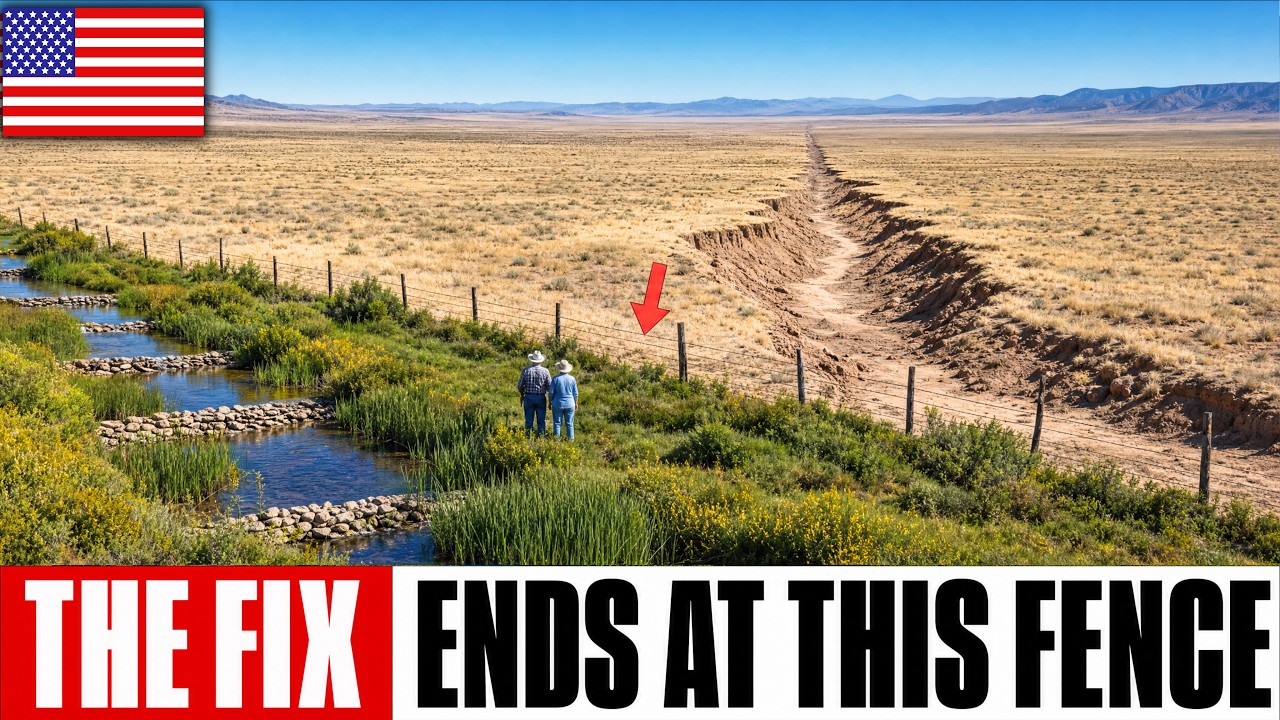
A cienega is a desert wetland fed by springs. Unlike most wetlands, it builds itself slowly. The water moves gently enough that sediment settles rather than washing away. Over time, the ground level rises. The Coles set out to restore that process on their land.
The problem at Pitchfork had developed over more than a century. In the early 1850s, a U.S. boundary commissioner named John Bartlett described the area as a grassy meadow about 300 yards wide with many springs. Cattle arrived later. In 1904, a rancher named Jeremiah McDonald started the Pitchfork ranch there. Decades afterward, the Coles found that previous owners had built a long berm pushing floodwater away from the old wetland, with levees and irrigation channels keeping it clear of fields. With nowhere to spread, water cut downward. By the time the Coles arrived, the stream ran at the bottom of a deep channel, and the water in it was only about six inches wide.
Across the Southwest, an estimated 95 percent of these wetlands have been lost or damaged. The Coles encountered the same pattern on their own property. Shortly after moving in, a flood cut a new gash through the wetland about the length of two football fields. Cole said they realized they had to start working immediately.
Their approach came from local restoration practitioners. While scouting for a retirement property in 2002, Cole read about a local man, Van Clothier, who repaired streams by hand. In a long phone conversation, Clothier offered a warning that stuck with Cole: do not be fooled by idyllic pastoral advertising. Their first lesson came from a scientific paper about cienegas that a friend picked up for a dollar at a yard sale. It was co-authored by a fish biologist named Dean Hendrickson.
The Coles began building structures in the channel in 2005. Their first design, based on plans by a retired Forest Service biologist named Bill Zeedyk, tilted to one side after a single flow of water, cut a pocket, and deposited sediment behind it. The straight channel began to curve. Zeedyk called this induced meandering. He and Clothier later wrote a book about the method with the title “Let the Water Do the Work.”
The work was difficult. Water washed out posts the Coles placed in the streambed, and rock structures collapsed. Pine posts failed. Only juniper held in place. Downstream, the channel kept deepening, and monsoon floods carried more ranch soil down the valley toward a dry lakebed near Lordsburg.
The solution, as it emerged, was to do small amounts of work repeatedly. Each structure was built to hold only six to eighteen inches of sediment, and nothing larger was built until the previous one had filled in. Hydrologist Ellen Soles, who later studied the property, summed up the rule in four words: we don’t get greedy.
Most of what the Coles built is hard to see from a truck. Single-rock dams, exactly what the name suggests, are layers of stone placed across small gullies to slow runoff and encourage sediment to drop. The Coles and their work crews built more than a thousand structures, about eight hundred of them in side channels. To measure what they were holding, Cole enlisted a retired engineering professor from Wyoming. He estimated the captured sediment at the equivalent of two or three hundred elephants.
In 2010, the Coles received federal stimulus money for part of the first level of structures, arranged through Nancy Riley of the U.S. Fish and Wildlife Service in Albuquerque. Cole learned to write grant applications. One grant came from a restoration fund financed by the copper company Freeport-McMoran as part of a settlement related to hazardous materials that had leaked from its mines.
Rare animals were reintroduced. The Chiricahua leopard frog, a threatened species, was brought back to the wetland. Wildlife agencies released Gila topminnow, an endangered desert fish smaller than two inches. In July 2012, a single fish trap caught more than three hundred of them.
The main channel, however, remained deep. Rock structures filled it slowly, and no one yet knew whether water would follow the rising soil. What accelerated the filling came from observing what happens to a tree that falls across a stream and refuses to die. Zeedyk noticed trees in the forest that had fallen across streams without breaking their roots. They kept growing, and their branches caught everything the water carried. This was, in effect, the work beavers once did across the Southwest before trappers eliminated them in the 1820s. As Cole put it, they were simply doing what beavers do naturally.
Zeedyk brought the idea to Pitchfork in July 2011. The technique involves cutting a tree partway through from the back in stages, until it bends and stretches across the channel while remaining connected to its stump. If cut incorrectly, the trunk splits down the middle, making the tree useless. On that first day, Zeedyk gave the directions, a ranch crew member ran the saw, and Cole described himself as the laborer.
The willows they dropped did what Zeedyk expected. Their branches combed silt from every flood and sprouted new trunks. Soles watched one sprout reach twenty feet in two years, crediting much of the channel’s rising level to just two days of felling trees. One tree from that first summer is now buried under the sediment it caught, with twenty-five-foot trees growing above it.
In 2024, Cole gave a talk titled “Hinged Felling, Best and Cheapest.” A rock structure on the ranch might cost between $150 and $2,000, he said, while a felled tree costs about $50. Early in the talk, Cole mentioned that true cienegas contain no trees. By the end, he was telling the audience the trees would last forever. The session host, who had visited the ranch, joked that Zeedyk should write another book called “Let the Tree Do the Work.” Cinda Cole then corrected a mistake. In a true cienega, she said, trees drown. A healthy cienega is a wet meadow of sedges and grasses, so saturated that willows cannot thrive. If the work succeeded, the trees that helped rebuild the wetland would eventually be flooded by the water they helped restore. A.T. Cole accepted the prospect with equanimity. It was always good, he said, to have a partner who keeps things balanced. Once the cienega was fully restored, he added, the trees apparently would die.
Whether the water would truly return could only be read underground. Since 2007, Soles has measured that. She drilled pipe wells into the wetland at two sites, one above most of the restoration work and one below it. She drove her equipment with a custom post driver she nicknamed Ned. Her dog, Edgar, supervised the surveys.
The Coles kept their own record. Since 2005, at nearly the same day each year, they photographed the same locations from the same spots. The images show the rise. At both of Soles’s well sites, the channel bottom rose about a yard, and in some places more. In early 2015, a news account reported that the structures had trapped enough mud to bury Cole, who is six-foot-six, up to his waist.
A site called Willow Pond was a deep gully eroding upstream in 2005. By 2023, it held water at least three feet deep year-round, stretched more than a hundred yards, and was full of bulrushes. Leopard frogs lived in it. The most recent survey counted about forty frogs. The stream changed its behavior. When floods come now, they flatten plants along the wetland but no longer dig the channel deeper.
In a two-mile stretch the Coles fenced off from cattle, where two stunted ash trees once stood, Cole counted about two hundred trees ranging from twelve to fifteen feet tall. Elk found the spot. Cole said, with reference to the field of dreams, that if you build it, they will come.
Beginning in 2021, drought in southwest New Mexico intensified. Soles described it as fierce, with dry heat reaching deeper into the summer. Her well above the restoration work dropped sharply in 2021 and 2022. Her well below it did the opposite. Compared with readings from a decade earlier, the water level had risen almost every year. Less water was flowing into the wetland, Soles said, while the restored part was retaining more of it. Clearly, she said, the restoration was paying off.
At the ranch house, water took a different course. By 2017, two of the ranch’s six wells had gone dry in a single year. Cole said at the time that a neighbor who had lived there for 76 years had told them that well had never gone dry. All six wells, Cole said, had failed since then. The Coles waited eleven months for a well driller and bought water delivered by truck in the meantime. The new wells reach hundreds of feet deep and produce only a gallon or two a minute. Soles’s wells are narrow pipes buried in the wetland floor itself. The wetland holds more water while the nearby house struggles to find it.
Rain patterns also changed. According to Soles’s calculations, light rains that barely moisten the soil doubled from about ten times a year to about twenty. The fish did not survive either. The topminnows that filled traps had vanished by 2024. Soles said they simply faded away, and no one knows why. Aplomado falcons released on the ranch in 2011 as part of an effort to return them to New Mexico never adapted.
Most of the money that supported the project was public, about 87 percent by Soles’s count, and it was spent on private land. Her argument for working on private land was straightforward. The people who lived in these places were not stupid, she said. They chose the water sites.
The Coles still keep a small herd of about ten head of white Charolais cattle, though their first restoration rule is strict: keep cattle away from riparian areas. The cattle were moved away from the wetland. But the work stops at the fence line. Soles said much of the sediment caught by the Pitchfork structures washes in from a neighboring ranch. In 2024, she said they had thought they would be able to restore this wetland in their lifetime. It turned out, she said, that someone else would have to finish the job.
The Coles are nearing eighty. A.T. Cole has spoken about creating a national monument for the wetland and about buying the smaller ranch upstream that contains the springs. He noted that Cinda reminds him that hope is not a plan.
In March 2025, the Pitchfork ranch itself was put up for sale. A conservation easement on its owned land, completed in 2009, remains in place. Whether the next owner continues building the levels will not be up to the Coles.
The oldest of those annual photographs shows a barren channel. The newest show willows, bulrushes, and standing water from the same points nearly twenty years later. About one image, Cole said the coyote willows had grown like crazy. Reflecting on his wife’s observation that the trees would eventually drown, he wondered who would stand at the photo points to see that day.
Elsewhere in the region, scientists have measured the effects of similar restoration. Across the state line in Arizona, government scientists spent 475 days measuring the impact of two rock walls on groundwater in another dying desert wetland. They found the walls were feeding a shallow layer of modern groundwater above older groundwater they never reached.
Recommended Stories

A bold experiment once unleashed thousands of piranhas into a thriving lake, aiming to wipe out a massive snake infestation that had turned the water into a danger zone. The plan seemed brilliant: release the fierce fish to slash the serpent population and restore balance fast.
Piranhas, known for their sharp teeth and fast movements, are among the most powerful predators in the Amazon's murky waters....
Texas ranchers called it war—feral hogs had destroyed 40 acres of pasture, collapsed a cattle pond dam, and cost Texas $500 million a year. But the fix wasn’t a bigger gun.
Dale Harmon has managed a 1,200-acre cattle ranch in southern Karnes County, Texas, for 22 years. When he describes what...

Fishermen off Australia’s coast in 1918 claimed a colossal shark ripped their heavy crayfish pots straight off the seafloor, telling a stunned naturalist it was at least as long as the wharf shed—some estimated a staggering 300 feet. These were seasoned professionals who insisted the ghostly white animal was no whale.
In 1918, a group of professional crayfish fishermen working out of Port Stevens on the coast of New South Wales,...