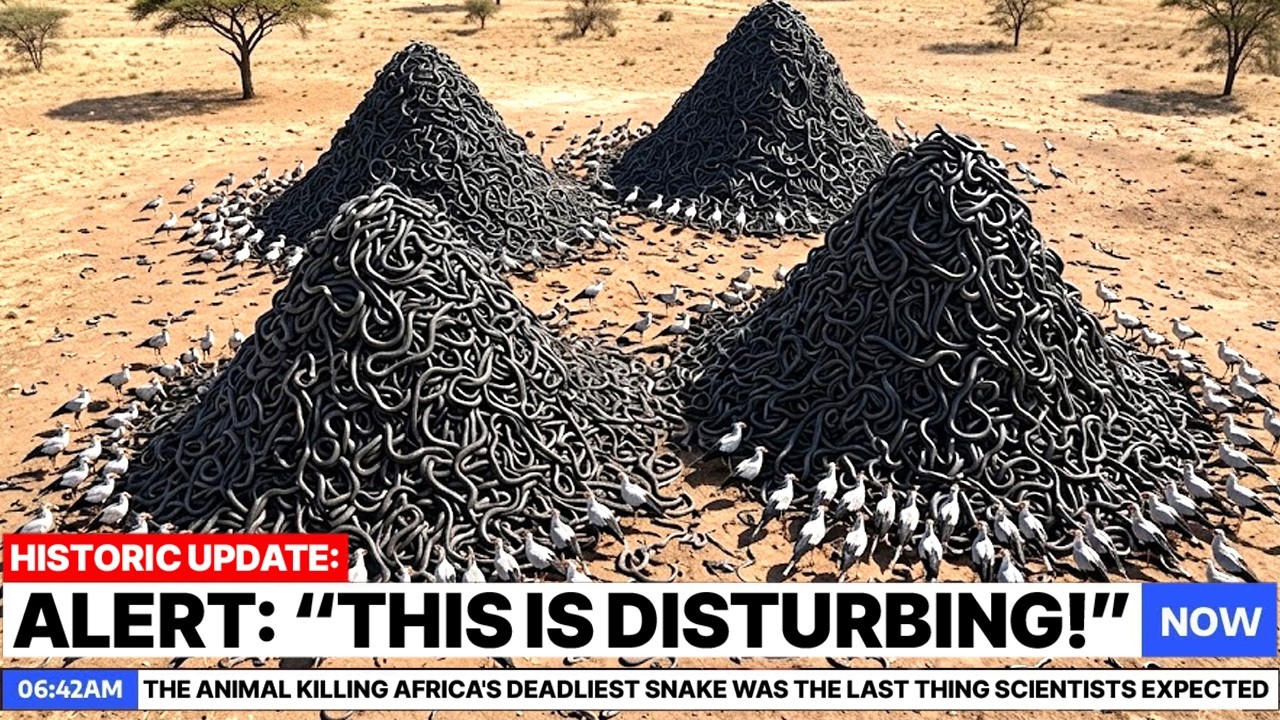
The black mamba strikes in 50 milliseconds—seven times faster than any human reflex—yet something on the Serengeti is killing these deadly snakes in open daylight, faster than they can reproduce. For years, researchers hunted for the predator in the wrong direction, assuming it fought from the sky.
The black mamba is one of the fastest and most aggressive venomous snakes in Africa, capable of striking in about 50 milliseconds. A human blink takes roughly 150 milliseconds. In the grasslands stretching between the Serengeti and the coast, something has been killing these snakes faster than they can reproduce, often in open daylight and on ground frequently crossed by tourists. For years, researchers looked for the answer in the wrong place, while the animal responsible was never hiding.
It is a bird of prey, but not the kind that hunts from the air. It abandoned that approach about 15 million years ago. What it does to survive a venomous bite is not what anyone initially expected.
**The hunting ground**
The grasslands from the Serengeti to the coast contain one of the densest collections of venomous snakes on the planet. The terrain is flat, the soil holds heat overnight, and rodents reproduce faster than predators can consume them. Over millions of years, these conditions have pushed snake evolution toward extreme toxicity.
At the top of the victim list is the black mamba, which can reach four meters in length and move at about 20 kilometers per hour, making it the fastest land snake alive. Most African snakes flee first. The mamba holds its ground and strikes before an intruder finishes approaching. Its neurotoxic venom can kill an untreated adult in under an hour.
Also present is the Cape cobra, small enough to disappear into brush and bold enough to follow rodents into structures. There is also the puff adder, which kills more people in Africa than any other snake, not because its venom is the strongest, but because it refuses to move. It lies flat on the soil, its markings breaking up its outline so effectively that it stops looking like a shape at all. People do not walk near puff adders; they walk over them.
This raises a question that has occupied field biologists for decades. Africa has some of the most impressive birds of prey on earth. Why have they not eliminated these snakes?
**Why the sky became useless**
An aerial hunter needs altitude, a clear line of sight, and a target with enough surface area. The savanna removes all three.
From 300 meters up, a martial eagle sees grass that reaches waist height and moves constantly with the wind. A four-meter snake is thin, roughly the width of a wrist. From above it appears as a line, and often not even that, because grass closes over its back and what remains visible looks like a split between stems, indistinguishable from wind movement.
If a bird of prey does spot the snake, it still has to descend. The landing takes seconds, which is geological time for a snake. The savanna is full of rodent burrows, and a snake rarely strays more than its body length from one. When threatened, it disappears below ground. A missed strike is costly; the altitude represents stored energy, and the bird must climb again for another attempt. With such a thin target that can vanish instantly and kill on contact, the math rarely works.
For millions of years, this pressure continued. Snakes remained a renewable food source that birds could see but almost never reach.
**A predator that walks**
Around 15 million years ago, one branch of the raptor family did something nearly unique among predators. It gave up flying. Over generations, its bones stopped being light, hollow tubes built for flight. Calcium accumulated, and its legs became solid and extended far beyond what would be useful for perching. It traded the defining advantage of its entire vertebrate class for ownership of the ground.
The result was photographed on safaris for a century, and almost nobody recognized what they were seeing. The bird is the secretary bird, known scientifically as Sagittarius serpentarius. From the shoulders up, it is clearly a bird of prey, with a hooked beak and forward-facing eyes surrounded by bare orange skin. Its wingspan reaches two meters. From the shoulders down, it belongs to a different kind of animal, with long, armored legs resembling those of a crane.
It can fly and nests in the tops of acacia trees, but it hunts almost exclusively on foot. It is the only bird of prey on earth that does so, and it kills with its feet rather than its talons, also a unique trait. An adult covers up to 30 kilometers of grassland per day, head raised, vision tuned not for fine detail at distance but for detecting movement on the ground. That movement is what separates wind from a snake’s body.
This method also places the bird within striking range of Africa’s most dangerous reptiles every day of its adult life. The first assumption among researchers was straightforward: some animals have chemical protection against venom, such as the mongoose, whose nerve receptors have changed so cobra venom cannot attach. The theory was that the secretary bird carried something similar in its blood. That theory was wrong, and the way it failed is the most unusual part of the story.
**The strike**
Those legs are not designed for walking. Walking is what happens between uses. A black mamba takes 50 to 70 milliseconds from stillness to sinking its fangs into flesh. In theory, it cannot lose because it completes its attack before any mammalian nervous system registers that the attack has begun.
High-speed footage of a secretary bird’s kick shows it takes 10 to 15 milliseconds, about seven times faster than a mamba’s strike. It is fast enough that the bird does not seem to react at all. It arrives before the snake can finish its movement. Biomechanics work at the Royal Veterinary College measured the force at the end of that movement at about five times the bird’s body weight, concentrated on a foot pad smaller than a coin. The technique is not raw power but a small mass moving very quickly into a very small contact area. The effect is like a hammer coming down directly on a spine. Vertebrae shatter before the reptile registers the shadow.
The obvious objection is that a kick strong enough to break a snake’s spine should also break a bird’s slender leg. The anatomy is built around this problem. A joint above the foot acts as a hydraulic dampener, absorbing load through pressure rather than transmitting it upward rigidly. A tendon system has a reflex that lifts the leg the moment of contact, so the foot is already withdrawing while the shock is generated. The scales on the lower leg are far thicker than a bird of this size would normally have, forming armor that deflects fangs that pass nearby rather than hitting directly.
Accuracy is not blind instinct either. The bird’s brain continuously tracks the target and adjusts the kick’s trajectory while the leg is already in motion. It does not kick to where the snake was; it aims at where the snake is.
Against a snake already raised in a striking posture with a meter of reach, such a weapon is useless. The encounter follows a different pattern.
**The standoff**
When a secretary bird faces an adult mamba, the sequence looks less like combat and more like discipline. The snake rises first, one-third of its body off the ground, head level with the bird’s chest, mouth open to reveal the black lining that gives the species its name. It hisses loudly.
The bird responds with the opposite of retreat. It spreads its wings fully. The wings serve two functions, one obvious and one less so. They balance the bird through the twisting movements that follow, and they cast a wide, shifting shadow on the ground in front of the snake, much larger than any single target, which makes it harder for the reptile to identify what it needs to strike. The snake now faces something two meters wide that constantly changes shape. The important part, a hidden leg, is somewhere below.
The two circle each other. The bird moves sideways in short steps, body facing the snake, wings extended, head steady. The mamba turns to keep facing it. Neither attacks immediately. The bird maintains a working distance of about a meter, far enough to avoid a full strike, close enough to close the gap the moment the snake’s head drops. Each passing second costs the snake more than the bird, because holding one-third of its body upright is exhausting.
Eventually the mamba tires and strikes. The bird leans just enough for the fangs to pass through air, with a margin of only centimeters. A wider dodge would lose its position. Then comes the moment the encounter exists for. A snake that has struck and missed must lower its head to regain balance before loading the next strike. For a fraction of a second, the head is low, extended, and unprotected.
The bird does not kick once. One observation in the Serengeti recorded a single bird delivering dozens of strikes in seconds, at a rate above five kicks per second, most aimed at the head and neck. The mamba never rose for a second strike. It died mid-sequence, and the bird kept kicking because a reflexively moving snake looks identical to a live one.
Against a puff adder buried motionless in scrub, the opening changes. The bird will not enter that cover. Instead, it circles the spot, beats its wings against the ground, and stamps its feet, sending vibrations through the soil until the hidden predator comes out onto open ground, exactly where the kick works best.
Then the bird does something that puzzled researchers for years. It eats the snake.
**The paradox of venom**
Laboratory research searched for an antibody defense that would explain how an animal could swallow the neurotoxin of a snake capable of killing a room full of people. Nothing was found. The secretary bird has no significant resistance to venom. If a fang reaches a blood vessel, the bird dies like any other animal its size.
The protection was not in the bird at all. It was in the nature of the venom itself. Snake venom is a mixture of proteins and enzymes. It only becomes a weapon when injected through skin into tissue or blood. When swallowed, it goes to the stomach and is treated chemically for what it is. Stomach acid breaks down the peptide bonds. The most dangerous biological weapon on the continent becomes a nutritious meal.
The dangerous part was never the killing. It was the handling. Once the snake is down, the bird lifts it with its beak and whips it side to side, finishing the involuntary contractions, because a dead snake can still deliver a full dose of venom through a bite reflex. Then it swallows the snake head first, without exception. Swallowing tail first drags the scales backward against the throat and causes obstruction. Head first wraps the skull, fangs, and venom glands inside the throat muscles, so nothing tears and nothing leaks.
During breeding season, a single pair can catch six venomous snakes in a day to feed two chicks. That number matters because it is now declining.
**What is killing the snake killer**
Over the past 35 years, the International Union for Conservation of Nature has moved the secretary bird through threat categories to its current listing as endangered. Its numbers have fallen by more than half across its range, with local disappearances from areas where it was once common.
The first cause is land itself. This bird needs open territory because its method depends on covering distance and having a place to put a snake once surprised. As farmland expands and people suppress the brush fires that kept grassland open, dense shrub closes in on the land. Sight lines vanish first, then pathways, and an area that hosted a pair of birds for decades becomes a maze full of food that cannot be reached.
The second cause is infrastructure. Power lines crossing the savanna are nearly invisible. The birds move at dusk to reach roosting trees. Their vision in low light is poor and their body mass is large relative to wing length, so collisions cause losses every year. This would be tolerable in a fast-breeding species, but the secretary bird is not that. A pair raises one or two chicks per season, one of the slowest reproduction rates among large African birds. Losses exceed replacement rates, and this has been going on for decades.
These birds are not fragile in every respect. They tolerate grazing land, hunt around livestock, and are less afraid of humans than many raptors. But if open land is removed, there is no substitute, because the species spent 15 million years specializing away from anything else.
**The wider effect**
Where secretary birds have declined or disappeared, ecologists have recorded rising numbers of venomous snakes. No ecologist claims a single bird species controls snake populations alone; rodent cycles, rainfall, and vegetation loss produce similar effects. But the correlation has been consistent enough that researchers no longer consider it coincidence.
Ground-nesting birds are affected first. Guinea fowl, francolins, and any bird that lays eggs on the soil lose nests one after another to a predator that no longer fears anything at ground level. Pressure then reaches inhabited areas, where the shrub that pushed out the birds has grown close to fields and settlements. Snakes move in because they offer cover the bird could never penetrate. Then it reaches footpaths.
A path through the savanna is warm underfoot, retaining the previous day’s heat through the night. That makes it the warmest surface for 100 meters in any direction. The puff adder lying at the edge of such a path is not hiding in the ordinary sense. Its markings break its body into pieces that take on the color of the surrounding debris, so the eye sees not a snake but a patch of ground that looks like part of the earth. It will not move as footsteps approach. It has never moved for anything. Its strategy is that the creature walking toward it does not know it exists.
Households report similar changes inside homes. Mambas and cobras appear under beds, in storage areas, and in yards where children play. These are not new snakes. They are the snakes that were always there, in numbers the land has not seen before, filling the gap left by the only predator that hunted them on foot.
The trade is straightforward. The bird lost its ground to farmland and brush. The snakes are reclaiming that ground from the people who removed it.
**Conservation work**
Conservation groups have fitted GPS trackers to surviving adult birds to map the territory a working pair needs, and built networks where herders log their sightings. That work has confirmed the hardest part of the problem. This bird cannot be bred in captivity to relieve the pressure on wild populations, and it cannot be shipped abroad to control snakes elsewhere. When confined, it stops eating or throws itself against the cage until injured.
The only solution is restoring the land: removing brush, allowing fires to return, marking the lines the birds collide with, and leaving space for grassland to remain grassland.
The secretary bird hunts snakes because it is hungry. The villages that sleep peacefully are a side effect it will never know about. But the result of that hunger is keeping a check on some of the most dangerous reptile populations on earth, and the people who share those grasslands have lived under its protection without ever being told it was there. Remove one piece from a system balanced this precisely, and the whole structure tilts. Take away the confident steps of the bird that gave up flying, and the land becomes a kingdom of venom.
Recommended Stories

A drone over a Florida preserve captured footage that stunned wildlife officials: wild-born Eastern indigo snake hatchlings emerging from a gopher tortoise burrow. The moment marked the species’ first confirmed wild reproduction in that area in decades, a major victory for a decades-long reintroduction program.
A drone flying over a preserve in the Florida Panhandle recorded two wild-born Eastern indigo snake hatchlings near a gopher...
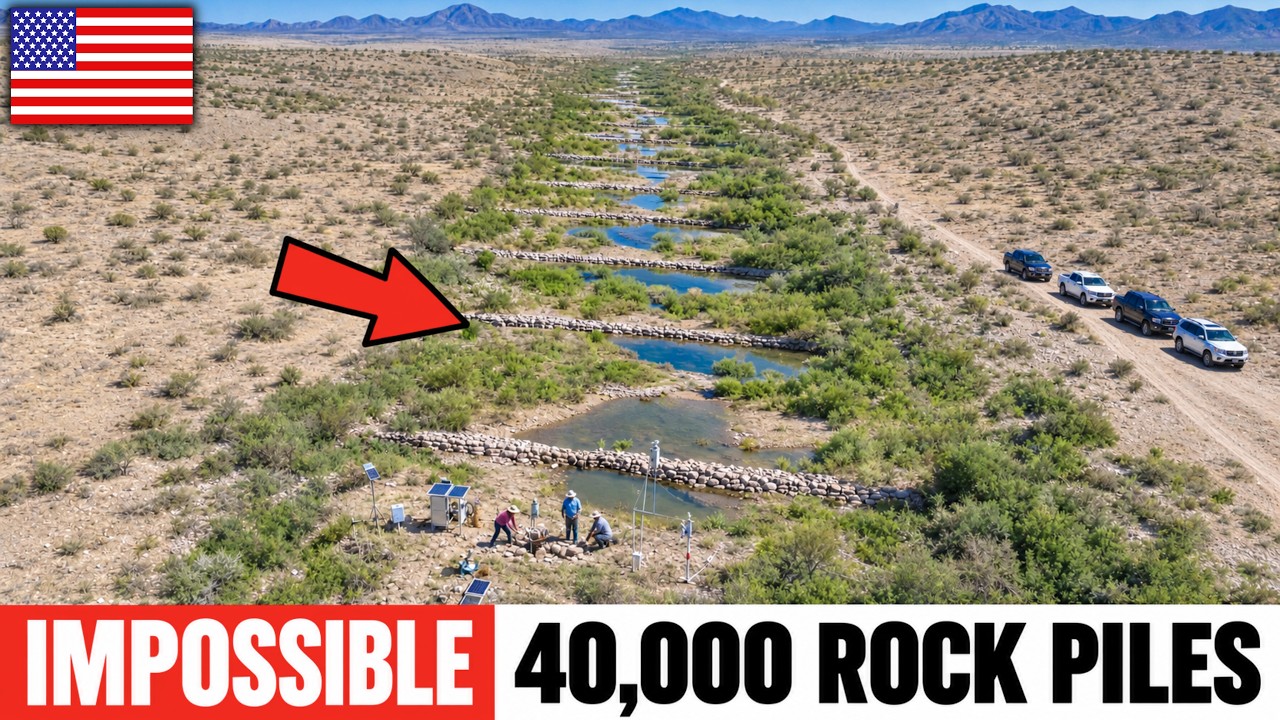
In 2021, a desert stream thought dead for a century began flowing again—but the shocking part is why. It wasn’t rain that revived it.
On the border between Arizona and the Mexican state of Sonora, a stream runs through desert land that can go...
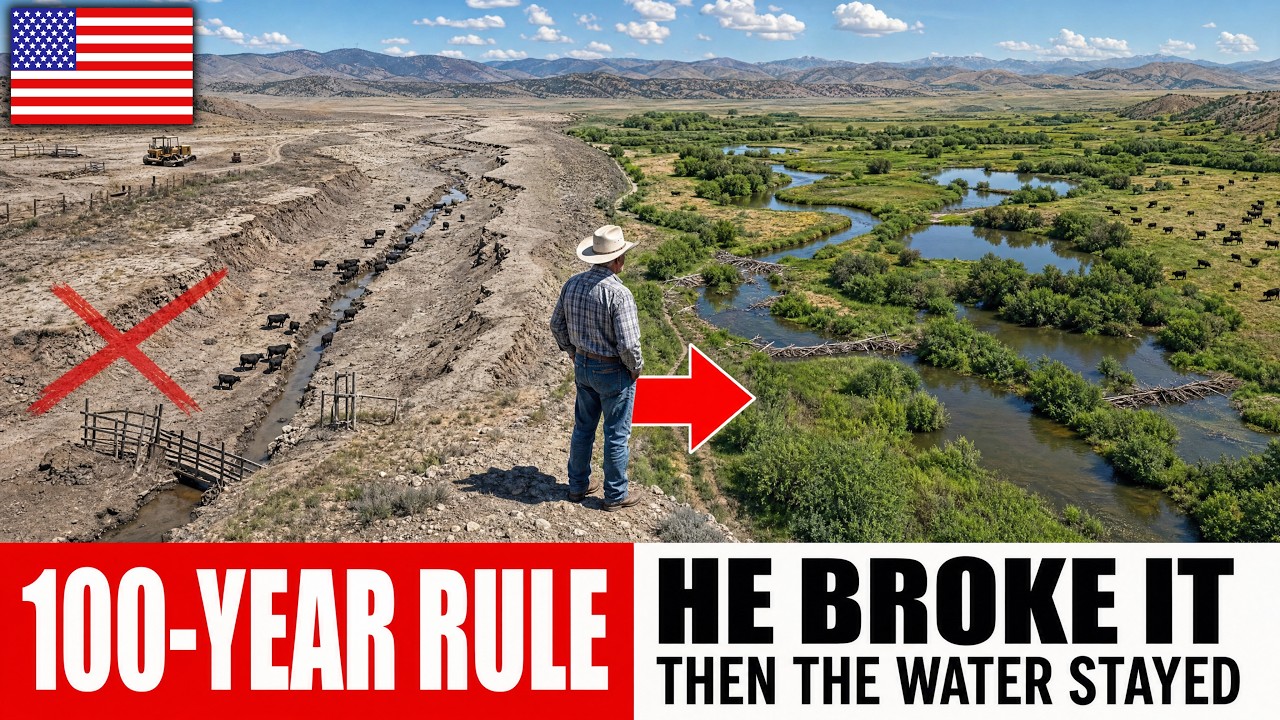
For a century, the Smith family ranch had one ironclad rule: beavers were the enemy, and the patriarch once walked the ditches with dynamite to blow up their dams. His son A.J.
Around a hundred years ago, the rule at this family ranch in the high desert of northeastern Nevada was absolute:...