For a century, the Smith family ranch had one ironclad rule: beavers were the enemy, and the patriarch once walked the ditches with dynamite to blow up their dams. His son A.J.
Around a hundred years ago, the rule at this family ranch in the high desert of northeastern Nevada was absolute: you controlled the land with machinery, iron, and force. If water was scarce, you redirected it. If an animal blocked your path, you removed it. Horace Smith embodied that conviction more than most, walking the irrigation ditches each spring with sticks of dynamite in his hands. He was not a distant figure from the family tree, but the father of A.J. Smith, the cattleman at the center of this story. According to a New York Times investigation by Catherine Einhorn, Horace blew up many beaver dams in his lifetime, usually with explosives, not out of cruelty but from a firm belief, shared by his generation, that the beaver was an enemy of water.
Decades later, his son would describe making peace with those same animals as one of the best decisions he ever made. That reversal sits at the core of this story. It is not the transformation of a stranger; it is a son dismantling the war he inherited from his father.
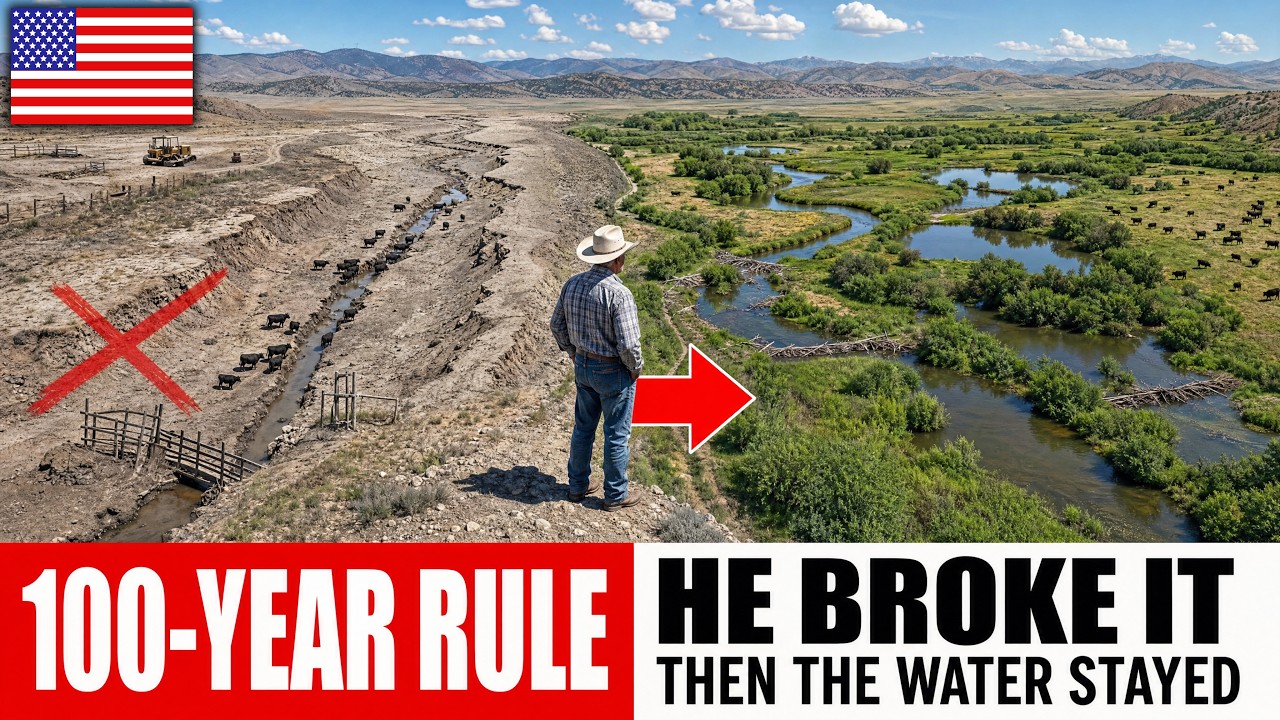
The Cottonwood Ranch sits in the most isolated corner of northern Nevada, in a region called the O’Neil Basin, about 30 miles from paved roads and more than 70 miles from the nearest town. The ranch has been in A.J.’s family for over a century. He is the fourth generation of cattle ranchers there, and the sixth generation is now growing up on the land. Growing up there meant learning to see the landscape through his ancestors’ eyes: livestock was the priority, the range was to be used as much as possible, and nature was a competitor to be overcome in the business of producing beef. By the late twentieth century, the land itself was breaking down. The traditional method was to turn cattle loose on the range for the entire hot summer. Searching for shade, cool air, and easy water, the cows gathered naturally along the streambanks. Decades of this system proved destructive. The tender shoots of willow, aspen, and grass were eaten before they could mature. A.J. recalled, as a child, that the streams were barren wastelands where barely a willow tree remained. With no plants to stabilize the banks, the hooves of hundreds of animals broke down the edges of the ground. Each spring, when snowmelt rushed through, nothing slowed it down. The shallow, winding streams that once watered the valley turned into channels several meters deep. Hydrologists call this a downcutting channel, and it works like a giant drain, pulling moisture from the surrounding soil down into the ditch. The water table dropped, and the meadows that stretched for hundreds of meters on both sides withered. By midsummer, the flow vanished, leaving behind hot rocks and dust.
The pressure on the family mounted. In the early 1980s, neighboring ranches expanded their herds and unintentionally introduced disease. Cottonwood lost 60 percent of its calf crop in a single season. Horace was forced to sell the herd, and the family diversified into camping trips and lodging to stay afloat. Later, federal agencies reduced grazing permits until fewer than 300 cows remained. A.J. realized that spending thousands of dollars on bulldozers and concrete dams was only delaying the inevitable. Concrete did not solve the problem; it pushed it downstream with greater force. The land was dying unless someone changed the rules of the game.
The turning point was not a flood but a classroom. In 1995, exhausted by years of litigation with the Bureau of Land Management and the Forest Service, A.J. attended a workshop on holistic management in Elko. At the time, the ranch was in critical condition, the herd had been reduced to fewer than 300 cattle, and he was tired of fighting. Instead of continuing to litigate, he did something unexpected. He invited his harshest critics, environmental groups, federal officials, and people from universities to sit on his decision-making team, not as consultants but as members with a real voice. This led to the creation of the Shovelfly Resource Management Group. It was an illogical move on its face. But as A.J. described it, the meetings stopped being about putting up barriers and started being about solving problems together. The opponents became partners responsible for the outcomes of decisions, and people who share in a decision stop sabotaging it.
The core practice was simple but radical: the problem was not the presence of cattle, but how long they stayed in one place. In the wild, large herds of grazing animals moved in tight groups, eating quickly, fertilizing the soil, and not returning to the same spot for about a year. The ranch divided its thousands of acres into small pastures with temporary fencing and applied a system of rotational grazing. Cattle would graze for a few days and then be moved to higher ground. A.J.’s golden rule: always let the riparian areas go to sleep with hair on them, meaning leave enough standing grass to hold sediment in the spring. The effect came quickly. Once the constant pressure was off the streambanks, the native willows grew with great vigor, and their roots began to bind the loose soil together.
Without planning it, A.J. was designing an ideal habitat for the real water engineers to enter the scene. With willow available for food and wood, beavers began to return. Initially, the cattleman’s instinct was the old alarm. But A.J. held back. As he told the Magic Valley Press: “We stopped fighting the beavers and let them do their work.” He did not set traps or use his father’s methods. He decided to watch and give them a chance. The beavers worked tirelessly, using willow branches, mud, stones, and roots to build a stepped network of dams along miles of the stream. The physics of nature did what machines could not do in a century. The dams slowed the spring runoff and stopped the erosion. Sediments that were once carried downstream were trapped behind the branches, slowly filling the stream bottom and raising the channel back toward the valley floor. The deep channel that had acted as a drain began to fill again. Most importantly, the dams forced water to seep underground, soaking the adjacent water table. The entire valley became a giant sponge.
During the heat of July and August, while neighboring streams turned to cracked earth, fresh, clean water continued to flow in Cottonwood’s channels. In a few years, the beavers accomplished what a century of heavy machinery had failed to do. The return of water brought an explosion of life. According to research by Chanley and colleagues in a 2023 volume from Springer on rangeland wildlife ecology, riparian areas occupy less than 2 percent of the land in the western United States, yet they support 70 to 80 percent of all wildlife at some point in their life cycle. The beavers, by rebuilding this narrow green strip, were not just beautifying a stream. They were rebuilding the foundation that almost all wildlife in the region depends on. The wetlands created by the dams became vital havens, green islands resistant to fire in a sea of arid sagebrush. The cold, oxygenated water was exactly what native trout needed to reproduce. Birds, deer, and other species were drawn to the green areas.
For the cattle operation itself, the well-watered riparian pastures stayed green and productive through the dry months. The test came in 2021. Nevada suffered one of its worst recorded droughts. While other ranches across the West were forced to sell cattle due to lack of water and feed, at Cottonwood the beaver-built ponds provided enough water for the livestock. As A.J. put it: “Even at the height of the drought, the streams kept running.” Before the beavers, they had not.
With the landscape transformed, the family saw an opportunity to diversify. Cottonwood opened its doors to ecotourism and education. Scientists, universities, skeptical ranchers, and travelers arrived to see how a desert could be restored. It became a living laboratory for environmental restoration applied on real ground.
Given the beaver’s usefulness, the question becomes why the U.S. government kills tens of thousands of them every year. According to data from the USDA Wildlife Services, in 2021 alone, 24,687 beavers were killed nationwide. In the same year, these animals were saving Cottonwood’s cattle from the worst drought in its history. Scientists Chris Jordan of NOAA and Emily Fairfax made the case clearly in a 2022 paper in WIREs Water. They described the beaver as a force of 15 to 40 million skilled environmental engineers, warning that we no longer have the luxury of working against them.
The institutional world eventually recognized the family’s work. In 2004, A.J. was named Nevada Farmer of the Year. In 2024, the National Cattlemen’s Association gave him an environmental stewardship award. In 2025, the Bureau of Land Management honored the family with a rangeland stewardship award. The U.S. Fish and Wildlife Service funded a $25,000 project to improve meadows on the ranch. The government that a rancher had challenged for decades ended up giving him national medals.
The beavers are not always easy partners. A.J. admits that the only time they still clash is when the beavers start building dams inside irrigation ditches, though they have learned ways to discourage that. In one stream, the beavers completely changed the flow. A.J. does not see it as a disaster but, in his words, just something different. Living next to a wild engineer means giving up some control.
On the question of judging the past, A.J. has a thoughtful response. “When you judge how the land was managed in the past, you have to be sensitive to the generation that was responsible then,” he says. “They were doing the best they could with the knowledge they had. Today, we simply know more.” He never turned his father into a villain. Horace was not a monster with dynamite; he was a rational man trapped in a system that rewarded the wrong things. The son’s revolution was not hatred of the father, but a gentle correction.
The ranch is now managed by A.J. alongside his daughter MacKenzie and her husband Jason Mulsby, with two grandchildren growing up among the willows. MacKenzie says she grew up with this management style. When you manage the land for everyone, not just your cows, you begin to see the diversity of wildlife flourish.
The Cottonwood Ranch story challenges one of civilization’s most persistent ideas: that humans and nature must be in constant conflict. For over a century, the attempt to tame arid landscapes with brute force, concrete, and eradication produced devastating results. A.J. and his family demonstrate that the path forward is not in fighting natural processes, but in allying with them. Well-managed cattle can mimic ancient herds and revive soil, and beavers, given space and plants, manage water better than any engineering work. On a planet with increasing water scarcity and prolonged drought, the lessons from this remote corner of Nevada have become more urgent than ever. We do not need to reinvent the wheel to heal our rivers and valleys. Sometimes the greatest technological innovation is simply understanding nature, stepping back, and letting life do its work.
Recommended Stories

A new predator is hunting the ocean’s giants, and the footage left marine biologists stunned. Researchers tracking a massive whale suddenly captured something that changed everything they thought they knew about the deep.
In 2017, several great white sharks washed up dead along the coast near Gansbaai, South Africa, a town known as...
A fried chicken executive spent millions on the worst land in Texas, a barren stretch experts said could never recover. He ignored the warnings, poured in resources, and slowly watched life return to the scorched earth.
In 1969, a former vacuum cleaner salesman who had become an executive at a fried chicken company purchased roughly 3,000...
They’re vanishing across the Great Lakes, and scientists just caught the culprit in action. Zebra mussels, the invasive species that clogged pipes and reshaped the ecosystem for decades, are suddenly disappearing from lake floors.
Charlie Hendrickson was at his fishing nets off Bailey's Harbor, Wisconsin, by 5:00 in the morning, the same hour his...