A single coyote on Texas ranch footage made a biologist evacuate his team—and the reason wasn’t fear, but preservation. For months, roughly 600 feral hogs had vanished from a monitored property, leaving no carcasses, no signs of disease, and empty traps.
In Blanco County, Texas, a heavily monitored cattle ranch faced a sudden and unexplained disappearance of its feral pig population. Around 600 animals simply stopped appearing on the property. There were no carcasses, no signs of disease, and the traps stood empty. Hunters had not changed their methods. Surveillance cameras showed the pigs did not move to neighboring land or to another part of the ranch. They just stopped coming.
When a biologist reviewed the footage from the brush cameras, he did not contact the agricultural extension office. Instead, he ordered his team to evacuate the site. The reason was not that what he found was dangerous, but that it was valuable, unexpected, and fragile enough that a single trace of human scent could ruin it. What appeared on the footage was something that could address the feral pig problem for years. It weighed about thirty pounds.
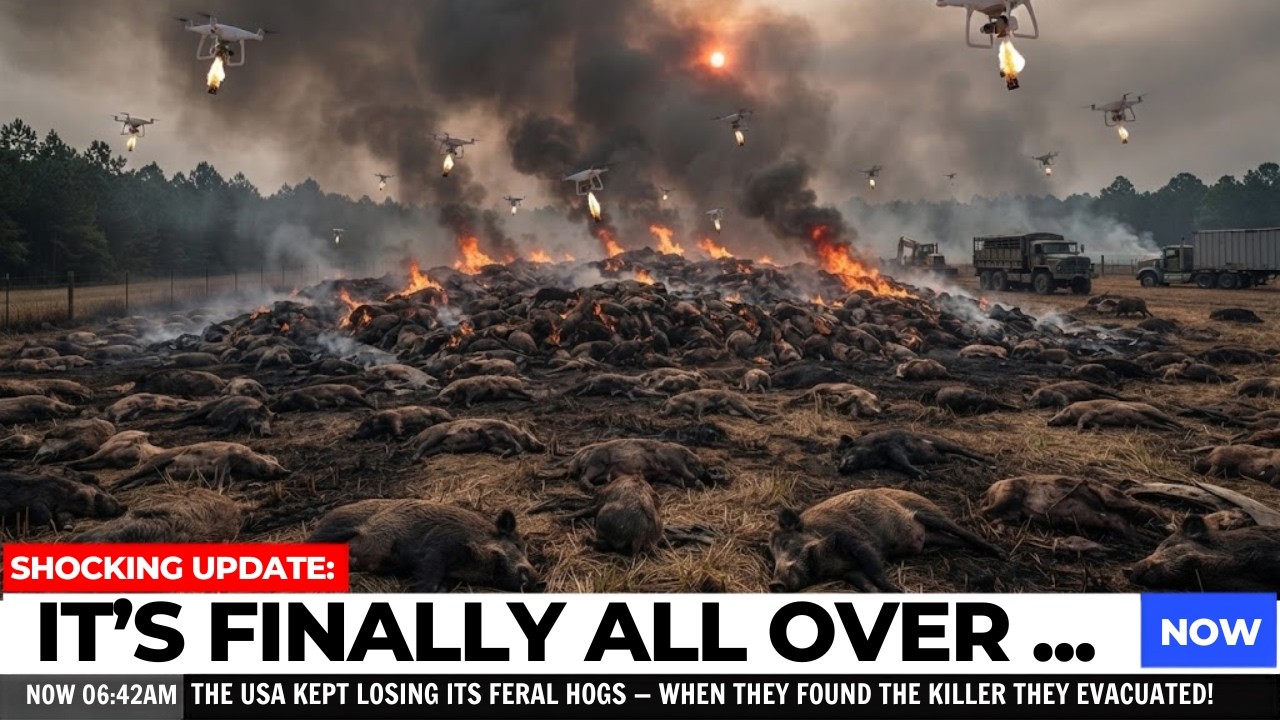
To understand why that footage mattered, it helps to understand the scale of the problem. Feral pigs are considered one of the most destructive invasive species in the continental United States. An estimated 6.9 million of them are confirmed across 35 states, and their range continues to expand. Their presence traces back to two separate introductions. Spanish explorers released domestic pigs along the Gulf Coast in the 1500s as a food source for future missions. Then, in 1912, wealthy hunters brought Eurasian wild boar to a fenced mountain preserve in North Carolina called Hooper Bald.
The fences did not hold. When the large Eurasian boars bred with domestic pigs, they produced a hybrid that was hardier, more intelligent, and more difficult to kill than either parent line. That hybrid is what now occupies much of the country. The modern feral pig has been shaped by a century of attempted eradication. Each failed control method taught surviving animals what to avoid. The result is a pig that has learned to adapt to hunting pressure, traps, poison, and aerial shooting.
The animal seen today is not simply a domestic pig that went wild. It is a pig whose ancestors have been pursued, shot at, trapped, and poisoned for generations, and each generation passed down what it learned. Pressure on a sounder, or family group, can cause it to reorganize its movement patterns within two weeks. The animals become nocturnal, shift their ranges away from pressured areas, and avoid locations and scents associated with encounters. Researchers who study feral pig cognition describe their problem-solving abilities as closer to primates than to livestock. They remember. A pig that has experienced one trap design becomes functionally immune to that design for life.
Reproduction compounds the difficulty. A female pig can become pregnant before her first birthday and can produce more than one litter per year. Each litter can contain six or more piglets. Those young reach breeding age within twelve months. This is not linear population growth but cumulative. To simply keep the population stable, not to reduce it, about 70 percent of the animals must be removed every year. If one season is missed, survivors breed faster because they now have more food and space. Biologists call this compensatory reproduction. In some documented cases, intensive culling led to higher pig numbers the following year than before the effort began.
The damage caused by these animals is difficult to overstate. A single sounder can turn twenty acres of corn into overturned mud in one night. Pigs have severed buried fiber-optic lines in Texas towns and disrupted internet service for entire neighborhoods. They have forced closures of regional airport runways. They have damaged irrigation infrastructure and earthen dam systems by digging beneath them. They carry more than 30 infectious diseases, including brucellosis, which has sent hunters to hospitals after improper cleaning of game. Their wallows contaminate water sources with bacteria that exceed safe levels for livestock and humans in downstream areas. In rare cases, they have killed people. In 2019, a woman in Texas died after an encounter with feral pigs on a property where she worked. National damage estimates range from $1.5 billion to $2.5 billion annually, and many researchers believe the real figure is higher.
Every intuitive intervention has been tested and found insufficient. Steel corral traps baited with food work once per learned sounder. A sounder that loses three animals to a trap will not approach that design again as long as any survivor remains. Aerial gunning from helicopters can clear hundreds of animals from open pastures in a single afternoon, but it costs hundreds of dollars per flight hour and requires clear sightlines, which the thick brush of Texas and lowlands of Louisiana do not provide. Dogs work in accessible terrain but suffer injuries that create veterinary costs. Chemical bait programs have spent years in regulatory testing over legitimate concerns about other wildlife dying at unattended feeders. A federal program called the Judas pig method, which uses a social pig fitted with a GPS collar to locate its sounder, works for targeted removals but cannot keep pace with the population pressure the math requires.
Almost all of these tools target adult pigs. Removing adults barely affects the number that matters most. The number that controls a feral pig population is not how many adults are removed, but how many piglets survive their first few months. Ecologists call this recruitment. If a field is cleared of adults today, the sounder will compensate by breeding more within a single cycle, because reduced competition for resources accelerates recruitment among survivors. But if recruitment is suppressed season after season, keeping piglet survival below the replacement threshold, the population cannot rebuild itself no matter how many adults remain.
The tools deployed by management programs were aimed at the wrong life stage. One observer described it as bailing water from a boat while the holes in the hull went unrepaired. And something in the brush had been plugging those holes for years before any government program asked what it was doing.
When the team reviewed the Blanco County footage, they moved staff away and sat in a closed room with the door shut. What they saw was a coyote. Not a pack of wolves, not an alligator or a mountain lion, but a single coyote. A thirty-pound animal with a sharp face and shaggy coat that rural America has spent a century treating as a pest, shooting on sight and paying bounties to eliminate. In the footage, it was doing the one thing that every helicopter, trap, and federal program had failed to achieve. It was taking piglets, steadily and precisely, at a rate that noticeably reduced recruitment in the sounder under observation.
For a predator of that size to specialize in hunting a species whose adults outweigh it tenfold requires a specific kind of intelligence. The sow is the obstacle. She is a wall of muscle with quick-tempered tusks and will kill any coyote that approaches her young directly. So the coyote does not approach directly. What the cameras captured over weeks of recording was patience. A coyote working downwind, far from the sounder, invisible, waiting for the precise moment imposed by the sow’s biology. A nursing sow expends enormous energy feeding her young and must leave regularly to eat. The coyote does not need to fight her. It needs to outlast her hunger. In the moment she moves away from the nest, the coyote moves in, takes a piglet, and leaves before she can react.
In some footage, two coyotes worked the same sounder simultaneously, one occupying the mother’s attention while the other approached from behind. In other segments, a coyote returned to the same nest site over multiple nights, as if learning the mother’s departure schedule before striking. This was not blind instinct following a fixed behavioral script. It was learned, updated behavior refined through enough successful attacks that individual animals became better at it within a single season.
When researchers examined the stomach contents of coyotes taken from areas with high pig density, including work by Texas A&M teams on military lands and independent surveys by county wildlife offices, a significant and consistent portion contained fresh, undigested remains of feral piglets. Not old carcasses scavenged from the ground, but fresh tissue from animals alive within the previous few hours. DNA analysis of coyote scat in multiple Texas counties confirmed the same result. When teams mapped the loss of piglets against coyote density, the pattern held in every county examined. The places losing the most piglets were the places with the most coyotes.
The story then takes an awkward turn. At the same time coyotes were quietly addressing the problem that had defeated funded management programs in America, state and county governments were paying hunters to kill them. Bounties of $75 per animal were offered in some Texas counties. Coyotes were turned in by the hundreds and thousands, based on the common assumption that fewer coyotes meant safer calves and lambs. Almost no one stopped to calculate what those coyotes were eating when they were not near livestock. The assumption was that any coyote near cattle is a threat to cattle. The parallel question, what the same coyote was eating in the brush at three in the morning in a county with a feral pig outbreak, did not appear in any bounty program documents anywhere in the state.
In counties where coyote numbers were sharply reduced under active bounty programs, feral pig populations rose significantly. In some documented cases, pig numbers after the bounty program ended were higher than they had been before the coyote elimination began. The equation the bounty program was trying to improve got measurably worse in the counties where the program was applied most heavily.
The approach that produced real results in the hardest-hit counties did not rely on any single tool. Managers who succeeded began intensifying multiple interventions at once. They used corral traps for whole sounders to remove intelligent adults, aerial shooting where terrain allowed, coordinated pressure across adjacent properties so pressured sounders could not simply move to neighboring land and wait, and, most importantly, an end to coyote bounty programs in pig areas. This allowed the coyotes to do the free nighttime work of controlling reproduction, work no budget could fund with staff. Where this integrated approach was applied consistently, crop damage declined. Farmers who had spent years on loss lists began planting again. Wildlife managers in Australia and New Zealand, facing their own feral pig populations, began studying the U.S. data.
None of this was planned by anyone understanding the system well enough to plan it. Coyotes expanded their range because humans eliminated wolves across most of the continental United States during the late 1800s and early 1900s, leaving a vacancy at the mid-level predator position in every food web those wolves had regulated. The coyote, smaller and far more adaptable, moved into that vacancy and stayed. It went from a western species to one confirmed in all 48 contiguous states, including states where no coyote had been documented in written records at any earlier point in American history. Their prey base shrank as farms and urban development reshaped the landscape. Then feral pig populations exploded across the same region, and the coyote adapted to the most abundant protein source available in the dark hours before dawn.
The free pest-control service now worth hundreds of millions of dollars a year emerged from three separate human errors committed across three different centuries. None was designed to interact with the others. Humans eliminated wolves. Humans introduced European livestock and wild boar. And humans paid bounties to eliminate the animal that quietly evolved to clean up the mess. What works now works because someone finally stopped to see what had been built by accident.
The central lesson in wildlife management remains the same. When a natural balance is broken, no amount of technology restores it cheaply. Sometimes the most effective intervention is getting out of the way of a system that had been functioning on its own, and letting the thirty-pound animal in the dark, the one people were paid to kill, do the job that nothing built by humans had been able to do for free.
Recommended Stories
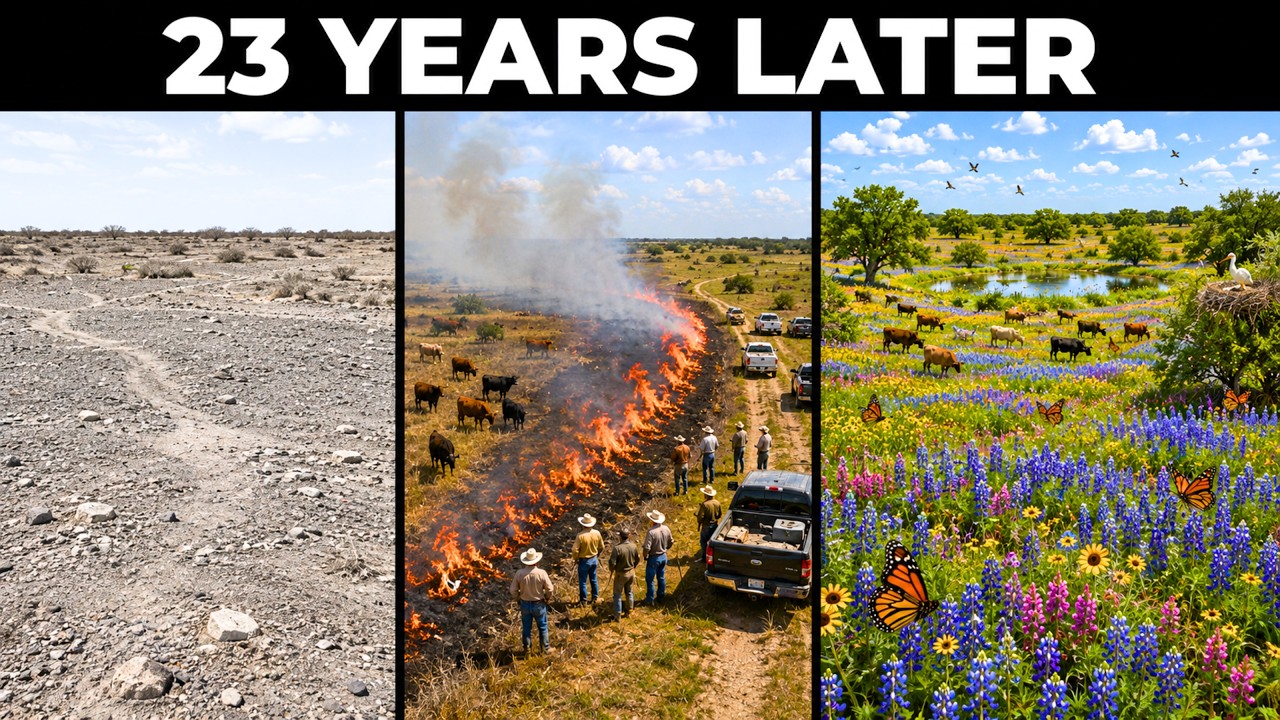
A dozen cows revived 80 acres Texas scientists called a barren “moonscape”—without a single seed being planted. The land was stripped to lifeless dirt, yet these ranchers bet on grazing alone as the turning point, watching cattle rotation trigger an unexpected transformation.
In 2000, a construction contractor and his wife bought an 80-acre property near La Grange, Texas. The land was a...

A camera plunged 36,000 feet into the pitch-black Mariana Trench, and what it captured has scientists deeply unsettled. The mission aimed to document unknown deep-sea life in the ocean’s most extreme zone.
The deepest part of the ocean floor, the Challenger Deep in the Mariana Trench, sits at approximately 10,935 meters below...
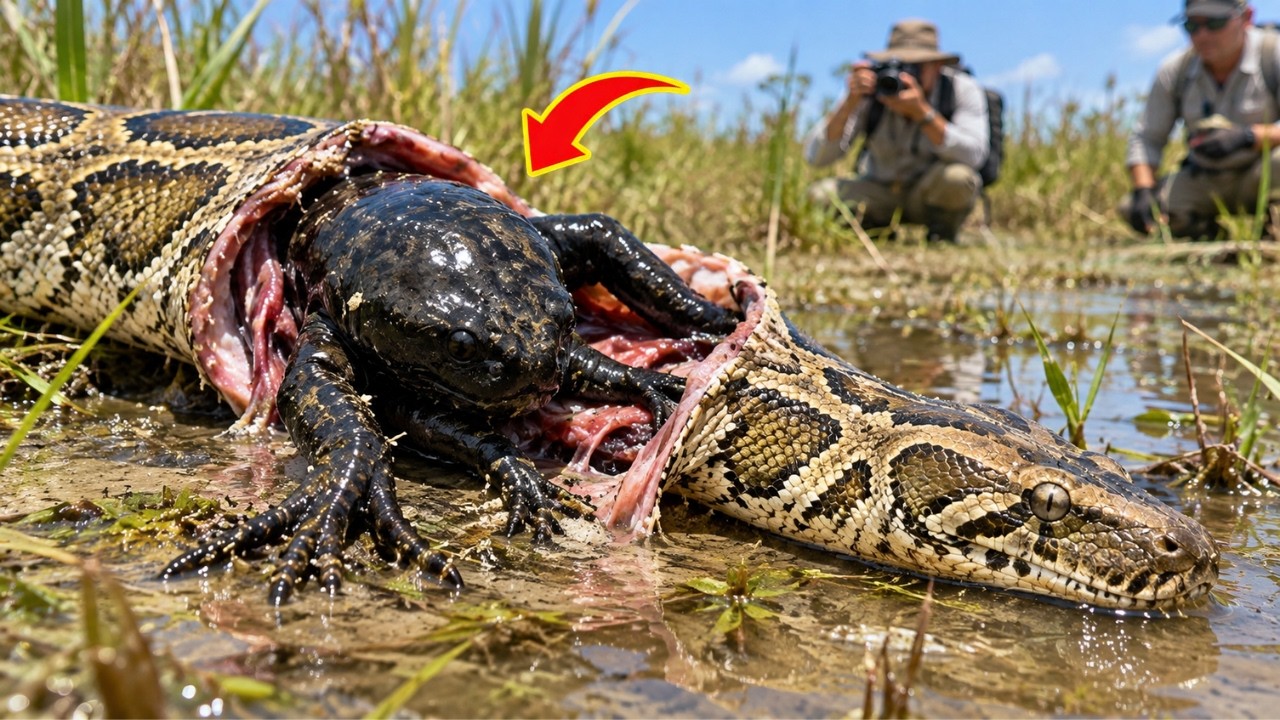
Invasive pythons have been swallowing Florida wildlife for years, but new hunters are using a tactic that’s triggering intense backlash. These hunters don’t just remove the snakes killing them in a way critics describe as cruel and chaotic.
In the wetlands of southern Florida, an estimated 300,000 Burmese pythons now live across more than a thousand square miles,...