The biologist Carol Evans spent ten years restoring Nevada’s ruined streams—then warned that a faster fix would fail. Engineers built beaver-dam analogs anyway, and early results seemed miraculous: one Idaho creek that dried every summer now flows year-round.
In 1988, a fisheries biologist named Carol Evans took a job with the Bureau of Land Management in Elko, a small city in Nevada’s high desert. Her official duties concerned fish, but her practical assignment was harder. She had to persuade cattle ranchers to keep their herds away from streams during the hottest months of the year.
At that time, the streams were in poor condition. Susie Creek, for example, was a thin ribbon of water running over bare gravel, with no willows or grasses along its banks. Evans asked ranchers to be patient, estimating that recovery would take about ten years. By her own count, she eventually helped restore roughly 250 miles of streams, or about 400 kilometers.
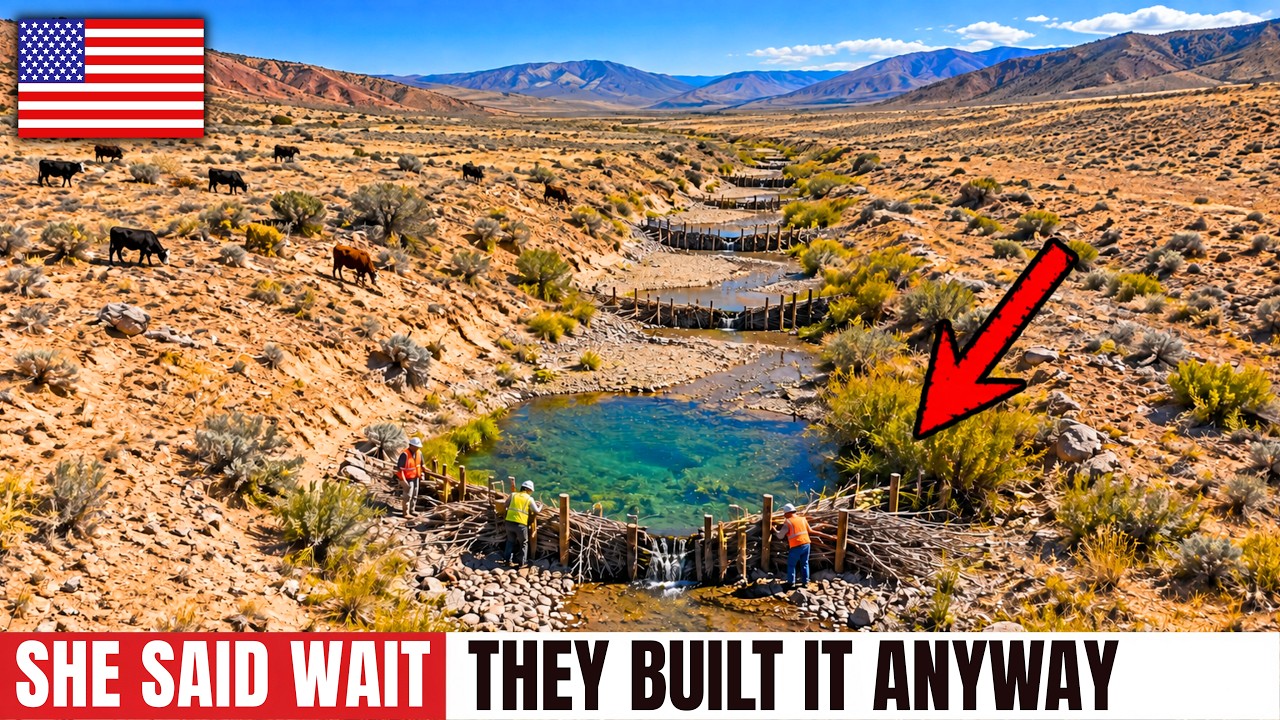
When asked whether there was a faster approach, Evans was direct. She said the shortcut would be to build a dam yourself and skip the waiting. But she also warned that if willows and grasses could not survive on their own, a human-built beaver dam analog would not help either. So the person who helped bring beavers back to these watersheds was among the first to caution against quick fixes.
Engineers built them anyway. In 2014, a team in Idaho placed four wooden structures in a stream that dried up every summer. Five years later, the same stream had more than 175 dams and flowed year-round. In a desert river, scientists built 70 similar structures. The result was more complicated. So who was right, the biologist or the engineers? The answer depends on the water.
The story begins with the streams themselves. These small waterways in the high desert lost something that was taken from them deliberately. For about a century, almost no one noticed. Between 1823 and 1841, fur trappers removed western beavers, partly to make the land less useful to British competitors. Then came livestock. By the mid-1880s, between 35 and 40 million cattle were grazing across the West. In the Great Basin, lowland grasses were already dying. There were no rules restricting herds until 1934. Over time, the hillsides improved, but stream banks did not. Cattle continued to graze along them through the season.
On Maggie Creek Ranch, that continued until the early 1990s. Evans says the entire story comes down to one thing: cattle grazing. The first part of the process was turning a stream into a drainage ditch. Then a new grazing plan allowed plants to return. Native grasses grew first. Willows took root by 1996. Beavers arrived on their own around 2003. Evans says it takes eight to twelve years to build a plant community that attracts beavers. She calls the chain of events a strong reaction sequence. The same approach worked on Susie Creek, where a 13,000-acre riparian pasture was established in 1993.
Most places do not have the combination of a persistent biologist, mining funding, and a threatened fish species that Elko had. So can the waiting period be shortened? Ten years is a long time for a stream that is dry today. For a rancher raising calves, it can feel like a lifetime.
Elsewhere, a different group decided they had waited long enough. For years, stream restoration meant heavy construction: concrete, steel, and machinery. Joe Wheaton, a river scientist at Utah State University, says Americans spend about 15 billion dollars annually on waterway repair. A 2022 review by American Rivers estimated that traditional methods cost between 600,000 and one million dollars per mile.
Some researchers began asking whether the missing piece was a natural process that could be simulated. The idea is called low-tech process-based restoration. In short, start small, build cheaply, and let beavers and floods do the rest. The tool is a beaver dam analog, or BDA, a human-made version of a beaver dam. Workers drive wooden posts into the stream bed, weave willow branches between them, and seal the gaps with mud and grass.
The BDA acts as an artificial speed bump. It slows the water, allowing sediment to settle and the stream bed to rise. The stream reconnects with its floodplain, and water spreads across the land, recharging the natural sponge. Planting willows alone often fails because the next flood can wash them out. Bringing in beavers directly has its own difficulties. Jay Wilde, a rancher near Preston, Idaho, tried that on Birch Creek. His family had run the property since 1933. When he took over in 1995, the creek was dry by midsummer. He released beavers, but they did not stay. Some died, some were killed by predators, and the creek remained dry.
A desert river faced the same problem. Floods damaged natural dams, predators killed 15 relocated beavers, and 39 others left. By 2025, the Western Beavers Cooperative cited this kind of field experience in its opposition to an Oregon bill on beaver relocation. A small study in New Mexico suggested another limitation: cattle can discourage beavers from staying.
Human-built dams solve part of the problem, but someone has to guess where they will work. For years, that made the approach feel like a gamble. Then Wilde decided to stop guessing. The Birch Creek project began with careful measurements. Before any post was driven, Wheaton and Nick Bouwes of Utah State University used a computer tool called BRAT to estimate how many dams the creek could support, based on water and wood. The result was 25 to 60 dams per mile.
In the fall of 2014, they built four test dams. A 3,000-dollar grant from the Forest Service covered materials. In 2016, they built 15 more. Idaho Fish and Game helped release nine beavers over two years. Wilde says cattle management had to be right first. Once that was in place, the beavers could do their part.
A similar project in Oregon, Bridge Creek, took seven years and was compared with a neighboring creek. After the human-built dams were installed, juvenile steelhead increased by 81 fish per 100 meters. Survival rates rose by 52 percent, and fish production increased by 175 percent. By 2013, the creek had 236 dams, about eight times the initial average. Costs ranged from 50,000 to 100,000 dollars per mile. In one Idaho case, volunteers built dozens of dams for less than 10,000 dollars, and beavers added more than 100 additional structures on their own. These are estimates from the people involved, not independent audits.
A California design firm, Swift Water Design, estimates its conventional restoration work at about 250,000 dollars per mile. It says its low-tech projects across 18 sites and 700 structures cost less than 20 percent of that figure. Another study looked at two common concerns. The dams did not raise water temperature, and willow cuttings planted near them grew 1.3 times faster than others.
The approach is relatively cheap and has been tested in several locations. But ranchers still ask the same question: how fast does it work? Compare that to the eight-to-twelve-year wait. The same type of stream, the same problem, but a very different timeline. On Muddy Creek in Wyoming, a Bureau of Land Management employee saw trout swimming over a human-built dam within minutes of its completion. On Birch Creek, later reports counted between 200 and 250 dams. Wilde says the creek now flows year-round, and Bonneville cutthroat trout are 10 to 50 times more abundant in the pooled sections.
Fires have also put the idea to the test. Within a week of the Sharps Fire in Idaho, which burned 65,000 acres, a team built about 150 dams along five miles of Bull Creek. Scientists who studied five large Western fires found that where beavers had built dams, vegetation stayed greener. Without beavers, the loss of green cover was three times worse. In both cases, plants regrew the following year. The dams provided a refuge.
When the Maggie Creek Fire swept through in 2016, the ranch manager said the burned willows regrew faster than plants on dry hillsides. A beaver pond and high water were already in place. In one section of Maggie Creek, the water level rose so high that it flooded the willows, turning the area into a marsh about 100 feet wide, full of sedges.
The presence of beavers attracts other wildlife: trout, frogs, ducks and geese, mule deer, elk, pronghorn, mountain lions, and bobcats. In the Maggie Creek basin, trout became three times more common in studied waters. Even sage grouse, birds of the dry sagebrush country, depend on wet areas. Scientists studied 1,277 breeding sites in California, Oregon, and Nevada, and found that 85 percent were within about six miles of summer wetlands. Those wetlands made up just over 2 percent of the surrounding area. On private ranch land, less than one-fifth of the land held about three-quarters of those wet habitats. A 2018 follow-up study found that private land, which makes up 40 percent of sage grouse range, holds 68 percent of the wetland habitat.
A 2018 study looked at grazing, beavers, and weather together. Where grazing was managed for the benefit of the stream and beavers were active, plant growth was 11 to 39 percent higher. To achieve the same effect, a site would need to move about 800 feet higher up the mountain or receive an additional 10 inches of rain per year.
The dams restored a natural process, and the process brought back fish. The water slowed in minutes. The stream took years. The water table gains are modest. The best figure from Maggie Creek is about two feet over 17 years, measured in shallow wells and published in a local paper. That is the difference between the pace of a viral article and the pace of a stream.
On Maggie Creek, the contrast is visible. Upstream, there are many dams. Downstream, there are none. The sections with dams used more water and were greener. Satellite data from 2019 tracked greenness along 1,600 meters of the creek over two 11-year periods after restoration. Over time, the plants became less dependent on each year’s rainfall, a direct sign of drought resilience. According to the Bureau of Land Management’s own assessment, seven miles of Maggie Creek reached proper functioning condition between 2006 and 2010. The ranch reported 107 dams in 2006 and 271 in 2010, numbers that came from a newspaper article about BLM data.
The financial picture is less clear. The main costs on the ranch were fencing, solar-powered livestock wells, and extra labor for herding. The ranch also moved calving season later, cut hay feeding, and kept restored stream pastures as drought reserves. The ranch sells some of its beef through Country Natural Beef to buyers like Whole Foods. Its 2015 award application says that 40 years of environmental progress made the ranch more profitable. That is the ranch’s own claim, not an audit.
John Griggs, who managed the ranch for about 28 years, once dynamited a beaver dam himself. Later he said he had a great deal of respect for beavers, calling them among the hardest-working creatures in the animal kingdom. His point was that the ranch needed to find a way to make them work for the operation.
The model has spread beyond Maggie Creek. Dixie Creek and the Humboldt Ranch, along with the BLM and Nevada Gold Mines, now cover more than 140 miles of streams. A 2016 workshop on Birch Creek trained about 40 agency staff members. Trust has passed from one rancher to another, and funding has followed through agency offices.
It is still too early to call this a settled success. Much of what has been described rests on questions that have not been fully answered. Utah’s 2019 design manual is now the main field guide. A 2024 review of about 65 Western projects found that natural beaver dams trap more sediment than human-built ones. How long do human-built dams last? No published answer was found. What happens when one breaks? Wilde worries about that. A dam not maintained by a beaver or stabilized by plants could fail and cut a deep notch in the stream bed, what experts call incision. One study in Quebec found that a beaver dam break added only 3.9 percent to peak flow during a large flood.
In 2015, Evans warned that beavers might become victims of their own success. The same drought that made ponds popular also tested the beavers. In Colorado mountains, active beaver meadows held about 12 percent of soil carbon, while older ones held about 3 percent. Ponds can also release methane, and that study was not conducted in Nevada.
Not everyone is convinced. Near Carey, Idaho, ranchers complained about 14 artificial dams and 35 wood structures on Fish Creek, and the state had to write temporary permit guidance. Critics say the dams hold water that belongs to people downstream and that ponds lose water to evaporation. A project on Holly Creek argued the opposite, claiming that holding water upstream provides irrigation water later in the season. Almost no one has published stream gauge data to settle the question. In Utah, since 2018, a state permit is required to drive posts into a stream to build a dam.
The results are mixed. On the positive side, the dams are cheap, and water, plants, and fish respond with measurable numbers. On the negative side, beavers ignored most of the dams in one desert river. Human-built dams can fail. Drought tests the ponds, and long-term records are missing. Reviews say the practice has outpaced the research. It works on small streams, one section at a time. It will not refill a large river or lake.
Looking forward, the next step is measurement: stream gauges, long-term water level records, and statistics on dams that beavers maintain. That part remains unfinished, and no clever dam can skip it. The dams are only as good as the care the surrounding land receives.
So who was right? Evans and Wilde, two people on two different creeks, said the same thing: fix the grazing first. The biologist treated the cause. The engineers reduced the burden. Neither works well alone. The best solution for these desert streams may be a prototype dam, left where a beaver can find it. That is the answer for desert creeks.
The idea does not stop at the stream’s edge. When someone applies the same principle elsewhere, letting animals do the engineering rather than machinery, the results can be very different. On exhausted farmland in West Sussex, England, a baron on the edge of bankruptcy spent decades fighting heavy clay soil with machines. Then he did the one thing no farmer was supposed to do. He closed the gates on 3,500 acres and let longhorn cattle, pigs, ponies, and deer manage the land as large herbivores once did. The return included a butterfly, a bird that had nearly disappeared, and a white stork that had not bred in the wild there in over 600 years.
Recommended Stories
New York just dropped 34 beavers back into the Adirondacks, and what happened over 80 years has stunned researchers. The animals had been completely wiped out from the region by the 1800s, leaving waterways barren.
In 1671, a single Dutch shipping season brought 80,000 beaver pelts to European markets. By 1895, a New York State...

He slithered through swamp water, but Florida wildlife officers now warn this hunter does not chase rodents—it stalks humans. The invasive species, initially dismissed as another python threat, has triggered a statewide alert after documented encounters near residential canals.
In 2016, genetic testing confirmed that Nile crocodiles, a species not native to the Americas, had established a breeding population...

Divers off Australia’s southern coast were filming a tagged white shark when her behavior shifted from relaxed to panicked, forcing the seventeen-foot predator to flee for the surface. In thirty combined years of experience, none had seen a great white run from anything.
In the waters off Australia's southern coast, sunlight penetrates only about sixty feet before fading into darkness. Below that depth,...