Two scientists tracking great white sharks off Australia got a transmission that didn’t make sense. Their tagged nine-foot female, Alpha, had suddenly plunged nearly 1,900 feet.
In 2003, researchers studying great white sharks off the southwestern coast of Australia recorded an unusual event that raised unresolved questions about the species. A team of scientists and a filmmaker, Dave Riggs, were conducting one of the first large-scale tagging projects for white sharks in that region. During the expedition, they tagged a healthy adult female shark measuring nine feet and weighing approximately 500 pounds, which they named Alpha.
The tag attached to Alpha was a pop-off satellite archival tag, designed to record depth, temperature, and light levels continuously before detaching from the animal at a predetermined date and floating to the surface to transmit the collected data. After releasing Alpha, the team waited months for the tag to reappear. It washed ashore roughly four months later, about two and a half miles from the location where Alpha had been tagged.
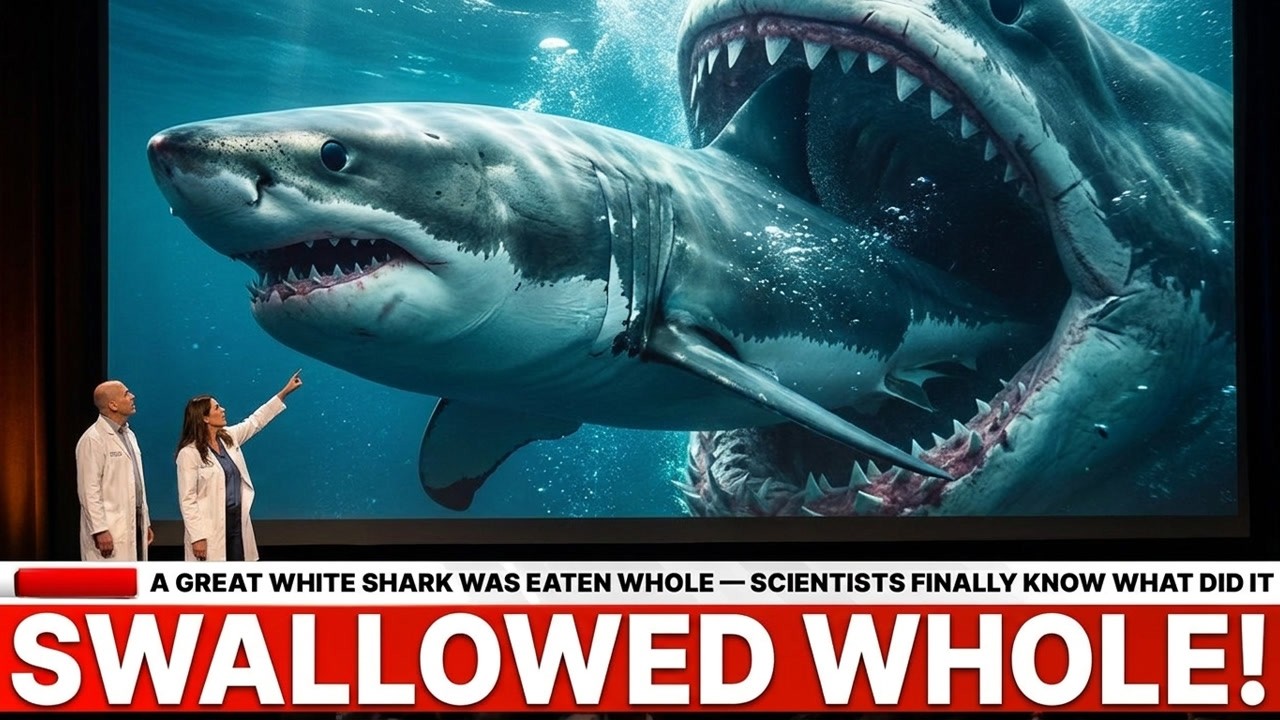
When researchers downloaded the data, they found a pattern that contradicted their expectations. Great whites typically spend most of their time in the upper layers of the ocean, making occasional deep dives. Alpha’s record, however, showed a sudden and rapid descent of nearly 1,900 feet, followed by several hours at that depth. The surrounding water temperature at that depth should have been around 46 degrees Fahrenheit, but the tag recorded a stable temperature of 78 degrees Fahrenheit.
The combination of the two readings suggested that the tag was no longer in open water but inside a warm-bodied animal. The researchers concluded that Alpha had been consumed whole by a larger predator. The temperature indicated the tag had entered a stomach, and the depth suggested the animal then carried it into deep water.
The investigation into what could have eaten Alpha eliminated several candidates. Orcas are known to kill great whites, but they typically hunt near the surface and do not dive to 1,900 feet to feed. Sperm whales are capable of diving to such depths, but their internal body temperature is closer to 98 degrees Fahrenheit, which did not match the recorded 78 degrees. Cold-blooded animals such as giant squid would have registered the ambient water temperature, not a warmer internal reading.
The only animal that fit all three conditions was another great white shark. Great whites are regional endotherms, meaning they can retain body heat in certain tissues, including the stomach. A very large white shark, estimated at roughly 16 feet or more, could plausibly swallow a nine-foot shark whole, maintain an internal temperature near 78 degrees, and dive to depths exceeding 1,900 feet.
Cannibalism among great whites is documented. Embryos devour siblings in the womb, and adults carry bite scars from other whites. The data from Alpha’s tag appears to be a recorded case of one great white consuming another.
The event does not close the question of how often such encounters occur in deep water, nor does it provide a precise size estimate of the shark that ate Alpha. It does indicate that the largest members of the species may spend much of their time far offshore, beyond the range of most observation. The case remains an open one, with the only direct evidence being the tag’s record of depth and temperature.
Recommended Stories

Ted Turner poured millions into New Mexico ranchland to save black-footed ferrets—so-called pests lawmakers once mocked as a waste of money. Critics called him crazy for breeding an animal many believed was doomed to extinction.
In 1997, Ted Turner purchased a ranch in New Mexico that had been used for cattle grazing for decades. Instead...

They released just 30 predators into the wild—then the snakes started vanishing. Wildlife teams had spent years tracking an invasive snake population that was devastating local species, and the plan seemed straightforward: introduce a limited number of natural hunters to regain control.
In 1979, Japan released about 30 small mongooses on Amami Oshima, a remote island in the warm waters between Kyushu...

Hawaii released cannibal snails to kill a pest — but they hunted the wrong species. The predatory snails were introduced to wipe out a damaging invasive slug, a mission they seemed ready to complete.
In 1955, Hawaii introduced a predatory snail to control an invasive pest, the giant African land snail. The rosy wolf...