Florida’s biggest crocodiles began vanishing from canals they had ruled for decades—and the usual suspect was quickly ruled out. These were mature territory holders, not wanderers, so biologists first blamed pythons.
The disappearance of dominant adult crocodiles from the mangrove channels of southern Florida went unnoticed at first, and then became a puzzle that defied the usual explanations. These were not young or transient animals. They were mature, established individuals that had occupied prime territory in the Everglades for years, often for more than a decade. Local airboat captains who had worked the same waters for twenty years could recognize them by sight, location, and the specific banks they favored at certain times of day.
Such animals do not simply wander off. A crocodile that has defended a distinct territory for years typically stays in that territory for life. But the animals in the southern Everglades were gone, and for a long time, no one tracking them could offer a convincing explanation for where they had gone.
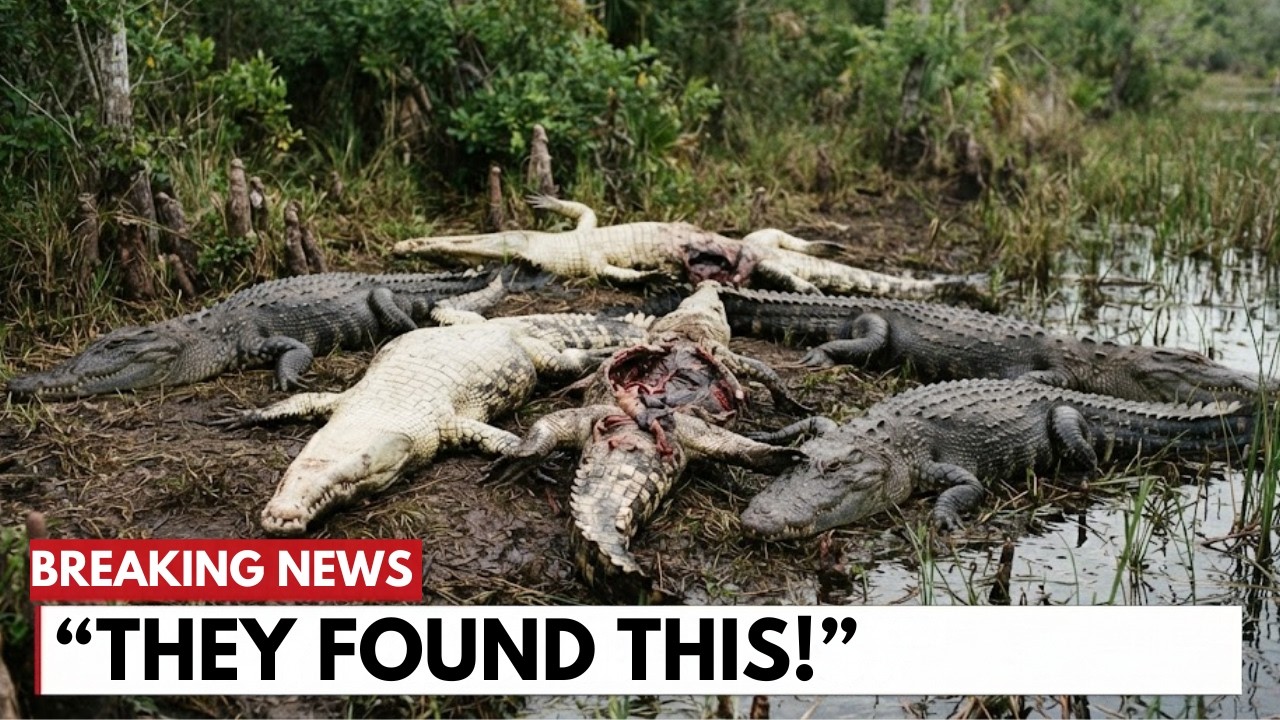
The disappearance was especially striking because it contradicted the arc of a conservation success story. The American crocodile was listed as an endangered species in 1967. By mid-century, coastal development, hunting, and habitat loss had reduced the Florida population to a few hundred animals concentrated at the southern tip of the state. Federal protection and careful management changed that trajectory. By 2007, the species was reclassified from endangered to threatened, and the population had grown to about 4,000. Wildlife managers regarded the recovery as evidence that legal protections could reverse a decline if applied early enough. Then, in the strongest areas, the numbers began to turn in the opposite direction.
To understand what the loss of dominant animals meant, it helps to know what the American crocodile is. It is not the familiar alligator often seen lounging along suburban Florida canals. The alligator tolerates a wide range of freshwater conditions and has little fear of humans. The American crocodile is a different animal. It is specialized for saltwater and brackish estuaries, keeps to coastal mangrove forests, and avoids human contact rather than investigating it. Its safety record in the United States is complete: no wild American crocodile has ever been recorded killing a person. That is not a statistical accident for an animal that can reach twelve feet and weigh several hundred pounds. It reflects a temperament shaped over millions of years.
When the strongest animals in the best habitat stopped appearing in surveys conducted by state and federal biologists, the natural assumption was that Burmese pythons were responsible. That assumption was not unreasonable. By 2009, the python invasion of the Everglades was one of the most thoroughly documented ecological disasters in American conservation history. The snakes had reduced raccoon populations by 99 percent in some areas, caused opossum numbers to collapse, and displaced marsh rabbits and foxes from sections of the park. The question of whether a large python could take on a native crocodile was not theoretical. In 2005, park researchers photographed the aftermath of such an encounter: a Burmese python that had attempted to swallow a six-foot crocodile and died in the attempt. That image became widely known and fixed in the public mind the idea that these snakes would challenge anything regardless of size.
But when biologists examined the dead crocodiles recovered from the channels, the python theory did not hold up. Pythons kill by constriction, which leaves specific patterns of trauma on the body. The dead crocodiles showed none of those patterns. The wounds suggested an animal that bit and tore rather than crushed. The killings also showed a level of speed and efficiency that did not match a python’s method. Whatever killed these animals did so quickly, and the crocodiles showed little sign of the defensive struggle typical of dominant territory holders. The native crocodiles had apparently been unable to mount an effective defense.
Clearing the obvious suspect made the situation more troubling. If not pythons, something else was in those channels, something capable of killing the estuary’s top predator without leaving visible signs of a fight. The investigation shifted from looking for evidence of a known threat to trying to identify an unknown one.
The breakthrough came from an unexpected location. A team from the University of Florida captured a small crocodile in a Miami-area canal, miles from any known American crocodile habitat. The location alone was a warning sign, since native crocodiles do not appear in those waterways. But the animal itself was the more significant finding. At first glance it looked like an American crocodile. On closer inspection, it did not. The snout was broader and heavier. The coloring was wrong, a darker olive tone rather than the gray-green of the native animal. And the behavior was unlike anything in the team’s experience. This was a small crocodile, and it moved toward the researchers rather than away. American crocodiles do not advance toward humans at any age.
The team suspected a hybrid, possibly a cross with an alligator, or an animal with a developmental abnormality. They collected tissue samples and sent them to a genetics laboratory. The result was unambiguous: the animal found in the Miami canal was a Nile crocodile. The species was reproducing in Florida.
The significance of that identification comes into focus when the two species are compared directly. The American crocodile has never recorded a human fatality in U.S. history. The Nile crocodile is the deadliest crocodilian on Earth. Across sub-Saharan Africa, it kills hundreds of people per year by conservative estimates, with some researchers believing the real number is higher because attacks in remote areas often go unrecorded. Nile crocodiles are built to hunt large mammals at the water’s edge. They do not share the native species’ instinct to avoid humans. Large adults can exceed eighteen feet and approach two thousand pounds, with some of the strongest bite forces ever recorded in a living species.
Genetic testing of captured Nile crocodiles in Florida showed nearly identical sequences among the individuals tested. That pattern does not arise from scattered, independent escapes occurring at different times from different facilities. Genetic diversity in any wild population increases as unrelated founding individuals accumulate over time. Nearly identical sequences pointed to a single founding event: a small group from one common source released into the same waterways at roughly the same time. This was not a pattern of isolated pet releases across years and locations. It was a single introduction that had begun to settle quietly into the southern mangroves while monitoring programs were still trying to explain why their largest native animals were disappearing.
How Nile crocodiles reached an American national park has one answer that withstands scrutiny: the exotic animal trade. South Florida is one of the largest markets for illegal and semi-legal exotic animals anywhere in the world. Nile crocodiles are available as hatchlings. They are impressive and manageable at two feet long. They become unmanageable at eight feet, and they do not stop there. An owner who decides the animal is no longer suitable as a pet faces a choice between the cost and difficulty of surrendering it to a licensed facility or simply releasing it into the nearest body of water. Years before the disappearances were first noted, some owners made the second choice. Because juvenile Nile crocodiles resemble juvenile American crocodiles closely enough to pass casual inspection, they moved through the mangroves without triggering the alarm they should have.
Removal efforts coordinated by the Florida Fish and Wildlife Conservation Commission and the University of Florida captured three confirmed Nile crocodiles from the wild. In a different kind of problem, removing three individuals would represent meaningful progress. But in a species capable of establishing a self-sustaining population from a small founding group, with no natural predators able to limit its growth, the number three indicates where the effort began, not where the problem ended. Nile crocodiles grow faster than the native American crocodiles. The individuals captured in Florida were already outgrowing native animals of the same age and size. They reproduce in ways adapted to keep a population stable.
The detail that removes the comfortable boundary between a South Florida problem and a statewide one is cold tolerance. The American crocodile is a tropical specialist, confined to the warm southern tip of the state by temperature. The Nile crocodile handles cooler conditions more effectively. There is no natural thermal barrier that stops the Nile crocodile at the same latitude where suitable habitat for the native animal ends. The invasion has no built-in northern wall.
The deeper context of the story is that the Nile crocodile did not appear suddenly in a healthy ecosystem and overwhelm it. It appeared in an ecosystem that had already been systematically weakened before its arrival. Coastal mangroves that the American crocodile depends on for nesting and shelter were removed for decades to make way for development along the South Florida coast. Water flow through the Everglades was diverted and channeled for agriculture and municipal water management in ways that damaged the estuarine environment at the edge of crocodile habitat. Runoff from farms, roads, and parking lots entered the same waters the native crocodile relies on for successful nesting. The recovery program for the species ran for decades while the environmental conditions the program depended on were being dismantled at the same time. The Nile crocodile did not invade a strong native population. It was introduced into a weakened one, within habitat that had already been degraded, by someone unwilling to face the consequences of purchasing an exotic animal.
That pattern extends well beyond this single case. The Burmese python followed the same path. So did the green iguana, the Argentine tegu, the lionfish, and the cane toad in contexts further north. Each arrived through a vector created by human activity, and each settled into a landscape previously altered in ways that removed the resistance a healthy ecosystem would have offered. The Everglades is not a natural experiment in what happens when invasive species meet native species. It is a case study in what happens when a fragmented, chemically damaged, developmentally constrained ecosystem runs out of defenses at the same moment its borders are opened by negligent or deliberate human choices.
The American crocodile’s clean safety record in the United States is a biological fact that will not survive sustained contact with a species that does not share its passive temperament. If Nile crocodiles become established and expand, the warning infrastructure around the waterways bordering South Florida’s coast will change permanently. That change would affect the ecotourism economy, the backcountry fishing industry, and the kayak operations in the Ten Thousand Islands region, none of which currently has a framework for managing it. The predator at the end of this path is not in the water. It is the decision that brought the water to its current state in the first place.
Recommended Stories
Scientists lowered a camera into a lake with no visible bottom, and the feed went dark. Then, hundreds of feet down, something massive moved past the lens.
A flooded sinkhole in Russia’s Kabardino-Balkaria region has been the subject of a 300-year-old myth claiming it has no bottom....
America introduced an African animal into its desert—and the fallout turned ecological. In the 20th century, a single species was brought in to address a growing problem, but its impact quickly spiraled beyond expectations.
In 1969, New Mexico wildlife officials began introducing gemsbok, a large African antelope, into the Tularosa Basin on the White...
Scientists found Florida’s rattlesnakes vanishing from wetlands, and the evidence points to something already hunting them. These snakes have thrived in the Everglades for centuries, but recent surveys show populations collapsing at an alarming rate.
Kevin Angie, a biologist, has managed the Eastern indigo snake reintroduction program at the Apalachicola Bluffs and Ravines Preserve for...