Biologists called Mount Maungatautari ecologically dead, its kōkako gone and kiwi silent for a century. One farmer, David Wallace, built a 47-km predator-proof fence anyway, a project experts dismissed as a waste.
In 1999, a sheep farmer in central New Zealand’s North Island built a fence around a patch of forest on his property. David Wallace carried a shovel, a roll of stainless steel mesh, and an idea that most experts dismissed as impractical. He wanted to enclose 17 acres and remove every rat, stoat, possum, and cat from within it.
The forest behind his farm had once supported an estimated 12 million native birds. By then, only about 68,000 kiwi remained nationwide, and roughly two percent of them disappeared each year. University scientists called the project a waste of money. Neighbors called it foolish. Officials in Wellington paid little attention.
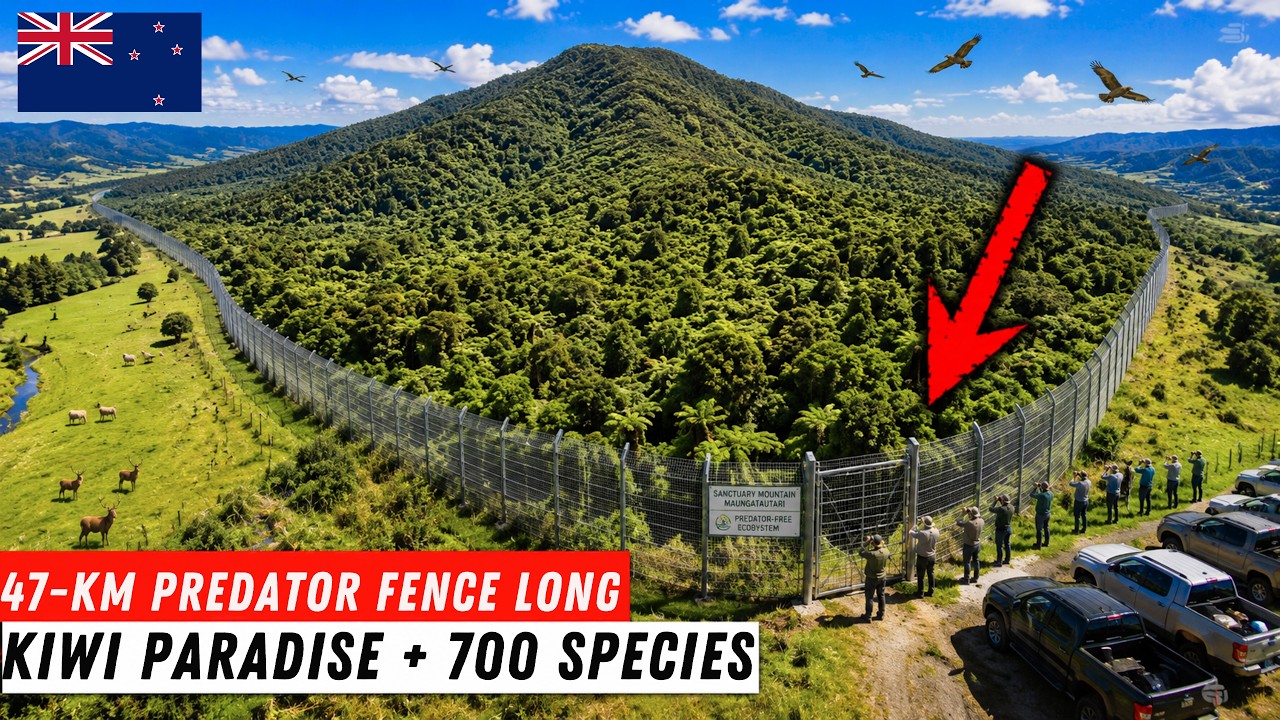
The site sat on the lower slopes of Mount Maungatautari, a volcanic dome sacred to three Maori tribes. Kiwi had been silent there for nearly a century. The kōkako had vanished, and the kākāpō was gone from the entire North Island.
Wallace completed his fence and brought kiwi chicks inside. One summer, heavy rain washed soil away from the base of the wire fence. A single stoat got through and killed eleven chicks before anyone noticed.
Today, nearly 3,000 kiwi live on that mountain. Hundreds have been transferred to rebuild populations elsewhere in the country. Eight out of ten kiwi in the hills above New Zealand’s capital were born there. In the summer of 2025, a kākāpō call was recorded on Maungatautari for the first time in more than a century.
New Zealand evolved without land mammals for roughly 80 million years. The kiwi lost the ability to fly because it had no need for it. It nested on the ground, had a strong scent, and lacked a strong escape instinct. When Polynesian settlers arrived around 800 years ago, they brought Pacific rats. When Europeans arrived about 500 years later, they brought stoats, weasels, ferrets, rats, cats, goats, deer, rabbits, and hares, and cleared forests for pasture. Native forest birds, which had never faced mammalian predators, suddenly lived alongside 14 introduced species. Stoats alone kill roughly half of each generation of kiwi chicks. Without help, only about one chick in ten survives to six months.
On Maungatautari, the pattern repeated. Forest on the lower slopes was cleared, and the remaining bush grew quiet. By the mid-20th century, kiwi were gone from the mountain. The kākāpō had disappeared from the mainland even earlier.
Wallace’s ancestors had farmed the mountain’s lower slopes, and his father’s generation helped clear thousands of hectares of Waikato forest. In his fifties, Wallace read a book by historian Geoff Park that described the lowland forests his forebears had removed. He later said it made him realize what had once been there. He also watched a documentary about a small island where scientists had eliminated rats and observed the ecosystem recover.
The standard approach to saving New Zealand’s rarest birds at the time was to move them to small offshore islands without predators, or to breed them in captivity. Wallace proposed something different: keep the birds on the mainland by building a fence that kept predators out. He began experimenting on his own land with a local fencing contractor. In 1999, the 17-acre prototype was completed, and kiwi chicks were brought in. Over the next few years, the small fence raised between 60 and 85 chicks. Then the stoat got through and killed eleven.
Wallace treated the failure as a lesson. The prototype proved the concept worked, and that a single breach could undo years of work. He and a few neighbors then began discussing how to apply the idea to Maungatautari itself.
The mountain covers 3,400 hectares, about 13 square miles, surrounded by dairy pasture. Fencing it would require the longest predator-proof fence ever built. The project needed permission from dozens of surrounding landowners and from three tribes with ancestral ties to the mountain: Ngāti Koroki Kahukura, Ngāti Hauā, and Raukawa. For those tribes, the mountain was a sacred ancestral peak, and any decision about its future had to come from them.
In 2001, the Maungatautari Ecological Island Trust was established with shared governance giving equal seats to tribes, landowners, and the community. A survey of 2,000 Waikato residents showed majority support. Early estimates put the cost at about NZ$8.7 million. By the time the fence was finished, the community had raised nearly NZ$15 million.
The fence itself is a precise physical barrier. The welded stainless steel mesh has openings of about 6 by 25 millimeters, small enough to exclude young mice. A curved metal hood at the top stops climbing possums. A mesh skirt buried just below the soil blocks animals trying to dig underneath. It is not electrified. At 47 kilometers long and about six feet high, it crosses 42 waterways with water gates and fish tunnels so eels and small native fish can pass. Construction required 8,500 posts, more than 850,000 fasteners, and 240 kilometers of high-tensile wire. Work was completed in August 2006, and around 3,000 students and supporters joined hands around the enclosure to mark the closing.
The fence only works if breaches are detected quickly. The trust runs the mountain like a secure perimeter. There are 270 kilometers of tracking lines, 2,700 monitoring tunnels with ink pads, trained detection dogs, and water gates with alarm systems. The aim is to get a ranger to any breach within 90 minutes. When a predator gets through the fence in summer, the chance that a mammal will exploit the gap within 24 hours is about 99 percent. In winter, it drops to about 85 percent. The fence must be inspected, monitored, and repaired indefinitely.
Fourteen introduced mammal species had to be removed from the mountain: hedgehogs, cats, rats, stoats, ferrets, weasels, rabbits, hares, possums, pigs, and goats. Mice refused to leave entirely, but everything else was removed or eliminated. The trust dropped brodifacoum bait from helicopters three times between late 2006 and September 2007. Gradually, the mountain grew quiet in a new way, and then things began to return.
Within two years, a study of the southern enclosure found native beetle numbers had increased by at least 300 percent. The Hochstetter’s frog, a small ancient amphibian rediscovered on the mountain by chance, quadrupled in number over three years. In 2010, a Duvaucel’s gecko was found dead in a mouse trap, the first record of the species on the mainland in about 100 years. A remnant population had been living quietly on Maungatautari the whole time, waiting for the mammals to leave.
With introduced mammals gone, native top predators such as hawks, moreporks, and tuatara recovered, and the old food chain slowly began operating again. In December 2005, before eradication was complete, a kiwi call was heard on the mountain for the first time in a century. Two years later, a chick hatched.
The first four kiwi chicks were given as a gift from one tribe, Ngāti Hikairo ki Tongariro, to Ngāti Koroki Kahukura. It was a tribal transfer rather than a government-to-tribe arrangement. Over the next 20 years, more than 320 founding birds were introduced. A pair of takahē, a species with only about 280 individuals left worldwide, arrived in 2006. Kākā came in 2007, followed by hihi, tieke, tuatara, and kōkako. In 2023, ten male kākāpō were moved to the mountain, the first kākāpō on the New Zealand mainland in about 40 years. In the summer of 2025, one of them made a low booming call to attract a mate, the first time that sound had been heard on the North Island mainland in more than a century.
The kākāpō story had its complications. Not long before that call, one of the ten males, a bird named Tau Tāhi, climbed over the fence via a fallen tree and spent seven to ten days on a neighboring farm before being recovered. By the end of the following year, only three of the ten males remained on the mountain. The other seven had been quietly returned to their island.
Visitors sometimes ask whether a fenced sanctuary is effectively a zoo. Guides at Zealandia, a fenced reserve in Wellington, point out that the fence keeps stoats and rats out, not birds in. Kākā fly over the fence and settle in trees across from the parliamentary buildings. Tūī have been seen five to ten kilometers beyond the fence. The mountain does not trap wildlife inside; it exports it outward.
Today, more than 700 native plant, animal, and fungus species live on Maungatautari. The kiwi population stands at nearly 3,000, and the forest functions as an ecosystem on an island where mammals were never part of the original order. Kiwi born on the mountain are boxed, carried out through the gates, and moved to other parts of New Zealand. Thirteen went to Waimarino in 2019, 111 to Tongariro and Wellington in 2023, and more than 200 in each of the following two years.
The mountain remains fragile. Running the sanctuary costs about NZ$5,000 per day. In 2024, a NZ$250,000 shortfall brought it close to closure, and it was saved by an exceptional NZ$750,000 contribution from international visitor levies. Helen Hughes, the trust’s chief executive, described the effort that year in two words: total exhaustion.
The community has not always stayed unified. In 2010, some surrounding landowners closed gates, disconnected electronic monitoring from their sections of fence, and warned that if management did not change, they would ask for the fence to be moved. Gallagher Group, a family company that pioneered electric fencing in New Zealand and was a major donor, suspended support until matters were resolved. A formal settlement in 2012 kept the project together.
Maintenance is constant. The trust digs up parts of the buried fence each year to check for rust. Storms bring trees down on the wire several times a year. The fence has an expected lifespan of about 30 years, and replacing it would cost NZ$40 million to NZ$42 million, roughly twice the original construction cost.
There are genuine scientific criticisms. Paul Scofield of the Canterbury Museum described such sites in a peer-reviewed paper as small, expensive zoos surrounded by a degraded environment. The numbers support part of that argument: maintaining an offshore island sanctuary costs about NZ$29 per hectare per year, while maintaining a mainland fenced reserve like Maungatautari costs about NZ$3,365 per hectare per year. All of New Zealand’s fenced sanctuaries together cover about 0.2 percent of the country’s land area.
New Zealand has a national plan called Predator Free 2050 to eliminate rats, stoats, and possums nationwide, though no one knows yet whether that is achievable. Each fenced mountain like Maungatautari serves as a test case. The model is spreading. Activists on Britain’s Jersey island cite Maungatautari in their push to build a fence to protect puffins. Hawaii has built 12 predator-exclusion fences since 2011, all based on the New Zealand model. In the Australian desert, the country’s largest fence designed to exclude cats protects bilby populations the same way.
Scofield himself offered the reply to his own critique: the ultimate measure of success would be the day the fence can be removed. A fence is a wall built in the hope that it will one day be unnecessary.
Wallace did not live to see most of what followed. He gave up his shares in the fencing company his experiments had inspired. When asked why he started, he gave the same answer: one day you suddenly realize what was here before.
Recommended Stories

A New Zealand botanist famously refused to kill an invasive weed, choosing to plant it instead. For 39 years, he meticulously cultivated the offspring of a scraggly tree known as “theworld’s most hated plant.”
In September 1987, Hugh Wilson took over management of 109 hectares of former farmland on New Zealand's Banks Peninsula. The...
A.T. and Cinda Cole bought a drained New Mexico desert ranch, unaware such a thing as a cienega even existed.
On a cattle ranch about an hour south of Silver City, New Mexico, a desert wetland had been cut by...
The black mamba strikes in 50 milliseconds—seven times faster than any human reflex—yet something on the Serengeti is killing these deadly snakes in open daylight, faster than they can reproduce. For years, researchers hunted for the predator in the wrong direction, assuming it fought from the sky.
The black mamba is one of the fastest and most aggressive venomous snakes in Africa, capable of striking in about...