For 20 years, they let 3,500 acres of English farmland sit completely untouched, blocking out all human interference. No planting, no harvesting, no management of any kind—just pure neglect.
In 2001, an English baronet opened all the gates of his 3,500-acre estate and walked away. He planted nothing. He sowed no seeds. He offered no management plan. The county called it embarrassing. The agricultural press called it a vanity project. A government wildlife agency spent the next eight years unable to decide whether his action was even legal.
Charles Burrell, the 10th baronet of his line, inherited the Knepp estate in West Sussex in 1985, at age 22. The land had been farmed by his family since 1787, when an ancestor married the daughter of the landowner. But the estate had a structural problem no amount of management could solve.
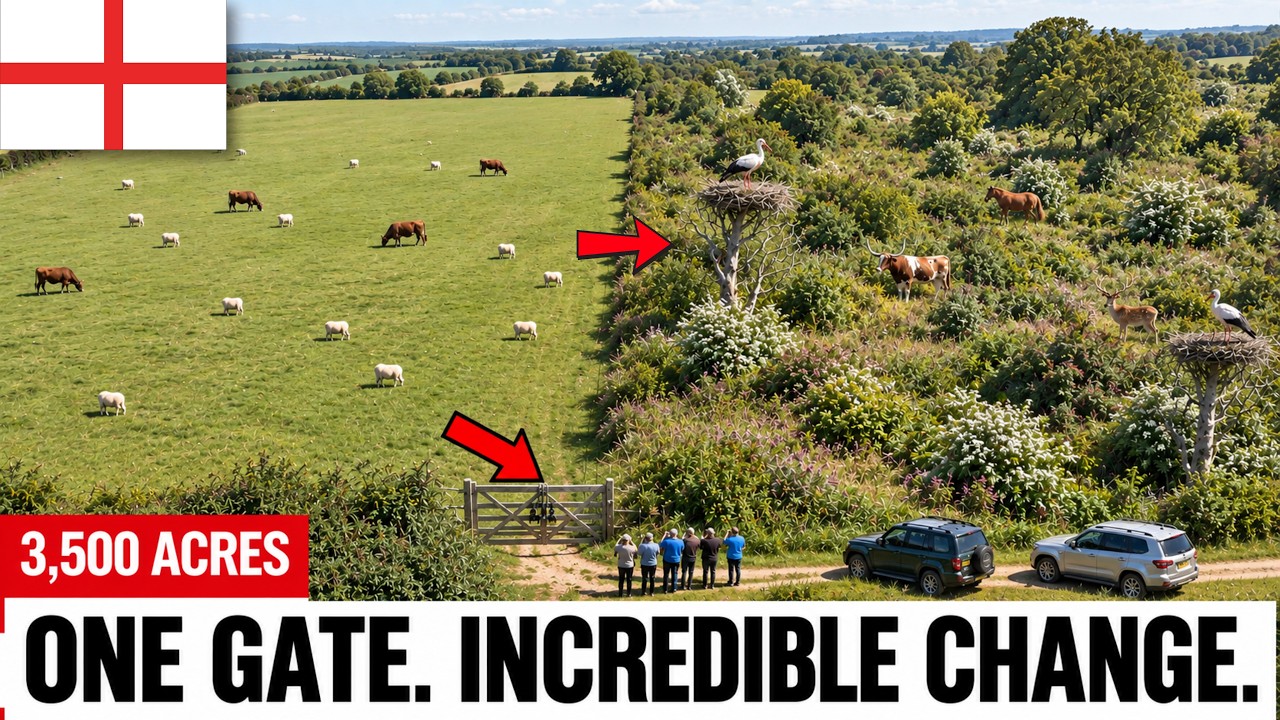
Knepp sits on heavy clay soil known as the Weald, which stretches beneath Kent and Sussex. Agricultural engineers describe it as among the most hostile farmland in Britain. In summer, it hardens like fired ceramic. In winter, it turns near-liquid. Drainage is poor, root penetration difficult. Burrell’s grandparents plowed it in the 1940s, when the British government pressured landowners to maximize food production. For four decades afterward, the family applied heavier machinery, more precise chemicals, and more expensive inputs. The land gave back very little.
Agricultural consultants who reviewed the farm in the late 1990s found that organic carbon in the topsoil was near zero: the material that holds water, feeds roots, and hosts the microbial network that makes soil a living system rather than compressed mineral dust. The estate was producing crops only with heavy chemical inputs, and the same yield cost more every year. The consultants concluded the land could no longer sustain the farming required of it. By 2000, the estate was losing money.
The idea that changed the estate’s direction appeared in a 2000 English translation of a book by Frans Vera, a Dutch ecologist. Vera argued that prehistoric Europe was not a closed-canopy forest, as British conservation institutions had assumed for a century. Instead, it was a mosaic: grassland yielding to thorn scrub, scrub sheltering scattered trees, trees becoming woodland, woodland reopening into grassland. The driver was not climate or geology, he said, but animals: aurochs, wild horses, elk, European bison, and wild boar. Their grazing, rooting, movement, and dung created the structural diversity that hundreds of species evolved to depend on.
Vera’s hypothesis remains debated; pollen records suggest more closed forest than his model predicts. But it forced conservation institutions to ask not just how they wanted the landscape to look, but how it actually looked before human modification. Burrell and Isabella Tree, his wife, visited Oostvaardersplassen in the Netherlands, a reclaimed area where large herbivores had been introduced and left alone, with no signage and no wardens. They found it dynamic and, by the ecological criteria they applied, more alive than any managed conservation site they had seen in England.
Burrell returned to West Sussex and contacted Natural England, the government agency responsible for wildlife protection. The agency said it would consider the proposal. Tree later described what they were attempting as “giving nature the space and opportunity to express itself in many different ways — an act of faith.”
Approval took seven years. Natural England’s mandate is to protect existing habitats: ancient woodlands, traditional meadows, and lists of particular species. Knepp did not fall into any of these categories. Approving it meant approving something the agency had no framework to evaluate. Burrell submitted a formal letter of intent in December 2002. Government financial support arrived only in 2009.
The animals came in stages, each chosen as a functional replacement for something lost. English Longhorn cattle stood in for the aurochs, extinct since 1627, selected for the selective grazing behavior of their wild ancestors rather than dairy traits. Tamworth pigs, with the deep-rooting snout of an animal still close to the wild boar. Exmoor ponies, small and weather-resistant. Red deer, fallow deer, and Yacur cattle. Each species was selected as a proxy for a missing one.
Wolves, which once controlled deer numbers, disappeared from Britain centuries ago, and cannot be released in West Sussex today. So Burrell performs the culling role himself, managing density through selective slaughter, which also produces organic beef and venison sold at premium prices.
Neighbors watched thistles colonize the 3,500 acres and sent letters of complaint to the council. But something else was watching too.
The first notable arrival came on wings. The purple emperor butterfly had been studied in Britain for nearly two centuries and classified as a creature of ancient oak woodland, specifically the dense canopy of mature forest in central and southern England. Conservation efforts focused logically on protecting and expanding those woodlands. Knepp had no ancient oak woodland. But by 2012, it had an explosion of sallow trees, spread by the pigs and deer. Sallow grows quickly; under normal farming conditions, it is pruned as shrubbery. At Knepp, unpruned and untreated, it spread into dense, unmanaged thickets across land that had been bare, compacted clay a decade earlier.
No one planted it. The seeds were already in the soil. The butterfly found its own way, arriving from surrounding populations to settle in habitat this part of England had not offered for a generation. Neil Hulme, an entomologist who had studied the species throughout his career, realized that conservation efforts for the purple emperor in ancient woodland had been addressing the wrong problem. The butterfly needed sallow, not forest. It had existed in woodlands for a century because woodland was the only place in England where ungrazed sallow could survive.
By 2015, Knepp had become the largest known breeding colony of purple emperor butterflies in the United Kingdom. In July 2018, Hulme counted 388 adults in a single day. On July 1, 2025, 283 were recorded, the second-highest daily count for the species in Britain on record.
The nightingale had been declining in Britain for 60 years. Conservationists believed they knew why: the bird needed coppiced woodland, ancient forest managed by periodic cutting to maintain the undergrowth it requires. Organizations had managed coppicing for the bird for 30 years, with diminishing success. Knepp had nine nightingale territories in the late 1990s. By 2025, the number had reached 62 singing males, an increase of 511 percent. A government survey of Surrey found 80 nightingale territories in the entire county; 20 of them were at Knepp. The solution had not been coppiced woodland. It had been dense thorn scrub, blackthorn thickets eight to fourteen meters deep, produced by free-grazing cattle and ponies.
The turtle dove story is harder to explain. Among 119 species tracked by Britain’s breeding bird survey, the turtle dove shows the most severe decline on record: 98 percent since 1994. The national population is about 2,000 territories in all of England. Knepp alone held 23 territories in 2020, in a county where the species had disappeared everywhere else. The RSPB identified three things the scrub provided that the surrounding countryside had eliminated: dense nesting cover, disturbed soil for foraging, and plants like fat hen, fumitory, and common vetch that had lain dormant in the seed bank for decades and emerged once plowing stopped.
Where the turtle doves came from is uncertain; no one tracked individual birds closely enough to say. Ecologists believe Knepp became a beacon, guiding migrants flying north from Africa to land here rather than in the hedge-free agricultural fields covering most of Sussex. The turtle dove needed less a nature reserve than the mess that farming had erased.
None of this prepared anyone for what happened on May 6, 2020. A white stork chick hatched in an oak tree in Knepp’s southern block. The last confirmed record of wild white storks breeding in Britain dated to 1416 at St. Giles Cathedral in Edinburgh: 604 years earlier. The birds had disappeared because the lowland wet open habitat they require was exactly what Britain spent three centuries draining for agriculture. Habitat went first, then the birds.
The White Stork Project, jointly run by the Durrell Wildlife Conservation Trust, Cotswold Wildlife Park, and Knepp, had been working toward this for years. The strategy was unusual: a group of flightless Polish storks was brought from Warsaw Zoo and placed in a six-and-a-half-acre pen, visible from the air. Wild migrating storks flying north would see settled birds and interpret that as a signal the habitat was worth exploring. The plan worked faster than expected. By 2024, 53 chicks had fledged. By 2025, another 45 joined them. The project’s goal of 50 breeding pairs in southern England by 2030 moved from ambition to operational plan.
One detail from that first season recurs in Tree’s interviews. A single chick, named Snappy, was born to flightless parents. He had no model for what flying looked like. The other 26 chicks around him, born to wild parents, took off, landed, and took off again. Snappy watched them. He flew for the first time at the end of the season and left with the others when autumn came. What Snappy did on the level of a single animal, Knepp does at the level of an entire ecosystem: the knowledge of how to live in a landscape does not disappear when animals are removed. It waits, and returns when conditions allow.
Soil data tells a similar story underground. Cranfield University researchers remeasured Knepp’s soil carbon in 2018 and found it had doubled since farming stopped. AgriCarbon found that the rewilded soil absorbs up to 4.8 tons of additional carbon dioxide per hectare annually compared to conventional farmland on similar geology nearby, matching or exceeding a 25-year-old broadleaf forest. This recovery took less than 20 years.
Nancy Burrell and colleagues explained why in Environmental Research in July 2026. Standard models governments use to calculate how much carbon shrubs and woodland store rely on above-ground measurements, visible via satellite. They miss what happens below the surface. At Knepp, the root-to-shoot ratio, comparing underground root mass to stems and leaves above, was just over one to one. The standard model predicts something closer to one to four. Root carbon accumulation ran at four times what any previous assessment assumed. National climate policies and carbon credit markets are built on these models. If shrubs are undervalued by fourfold, policy misallocates resources on a wide scale.
Queen Mary University of London mapped nearly four million square meters of new vegetation in the southern block between 2011 and 2019. By 2025, breeding bird abundance had risen roughly ninefold compared to the 2007 baseline. Dragonflies and tree pipits followed. A farm, released.
The criticisms of Knepp are real. Tom Bradshaw of the National Farmers’ Union argues that land is finite, food security is a legitimate public obligation, and removing agricultural productive capacity is not a decision to take lightly, whatever the biodiversity data. The Tenant Farmers Association goes further: projects like Knepp displace tenants and rural labor, replacing working farmers’ livelihoods with a model that works only if the landowner holds freehold ownership, capital, and the patience to absorb years without returns.
This criticism is accurate. Burrell inherited the land. He owns it outright. High-level stewardship payments, about £300,000 per year in the average year, are public money. Not every farmer has this mix of ownership, capital, and government support. Most do not.
In the early years, neighbors wrote formal complaints about thistles, ragwort, and the visual chaos spreading across the land. One neighbor, who described the estate in a letter as “disgusting,” sent a second letter years later. She had changed her mind.
Burrell and Tree do not deny the privilege argument. They argue that Knepp still produces food, 75 tons of live weight annually of organic beef, pork, and venison, and that pollinators, flood mitigation, and water retention flow outward across the farm’s borders whether adjacent farmers choose that or not. Without environmental stewardship subsidies, without safari income of £800,000 per year at a profit margin of 22 percent, and without premium meat sales, the numbers would not balance. The model is viable. But public support is structural, not incidental.
A single estate does not constitute policy. But it may demonstrate something policy has long needed: evidence of what becomes possible when the calculation includes what conventional farming has never been asked to count.
Knepp has since launched “From Wilderment to Waves,” a corridor connecting over 20,000 hectares across Sussex from Ashdown Forest to the English Channel. Seven landowners at the start; roughly 50 by 2026. In May mornings at the western edge, the sound comes before the sight: turtle doves, their cooing low and hesitant and persistent, a call with no equivalent in the modern British countryside, rising from the blackthorn scrub that grew where barley was once planted. White storks stand on nesting platforms above the canopy. The purple emperors will not appear until July, when males emerge to claim territories in the oak treetops. The turtle dove count peaked at 23 in 2020 and fell to 14 in 2025. The national population remains in collapse. A single estate cannot absorb what half a century of agricultural intensification did to the wider British countryside.
In the oak trees above the southern block, a white stork stands on a nest platform that did not exist 20 years ago. Below it, where barley once grew, blackthorn scrub shelters 62 nightingales. The seeds that produced all of this were already in the soil, there since the last plow passed through. Waiting for someone to stop plowing.
Recommended Stories
Italy just released 150,000 hungry predators into a dying ocean, and the aftermath is nothing like anyone expected. The mass release was meant to restore collapsing fish populations, but scientists soon realized the predators were not behaving as planned.
Italy released about 150,000 octopuses into the Adriatic Sea between June and August 2024. Most of them were smaller than...
Israel is bracing for an invasion of hungry new predators, and wildlife officials admit no one saw this coming. For years, shrinking habitats have pushed a surprising animal population steadily toward urban edges, but now the situation has escalated beyond simple sightings.
Israel developed an extensive agricultural system in one of the driest regions on Earth, transforming desert valleys into productive farmland...
Florida dumped half a million tons of oyster shells into the Gulf decades ago as a simple waste solution. Years later, divers discovered something unexpected forming on the artificial reef below the surface.
Florida oyster restoration programs have shown that dumped oyster shells and limestone can rebuild reefs and support marine life, but...