Witnesses in the Congo have long whispered about J’Ba Fofi, a giant spider said to dwarf any known species, but new reports suggest the reality is far more terrifying than the legend. Villagers describe encounters deep in the jungle with a creature whose leg span allegedly stretches several feet, leaving behind tracks and webs that defy explanation.
J’ba Fofi is the name given to a giant spider said to live in the forests of the Congo Basin. Hunters describe it as a real animal rather than a legend: brown in color, with a purple marking across its abdomen, and capable of producing silk thick enough to block a forest path.
For decades, missionaries, soldiers, and trackers reportedly told similar stories about the creature. For years, those accounts were dismissed. More recently, an online narrative has grown around the story, adding details about a scientist who investigated the claims and disappeared into the forest. That version of events is widely shared but difficult to verify.
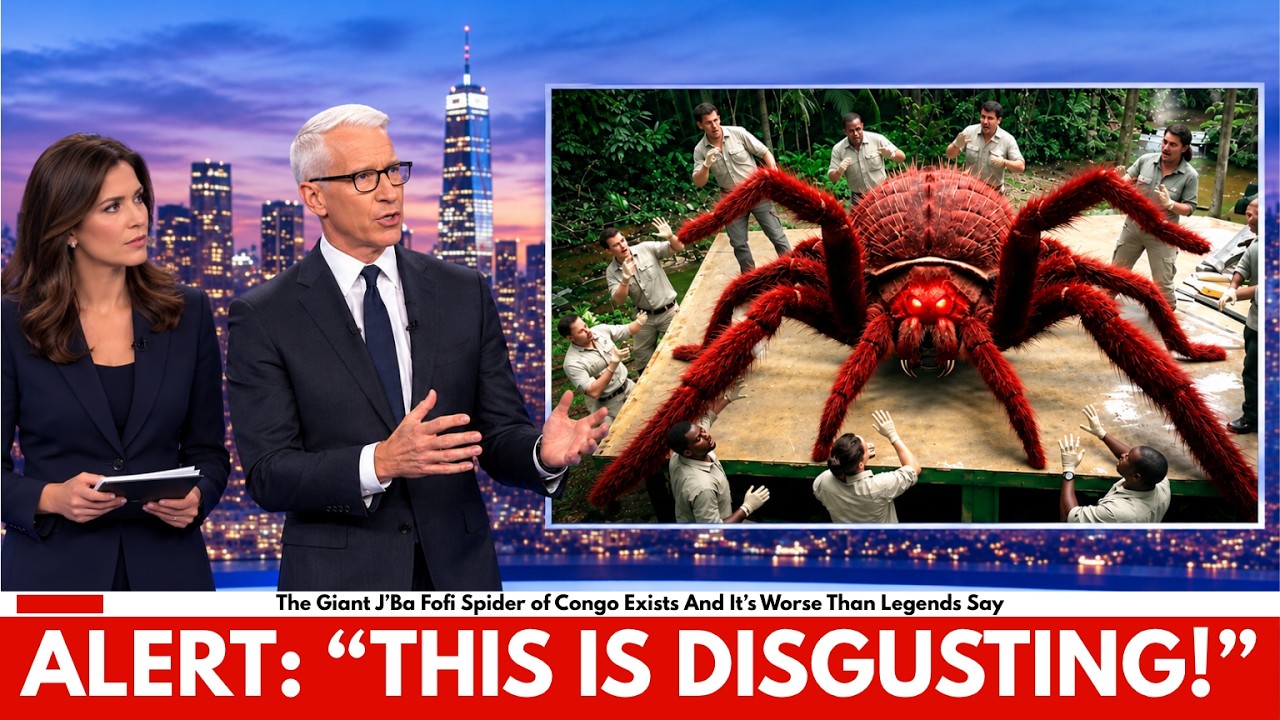
The most frequently repeated account places the first incident in 1938, near the Ituri Forest in what was then the Belgian Congo. A missionary expedition reportedly encountered thick spider silk stretched across a narrow path. That night, three members of the group vanished. Their belongings were left untouched, and drag marks led away from the tents. The sole survivor, a man named Robert Hill, could barely speak and repeated a single image: a shadow descending from the trees on many legs. Colonial officers classified the case as malaria-induced delirium but collected samples of the strange silk, which were stored in archives and forgotten.
In the early 1940s, a Congolese soldier serving with Belgian forces reportedly arrived at his post unable to move his legs. Doctors found venom in his blood that did not match any known spider. According to the story, the military closed the surrounding area for six months without explanation.
Baka hunters have added their own accounts. They describe monkeys found dead without wounds, wrapped in fine silk, and partially drained. There are also stories of a child who wandered from his village and was found only by torn clothing beside a depression in the mud wider and deeper than any human or gorilla footprint.
Those accounts are difficult to confirm. The 1938 story that actually appears in cryptozoological literature is different. It involves an English couple, R.K. Lloyd and his wife, who said they were driving through the Belgian Congo when something crossed the road ahead of them. They first thought it was a cat or a monkey, then saw legs roughly three feet long. The story reached print decades later in writer George Eberhart’s book “Mysterious Creatures” as a secondhand account.
The missionary expedition, Robert Hill, the paralyzed soldier, and the six-month closure do not appear in any colonial report, medical file, or archival record. That matters because the Belgian Congo was a heavily documented colony, with extensive archives in Brussels and at the Royal Museum for Central Africa in Tervuren.
The modern version of the story owes much to American cryptozoologist William Gibbons. In the early 2000s, he traveled through the Congo Basin searching for the legendary dinosaur Mokele-mbembe. He later wrote that when he asked Baka pygmies about a giant spider, they knew exactly what he meant: J’ba Fofi, brown with a purple marking. Gibbons is a believer in these stories, not a neutral witness.
It is also worth noting that the Baka people live mainly in Cameroon, Gabon, and the Republic of Congo, while the people of the Ituri Forest are the Mbuti. The legend mixes the two groups.
The strongest argument for the story involves historical precedent. Early twentieth-century scientists did sometimes ignore local knowledge. In the late 1890s, British official Harry Johnston accompanied a group of Mbuti through the Congo. They told him about a forest animal resembling a striped donkey: the okapi. European zoologists dismissed it as myth. In 1901, the Zoological Society of London formally described the species.
Similarly, in 1913, ornithologist James Chapin noticed an unfamiliar feather in a headdress worn by a man in the Ituri Forest. It took until 1936, after Chapin found two dusty stuffed birds in a Belgian museum, for the species to be named: the Congo peafowl.
But in both cases, there was physical evidence: skin, a skull, a feather. For J’ba Fofi, no such evidence has been presented.
The story also includes cultural details. Elders say J’ba Fofi is a softened word used for travelers. The true name is spoken only in daylight, inside private gatherings, because speaking it after dark is believed to attract the spider. Hunters say that when birds, insects, and frogs fall silent at the same moment, a large predator is near. Villagers leave small offerings of meat or fruit under certain trees, described not as worship but as a courtesy.
There are also stories of a guardian mother. The great spider is always female in this account. She controls a large territory, while smaller spiders act as scouts watching the trails. One story, called the Night of White Bones, describes a hunting party entering a clearing and finding dozens of skeletons hanging from trees in half-finished cocoons. The hunters fled, and the area was treated as forbidden from then on.
No published ethnographic study records a secret name for a great spider. That detail appears only in oral accounts. However, the practice of softening dangerous names is real and ancient. The English word “bear” is believed to derive from a word meaning “brown,” used because people feared calling the animal by its true name.
Anthropologist Colin Turnbull, who lived among the Mbuti in the 1950s, described in his book “The Forest People” a community that viewed the forest not as a threat but as a loving father, singing to it in their most sacred rituals. Many Baka celebrations center on Jengi, the forest spirit. This complicates the image of a culture living in fear of a single monster.
The silence rule has a solid basis. Birds and monkeys do become quiet when a leopard or raptor moves nearby, and skilled trackers read that immediately. Social spiders also exist. About twenty species cooperate in colonies, including Anelosimus eximius. In Gabon’s forests, these spiders share massive webs and can catch prey much larger than any individual.
The later part of the story introduces a scientist named Thomas Avery. No university affiliation, publications, or expedition records under that name could be found. The story should be treated as fiction with a researcher’s name added.
According to the narrative, Avery found a web stretching nearly three meters between trees, with each strand as thick as fishing line. He reported unusual protein chains in the silk and chemical markers consistent with pheromones. Trail cameras captured a limb thicker than a human arm touching the outer strands. When Avery collected samples, a strand touched his wrist and his skin began to burn. The story claims analysis found active digestive enzymes in the silk.
A three-meter web is impressive but not impossible. Golden orb-weaver spiders, of the genus Nephila, spin golden webs more than a meter wide in tropical forests, including in Africa. Their silk is strong enough to catch small birds and bats. A 2013 study published in PLOS One, by Martin Nyffeler and Miriam Knörnschild, documented more than fifty cases of spiders catching bats on every continent except Antarctica. So bird remains in a large web are plausible.
Spider silk can indeed be extraordinary. In 2010, researchers reported that Darwin’s bark spider in Madagascar produces the strongest biological material ever measured, more than ten times stronger than Kevlar. Its webs span rivers on bridge lines up to 25 meters long.
But the claim about pheromones is more problematic. Spiders do use chemical signals. Female silk carries sex pheromones that males follow. However, identifying a spider pheromone requires laboratory chemistry, not a handheld sensor. The claim about burning enzymes also does not align with how spider silk works. Spiders digest their food externally by injecting enzymes into prey, but silk is a protein fiber, not a chemical trap.
The story also describes an attack. Avery and his guide Enochi reportedly saw a creature with legs like wooden branches, a body the size of a man’s torso, and eyes reflecting light with a faint gold glow. It shot a rope of silk that struck Avery’s shoulder hard enough to knock him aside. The creature then stayed on its branch, maintaining eye contact, and withdrew slowly. The story interprets this as a test of distance, speed, and reaction, suggesting decision rather than instinct.
No known spider can shoot rope-like silk at a human. Spitting spiders of the genus Scytodes eject a mixture of silk and venom from their fangs to pin prey, but they are a few millimeters long and target flies. Bolas spiders drop a small sticky web over prey passing below. These are real hunting techniques, but they do not match the description.
The glow of spider eyes is real. Arachnologists find wolf spiders at night by the reflection of their eyes in flashlight beams, though the glow is usually green or blue, not gold.
The story’s claims about the creature’s biology also require scrutiny. Spiders do have very low metabolic rates and can go weeks or months without food. External digestion is how all spiders eat. Some species reinforce their fangs and mouthparts with metals like zinc. But the rest of the body collides with physics. Spiders breathe through book lungs and tracheae, move blood through an open circulatory system, and grow by molting, a dangerous process that becomes riskier with size.
The largest spider by weight is the Goliath birdeater of South America, weighing about 175 grams. The largest by leg span is the giant huntsman spider in Laos, described only in 2001. If a spider’s body grew to the length of a human torso, about four times the size of a birdeater, its mass would increase roughly 64-fold, to about 11 kilograms. But the strength of its limbs increases only with cross-sectional area, about 16-fold. The animal becomes heavier much faster than it becomes stronger. It would also have to molt, becoming soft and immobile in an open forest.
Higher oxygen levels might help. About 300 million years ago, during the Carboniferous period, the atmosphere contained roughly 30 to 35 percent oxygen, and giant arthropods did exist. Dragonfly relatives called Meganeura had wingspans up to 70 centimeters. The millipede-like Arthropleura reached about two and a half meters. But even in that oxygen-rich world, spiders remained small.
Today’s atmosphere contains about 21 percent oxygen. Medically significant spiders like the black widow or funnel-web produce venom designed for insects that sometimes harms humans. None of them paralyze a person for hours while leaving them conscious. The hallucination detail fits common fears, not pharmacological literature.
The story later describes a nest. Avery reportedly found a collapsed chamber underground lined with dozens of silk sacs the size of gourds, more than forty of them. Some sacs were open or hatching. Young spiders, waist-high, moved in formation around him. The chamber, according to the story, contained a broken shoe, a shattered camera lens, and fragmented human bones arranged in a semicircle, more than could belong to a single victim. The trees around the nest were wrapped in silk designed to funnel prey toward the chamber.
The numbers contradict themselves. If each adult spider eats only three or four large prey per year, a nest with dozens of egg sacs and hungry young would require enormous food supplies. A true apex predator needs a large prey base. If each adult killed only a few animals, the colony would starve. If they fed enough to survive, the forest population would visibly decline.
The warm air rising from the chamber is also not evidence. Spiders are cold-blooded and do not heat anything. A cave or vent hole would naturally release stable underground temperatures, which are already warm in the tropics.
Spider egg sacs are typically filled with hundreds or thousands of tiny eggs. Forty sacs the size of gourds would produce an immense number of hatchlings. Even if a fraction survived each season, the forest would be overrun within generations. No one has observed anything like that.
The bones have a quieter explanation. Leopards, crowned eagles, and scavengers leave plenty of bones in forests. In the Ituri Province, armed groups have also brought violence for more than two decades. People who disappear there often have explanations that are darker and entirely human.
The story ends with a cover-up. Avery returned to his camp to find his equipment tampered with, his memory cards missing, and his satellite phone nonfunctional. Congolese officials arrived, took him out of the area, and confiscated his research, citing environmental protection. He received no paperwork. A single low-resolution photo circulated showing a large shadow behind Avery, with some witnesses claiming three shapes rather than one. The frame was removed from circulation, and no one said where it came from.
Research in the Democratic Republic of Congo requires permits from national authorities, including the ICCN conservation agency. Exporting biological samples requires special authorization. A foreign researcher expelled with samples confiscated is not evidence of a monster. It is a familiar story about what can happen to researchers in conflict-affected areas.
The photo with three shapes fits the concept of pareidolia, the human tendency to find patterns in noise. It has no source, no chain of documentation, and no one ever presented it formally. Thermal anomalies detected by satellites across Central Africa each dry season are almost always agricultural fires.
As for Thomas Avery himself, a real arachnologist leaves a trail: a degree, a thesis, research, colleagues, an institution. That name leaves none. The character exists, it seems, to let listeners enter the forest behind someone.
The forest itself is real, as is the mystery around it. More than 50,000 spider species have been formally described, and taxonomists add hundreds each year. The Congo Basin is among the least-studied biodiversity regions on Earth. A web spanning a river in Madagascar changed our understanding of what silk can do. A striped forest animal dismissed as myth turned out to be a living relative of the giraffe.
It is possible that this story has roots in a real observation, perhaps a large tarantula seen on a dark trail, or a tangled web of a social colony misunderstood as the work of a single beast. Those explanations are more plausible than a giant, intelligent predator hiding from cameras and coordinating a government cover-up. The tale of J’ba Fofi has been shaped by genuine fear of a forest with real dangers, and by storytellers who kept adding details as the story crossed oceans.
Recommended Stories
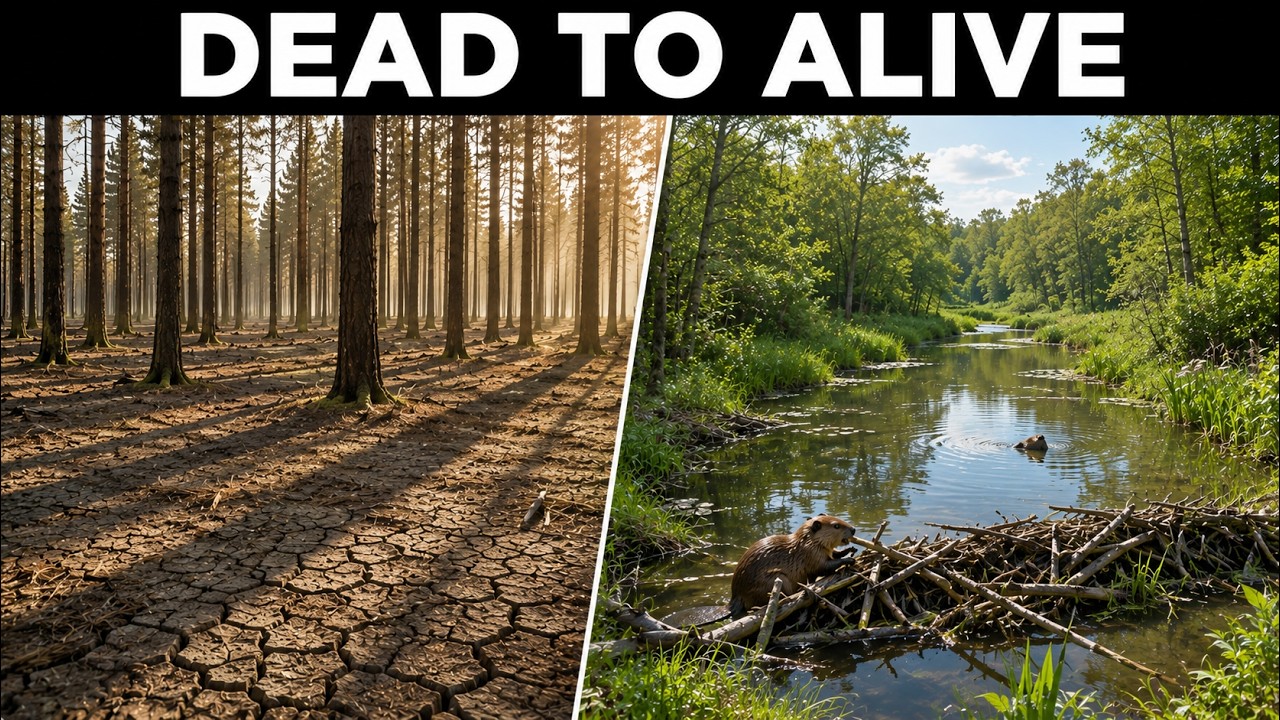
Five years ago, England released just two beavers into a flooded forest to manage the landscape. Now, scientists have returned and discovered something extraordinary—a thriving ecosystem they never expected.
In April 2019, two Eurasian beavers from Scotland were placed in a fenced enclosure in Cropton Forest, North Yorkshire. The...
Florida quietly admitted no honey badgers exist here—yet trail cameras near Miami recorded a low, striped animal dragging a snake through the Everglades. The state agency issued no response, then or since.
Night reports from the levee roads began arriving not from researchers but from airboat guides who had worked those waters...
Florida released millions of mice to fight invasive pythons, but the plan backfired in a way researchers never predicted. Officials hoped the rodents would poison the snakes, yet something unexpected happened almost immediately.
Sandra Kowalski has photographed wildlife along the banks of a canal in Collier County for the past 11 years. She...