A robot plunges 27,000 feet into the Puerto Rico Trench, and what its cameras capture is unlike anything researchers expected. The deep-sea expedition, aimed at mapping the ocean floor, suddenly shifts when the submersible’s lights illuminate something massive moving in the darkness below.
The deepest point of the Atlantic Ocean lies in Brownson Deep, a flat basin of mud in the Puerto Rico Trench north of Puerto Rico. Three separate studies and multiple unmanned vehicles have visited this area since 2012, building a documented record of the site’s depth, water chemistry, and animal life.
The trench formed where the North American plate scrapes past the Caribbean plate. The U.S. Geological Survey lists it as the deepest place in the Atlantic. In December 2018, the support ship DSSV Pressure Drop ran a multi-beam echo sounder across nearly 4,000 square kilometers of the basin. The hydrographer Cassie Bonjiovani and colleagues published the results in 2022, placing the deepest spot at 8,378 meters, give or take 5, at 19.712° north and 67.311° west. A pressure gauge on the seafloor read 8,376 meters when the submarine Limiting Factor landed there on December 19th, 2018.
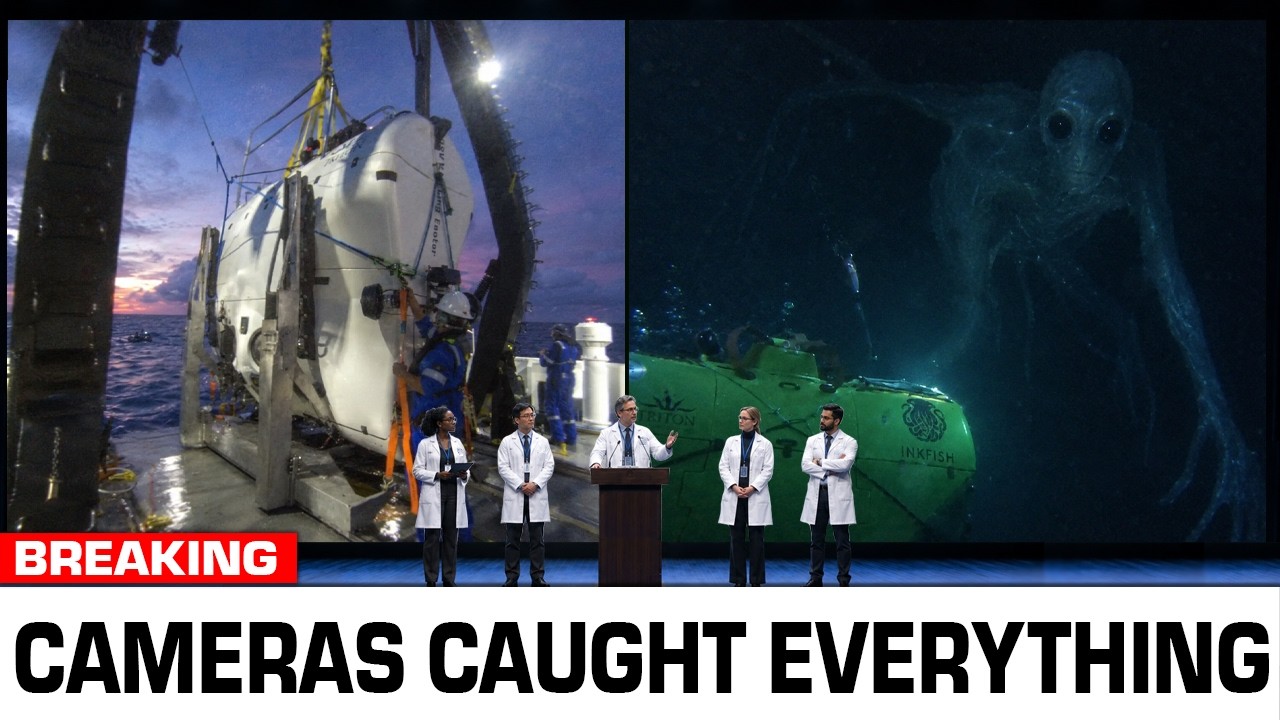
The first unmanned vehicle to reach these depths was the 11K, built at the Norwegian University of Science and Technology in Trondheim. Marine engineer Frederick Soreide designed it to reach 11,000 meters using a glass housing, sensors, an HD camera, LED lights, and lithium batteries. In the autumn of 2012, the 11K made a three-hour dive to more than 8,000 meters. The footage showed swarms of scavenging amphipods drawn to the bait, along with a sea cucumber and a possible isopod. The amphipods were later identified as Scopelocheirus schellenbergi, a scavenger previously known only from the Pacific.
In April 2015, NOAA brought its remotely operated vehicle Deep Discoverer to the trench aboard the exploration ship Okeanos Explorer. The vehicle stopped at 5,999.7 meters when its high voltage oil compensator ran low, and the dive was called off before reaching the bottom.
That same year, engineers at the University of Rhode Island began testing a different approach. Christopher Roman’s lab built the Deep Autonomous Profiler, or DAP, a frame that carries water-sampling bottles to the seafloor and returns without a cable. A Raspberry Pi computer sealed in a titanium container controls it, and burn wires release steel drop weights when the clock runs out. In September 2018, the profiler made nine test dives into the trench, reaching 8,377 meters at its deepest. The water it collected was analyzed for radiocarbon, a form of carbon that decays after water sinks below the surface. The team estimated the bottom water had been out of contact with the sky for about 318 years, give or take 25.
In December 2018, the Five Deeps expedition sent four landers into the trench. Landers are frames that drop to the seafloor on their own, do their work, and float back up when they release their weights. On December 18th, two landers reached 6,954 and 7,550 meters. On December 19th, two more, named Scaff and Clasp, reached 8,370 and 8,378 meters on the bottom of Brownson Deep. All four traps brought up an amphipod called Hirsutonia dubia, a species previously thought to be confined to three southwest Pacific trenches. The expedition also recovered Bathyscalinoma schellenbergi, a species first found in the trench in 2012. A 2022 study in Science Advances found that the Puerto Rico amphipods formed their own genetic group, separated from Pacific relatives about 26,000 kilometers away.
In July 2022, the DAP returned to the trench with LED lights and a downward-facing HD camera. The team tied mackerel to the drop weights, and the footage showed crustaceans nibbling at the bait, followed by cusk eels, slender deep-sea fish, swimming in to eat the crustaceans. The deepest touchdown on that trip came at 7,960 meters. Graduate student Philip Paresi said it felt like watching a whole food chain in a place almost nobody observes.
Viral videos have circulated claiming footage of an “unexplained glow” or a machine called the Pelagia X7. No published record of a vehicle by that name exists, and the videos do not name the drone or the ship that launched it. They also make claims that do not hold up. One says Mount Everest dropped into the trench would leave its summit underwater; at 8,848.86 meters, the peak would stand about 470 meters above the water. Another credits early 2000s mapping missions to NOAA alone and places hydrothermal vents with tubeworms in the trench, but the vent work occurred at the Mid-Cayman Rise south of the Cayman Islands.
Some earlier records have also been corrected. In 1964, French biologist Jean-Marie Pérès reported counting about 200 snailfish along a one-mile track at 7,300 meters. A 2020 paper concluded these were almost certainly sea cucumbers, which share the fish’s outer color and body shape. A cusk eel hauled up by a trawl in 1970 from a listed depth of 8,370 meters was long treated as the deepest fish known, but Guinness World Records notes the species is common at shallower depths and may have been caught in midwater as the net went down or came up.
The USGS explains the trench’s depth through an active downward force. The trench sits under the most negative free-air gravity anomaly on Earth, minus 380 milligals, which the agency reads as a sign of a slab of North American plate pulling downward. A 2005 paper argued that a flat layer of limestone once built near sea level now tilts from 1,300 meters above sea level on Puerto Rico to about 4,000 meters below it offshore, likely because the sinking slab suddenly steepened about 3.3 million years ago.
The trench also presents a hazard. The USGS report on the 2002 and 2003 mapping cruises found large cracks on the slope north of Puerto Rico and giant landslides on the sinking plate. It warned that future submarine slides could threaten the roughly four million U.S. citizens of Puerto Rico and the Virgin Islands.
The record stands as follows. An unpiloted machine passed 8,000 meters in 2012. Unpiloted machines passed 8,370 meters twice in 2018. The DAP filmed cusk eels feeding at its bait in 2022 on dives that reached 7,960 meters. The water bottles added an age estimate of 318 years for the bottom water. Richard Branson never made a dive to the Atlantic floor; his Virgin Oceanic plan was shelved in 2014. The documented record lists considerably more unpiloted visits below 8,000 meters than piloted ones. Until a new expedition publishes its results, these named machines and their footage are the full record.
Recommended Stories

New Mexico’s African oryx are spreading fast—and they’re far more dangerous than anyone expected. These massive antelope, imported decades ago for hunting, have thrived in the desert, their population exploding beyond control.
In the desert between White Sands and Highway 70 in Southern New Mexico, a large antelope stands in the brush....
A secret cache of naked beavers might be wilder than any story ever told. In Canada, they were released onto barren land to revive it.
In the summer of 1948, wildlife officials in Idaho carried out an unusual relocation program: they dropped beavers from airplanes...

Texas ranchers called it war—feral hogs had destroyed 40 acres of pasture, collapsed a cattle pond dam, and cost Texas $500 million a year. But the fix wasn’t a bigger gun.
Dale Harmon has managed a 1,200-acre cattle ranch in southern Karnes County, Texas, for 22 years. When he describes what...