In the world’s deepest abyss, fifteen hundred meters below even the Titanic’s grave, divers captured footage researchers say rewrote ocean science. The Mariana Trench’s crushing pressure was supposed to make life impossible, yet the cameras revealed something thriving where nothing should survive.
On January 23, 1960, Swiss engineer Jacques Piccard and U.S. Navy Lieutenant Don Walsh climbed into the bathyscaphe Trieste and descended nearly 11,000 meters to the bottom of the Mariana Trench, the deepest known point in the ocean. The descent took about five hours, and during their brief 20-minute stay on the seafloor, Piccard reported seeing a flatfish-like animal roughly a foot long moving across the sediment.
That sighting became famous evidence that vertebrate life could survive at the greatest depths of the ocean. But as marine biology advanced, it became a problem. Modern research indicates that vertebrate life cannot survive below roughly 8,200 meters due to chemical limits within living cells. Piccard’s reported sighting was nearly three kilometers deeper than that threshold.
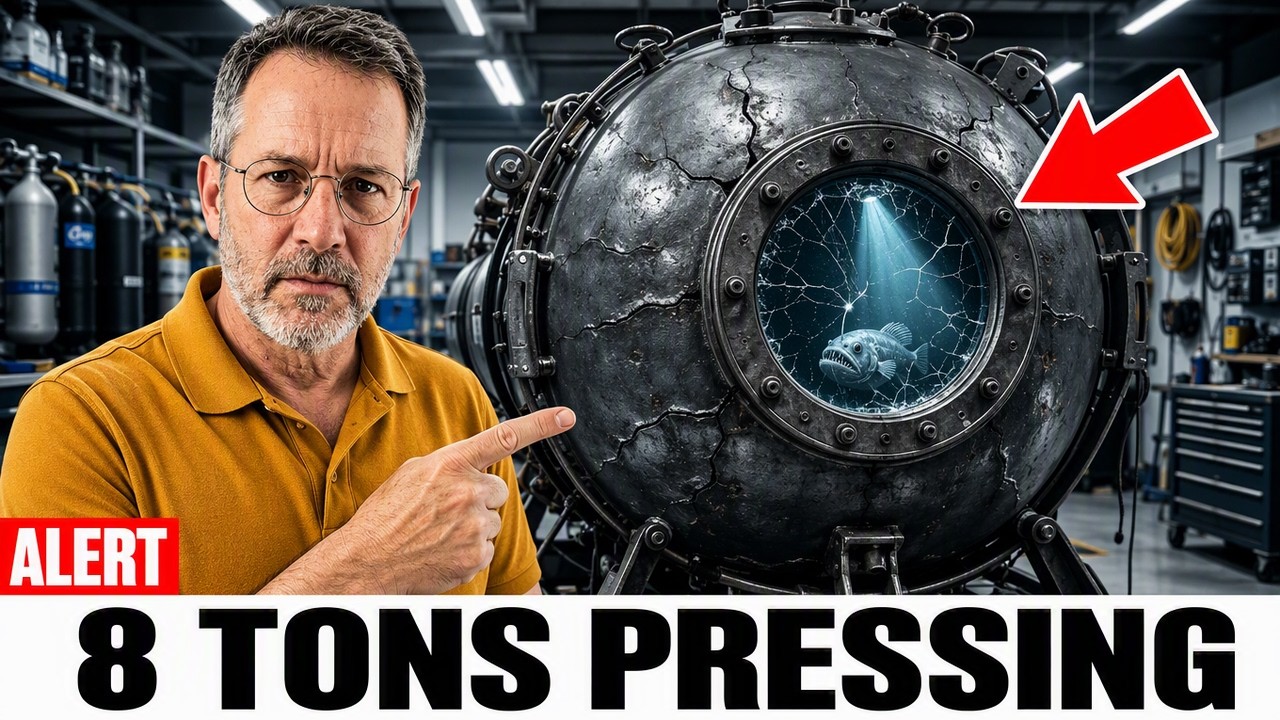
The Trieste was designed by Piccard’s father, Auguste, and consisted of a gasoline-filled float attached to a small steel sphere with walls about five inches thick. During the descent, a cracked pane in an outer window caused concern, but the crew continued. At approximately 9,000 meters, they heard a loud sound, later identified as the crack in the outer window layer. They reached the bottom at a logged depth of 35,814 feet, roughly 10,916 meters. Later surveys corrected the true depth of the Challenger Deep to just under 11,000 meters.
The scientific obstacle to Piccard’s claim comes down to chemistry. Deep-sea fish rely on a molecule called trimethylamine oxide, or TMAO, to stabilize their proteins against the effects of high pressure. The deeper a fish lives, the more TMAO it produces. However, too much TMAO creates a new problem: it makes the fish’s internal concentration higher than seawater, causing water to rush into the body through osmosis. Physiologist Paul Yancey and his colleagues calculated that this creates a hard limit around 8,200 meters, where a vertebrate can no longer survive.
Given that limit, a fish at nearly 11,000 meters would be biologically impossible. One common explanation is that Piccard, exhausted after a long descent with a cracked window and poor visibility, may have mistaken a sea cucumber or sediment for a fish. To his credit, Walsh later spoke more cautiously about what they had seen. Many marine biologists concluded the flatfish was likely a holothurian, a soft-bodied bottom-dwelling animal that can look vaguely fishlike in murky light.
For decades, that explanation was generally accepted. The science supported it, and the incident was filed away as a case of human error under extreme conditions.
More recent expeditions, however, have complicated the story. In 2012, filmmaker James Cameron made a solo dive to the bottom of the Challenger Deep in the submersible Deepsea Challenger. He did not find a flatfish. He did find large amphipods scuttling across the seafloor, but no vertebrates.
Scientists also began systematically searching for the deepest fish that could exist. They found the Mariana snailfish, a small, pale, gelatinous species living around 8,000 meters down, feeding on amphipods. Its TMAO levels were high, matching the chemical ceiling predicted by Yancey’s work. The snailfish was not an exception to the rule; it was living right at the edge of it. This confirmed that the 8,200-meter limit was real, and it strongly suggested Piccard could not have seen a fish.
But the deeper ecosystem below that line turned out to be far from empty. In 2011, researchers from the Scripps Institution of Oceanography filmed giant single-celled organisms called xenophyophores at around 10,600 meters. Some of these cells grow to roughly four inches across. They carpet parts of the trench floor in large numbers, feeding on organic material that drifts down from the surface. The bottom of the trench is not a barren wasteland. It supports a functioning ecosystem.
The most significant finding, however, came from a study published in 2017 in Nature Ecology and Evolution. A team led by marine ecologist Alan Jamieson of Newcastle University collected amphipods from the very bottom of the Mariana Trench in the Pacific and the Kermadec Trench, thousands of miles away. When they analyzed the creatures’ tissues, they found high levels of persistent organic pollutants, including PCBs and flame retardants, chemicals that were manufactured on the surface in the twentieth century and later banned because they break down very slowly.
The concentrations were substantial. In some samples, the levels of these industrial chemicals were up to 50 times higher than in crabs living in one of the most heavily polluted river systems in China. The pollution had reached the deepest, most isolated habitat on the planet, settled into the sediment, and entered the food web through the amphipods. The snailfish that feed on those amphipods would absorb the same contaminants.
This discovery reframed the entire story. The deepest trench on Earth carries clear evidence of human industrial activity. The place that was once imagined as the ultimate untouched frontier does not exist in that form anymore. By the time scientists proved that life could survive at the bottom of the ocean, that same life was already carrying pollutants deposited there by human activity.
Whether Piccard saw a fish in 1960 remains unresolved. The chemistry says he could not have, and more recent expeditions have not found any vertebrates at that depth. The more cautious interpretation, that he misidentified a sea cucumber or sediment through a cracked window in dim light, is consistent with the known science and with Walsh’s later, more careful statements.
Yet the broader conclusion of the later research stands on firmer ground. The deepest ocean is not dead. It supports life right up to the chemical limit of what is physically possible. And that life, even in the most remote place on Earth, is no longer separate from the effects of human activity.
Recommended Stories
Canada released 16 bison into a dead valley, and what they did with their hooves and wallows turned out to be unbelievable. The arid landscape had lost its fertility, with the soil too hard for most life to return.
In February 2017, Parks Canada released 16 plains bison into the Panther Valley of Banff National Park. The animals were...
A mysterious force is devastating Florida’s Everglades, and the culprit has wildlife experts bracing for an ecological disaster. Pythons, invasive predators that can grow over twenty feet long, are strangling the natural food chain, and state officials have declared an all-out war.
The Everglades, a vast wetland at the southern tip of Florida, is often described as a swamp, but it is...
A deep-sea camera at 27,000 feet in the Mariana Trench just recorded something alive—something scientists say has no business being there. The footage shows a creature moving in total darkness, where crushing pressure and freezing cold were long believed to make such life impossible.
In May 2017, a research vessel operated by the Japan Agency for Marine Earth Science and Technology lowered a baited...