Deep in the Congo, witnesses keep reporting the same impossible creature. Local villagers describe a massive, reptilian beast lurking in the swamps, with some suggesting it matches the legendary Mokele-mbembe.
For more than two centuries, explorers, missionaries, and scientists have traveled to the Congo in search of a large, dinosaur-like creature. Reports of this animal have come from people who never met one another, lived hundreds of kilometers apart, and spoke different languages. Despite this, their descriptions have remained consistent: a massive animal with a long neck, a small head, and a heavy tail that spends most of its time in deep water.
The creature is known in the Lingala language as Mokele-Mbembe, a name usually translated as “the one that stops the flow of rivers.” The name does not describe a god or a spirit. It describes a physical effect, the idea that the animal is so large that when it moves through a channel, the water appears to stop. Communities living along the rivers of the Congo Basin generally advise staying away from areas where the creature is said to live.
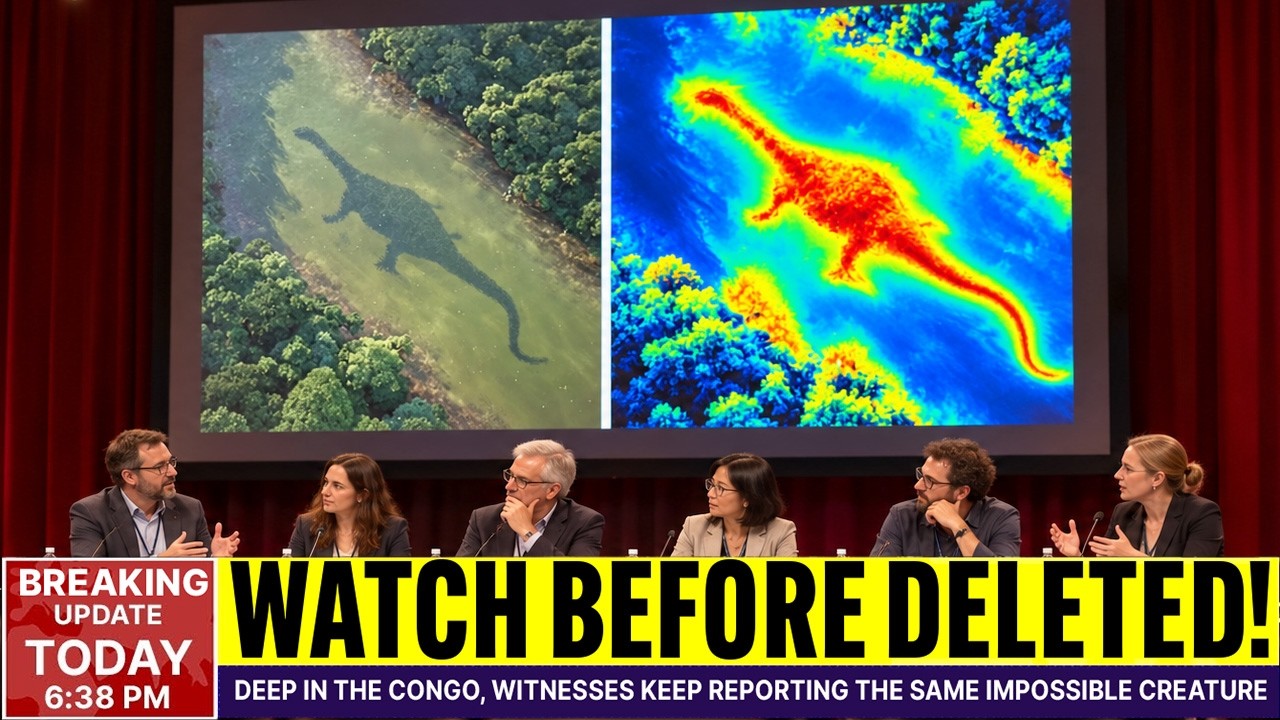
Over the years, missionaries reported finding enormous footprints with claw marks. A German officer stationed in the area in 1913 recorded local accounts of a gray-brown animal with smooth skin, a long flexible neck, and a size comparable to an elephant. He was also told that it fed on plants, lived in underwater caves, and would attack canoes that came too close. In the 1980s, a biologist from the University of Chicago led two expeditions to the region and collected systematic testimonials from villages across a wide area. Those accounts matched earlier reports in detail, including the animal’s size, color, behavior, and preferred food.
In 1983, a Congolese biologist named Marcellin Agnagna reported seeing such an animal in Lake Tele. According to his account, he observed it for about twenty minutes from a few hundred meters away, noting its long neck and small head above the waterline. He attempted to take photographs, but the film was spoiled. No clear photographic evidence has ever been produced.
The region in question, the Likouala swamps in the Republic of the Congo, is one of the least explored areas on Earth. It spans tens of thousands of square kilometers of flooded forest, grass swamps, and slow-moving black-water rivers. During the rainy season, much of the area is submerged. During the dry season, it becomes a maze of mud, channels, and dense islands of trees. There are few roads, and travel is measured in hours per kilometer rather than kilometers per hour. Equipment fails, film deteriorates, and illness is a constant risk. Large parts of this area have never been systematically surveyed on the ground.
It is true that the Congo has hidden large animals from the outside world before. The okapi, a forest-dwelling relative of the giraffe, was known to local communities for generations but was not formally described by Western science until 1901. The bonobo, one of humanity’s closest living relatives, was not recognized as a separate species until 1929. The Congo peacock was identified in the 1930s after a researcher noticed unusual feathers on a hat. These cases do not prove that Mokele-Mbembe exists, but they illustrate that local knowledge in the Congo Basin has sometimes preceded scientific confirmation by decades.
Skeptics offer several arguments against the existence of such a creature. The fossil record shows that non-avian dinosaurs, including the long-necked sauropods, disappeared about 66 million years ago. No known fossils of sauropods exist from any time after that period, anywhere on Earth. A breeding population of large animals would require dozens or hundreds of individuals, and those animals would eventually die and leave bones. The acidic, humid conditions of the rainforest floor are poor for fossilization, but the absence of bones is still notable. Some critics also suggest that witnesses may have misidentified known animals such as hippos, elephants with raised trunks, large reptiles, or floating logs. The image of a swamp-dwelling sauropod, popular in early twentieth-century museum murals, may have shaped the stories themselves.
There are counterpoints to each of these objections. The lack of fossils in the Congo Basin may simply mean that conditions there were not suitable for preservation, not that the animals did not exist. The coelacanth, a fish believed to have gone extinct around the same time as the dinosaurs, was found alive off the coast of South Africa in 1938. Local fishermen in the Comoros had been catching it for years. The presence of a creature thought to be long extinct demonstrates that scientific judgments about extinction are based on available evidence and can be wrong.
The reports of Mokele-Mbembe are geographically concentrated in specific river systems and swamps where a large aquatic herbivore would be expected to live. They are described in practical terms, with consistent details about what the animal eats, where it lives, and what it does when approached. This is different from how mythological creatures are usually described. Myths tend to accumulate magical properties and cultural significance over time. These accounts remain matter-of-fact, which aligns more closely with how people describe real animals.
The question of why no definitive evidence has been produced remains unresolved. One explanation is that the environment is extremely difficult for fieldwork, and most expeditions have been small, poorly funded, and short. Another is that the scientific community has been reluctant to take the subject seriously, which discourages professional researchers from committing the time and resources needed for a thorough investigation. No systematic survey using modern methods, such as environmental DNA sampling from water or camera traps, has been conducted in the Likouala swamps. Until such a survey takes place, the debate will likely remain unresolved.
If a large unknown animal were confirmed to exist in the area, it would be a major zoological discovery. It would also raise questions about the completeness of the fossil record and the ability of large animals to remain undetected in remote habitats. The conservation implications would be significant as well, as the Congo Basin is already under pressure from logging, mining, and road construction. A discovery of this kind would likely bring international attention and funding to the region.
For now, the Likouala swamps remain largely unmapped and unexplored. The communities there continue to describe the same animal their ancestors described. No one has produced a body, a clear photograph, or any physical evidence. The skeptics have reasonable arguments. The witnesses have consistent accounts. Neither side has been able to close the question completely.
Recommended Stories
Kazakhstan’s tiger reintroduction is not the homecoming scientists expected. After 70 years of absence, they released big cats into the Caspian region, and the initial signs looked promising.
Kazakhstan released a tiger into the wild in late July 2026 as part of a long-running reintroduction project, marking the...

They released just 30 predators onto the island, then the snakes started vanishing. Wildlife teams had spent years battling an invasive serpent plague that was devastating native birds, so the plan seemed bold but logical.
In 1979, Japan released approximately 30 small carnivores on a remote island with the intention of controlling a venomous snake...
A Florida wildlife biologist is issuing a chilling new warning about the state’s latest predator, and it is reportedly targeting humans in the most terrifying way. This isn’t just another bear or alligator encounter; officials describe a creature altering its natural behavior to hunt people in residential areas.
In 2016, researchers at the University of Florida and the Florida Museum of Natural History published a record of Nile...