America’s wild turkeys are quietly rebuilding ancient southern forests once scarred by agriculture and logging. These birds, nearly wiped out a century ago, now roam expanses where longleaf pines once dominated.
In 1973, an insurance salesman in Virginia named Tom Rogers was concerned about the declining wild turkey population across the American South. The numbers had fallen to around 1.3 million birds. Without a background in biology or institutional support, Rogers used $10,000 of his own savings and a cigar box of membership cards to establish the National Wild Turkey Federation. The organization’s stated purpose was to increase turkey numbers to support hunting.
The group focused on breeding birds, protecting them, and creating suitable habitat. Over the following five decades, the organization invested roughly half a billion dollars in reshaping forests across the Southeast. In October 2024, the U.S. Fish and Wildlife Service reclassified the red-cockaded woodpecker from endangered to threatened. The woodpecker, a small black and white bird, had been declining for 50 years despite federal protection efforts.

The connection between turkey hunting and the woodpecker’s recovery lies in forest management. Young turkey chicks require a specific type of habitat to survive their first weeks. They need ground that is open at soil level so they can move and find insects, but with vegetation overhead tall enough to provide cover from predators. The area also needs significant sunlight, as insects tend to gather in sunny spots.
By the 1970s, the forests of the American South had changed dramatically due to decades of fire suppression. Without regular low-intensity surface fires, hardwoods and dense scrub had grown thick between the forest floor and the canopy. The ground was covered in a layer of decaying leaves that blocked sunlight. This made it difficult for native grasses to grow and for insects to thrive, which in turn made it hard for turkey chicks to find food.
The National Wild Turkey Federation grew into a large grassroots fundraising operation. Local chapters, banquets, and donations, supplemented by federal excise taxes on ammunition, funded their efforts. Within two decades, the organization was working across large areas of the Southeast using two main methods.
The first method involved mechanical removal. Heavy equipment and crews with chainsaws cut down the invading hardwoods that had grown thick in the absence of fire. In some cases, herbicide was applied to stumps to prevent regrowth. The second method was the reintroduction of prescribed fire. Once the dense vegetation was reduced, land managers used drip torches to set controlled surface fires on a regular rotation.
The fires accomplished several things. They removed the layer of leaf litter, exposed mineral soil, killed hardwood regrowth, and stimulated the germination of native grasses and wildflowers that had been dormant in the soil. Within a season, treated areas produced knee-high growth of wiregrass and other plants. Insect populations followed, providing food for turkey chicks.
The organization also ran programs to plant nut and fruit-bearing trees across degraded land, supplying winter food sources. From its modest start, the operation expanded to cover millions of acres. Turkey populations climbed from 1.3 million in the 1970s to over 6 million by the 2020s.
During this period, field biologists noticed an unexpected development. Red-cockaded woodpeckers began moving into the newly managed pine stands. These birds were not part of the plan. The woodpecker, which had been listed as endangered since 1970, had been declining despite legal protection. By the late 1970s, the population had fallen to roughly 1,500 active family groups.
The red-cockaded woodpecker is the only North American woodpecker that nests exclusively in living pine trees. A breeding pair spends years carving a cavity into old pines softened by a specific fungus. They maintain resin flow around the cavity entrance to deter climbing snakes. This defense requires open space around the tree. If hardwoods grow close enough to touch the cavity tree, snakes can bypass the resin barrier.
The federal approach to protecting the species had been to draw boundaries around known colonies and prohibit disturbance within them. This approach proved counterproductive. Without disturbance, hardwoods grew unchecked, closing the canopy and allowing snakes to reach cavities. The protected zones became poor habitat, and woodpeckers abandoned them.
Additionally, the regulations created an incentive for private landowners to harvest pines before they reached the age that would attract the birds. This prevented the creation of new habitat. The law designed to protect the species was inadvertently accelerating habitat loss.
The turkey hunters’ forest management practices addressed the woodpecker’s needs. The open, sunlit conditions maintained by prescribed fire were the same conditions the woodpecker required. The fire kept hardwoods down, kept the ground open, and supported insect populations. By the late 1990s and early 2000s, data showed that woodpecker populations were growing on land managed for turkey habitat.
The restored savanna structure also benefited other species. The gopher tortoise, which digs deep burrows in open, sandy pine flats, returned to the restored areas. More than 350 other species use these burrows for shelter. The recovery of the tortoise brought back an entire community of animals dependent on its tunnels.
The red-cockaded woodpecker population rose from roughly 1,500 active clusters in the late 1970s to approximately 7,800 clusters across 11 states by the early 2020s. The October 2024 federal reclassification credited collaborative forest management, including mechanical thinning and prescribed burning, as the primary driver of the recovery.
The longleaf pine ecosystem, which had declined from 90 million acres to fewer than 3 million, has begun to expand again, reaching nearly 5 million acres. In some areas, researchers have also found that restoring open savanna reduces water consumption by trees, increasing streamflow in river basins.
There are ongoing challenges. In 2018, Hurricane Michael damaged mature longleaf pines in the Florida Panhandle, destroying cavity trees and woodpecker colonies. Biologists worked to install artificial nesting inserts in surviving trees. The longleaf pine system requires ongoing management; without regular burns, hardwoods return and the habitat degrades within a decade. New regulatory tools, such as Safe Harbor agreements, encourage landowners to manage for woodpecker habitat by removing the penalty for attracting the species to their property.
The funding and labor for this ongoing work still come largely from the same source as in 1973: hunters supporting the National Wild Turkey Federation. A $10,000 investment in a cigar box grew into one of the largest accidental ecosystem restorations in North American history. The longleaf pine savanna was not restored by a preservation mandate. It was restored by people who wanted to hunt turkeys and paid to reshape the forest to do so. The woodpecker, the tortoise, and the ancient forest were unintended outcomes of that effort.
Recommended Stories

A 55-foot “sea serpent” washed ashore in Scotland in 1808, dismissed for two centuries as a myth. Now, new analysis of the original eyewitness sketches and preserved skeletal fragments suggests the discovery may have been entirely genuine.
In September 1808, after a three-day storm, residents of Stronsay, an island in Scotland's Orkney chain, found a large animal...
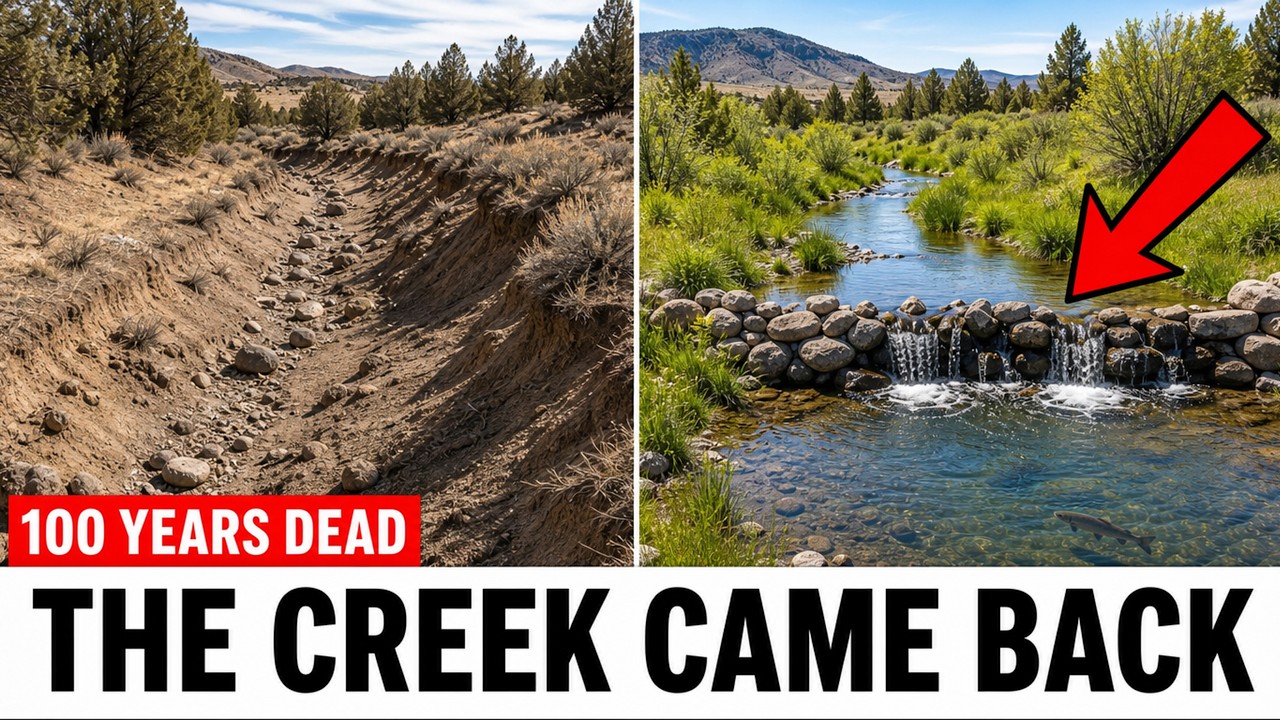
Engineers warned his rocks would kill the fish. Then the US veteran ignored them and began reviving a creek declared dead for a century.
Scott Campbell, a retired veterinarian from Portland, Oregon, spent years building a chain of animal hospitals before selling the business...

Something Bigger Than a Python Is Hunting in Florida — Cameras Captured It. Locals thought the massive tracks belonged to an oversized python, but a trail cam caught something far stranger lurking near the Everglades.
Researchers at the Conservancy of Southwest Florida found a dead Burmese python roughly 15 miles deep in the Everglades. They...