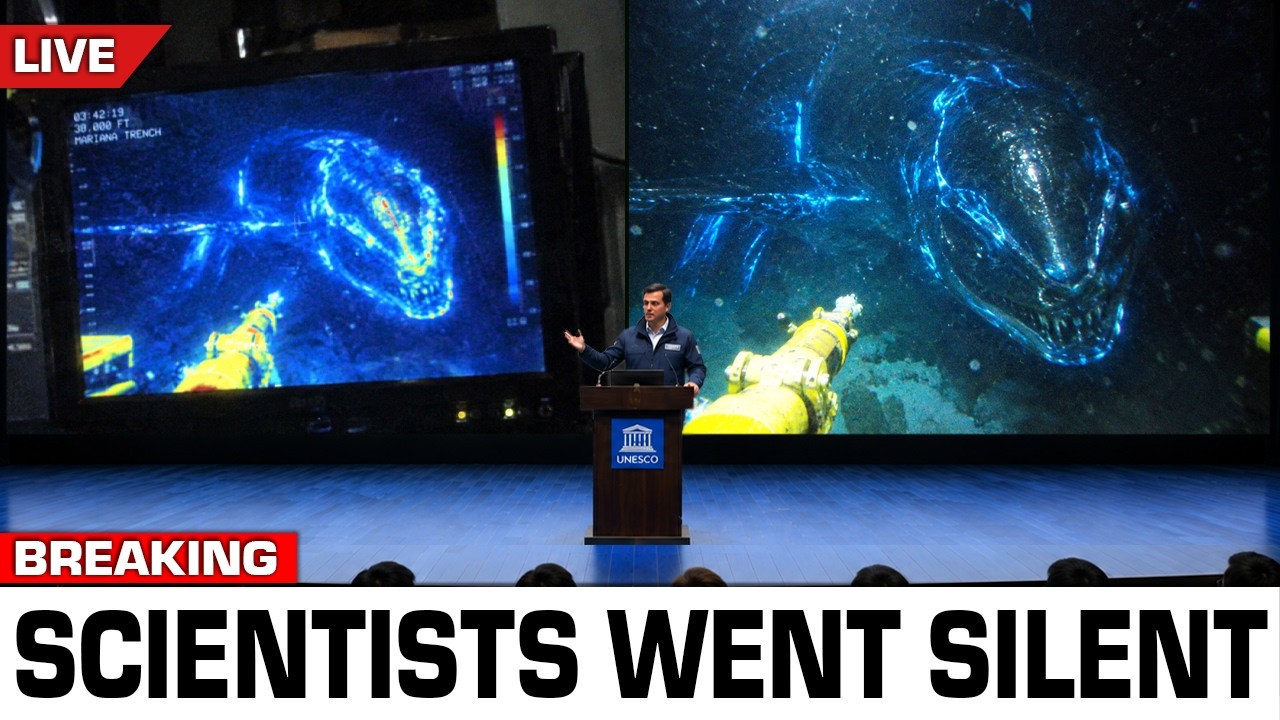
Deep in the Mariana Trench, over 38,000 feet below the surface, cameras captured something moving—an organism thriving where crushing pressure should make survival impossible. Scientists were baffled because this creature appeared far more complex than the simple microbes expected in such extreme darkness.
The pressure at the bottom of the Mariana Trench reaches roughly eight tons per square inch, and sunlight never reaches that depth. In 2018, researcher Shiba avoided the ocean entirely and searched video archives instead, reviewing 5,010 old dives that had received little attention. One scene from 1998 stopped her completely.
The trench was first discovered on March 23, 1875, when the Royal Navy survey ship HMS Challenger lowered a weighted rope into the water. The rope kept running out. The reading came to 4,475 fathoms, about 8,184 meters, and the crew confirmed it with a second survey at the same location. That expedition, part of a four-year voyage around the world to systematically collect oceanic data for the first time, did not realize it had found the deepest place on the planet. The crew recorded the number and moved on, leaving later researchers to recognize its significance.
Every measurement since then has pushed the figure deeper as instruments improved, from weighted ropes to sonar pulses to satellite-corrected pressure sensors placed directly on the seafloor. In October 2010, the U.S. Navy survey ship USNS Sumner measured the bottom from the surface at 10,994 meters. The most accurate figure comes from June 2020, when Victor Vescovo conducted six crossing tracks through the deepest basins in the submersible Limiting Factor with three autonomous landers alongside, cross-referencing multiple independent pressure readings taken directly at depth rather than relying only on sonar bounced from a distant ship above. The pressure sensors identified the deepest observed seafloor at 10,935 meters, plus or minus six meters. That equals 35,876 feet, about 2,000 feet less than the 38,000-foot figure sometimes repeated online, a gap large enough that it is not a rounding difference but a genuine overstatement with no measurement behind it.
Water pressure increases by about one atmosphere for every ten meters of descent. At the bottom of Challenger Deep, that means roughly 16,000 pounds per square inch, about a thousand times more than what a person feels standing on the shore.
The Trieste, the first primitive vehicle to reach it in 1960, had a steel ball with walls five inches thick and room for two men in a space 38 inches across. The two men who operated it endured the cramped, cold environment for the five hours the round trip took. Building something that survives such conditions is difficult, and recovering it with usable footage is another challenge. The answer turned out to be surprisingly low-tech.
Most footage of the deep ocean was not captured by a piloted submarine. It came from landers. A lander is a frame carrying weights, floats, lights, a camera, and often a baited trap. Crews drop it from the stern of a ship and it sinks to the bottom. There are no cables and no joystick. It settles on the seafloor and films whatever approaches the light. When the timed program ends or an acoustic signal arrives, a release mechanism drops the anchor weights and the lander floats back to the surface on its own, often emerging miles from the ship’s expected position depending on deep currents, which means recovery crews sometimes track a radio beacon for hours before retrieving the unit.
Alan Jamieson, a marine ecologist responsible for much of the hadal research over the past twenty years, designed the landers his teams used in the Pacific, prioritizing simplicity and multiple safety measures precisely because any failure at these depths cannot be repaired or rescued once the vehicle reaches the bottom. The advantage is complete simplicity. There is no rope to break and no human life at risk, so multiple landers can be dropped at different depths simultaneously, which is how depth records have been broken.
In August 2022, the research vessel DSSV Pressure Drop carried three high-definition camera landers across three Japanese trenches over two months as part of a ten-year study of the deepest fish on Earth, a project designed around systematic repeated surveying rather than a single dramatic attempt. The researchers noted that finding such a rare animal at that depth generally requires dozens of drops before recording one confirmed sighting.
The Japanese remotely operated vehicle Kaiko worked differently, tethered to a ship, making hundreds of dives into hadal depths starting in 1995. It became the second vehicle in history, after the Trieste, to reach the bottom of Challenger Deep, and it continued collecting biological samples and video footage across dozens of expeditions over the next eight years.
The Woods Hole Oceanographic Institution built Nereus in 2008, a hybrid vehicle that could operate freely or be guided from the surface via an optical fiber cable as thin as a human hair. The design combined the wide survey capability of a free robot with the precise real-time control of a tethered robot. Nereus reached Challenger Deep in 2009 and transmitted high-quality video through that glass thread, becoming the third vehicle in history to touch the bottom of that particular trench, after the Trieste in 1960 and Kaiko in 1995. Both machines collected footage no one had seen before. Neither remains in service, and the way each ended says something about what that depth does to equipment.
Kaiko was lost at sea in 2003 when its communication cable broke during a storm while operating in a completely different part of the Pacific, far from the Mariana Trench. It was a mechanical failure caused by ordinary storm conditions rather than deep pressure.
Nereus ended differently. On May 10, 2014, it was seven hours into a planned nine-hour dive in the deepest part of the Kermadec Trench northeast of New Zealand. It had been settled on the sediment at 9,990 meters for more than six hours when the team aboard the research vessel Thomas G. Thompson lost contact. Standard emergency recovery procedures failed. The crew searched near the dive site and spotted debris floating on the surface, later confirmed to be parts of Nereus. Scientists concluded that part of the vehicle had collapsed under pressure reaching 16,000 pounds per square inch. It was the thirtieth day of a forty-day expedition, and it was the only working science vehicle at the time that could operate at that depth. Timothy Shank, a Woods Hole biologist who helped create it, said Nereus allowed them to explore places they had never seen and ask questions they had not thought to ask. Before that expedition ended, the vehicle had already found unknown trench habitats and roughly a dozen new species, discoveries that remained valuable to researchers even after the vehicle responsible for finding them was gone.
The danger existed from the first descent. On January 23, 1960, as Jacques Piccard and Lieutenant Don Walsh approached the bottom in the Trieste, a sound like a gunshot echoed inside the cabin. One of the exterior Plexiglas viewing windows had cracked. The pressure pushed the remaining layers harder into the frame rather than shattering them inward, and the window held. They spent about twenty minutes on the seafloor and reported seeing living creatures there, surprising nearly everyone, since prevailing scientific opinion at the time held that such extreme pressure would prevent any complex animal life entirely.
Sixty-five years of footage later, the most frequently observed and filmed object at that depth was not an animal. It was something a human discarded: a plastic bag. At 10,898 meters, and in 2017, the Japan Agency for Marine-Earth Science and Technology opened its deep-sea debris database to the public. The archive contains more than thirty years of images and videos of waste collected by Japanese submarines and remotely operated vehicles, accumulated gradually over decades of separate research missions that had little to do with pollution monitoring at the time they were recorded.
A team led by researcher Sanay Shiba examined the archive and published its findings in the journal Marine Policy in 2018. The team reviewed 5,010 dives. They counted more than 3,000 pieces of human-made waste, including metal, rubber, fabric, fishing gear, and plastic. About a third of the classifiable debris was plastic, and of that plastic, 89 percent was single-use, the kind used once and thrown away. The deepest item in the entire database was a plastic bag found at 10,898 meters in the Mariana Trench. The video was recorded in 1998 and sat in the archive for two decades, only attracting attention when someone finally began looking for it. It is a striking example of how evidence can remain entirely unnoticed inside institutional files for years simply because no one had asked the specific question that would make it relevant.
Below 6,000 meters, more than half of the debris the team recorded was plastic, most of it single-use. Deep-sea creatures appeared in 17 percent of the debris images, including sea anemones attached to bags and plastic entangled in cold seep communities, evidence that marine life was not only living near this debris but in some cases growing directly on top of it. Many of the dives were more than 1,000 kilometers from the nearest land, ruling out any simple explanation of nearby coastal waste drifting a short distance out to sea.
A year later, someone was at the bottom looking through a window with his own eyes. On April 28, 2019, Victor Vescovo took the Limiting Factor to the bottom of the Mariana Trench as the fourth leg of his Five Deeps expedition, an attempt to reach the deepest point of all five oceans. He spent about four hours there and reported seeing several creatures, some possibly new to science, along with a plastic bag and candy wrappers. The observation carries weight because so few people have had the opportunity to make it. By July 2022, 27 people had been documented reaching Challenger Deep across about 22 crewed dives. The submersible DSV Limiting Factor alone accounted for 15 of those dives between April 2019 and July 2022, nearly doubling the number of individuals who had visited that specific site in just a few years. The list includes Kelly Walsh, son of Don Walsh from the 1960 dive, and Kathy Sullivan, a former NASA astronaut who became the first person to visit both space and the deepest point of the ocean. For comparison, human spaceflight began in 1961, and by November 2021, the 600th person had left the planet. The number of people who have seen Earth from orbit is more than twenty times the number who have sat at the bottom of Challenger Deep. The sample size of direct human observation is tiny, and yet trash has been found there twice.
The most common creature in Challenger Deep is Hirondellea gigas, a scavenging crustacean that consistently appears in baited traps on the bottom, feeding on whatever organic material falls from above, including whale carcasses that support scavenger communities for years. Vertebrates have a much harder time. The deepest known one is the snailfish Pseudoliparis swirei, described in the Mariana Trench in 2017. Researchers who sequenced its genome found that its skull does not fully close, and a mutation appears to stop bone calcification early, leaving a thin skeleton that bends rather than shatters, an adaptation that helps the animal withstand pressure that might crush a fish with harder bones.
The camera record for any fish was set in August 2022 and announced in April 2023. Jamieson’s team, working with the University of Tokyo’s marine science and technology department, filmed a small Pseudoliparis snailfish at 8,336 meters in the Izu-Ogasawara Trench, breaking the previous record of 8,178 meters in the Mariana Trench. Days later, they caught two Pseudoliparis belyaevi snailfish at 8,022 meters in the Japan Trench, the first fish ever caught below 8,000 meters, giving researchers physical specimens rather than video footage alone. They measured 20 to 25 centimeters long and fed on small crustaceans. Jamieson noted that the Izu-Ogasawara Trench is the warmest of the deep trenches, less than a degree warmer than the Mariana Trench, and that difference matters. He said that if anyone finds fish at greater depth, it will not be by much.
In 2014, a team including Paul Yancey, Mackenzie Gerringer, Jeffrey Drazen, Ashley Rowden, and Jamieson published an answer in the Proceedings of the National Academy of Sciences. The key lies in trimethylamine N-oxide, or TMAO, a compound that stabilizes proteins under pressure. Fish carry more of it the deeper they live, rising from about 40 to 261 millimoles per kilogram between the surface and 4,850 meters. The problem is that TMAO also changes the animal’s internal salinity. Shallow-water fish operate at about 350 units of internal osmolarity compared to 1,100 units for seawater. Adding enough TMAO equalizes these ratios, at which point the fish’s internal fluid balance would work against it instead of protecting it. The team caught five snailfish from 7,000 meters in the Kermadec Trench, measured the highest TMAO levels ever recorded in a fish, and calculated where the curves intersect. The answer was about 8,200 meters. Below that depth, a fish’s body would have to reverse its own water balance. Yancey pointed to a second limit: too much TMAO makes proteins so stable they stop working entirely. Myosin in muscles must move for contraction, and enough TMAO would freeze it completely, meaning even if a fish solved the osmosis problem, it would eventually reach a point where its muscles could no longer contract.
There is therefore a strict ceiling for vertebrates, and the snailfish filmed at 8,336 meters sits right at that boundary. Any organism living deeper must be built on different rules, and in July 2025, a Chinese submersible showed what that looks like.
Between July 8 and August 17, 2024, the research vessel Tansuo Hao carried the submersible Fendouzhe, meaning “the striver,” across sections of the Kuril-Kamchatka Trench and the western Aleutian Trench in the northwest Pacific. The submersible had already reached Challenger Deep in 2020, carrying three Chinese scientists to 10,909 meters. On dive number 271, at 9,533 meters, the crew found dense clusters of tubeworms over black mud where the trench floor meets the base of the slope. Elsewhere, they found expanses of clam-like bivalves buried in sediment so densely that one site was nicknamed “clam bed.” The findings were published in Nature on July 30, 2025, by a large international team led by Shao Tong Pang and Mugen Du of the Institute of Deep Sea Science and Engineering at the Chinese Academy of Sciences. These communities spanned roughly 2,500 kilometers, ranging in depth from 5,800 meters down to 9,533 meters. They are the deepest and widest chemosynthesis-based community known on Earth. Nothing there depends on sunlight. Fluids rich in hydrogen sulfide and methane travel through faults piercing deep sediment layers, with isotope analysis indicating the methane is produced by microbes breaking down buried organic matter. Bacteria convert those chemicals into usable food, and many of the worms and clams host these bacteria inside their tissues, an arrangement biologists call chemosynthetic symbiosis. The idea had been proposed for decades, but actual documentation had been exceptionally rare, and the authors noted that given geological similarities between other trenches, such communities may be far more common than anyone assumed.
In February 2017, a team led by Jamieson published a study in Nature Ecology and Evolution that changed how researchers talk about ocean depths. They used landers to collect amphipod crustaceans, small shrimp-like predators, from depths between 7,000 and 10,250 meters in the Mariana and Kermadec Trenches. These trenches lie about 7,000 kilometers apart on opposite sides of the Pacific, making it difficult to dismiss the results as a local coincidence. They tested fatty tissues for persistent organic pollutants. Two compounds appeared strongly: polychlorinated biphenyls, or PCBs, used for decades as electrical insulators, and polybrominated diphenyl ethers used as flame retardants. Regardless of depth, species, or trench, the animals were loaded with these pollutants. The highest PCB levels found in Mariana Trench crustaceans were fifty times higher than those in crabs from the Liaohe River system in China, one of the country’s most polluted river systems. PCBs began being banned in the 1970s, with global production between the 1930s and the bans totaling about 1.3 million tons. These substances do not break down naturally.
In February 2019, Jamieson and colleagues published a study in Royal Society Open Science examining the hindguts of 90 amphipods collected from six trenches around the Pacific rim: Japan, Izu-Bonin, Mariana, Kermadec, New Hebrides, and Peru-Chile, at depths between 7,000 and 10,890 meters. Sixty-five of the 90 animals, more than 72 percent, had ingested at least one microplastic particle. In the Mariana Trench, the figure was 100 percent: every animal examined from the deepest place on Earth contained at least one human-made fiber. Chemical analysis revealed a list that reads like a clothing label: nylon, polyethylene, polyamide, polyvinyl alcohol, polyvinyl chloride, plus rayon and lyocell. Jamieson offered a comparison for what these fibers do to such a small animal, describing the human equivalent as swallowing a two-meter polypropylene rope and expecting no side effects.
While examining amphipods collected in November 2014 from the depths of the South Shetland Trench, Johanna Weston, a doctoral student at Newcastle University, found microfibers in the hindgut of a specimen belonging to a species new to science. Analysis showed it matched roughly 84 percent of the material to PET, the plastic used in drink bottles. The team named the species Eurythenes plasticus and described it in Zootaxa on March 5, 2020, specifically to illustrate that a brand-new species from an unexplored habitat had already been contaminated before humans even knew it existed. Heike Vesper of WWF Germany, whose organization supported the research, said there are species living in the deepest and most remote places on Earth that have ingested plastic before humanity even knew of their existence.
Nuclear weapons testing in the late 1950s and early 1960s nearly doubled the amount of carbon-14 in the atmosphere, an increase researchers call “bomb carbon.” In 2019, a team led by geochemist Ning Wang of the Chinese Academy of Sciences published a study in Geophysical Research Letters using that signal as a tracer, collecting amphipods from the Mariana, Mussau, and New Britain trenches at depths up to 11 kilometers. Muscle tissue showed carbon-14 levels much higher than the floating organic matter in the deep water around them, matching instead the organic material collected from the sunlit surface of the Pacific. The conclusion was that these animals feed on debris falling from the surface rather than living off local material, meaning the surface and the trench floor are connected far more closely than anyone had assumed. The study also found that trench amphipods grow larger and live longer than their shallow-water relatives, giving pollutants more time to accumulate within a single animal over its lifetime.
Human activity releases more than 2,000 metric tons of mercury into the atmosphere every year. In November 2020, a team led by Joel Blum at the University of Michigan published research in the Proceedings of the National Academy of Sciences showing that mercury isotope ratios in snailfish and amphipods from the Mariana and Kermadec Trenches matched mercury found in fish feeding at about 500 meters deep in the central Pacific, waters dominated by mercury of human origin. Blum summarized simply: “The mercury that was once in the stratosphere is now in the deepest trench on Earth.” A second team, led by Ruo Sun of Tianjin University, reached a compatible conclusion using landers in the Mariana and Yap Trenches.
On May 7, 2025, researchers from the Ocean Discovery League, led by Katy Croff Bell, published a study in Science Advances compiling 43,681 submersible dive records dating back to 1958 across waters of 120 countries. The team calculated that all those dives combined had visually observed about 3,823 square kilometers of deep-sea floor, less than 0.001 percent of the world’s total deep-sea floor. That is an area slightly larger than Rhode Island, or about a tenth of Belgium. Sixty-five percent of all observations came from the waters of just three countries: the United States, Japan, and New Zealand. The authors compared this to trying to understand all terrestrial wildlife from a land sample the size of Houston. Bell’s point was not that nothing is known, but the opposite: look at how much has been extracted from that tiny fraction, and ask how much remains. Mapping the shape of the bottom with sonar is faster than visual observation, and even that lags behind full coverage. On April 20, 2026, the Nippon Foundation and the GEBCO Seabed 2030 project announced that 28.7 percent of the world’s ocean floor had now been mapped to modern standards, about 104 million square kilometers, with nearly 5 million square kilometers added in a single year. When the project began in 2017, the figure was 6 percent.
Here is where things actually stand. Cameras have reached the deepest parts of the ocean since the 1990s, mostly on simple landers that descend, film, and float back to the surface. The deepest point reached, Challenger Deep, is 10,935 meters, or 35,876 feet, according to the most accurate available measurements, not 38,000 feet. Only 27 people have been documented reaching it as of July 2022. Machines do not always come back intact. Kaiko was lost in 2003, and Nereus collapsed under pressure at 9,990 meters in 2014. The most striking thing in the footage was never a monster. It was a plastic bag filmed in 1998 at 10,898 meters, along with more than 3,000 documented pieces of human waste, and measurable levels of PCBs, microplastics, bomb carbon, and mercury already present inside the animals that live there. There is also confirmed exceptional life, such as the snailfish filmed exactly at the chemical limit researchers predicted for vertebrates in 2014, and a chemosynthesis-based community of tubeworms and clams documented living on methane and hydrogen sulfide at depths up to 9,533 meters. Humans have visually observed less than 0.001 percent of the deep seafloor. The plastic bag arrived before the cameras did.
Recommended Stories
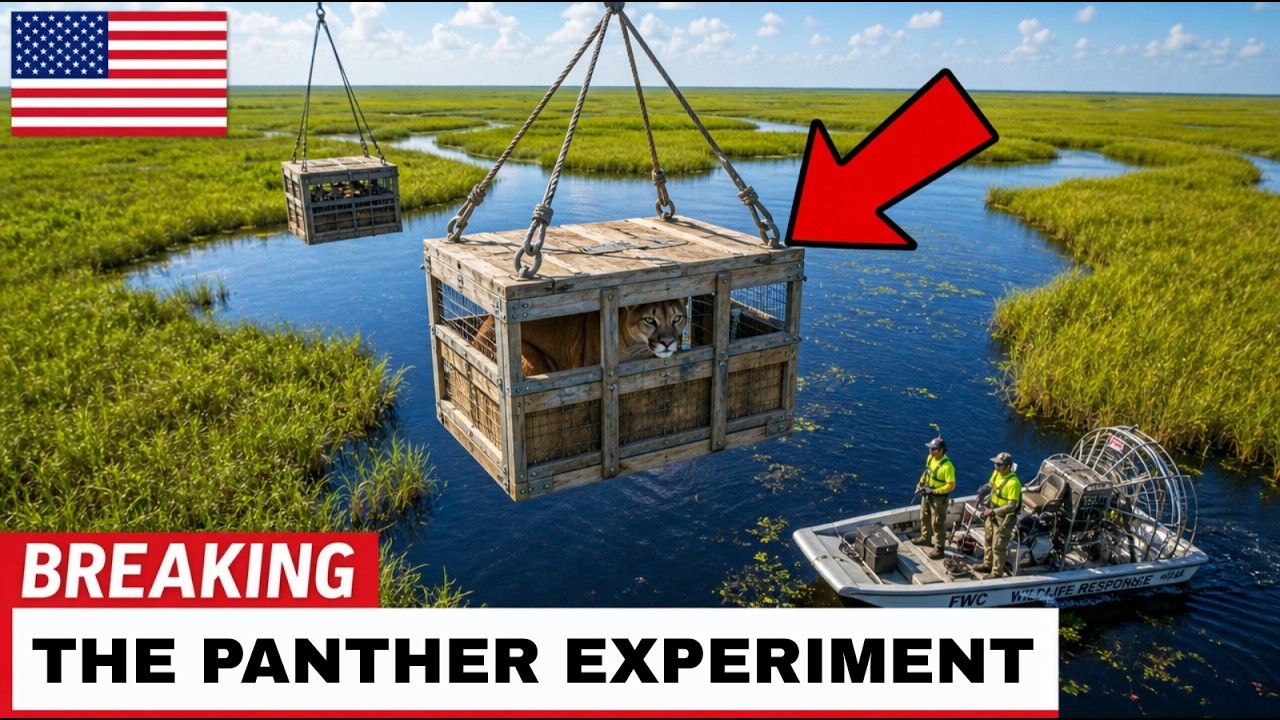
Florida released eight Texas pumas into its collapsing panther population, a desperate move to save a species on the brink. Within weeks, something impossible appeared in the genetic data, challenging everything scientists believed about the big cats’ survival.
By the early 1990s, fewer than 30 Florida panthers remained in the wild, the last survivors of a cat that...
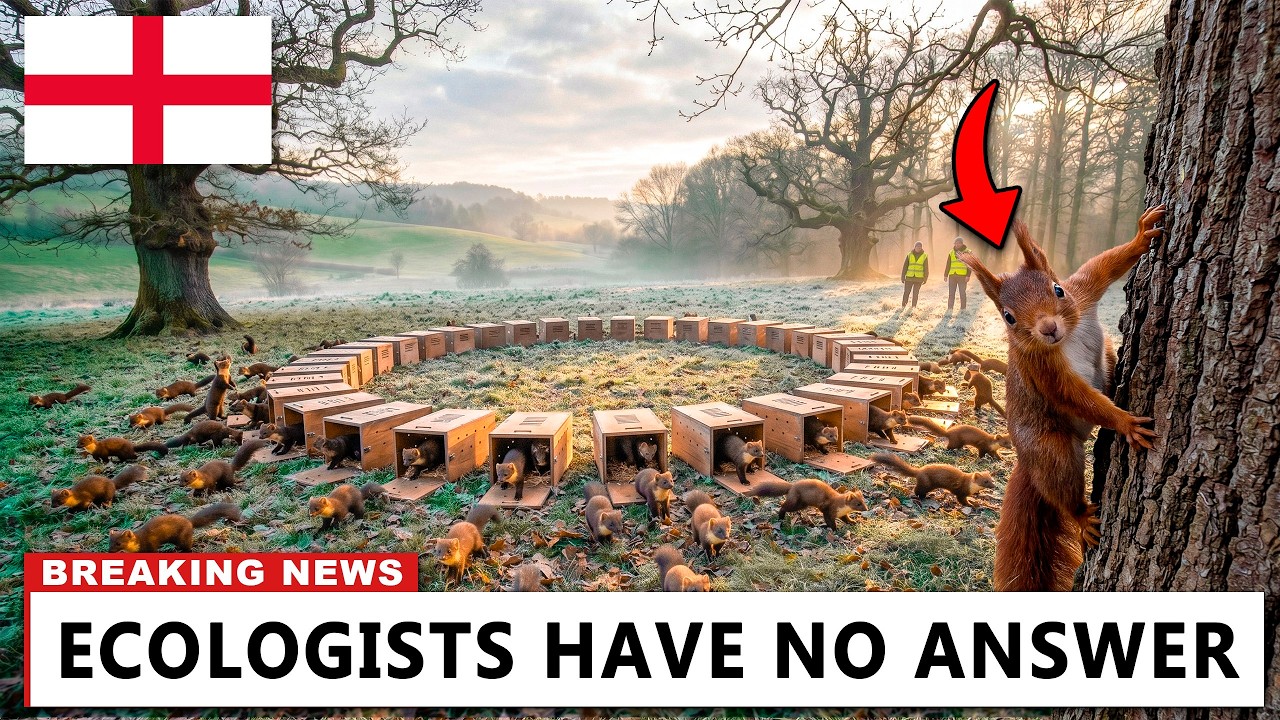
England quietly released 35 pine martens into a supposedly dead forest, and wildlife officials kept a close watch on the grey squirrels. The predators were a last-ditch experiment, dropped into a woodland that had lost its natural balance, with the goal of pushing back an invasive population that was choking out native species.
In September 2019, pine martens were reintroduced to the Forest of Dean in England for the first time in 160...
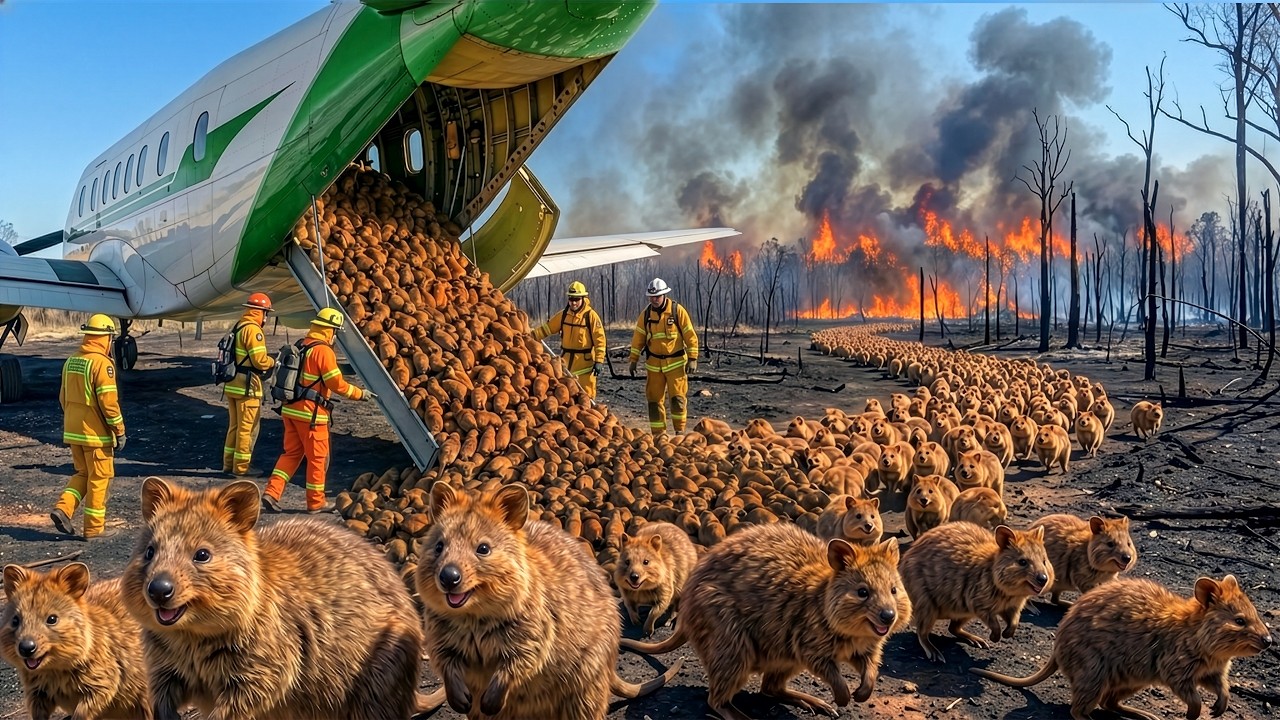
Australia released thousands of quokkas into a burnt forest with zero life remaining. After devastating wildfires wiped out the habitat, conservationists hoped the small marsupials would help restore the ecosystem.
A lightning strike in Shannon National Park, in the far southwest corner of Australia, started a fire on January 28,...