England quietly released 35 pine martens into a supposedly dead forest, and wildlife officials kept a close watch on the grey squirrels. The predators were a last-ditch experiment, dropped into a woodland that had lost its natural balance, with the goal of pushing back an invasive population that was choking out native species.
In September 2019, pine martens were reintroduced to the Forest of Dean in England for the first time in 160 years. Eighteen animals were brought from the Scottish Highlands, followed by additional releases that brought the total to 35 by 2021. Each was fitted with a radio collar.
The goal was to reduce the grey squirrel population, which had displaced the native red squirrel across England over the previous 120 years. What the researchers did not anticipate was that the martens would have a significant effect on the greys without directly hunting them in large numbers.

The pine marten is a native British woodland species that has lived there for roughly 10,000 years. In the 19th century, it was classed as a pest by hunting estate owners because it took pheasants. Traps were set across forests, and by the early 20th century, the animal had virtually disappeared from England and Wales. Only small populations survived in the Scottish Highlands.
A separate event had set the stage for the grey squirrel’s dominance. In 1876, a banker named Thomas Brocklehurst released a pair of American grey squirrels that he had brought back as pets at Henbury Park in Cheshire. Within decades, grey squirrels had spread across England. They displaced the native red squirrel through direct competition for food and through squirrel pox virus, which greys carry without falling ill but which is fatal to reds.
The red squirrel population in Britain declined from roughly 3.5 million before the greys arrived to around 287,000 today. In England, the figure is roughly 39,000, concentrated in a few isolated northern areas.
There was also an economic dimension. Grey squirrels strip bark from young trees to reach sap beneath, which is often fatal to the tree. Forestry Commission estimates put the annual damage to British forestry at more than 37 million pounds.
The reintroduction plan was straightforward: if martens reduced grey squirrel numbers enough, red squirrels might recover on their own. Critics raised three reasonable objections. First, 35 martens could not physically eat enough greys to matter. Second, martens are generalist feeders that eat voles, birds, eggs, berries, and carrion, so they would not necessarily target squirrels. Third, if martens did learn to hunt squirrels, they might eat reds as well, making things worse.
Another factor is the marten’s slow reproductive cycle. Mating occurs in July and August, but the embryo does not implant until February or March, with young born in spring. A female produces one litter per year, usually no more than five kits. A population of 35 cannot grow quickly.
The most useful evidence came from Ireland. The pine marten had survived there in small numbers and began to recover after receiving legal protection under the 1976 Wildlife Act. In 2014, a researcher at the University of Aberdeen, Emma Sheehy, noticed an unusual pattern. In areas where martens were increasing, grey squirrels were disappearing entirely, and red squirrels were returning on their own.
In 2018, Sheehy and her team published a paper in Proceedings of the Royal Society B quantifying this effect. The presence of martens strongly correlated with the absence of grey squirrels and the presence of red squirrels. The effect was asymmetric: grey squirrels reacted to martens far more strongly than reds did.
The likely explanation is evolutionary history. Red squirrels and pine martens have lived alongside each other for tens of thousands of years. Reds appear to recognize marten scent instinctively and respond by spending more time in the canopy. Grey squirrels, having evolved in North America, have no such recognition. European pine marten scent does not register as a threat to them. In some cases, greys even increased their activity around feeding stations visited by martens, an apparently maladaptive response.
The presence of martens also appears to affect grey squirrel behaviour in less direct ways. Even when martens are not actively hunting, greys in the same forest eat less, accumulate less fat, survive winter less well, and reproduce less. The chronic stress of an unrecognised threat has a suppressive effect.
The marten also uses grey squirrel dreys as dens, sometimes raising young in nests the squirrels built. This literal overlap appears to reinforce the pressure on greys.
Irish data confirmed the pattern. In County Fermanagh in Northern Ireland, the grey squirrel population collapsed to near zero after martens returned, without hunting or poisoning. The 2019 All-Ireland survey found that expanding marten range corresponded with contracting grey squirrel range. In 2012, greys and reds in Fermanagh were divided along a line through Lough Erne, with greys to the north and reds to the south. By 2019, greys had retreated from the entire county, and reds had reappeared without direct human assistance.
It is worth noting that this took time. Martens received legal protection in Ireland in 1976, and the first measurable changes in squirrel distribution were recorded in 2007, 31 years later. The process is slow by human standards.
On the question of what martens actually eat, field voles make up a substantial part of the diet in winter. Birds and eggs are taken in spring and summer, berries in autumn, along with insects, frogs, and carrion. Grey squirrels account for roughly 10 to 15 percent of the diet in Irish data. In Scandinavia, where red squirrels are more numerous, martens may take them at higher rates in winter, but in Britain and Ireland, greys are more abundant, larger, and spend more time on the ground, making them more accessible prey. If grey squirrel numbers fall, martens shift to other food rather than switching to reds.
By 2022, three years after the reintroduction began, the Forest of Dean marten population had exceeded 40 individuals through natural breeding. Grey squirrel activity had declined in some areas, but direct evidence of widespread predation was limited. The effect appeared to be driven more by the landscape of fear than by predation itself.
The Forest of Dean is a difficult environment for this experiment. It borders suburban Gloucester and contains roads and infrastructure. Several martens were killed by cars in the first years. The process that unfolded naturally over two decades in Ireland is being compressed into a shorter period in a fragmented landscape.
There is an additional consideration. Red squirrels, like greys, cache acorns and nuts for winter and do not recover all of them. Those forgotten seeds germinate, and researchers have calculated that red squirrels plant thousands of trees each year through this forgetfulness, including oak, beech, and hazel. Years of grey squirrel dominance meant that process ran with a different, American species repertoire. If the marten helps restore red squirrels to parts of the forest, it may also restore that role.
The reintroduction does not address urban grey squirrel populations. Martens do not enter large cities, and there is no continuous woodland or sufficient cover in urban parks and suburbs. Irish cities such as Belfast and Dublin still have grey squirrels even where martens have displaced them from rural forests, and the same is likely to be true in England.
A separate approach is being developed for urban areas. The UK Squirrel Accord, a coalition of government agencies and conservation groups, is funding research into an oral contraceptive for grey squirrels. The bait would be delivered through feeding stations with a weight-sensitive lock that opens for animals heavier than 450 grams, a threshold that admits greys but not reds. In November 2025, the Animal and Plant Health Agency announced the first recorded case of achieving infertility in rats through free feeding of an oral immuno-contraceptive, and a similar response had been recorded in grey squirrels. The target date for market release is 2030.
If both approaches work, martens would address rural forest populations and the contraceptive would address urban ones. That would be the first time in roughly 150 years that both parts of the problem had a plausible solution.
The Irish case suggests that meaningful results take decades. The changes measured by Sheehy’s team in 2018 reflected a process that began in the 1990s. In the Forest of Dean, the project is in its early stages, and it is too soon to call it a success. What has been documented so far is that the martens have bred and that their presence is correlated with changes in grey squirrel behaviour consistent with what was observed in Ireland.
Recommended Stories

Two scientists tracking great white sharks off Australia got a transmission that didn’t make sense. Their tagged nine-foot female, Alpha, had suddenly plunged nearly 1,900 feet.
In 2003, researchers studying great white sharks off the southwestern coast of Australia recorded an unusual event that raised unresolved...

A bold experiment once unleashed thousands of piranhas into a thriving lake, aiming to wipe out a massive snake infestation that had turned the water into a danger zone. The plan seemed brilliant: release the fierce fish to slash the serpent population and restore balance fast.
Piranhas, known for their sharp teeth and fast movements, are among the most powerful predators in the Amazon's murky waters....
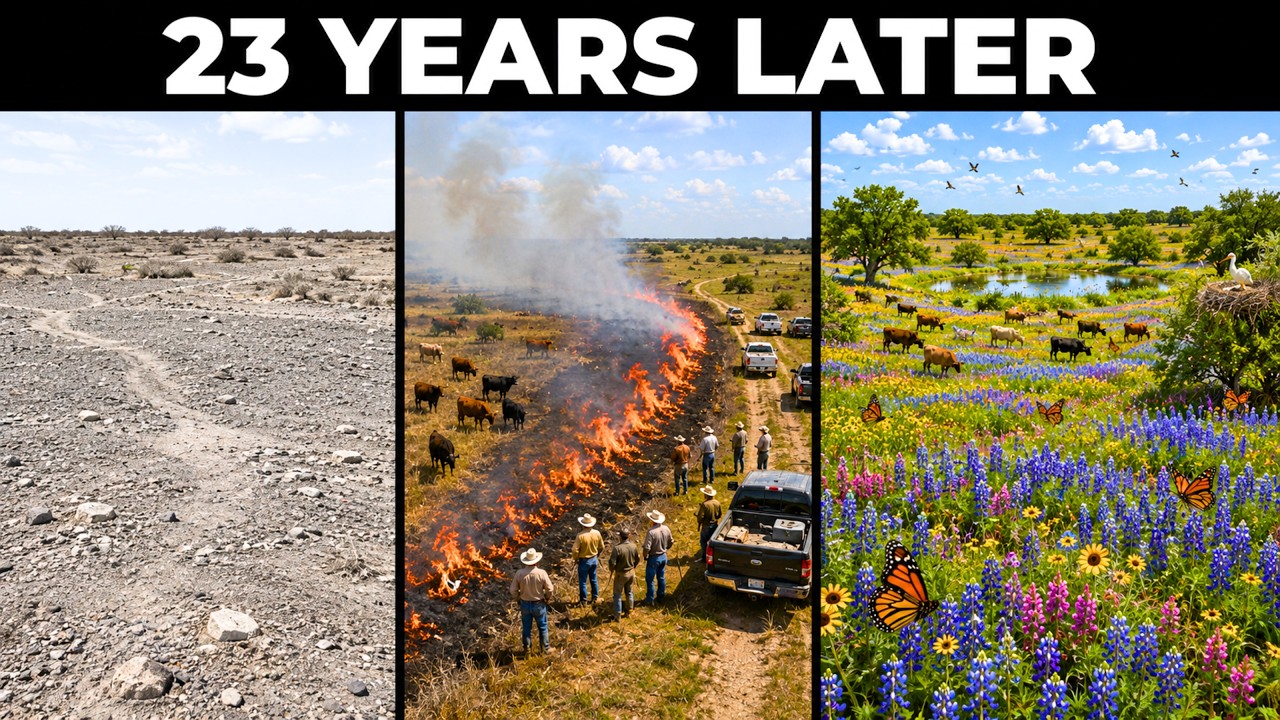
A dozen cows revived 80 acres Texas scientists called a barren “moonscape”—without a single seed being planted. The land was stripped to lifeless dirt, yet these ranchers bet on grazing alone as the turning point, watching cattle rotation trigger an unexpected transformation.
In 2000, a construction contractor and his wife bought an 80-acre property near La Grange, Texas. The land was a...